- 225 pages
- English
- ePUB (mobile friendly)
- Available on iOS & Android
eBook - ePub
About this book
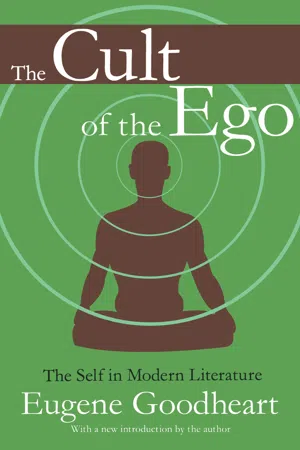
Goethe once remarked that "every emancipation of the spirit is pernicious unless there is a corresponding growth of control." This remark may be taken as a motto for Eugene Goodheart's study of an aspect of the cultural history of the past two hundred years. In separate chapters on Rousseau, Stendhal, Goethe and Carlyle, Dostoevsky, Whitman, Lawrence, and Joyce, Goodheart discovers a community of concern which he calls the cult of the ego. All these writers examined here in one way or another deal with "the emancipation of the spirit" with all its promise and danger. The characteristic attempt is to "extend the boundaries of the self by going beyond the area of safety" and. thereby risking even the destruction of the self. They advance the claims of the self at the same time seeking the controls that will secure these claims. The artist-hero becomes the central figure in Goodheart's volume, since it is he who comes to exemplify the possibilities of the cult of the ego. Their efforts, Goodheart argues, have ambiguous results. The seeds of contemporary nihilism are in the failures of these writers to master the chaos of egoism, which they helped engender. But their heroism was partly in the effort of resistance: moral, religious, aesthetic. In a large portion of modern literature, resistance has been abandoned either out of exhaustion or out of fascination with the destructive tendency of modern life: in Beckett's phrase, "a world endlessly collapsing." In his introduction to this first paperback edition, Goodheart discusses the book's origin in relation to the counter-cultural unrest of 1968 when it was first published and weighs its theme of the emancipated self against current postmodern assertions of the "death of the author." The Cult of the Ego is written with admirable clarity and economy. Its interests are literary, moral and political. Moving freely and knowledgeably among various national literatures, Goodheart has made an original and valuable contribution to the field of comparative literature. Eugene Goodheart is Edytha Macy Gross Professor of Humanities Emeritus at Brandeis University. Among his books are Novel Practices: Classic Modern Fiction, Modernism and the Critical Spirit, Culture and the Radical Conscience, and Confessions of a Secular Jew: A Memoir, all available from Transaction.
Information
I
The Antinomianism of Jean-Jacques Rousseau
“I am not made like any of those I have seen.”1 With that announcement in The Confessions, Jean-Jacques Rousseau presents his reader with a strange new hero. The conviction of his uniqueness distinguishes him at once from Augustine, who would have condemned Rousseau for the sin of pride. The events of his life, the feelings and thoughts that Rousseau records in such copious detail are the consequences of a proudly extravagant sensibility and a perverse temperament. Nor is Rousseau like that other great confessor, Montaigne, crotchety and idiosyncratic on occasion, but confident of his normal human qualities. “The vagabondage and egoism,” one critic has remarked of Montaigne, “are more or less superficial. What we find under the surface is a fairly firm conviction, based on the Greek, and especially the Latin, classics, as to what the true man should be.”2 Rousseau is perversely, one might say pathologically, unique. And he cherishes his uniqueness with the pride of the immoralist.
“If I am not better, at least I am different.”3 Even when he condemns vicious actions, the pride of the immoralist asserts itself in the fantastically indulgent descriptions of everything. The pleasure of recollection is so great for Rousseau that whatever moral impulse is contained in the work gives way to a kind of shamelessness. “I will let you off with five [anecdotes],” he remarks to the reader, “but I wish to tell you one, only one, provided that you will permit me to tell it in as much detail as possible, in order to prolong my enjoyment.”4 The anecdotes are about a happy time in his life, but the statement could as well apply to his sufferings and humiliations. Rousseau’s confessional impulse seems to take as much delight in revealing the masochistic pleasures, for example, that he experienced as a child at the punishing hands of Mile Lambercier as it does in evoking the joys of solitary walks in the country.
Rousseau’s overriding passion is a need to dramatize himself, to show himself as other–and this passion cannot be reduced to moral or exemplary terms. The Confessions belongs to a side of Rousseau that made him uneasy when he thought of the role he had created for himself as citizen of Geneva, the champion of the Spartan virtues.
The line from Jean-Jacques is to Stendhal’s heroes, Werther, the underground man, the immoralist of Nietzsche and Gide. What do these characters have in common? In the first place, none of them is virtuous, except perhaps in the Renaissance sense of virtu. They possess an energy, an impulsiveness for which we are hard put to find a name. Abbé Pirard’s view of Julien Sorel (in The Red and the Black) is suggestive: “I see in you something that offends the common herd.”5 The energy may not be entirely free of scruples, but the scruples are obstacles to the energy, which thrives in an atmosphere free of the constraints of conventional society and morality. One hesitates to include Jean-Jacques in this discussion, for doesn’t he give as the motive for The Confessions a desire to expiate his crimes: his accusation of a maid for a theft of a ribbon he himself committed, the abandonment of a friend in need, the surrender of his children to a foundling hospital, and so on? The confessions, it would seem, deliberately invite the judgment that he had escaped when the acts were performed. But on closer inspection the moral animus disappears, for Jean-Jacques’ guilt does not issue in remorse or contrition. The guilt retains a residue of anxiety, but in the confessional act it is strangely robbed of its moral quality and becomes instead an energy, an expansiveness of the heart, a dramatic occasion. The confession of the theft (which he had committed as a youth while in service to the Comtesse de Vercellis) is a superb instance of this curious transformation of guilt; after describing the incident in fulsome detail, Rousseau, without precisely justifying himself, turns the incident into a testimony to his uniqueness, a memorial to Jean-Jacques.
I have behaved straightforwardly in the confession which I have just made, and it will assuredly be found that I have not attempted to palliate the blackness of my offence. But I should not fulfill the object of this book, if I did not at the same time set forth my inner feelings and hesitated to excuse myself by what is strictly true. Wicked intent was never further from me than at that cruel moment; and when I accused the unhappy girl, it is singular, but it is true, that my friendship for her was the cause of it. She was present to my thoughts; I threw the blame on the first object which presented itself. I accused her of having done what I meant to do, and having given her the ribbon, because my intention was to give it to her. When I afterwards saw her appear, my heart was torn; but the presence of so many people was stronger than repentance. I was not afraid of punishment, I was only afraid of disgrace; and that I feared more than death, more than crime, more than anything else in the world. I should have rejoiced if the earth had suddenly opened, swallowed me up and suffocated me; the unconquerable fear of shame overcame everything, and alone made me imprudent. The greater my crime, the more the dread of confessing it made me fearless. I saw nothing but the horror of being recognized and publicly declared, in my own presence, a thief, a liar and slanderer. Complete embarrassment deprived me of every other feeling . . . .6
This is hardly the language of contrition. All that Rousseau can muster at the end of this passage is a statement about “the unhappiness that has overwhelmed the last years of [his] life.”7 In that fact, Rousseau rests content that “poor Marion finds so many avengers in this world, that, however great my offence against her may have been, I have little fear of dying without absolution.” The episode was to plague Rousseau all his life. We can guess this from the vividness with which he recalls it more than thirty years later. He is reliving it with all its shame. But the language of the recollection indicates a desire to displace the significance of the episode from his guilt to his suffering. Poor Marion’s sufferings (she had been immediately discharged from service) had been more importantly the occasion for Rousseau’s sufferings, which he would like his reader (and himself) to believe sufficient to absolve him of responsibility.
The confession itself, then, is no longer an occasion for genuine contrition and expiation. The act of confession tends to bestow forgiveness. Thus, in defense of his behavior in surrendering his children to a foundling hospital, Rousseau says: “My remorse at length became so keen, that it almost extorted from me a public confession of my error at the beginning of Emile; the allusion itself is so obvious in a certain passage, that it is surprising to me how anyone, after having read it, can have the courage to reproach me.”8* He has suffered and admitted the act. But nowhere does he suggest the moral urgency to compensate by some action for the things he had done. It is of course true that the time for compensation had passed. But I am characterizing a mentality which immediately transforms the whole question of moral responsibility to one of personal suffering. Rousseau would have been incapable of admitting, though he was capable of feeling, that the failure to compensate for a crime or sin necessarily leaves its traces on the offending soul.
Rousseau’s shame is very intense, but the confessions (and herein lies their originality) are not so much expressions of, as sharp reactions against, his guilt. He has felt the guilt all along and does not need the confessional atmosphere to bring it to consciousness. Rousseau is the first of those modern writers who expose their most intimate lives out of a com-pulsiveness that Rousseau called his “disposition [which] renders it impossible for me to conceal any of my thoughts or feelings.”9 Jean Guehenno, in his biography, mistakes the implication and truth of this statement when he speaks of Rousseau’s capacity for “discretion and secrecy” as proof that Jean-Jacques was quite mistaken about himself.10 The impassioned eloquence with which Rousseau speaks in The Confession is not necessarily a guarantee of the authenticity of his statements or of his essential goodness, but it is unmistakably an expression of his compulsive need to rid himself of self-wounding feelings that might poison him if he were silent. In both The Confessions and Rousseau: Juge de Jean-Jacques he speaks of his tendency to remember only pleasurable moments in the past. The fact is that he remembers painful moments and remembers them with remarkable intensity. The apologetic writings, after all, are in part a cataloguing of the sufferings which the world has caused him throughout his life. The confession has a paradoxical effect: it recalls the past, which it tries (often unsuccessfully) to purge or liquidate through the act of expression.
If we detect the absence of genuine remorse, we cannot simply charge Jean-Jacques with sophistic self-justification. Rousseau’s “method” is too transparent, too revealing for a Jesuitical purpose. In confessing all, he has taken risks that no amount of disingenuousness (conscious or unconscious) can mitigate. What disturbs is not the disingenuousness, but the self-fascination which dissolves the moral question in the psychological analysis. “The important thing is what I felt, not what I did,” Rousseau seems to tell us; he attempts to gain our sympathy by distracting our attention from his actions to his sentiments and motives. For all of Rousseau’s apparent and real candor, the confessions are motivated by a desire to sustain his self-esteem at all costs. There is more than a hint of this trait in his failure to do the decent thing by Marion: “I was only afraid of disgrace; and that I feared more than death, more than crime, more than anything else in the world. . . . the unconquerable fear of shame overcame everything.”
Self-esteem is, of course, a complicated idea. Rousseau himself regarded self-esteem as a “natural” feeling, which is ultimately the basis of a moral community. But he also knew that he had to distinguish it from a vice, which it closely resembled. Rousseau had developed this distinction in philosophical terms in A Discourse on the Origin of Inequality (1755). (He is never simply a “psychological case”: he always raises his torment to the dignity of a philosophical idea.) The virtue is amour de soi, which translates roughly as self-respect or pride, and the vice is amour propre, to which egoism or vanity is probably the closest equivalent.
Egoism must not be confused with self-respect: for they both differ in themselves and in their effects. Self-respect is a natural feeling which leads every animal to look to its own preservation, and which, guided in man by reason and modified by compassion, creates humanity and virtue. Egoism is a purely relative and factitious feeling, which arises in the state of society, leads each individual to make more of himself than of any other, causes all the mutual damage men inflict on one another, and is the real source of the sense of honour.11
Rousseau pursues this distinction in the Dialogues, Rousseau: Juge de Jean-Jacques. The causes of egoism are social obstacles to the simple enjoyment of self-respect.
The primitive passions all tend directly toward our happiness, and bring before us only the objects related to that end; since they are rooted only in self-love, they are all essentially tender and loving: but when they are deflected from their goal by obstacles, they become more preoccupied by the obstacle they must overcome, than by the object they seek to attain. At this point their nature changes, they become irritable and hateful; that is how self-love which is a good and absolute emotion, becomes vanity; that is to say, a relative emotion which leads one to comparisons, requires preferences, whose enjoyment is purely negative, no longer seeking satisfaction for our own good, but rather in the harm of others.12
The obstacles in his own life (real and imaginary) made it impossible for Rousseau to rid himself of the self-righteous and egoistic tone. He did, despite himself and unwittingly, “make more of himself than of any other.”
Jean-Jacques is caught in a conflict between his wish to speak the truth and his desire to satisfy his pride. The two desires are not necessarily opposed to each other, since it is an essential part of Rousseau’s program to justify his singularity, to convince the reader of its significance and therefore of its worthiness of an audience. Rousseau must establish at once the truth and value of his singularity. But he is deluded about himself: he insists forever on his innocence and sincerity because he cannot endure admitting the duplicities to which he has been compelled by character and circumstance. So he transforms the truth to serve his self-esteem. Rousseau’s love affair with Sophie d’Houdetot (the model for Julie of La Nouvelle Héloïse) reveals, perhaps more than any other episode in his life, what a devious thing his heart was. It is the story of “alienation of affections” under the guise of platonic love. While Saint Lambert, Mme d’Houdetot’s lover and Jean-Jacques’ friend, was away, Rousseau read passages from La Nouvelle Héloïse (which he was then writing) aloud to her. As Guehenno remarks: “Saint Preux [the hero of the novel] said for him what he himself had not yet the courage to say.”13 Sophie found it difficult to resist Rousseau’s eloquence and fell in love. Whether Jean-Jacques slept with her is beside the point. He had compromised her and betrayed a friend while protesting solipsistically and irrelevantly the purity of his feeling for her. It is the kind of episode that occurred daily in the aristocratic life of France in the eighteenth century. But the episode is particularly damaging to Rousseau, because such equivocal behavior was anathema to the honesty and forthrightness that he cherished.
And yet the eloquence with which Rousseau defends himself on almost every occasion of wrongdoing springs from genuine conviction, however deluded. The basis of the conviction is amour de soi—in the sense of self-preservation. Beleaguered by enemies and by guilty memories, Rousseau creates the impression that the confessions are acts of self-preservation. He feels himself to be in extremis, for the man with the highest conception of himself who feels his self-respect menaced at its very foundations is like a man threatened by physical destruction.
II
“That I was a great transcendent sinner I confess. But still I had hopes of forgiveness, because I never sinned from principle, but accident.”14 This is not Jean-Jacques speaking, but the antinomian “hero” of James Hogg’s curious and fascinating Confessions of a Justified Sinner, originally published in 1824, approximately sixty years after the publication of Rousseau’s apology. Hogg’s hero has unwittingly summed up the moral burden of Jean-Jacques’ apology.
Antinomianism has an ancient lineage. As old as Christianity, it can be traced to certain gnostic cults. It appears in Christianity at various times and in various forms as a heresy. Hogg’s book re-creates a peculiarly Scottish atmosphere of the sixteenth and seventeenth centuries: Calvinist and fanatical. The antinomianism of the Justified Sinner can be understood as a perversion of Calvinist (and for that matter Lutheran) doctrine of the superiority of faith over good works. Both Calvin and Luther found man’s spiritual connection with God in an invisible bond (the bond of conscience), not in the activities of the practical life. Calvin valued the practical life more than did Luther, but he pl...
Table of contents
- Cover
- Half Title
- Title Page
- Copyright Page
- Contents
- Dedication
- Acknowledgments
- Introduction to the Transaction Edition
- Prefatory Note
- Introduction
- 1 The Antinomianism of Jean-Jacques Rousseau
- 2 The Aesthetic Morality of Stendhal
- 3 Goethe, Carlyle, and “The Sorrows of Werther”
- 4 Dostoevsky and the Hubris of the Immoralist
- 5 Nietzsche and the Aristocracy of Passion
- 6 Walt Whitman: Democracy and the Self
- 7 Lawrence and Christ
- 8 Joyce and the Career of the Artist-Hero
- Notes
- Bibliography of Books and Essays cited
- Index
Trusted by 375,005 students
Access to over 1.5 million titles for a fair monthly price.
Study more efficiently using our study tools.
Frequently asked questions
Yes, you can cancel anytime from the Subscription tab in your account settings on the Perlego website. Your subscription will stay active until the end of your current billing period. Learn how to cancel your subscription
No, books cannot be downloaded as external files, such as PDFs, for use outside of Perlego. However, you can download books within the Perlego app for offline reading on mobile or tablet. Learn how to download books offline
Perlego offers two plans: Essential and Complete
- Essential is ideal for learners and professionals who enjoy exploring a wide range of subjects. Access the Essential Library with 800,000+ trusted titles and best-sellers across business, personal growth, and the humanities. Includes unlimited reading time and Standard Read Aloud voice.
- Complete: Perfect for advanced learners and researchers needing full, unrestricted access. Unlock 1.5M+ books across hundreds of subjects, including academic and specialized titles. The Complete Plan also includes advanced features like Premium Read Aloud and Research Assistant.
We are an online textbook subscription service, where you can get access to an entire online library for less than the price of a single book per month. With over 1.5 million books across 990+ topics, we’ve got you covered! Learn about our mission
Look out for the read-aloud symbol on your next book to see if you can listen to it. The read-aloud tool reads text aloud for you, highlighting the text as it is being read. You can pause it, speed it up and slow it down. Learn more about Read Aloud
Yes! You can use the Perlego app on both iOS and Android devices to read anytime, anywhere — even offline. Perfect for commutes or when you’re on the go.
Please note we cannot support devices running on iOS 13 and Android 7 or earlier. Learn more about using the app
Please note we cannot support devices running on iOS 13 and Android 7 or earlier. Learn more about using the app
Yes, you can access The Cult of the Ego by Eugene Goodheart in PDF and/or ePUB format, as well as other popular books in Literature & Literary Criticism. We have over 1.5 million books available in our catalogue for you to explore.