- 500 pages
- English
- ePUB (mobile friendly)
- Available on iOS & Android
eBook - ePub
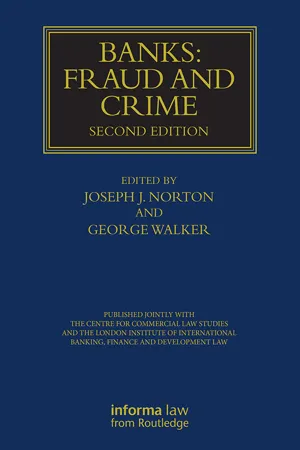
Banks: Fraud and Crime
About this book
Banks: Fraud and Crime explores the main issues which arise in bank fraud world-wide and looks at the possible options available for corrective action. A series of leading commentators examine the basic nature of bank fraud and financial crime, comparing the legal and regulatory framework in England to those in place in the USA and elsewhere. Banks: Fraud and Crime also takes a detailed look at the core issue of money laundering at a national, regional and international level as well as considering the many other complex issues arising from bank fraud and financial crime.
Information
Chapter 1
Banks—Fraud and Crime: A Survey of Criminal Offences under English Law
Introduction
1.1 This Chapter attempts to survey the principal criminal offences concerning banks and fraud. The topic is potentially vast and I have restricted this discussion to those types of fraud which appear, as with the other chapters in this book, particularly to affect banks. It is, furthermore, anglocentric. This is not to ignore the importance of the Scottish financial sector, only that very few cases in Scotland address the topic.1
1.2 Other Chapters in this book address two principal issues: those of substantive law of which relatively little is said and of investigations and procedure which are quite extensively covered by other participants. This Chapter deals with the former only, and only in outline form.
1.3 Frauds against banks may be internal or external. They may take the form of theft or electronic transfer of funds done for personal gain by employees. Such offences may also be committed by third parties using the bank as a vehicle for fraud, or perhaps defrauding the bank itself. Banks may be induced to advance funds for non-existing purchases. They may be gulled into accepting documents of title and letters of credit to non-existing goods. Cheque frauds associated with the use of cheque guarantee cards continue to prove troublesome. Increasingly, diversions committed by unauthorised withdrawals from cash machines are reported. So broad is the concept of fraud that offences of fraudulent trading, of insider dealing and of the conduct of unauthorised investment business are also relevant. Quite apart from the statutory offences which apply to this field, common law conspiracy to cheat and defraud remains in vigour. What follows is a survey of some of these matters.
1.4 It should immediately be said, however, that in some respects the Theft Act 1968 betrays its origins as a masterful restatement of the law as it stood before the era of modern electronic banking practices. Although the Theft Act 1968 broke away from the older law which based theft upon taking, it still envisaged an adverse dealing with and obtaining of property belonging to another. As will be seen, unlike certain, even older fraud offences to be found in other jurisdictions, it has not adapted well to certain frauds, of which mortgage frauds are the most obvious example, and it has been made effective against certain cheque and guarantee frauds only by a decidedly elastic process of interpretation.2
Theft
1.5 The structure of the theft provisions in the Theft Act 1968 ensures that they will apply not merely to taking but to almost all diversions of assets save those, such as real property, which cannot be stolen.3 Furthermore, the affirmation in Gomez that there is a near total overlap between theft and deception means that where property belonging to another is appropriated by means of a deception, theft is committed, whether or not title remains in the original victim subsequent to the transaction.4 On the other hand, where the rogue acquires that which never was the property of another, theft will not lie nor will deception (as will be explained).
1.6 The theft provisions referred to are highly compressed and represent an attempt to bring under the same crime conduct characterised by taking, by non-possessory appropriation, by diversions and by the abstraction of trust property. They are singularly open-ended in two respects. The first concerns “appropriation” and the second concerns the meaning of “property”.
1.7 “Appropriation” does not refer to physical taking. It is defined in terms of the assumption of rights of an owner. In order to cater for both the case where all rights are assumed and only one right is assumed, section 3(1) of the Theft Act 1968 provides:
“3.—(1) Any assumption by a person of the rights of an owner amounts to an appropriation, and this includes, where he has come by the property (innocently or not) without stealing it, any later assumption of a right to it by keeping or dealing with it as owner.”
1.8 In Gomez, affirming Morris on the point, the House of Lords held that appropriation involves not an act done with the owner’s consent, but an act by way of adverse interference with or usurpation of those rights.5 This is obviously wide. He who interferes inhibits me in the exercise of my rights. He who usurps clothes, or purports to clothe himself, with those rights. However that may be, the inquiry in any case of theft involves whether another has property and whether the rogue has either assumed, purported to assume, or interfered with rights over that property. Clearly, however, appropriation does not involve any physical act of taking and this in an age of electronic transfer expands the potential coverage of theft.
1.9 Similarly, the notion of “property” is an open one. The Theft Act simply defines the term to mean money and all other property, real or personal, including things in action and other intangible property. This means that anything which courts have or in the future will recognise as the subject of property rights constitutes property for the purposes of theft.6
1.10 From the structure of theft it follows that a bank balance where an account is in credit, or even within overdraft limits, is property for the purposes of theft.7 The abstraction of money from an account through a cashpoint machine is theft since appropriation occurs by the unauthorised use of a card.8 Theft of the bank’s indebtedness to its customer may occur even before the transaction has been fully completed, for example by the rogue issuing a cheque and doing what he can to ensure that the victim’s account is debited with the amount of a cheque or withdrawal.9 While CHAPS orders have been dealt with under section 20 of the Theft Act 1968 (see below) there is a real difficulty in invoking the law of theft since the transaction does not involve an appropriation of another’s property, but rather the creation of a new right in favour of the transferee.
1.11 The breadth of appropriation together with the recognition of a bank balance as property for the purposes of theft may make it possible to charge instances of cheque and credit card fraud committed abroad as theft triable in England. Under the Criminal Justice Act 1993, theft will be triable in England where any element of it occurs here. If by means of a cheque fraud committed abroad a customer’s account is debited in England, appropriation and hence theft will be committed in England, notwithstanding that the bank will ultimately make good the loss to the victim.10 In some cases it will be crucial to jurisdiction to know where the assumption took place. Professor Griew, discussing Chan Man-sin, concludes that theft is complete when and where acts are done which will result in the debiting of a bank account.11 This seems clearly correct even on former existing bases of jurisdiction. Now, under the wider jurisdictional provisions, it will still remain open to the foreign jurisdiction to seek extradition of the rogue in respect of the obtaining of an article by deception. The situation may be somewhat more complicated when a credit or charge card is used. There, the rogue causes an appropriation to be made, but does not himself, seemingly, appropriate any balance. Deception could not be charged, nor could the offence under section 20 of the Theft Act 1968 of dishonestly procuring the execution of a valuable security. Even under the new legislation there may thus be a hiatus in respect of credit card frauds committed abroad.
1.12 Perhaps the clearest illustration of the effect of an open-textured definition of property is afforded by Shadrock-Cigari.12 The accused acted as guardian to his nephew whose father in Iran arranged for money to be paid to the child’s bank account from the USA. The American bank, in error, credited $286,000 to the account instead of $286. The child, at the appellant’s instructions, signed an authority for the issue of four banker’s drafts in favour of the appellant for large sums of money. The appellant used virtually all of the money so obtained. Charged with theft, he argued that the drafts issued by the bank were his property and that, in using them, he could not have committed theft. The court, however, held that the bank retained a residual proprietary interest in the drafts. The mistake of the American bank undermined the basic assumption on which the English bank could deal with the drafts, namely that the funds which had been received could properly be dealt with as directed by the account holder. Because the bank acted under a fundamental mistake of fact, the appellant was under a legal duty to restore the drafts on the basis that the bank retained an equitable proprietary interest in them. This recognition of an equitable proprietary interest sufficed to support an indictment for theft.
Deception
1.13 Frauds on banks are dealt with under both sections 15 and 16 of the Theft Act 1968. When a cheque or credit card is used to obtain goods the offence under section 15 is made out. A person who by deception is allowed to borrow by overdraft commits an offence under section 16. A person who obtains services by deception commits an offenc...
Table of contents
- Cover
- Half Title
- Title Page
- Copyright Page
- Table of Contents
- Preface
- Contributors
- Table of cases
- Table of legislation
- Chapter 1. Banks—Fraud and Crime: A Survey of Criminal Offences Under English Law
- Chapter 2. Serious Fraud—A Banker’s Perspective
- Chapter 3. Banks, Policing and The Regulation of Money Laundering in England and Wales
- Chapter 4. Fraud Against Banks: A Practical Perspective
- Chapter 5. The Role of Auditors in Protecting Against Bank Fraud
- Chapter 6. Cross-Border Fraudulent Activity
- Chapter 7. BCCI and The Lessons for Bank Supervisors
- Chapter 8. Operational Risk in Banking Institutions
- Chapter 9. Banks, Money Laundering and The European Community
- Chapter 10. Money Laundering and Banking Institutions: The US Framework
- Chapter 11. The United States’ Perspective on “Bank Fraud”
- Chapter 12. Financial Fraud and Crime and Lessons from The American Bank and Thrift Crisis
- Chapter 13. International Efforts to Combat Financial Fraud and Crime
- Chapter 14. Internet Payment Services and Crime in Cyberspace
- Appendices
- Index
Trusted by 375,005 students
Access to over 1.5 million titles for a fair monthly price.
Study more efficiently using our study tools.
Frequently asked questions
Yes, you can cancel anytime from the Subscription tab in your account settings on the Perlego website. Your subscription will stay active until the end of your current billing period. Learn how to cancel your subscription
No, books cannot be downloaded as external files, such as PDFs, for use outside of Perlego. However, you can download books within the Perlego app for offline reading on mobile or tablet. Learn how to download books offline
Perlego offers two plans: Essential and Complete
- Essential is ideal for learners and professionals who enjoy exploring a wide range of subjects. Access the Essential Library with 800,000+ trusted titles and best-sellers across business, personal growth, and the humanities. Includes unlimited reading time and Standard Read Aloud voice.
- Complete: Perfect for advanced learners and researchers needing full, unrestricted access. Unlock 1.5M+ books across hundreds of subjects, including academic and specialized titles. The Complete Plan also includes advanced features like Premium Read Aloud and Research Assistant.
We are an online textbook subscription service, where you can get access to an entire online library for less than the price of a single book per month. With over 1.5 million books across 990+ topics, we’ve got you covered! Learn about our mission
Look out for the read-aloud symbol on your next book to see if you can listen to it. The read-aloud tool reads text aloud for you, highlighting the text as it is being read. You can pause it, speed it up and slow it down. Learn more about Read Aloud
Yes! You can use the Perlego app on both iOS and Android devices to read anytime, anywhere — even offline. Perfect for commutes or when you’re on the go.
Please note we cannot support devices running on iOS 13 and Android 7 or earlier. Learn more about using the app
Please note we cannot support devices running on iOS 13 and Android 7 or earlier. Learn more about using the app
Yes, you can access Banks: Fraud and Crime by Joseph Norton,George Walker in PDF and/or ePUB format, as well as other popular books in Law & Financial Law. We have over 1.5 million books available in our catalogue for you to explore.