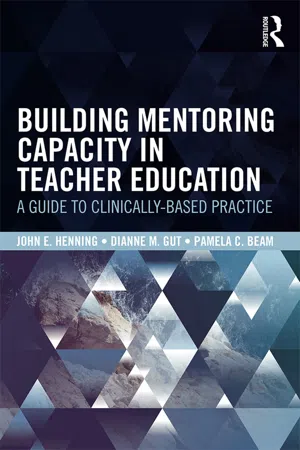
This book is an instructional guide for designing and implementing mentoring programs that support clinically-based teacher education. Veteran teacher educators John E. Henning, Dianne M. Gut, and Pam C. Beam outline a developmental approach for supporting mentees as they grow in their careers from teacher candidates to early-career teachers and teacher leaders. Mentors will learn how professional development occurs and how to create the conditions to foster and accelerate it. In Part I, chapters outline key components of the mentoring process, including strategies for engaging, coaching, co-teaching, and encouraging reflection. Part II demonstrates how those strategies can support mentees at different stages of their development. Included throughout are case studies, activities, and discussion questions to facilitate learning.
eBook - ePub
Building Mentoring Capacity in Teacher Education
A Guide to Clinically-Based Practice
- 226 pages
- English
- ePUB (mobile friendly)
- Available on iOS & Android
eBook - ePub
Building Mentoring Capacity in Teacher Education
A Guide to Clinically-Based Practice
About this book
Trusted by 375,005 students
Access to over 1.5 million titles for a fair monthly price.
Study more efficiently using our study tools.
Information
Topic
EducationSubtopic
Education GeneralPart I
Mentoring for Clinically-Based Teacher Education
1 Teacher Development
Introduction
The primary purpose of this book is to describe the implementation of effective mentoring in a clinically-based teacher preparation program. The book depicts teacher development as occurring through practice in an unbroken continuum from pre-service to in-service. Thus, the role of the mentor teacher is to better understand how that development occurs and to create the conditions to foster and accelerate it. With the emergence of clinically-based teacher education, mentor teachers are more important than ever before. The first chapter discusses the expansion of clinical experiences during teacher preparation, how teachers develop through their classroom experiences, and how mentoring can foster those experiences. This information is foundational to the mentoring strategies recommended in later chapters.
Introducing the Framing Discussion
For those who are using the book in a group setting, each of the twelve chapters begins with a framing discussion. The purpose of the framing discussion is to review what is already known about the topic while receiving an introduction to new ideas. In this way, you can create anticipatory sets for learning new knowledge. Such a discussion also facilitates a collaborative sharing that is not only a valuable aid to your learning, it is also an important source of information for others. If you are reading the book as an individual, then consider the framing discussion questions as an introduction to the topics to be discussed. The following are the framing discussion questions for the first chapter.
Framing Discussion
- How does one learn to teach?
- In what ways are teacher candidates in early clinical experiences different from clinical interns (formerly known as student teachers)?
- What differences do you see between mentoring teacher candidates, clinical interns, beginning teachers, and teacher leaders during early clinical experiences?
- What changes have you seen in teacher candidates during their clinical experiences with you?
The Role of Mentoring
Mentor teachers play a critically important role in the careers of pre-service and developing teachers. They have the responsibility of introducing pre-service and newly inducted teachers to the practical and intellectual work of teaching by providing sustained and critical feedback (Feiman-Nemser & Buchmann, 1987; Zeichner, 1996). When mentors do their jobs well, teacher-candidate learning is accelerated. Their effectiveness can be enhanced by a carefully designed mentoring program that (a) supports communication between university faculty and public school teachers; (b) helps mentor teachers develop the skills to work with teacher candidates; and (c) helps mentor teachers in other aspects of their everyday practice, for example, in collaborative coaching with their peers (Bridges, 1995; Dever, Hager, & Klein, 2003; Evertson & Smithey, 2000; Killian & McIntyre, 1986).
Arguably, mentoring has become even more important to teacher education with the worldwide movement to expand clinical experiences in teacher preparation programs. The global expansion of clinical experiences has occurred in different ways around the world, for example, the use of practice-based methods in France, the emphasis on partnerships and school-based learning experiences in the Netherlands and Great Britain, and the worldwide expansion of student teaching experiences (Maandag, Deinum, Hoffman, & Buitnk, 2007; Ronfeldt & Reininger, 2012; Villegas-Reimers, 2003). In the United States, the movement in this direction has received further impetus by the Blue Ribbon Panel Report calling for “clinically-based teacher education” (NCATE, 2010) and the recent release of the Clinical Practice Commission’s (2018) recommendations. A primary purpose of both reports was to set a national reform agenda by putting “practice at the center of teaching preparation” (NCATE, 2010, p. 3).
Accompanying this expansion has been an increasing emphasis on the role of clinical experiences in learning to teach, the assessment of teacher-candidate performance in clinical settings, and the development of profession-ready graduates who can positively impact student learning from the moment they enter a classroom. Thus, there is a significant trend toward increasing the role of teacher preparation in schools and the consequent need for building capacity in mentoring.
Mentoring to Promote Teacher Development in Clinical Settings
Despite the trend toward increased clinical experiences, there has been little information on how to move from a traditional model of teacher candidate development to a clinically-based approach. To successfully design and implement clinically-based programs, teacher educators must first understand how teaching develops through practice. Traditionally, teacher education programs introduced foundational theories of teaching and learning in college classrooms so that teacher candidates could apply them in P–12 school settings. This course-based approach affirms and sustains a theory-to-practice orientation for teacher learning. Teacher candidates acquire generalizations (theories and principles) about teaching in campus-based courses and then try to apply them in school settings. The role of clinical experiences is to provide a practice site to apply concepts learned in a college classroom.
In clinically-based teacher preparation, the theory-to-practice relationship typical of traditional teacher preparation is reversed. Learning through practice is the centerpiece of the program, and the practice of teaching serves as the foundation upon which theoretical knowledge is constructed (Ball & Cohen, 1999; Ball & Forzani, 2009; Korthagen & Kessels, 1999; Korthagen, Kessels, Koster, Lagerwerf, & Wubbels, 2001). Mentoring in a clinically-based program requires that teacher educators create and manage authentic experiences in complex environments, provide numerous opportunities for teacher candidates to reflect on those experiences, and guide teacher candidates from their specific and contextualized observations to broader generalizations that can inform their teaching practice.
The new relationship between theory and practice is illustrated by Cochran-Smith and Lytle’s (1999) three domains of knowledge in teacher education. These include knowledge-in-practice, which refers to experiential learning in classroom settings (practice knowledge); knowledge-of-practice (reflection), which refers to the generalizations or principles of teaching derived from reflecting on experiences; and knowledge-for-practice (theory), which refers to the theoretical and research-based knowledge learned through the professional literature. In a clinically-based model of teacher education, the practice of teaching (knowledge-in-practice) resides at the core of the program in the form of an extensive series of clinical experiences. Those clinical experiences are enhanced through reflection (knowledge-of-practice), which also is utilized to make connections with the theoretical knowledge (knowledge-for-practice) that informs practice through coursework and professional development programs. Learning in clinically-based teacher preparation programs is grounded in practice, enhanced through reflection, and informed by theory.
In the following sections, we discuss a few basic premises related to teacher development, namely that teachers learn to teach in specific classroom contexts, gradually acquire an increasingly complex set of performance skills through experiential learning, and cultivate an increasingly explicit understanding of teaching and learning through reflection. In the following six sections, we discuss in more detail why understanding these premises can facilitate mentoring. The next sections are organized into three pairs; the first of each pair describes how teachers develop, and the second shows how to foster the development of each. These ideas are foundational to the mentoring approach recommended in this book.
Teacher Development in Context
One of the biggest benefits of fostering teacher growth and development in clinical settings is the opportunity for tacit learning, which is acquired implicitly or unconsciously from the context of teaching. It is often understood on a sensory level beyond words, and “can provide valuable information for teachers to interpret the nuances of human behavior, teacher/student interactions, and the pedagogical and emotional needs of students” (Cianciolo, Matthew, Sternberg, & Wagner, 2006, p. 113). The importance of tacit learning cannot be underestimated. First, cognitive scientists estimate that ninety-five percent of all thinking and learning occurs tacitly (Lakoff & Johnson, 1999). Second, teachers depend on tacit learning to function effectively because no explicit explanation can fully address all the information or describe all the possible interactions that take place in a single context of learning. Third, tacit thinking processes have tremendous potential for greater capacity, speed, and processing power in comparison to explicit thinking processes (Sadler-Smith, 2008). Fourth, tacit knowledge is very closely associated with practical intelligence, is critically important for solving complex practical problems, and is also a great source of creative inspiration (Cianciolo et al., 2006, p. 622).
Because tacit learning is essential for learning to teach, the classroom context has a critical influence on the learning process. Examples of those influences include the time and place for teaching; the diversity of the students engaged in learning; and the types of activities, dialogue, and social organization that occur in the classroom and school (Borko & Putnam, 1996; Vygotsky, 1986). It is through these interactions that teacher candidates integrate perceptions, cognitive processes, emotional responses, and behaviors into a unique teaching identity (Kolb, 1984).
For example, consider the different potential for tacit learning from the following two approaches to leading discussions. In the first, the teacher candidate co-teaches with a teacher who uses the Inquiry-Response-Evaluation method of conducting a discussion. The teacher stands at the front of the room, asks questions that are predominantly at the lower end of Bloom’s taxonomy, and elicits brief, factual responses from students while the teacher candidate observes. Compare that to a second large-group discussion that is preceded by an inquiry-based activity in a small-group discussion and collaboratively led by a teacher and teacher candidate who ask higher-level thinking questions and respond in multiple ways to diverse student answers. The interactions are much more complex in the second scenario, involving an integration of cooperative learning, inquiry-based learning, and discussion-based teaching. Embedded within the instructional strategies is a subtle and integrated approach to student motivation that includes both intrinsic and extrinsic strategies (Henning, 2008).
An obvious challenge to learning in a classroom context is the variability among clinical settings. In each setting, teacher candidates are faced with a unique group of students unlike any other. Further, their mentors are unique in both their teaching and mentoring styles. Each mentor may vary in his or her communicative style; some mentors are more directive and others more open and flexible. In addition, teacher candidates are individuals who bring different personalities, different orientations toward extroversion or introversion, and different ways of relating to people. They vary greatly in their prior experiences, knowledge, skills, and dispositions when they begin teaching. Some are extroverted, have far more experience with children, and begin way ahead of their peers; others are introverted and lack confidence.
Given the variability among settings, teacher candidates and teachers tend to develop professionally at uneven rates, depending on the mentors they find, the classroom opportunities they are afforded, and the number of students with whom they interact. It is very challenging to devise a preparation program that will afford all teacher candidates the same set of experiences.
Fostering Development in Context
Despite these variations, the longer teacher candidates spend in a clinical setting, the greater their potential for developing an understanding of the fundamental principles of teaching. In a clinically-based teacher preparation program, clinical experiences should be treated as the primary place for learning. They should not be construed as a series of appendages to various education courses or as opportunities to apply already-learned information. Rather, campus-based coursework should be designed to support the primacy and foundational character of learning through clinical experiences.
Learning in context can occur through shorter, more varied clinical experiences and longer, more sustained clinical experiences. Each offers advantages. Shorter, more varied clinical experiences contribute to the teacher candidate’s breadth of experiences across classroom contexts. Placements in a variety of classrooms and schools provide for a greater diversity of experience and more exposure to different types of students, teaching approaches, and school systems. While shorter experiences do not enable the same depth of experi...
Table of contents
- Cover
- Title
- Copyright
- Dedication
- Contents
- List of Tools
- List of Figures
- Preface
- Acknowledgements
- Definition of Terms
- Part I Mentoring for Clinically-Based Teacher Education
- Part II Building a Mentoring Culture
- References
- Appendix: Performance-Based Assessments for Clinical Experience
- Index
Frequently asked questions
Yes, you can cancel anytime from the Subscription tab in your account settings on the Perlego website. Your subscription will stay active until the end of your current billing period. Learn how to cancel your subscription
No, books cannot be downloaded as external files, such as PDFs, for use outside of Perlego. However, you can download books within the Perlego app for offline reading on mobile or tablet. Learn how to download books offline
Perlego offers two plans: Essential and Complete
- Essential is ideal for learners and professionals who enjoy exploring a wide range of subjects. Access the Essential Library with 800,000+ trusted titles and best-sellers across business, personal growth, and the humanities. Includes unlimited reading time and Standard Read Aloud voice.
- Complete: Perfect for advanced learners and researchers needing full, unrestricted access. Unlock 1.5M+ books across hundreds of subjects, including academic and specialized titles. The Complete Plan also includes advanced features like Premium Read Aloud and Research Assistant.
We are an online textbook subscription service, where you can get access to an entire online library for less than the price of a single book per month. With over 1.5 million books across 990+ topics, we’ve got you covered! Learn about our mission
Look out for the read-aloud symbol on your next book to see if you can listen to it. The read-aloud tool reads text aloud for you, highlighting the text as it is being read. You can pause it, speed it up and slow it down. Learn more about Read Aloud
Yes! You can use the Perlego app on both iOS and Android devices to read anytime, anywhere — even offline. Perfect for commutes or when you’re on the go.
Please note we cannot support devices running on iOS 13 and Android 7 or earlier. Learn more about using the app
Please note we cannot support devices running on iOS 13 and Android 7 or earlier. Learn more about using the app
Yes, you can access Building Mentoring Capacity in Teacher Education by John E. Henning,Dianne M. Gut,Pamela C. Beam in PDF and/or ePUB format, as well as other popular books in Education & Education General. We have over 1.5 million books available in our catalogue for you to explore.