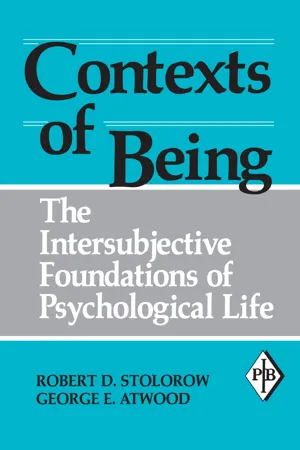
In this volume, the authors complete the circle begun with Faces in a Cloud (1979) and continued with Structures of Subjectivity (1984) and Psychoanalytic Treatment: An Intersubjective Approach (1987- with Brandchaft). They now extend intersubjectivity theory to a rethinking of the foundational pillars of psychoanalytic theory since they have already demonstrated the degree to which psychological theory is influenced by the subjective world of the psychological theorist, explored the various "structures of subjectivity" that organize the subjective world, and applied the intersubjective perspective to a broad array of clinical issues.Beginning with an in-depth critique of the concept of the isolated individual mind, Stolorow and Atwood argue that this myth has long obstructed recognition of the intersubjective foundations of psychological life. The authors then proceed to a series of chapters that reframe, from the standpoint of intersubjectivity theory, basic assumptions of the psychoanalytic theory of mental life. Concluding chapters on "varieties of therapeutic alliance" and "varieties of therapeutic impasse" further exemplify the ability of intersubjectivity theory to reorient the psychoanalytic therapist, thus providing fresh strategies for understanding and addressing the most challenging clinical contingencies. Contexts of Being is the conceptual culmination of Stolorow and Atwood's earlier studies, giving them a forum to explain why the perspective of intersubjectivity cannot be reduced to a clinical sensibility that can be grafted onto existing psychoanalytic theory. Rather, the authors argue, the intersubjective perspective has methodological and epistemological implications that mandate a radical revision of all aspects of psychoanalytic thought. Not only a cogent elaboration of these implications, the volume is also an important first step in effecting the sweeping revision that follows from them.
eBook - ePub
Contexts of Being
The Intersubjective Foundations of Psychological Life
- 158 pages
- English
- ePUB (mobile friendly)
- Available on iOS & Android
eBook - ePub
Contexts of Being
The Intersubjective Foundations of Psychological Life
About this book
Trusted by 375,005 students
Access to over 1.5 million titles for a fair monthly price.
Study more efficiently using our study tools.
Information
Index
Abandonment, fear of, 69, 71
Abraham, K., 89, 105, 125
Absences, vulnerability to, 66
Abstinence, 107
Abuse, neuroses and, 56
Action language, 14
Affect, 16, 26
experience of, mind-body relationship and, 42-43
painful, 54-55
Affect attunement
caregiver's, 46
failure of, 26, 46, 52
mutual, 26
Affect integration, 13
Affect-regulatory process, loss of, 26
Affect state, 16
disruptive, 64
infant's, caregiver's response to, 46
traumatic, intolerability of, 52-53
Affective development, 3
arrests in, 43
Affective experience, 52
articulation of, developmental derailments in, 34-35
attuned responsiveness of caregiver and, 31
early, 46
regulation of, 31
verbal articulation of, 45
Affective reactions, violent, 97
Affective states, central, 31
Affectivity, dynamic unconscious and, 31
Agency, experience of, 15
Aggressive drive, 16
Akhtar, S., 56, 129
Alexithymia, 43
Alienated aloneness, 10
Alienation, 7-8
from nature, 8-9
from social life, 9-11
from subjectivity, 11-12
Aliveness, 94
Aloneness
alienated, 10
ontological, 9-10
psychological, 9
Amnesia, 74, 77
Analysand, See Patient
Analyst, therapist
archaic bond with, 72
disparity with patient, 105
identification with, 90
impact of, 93
interpretive approach, patient's identification with, 88
oedipal wishes toward, 101
organizing principles, 124
archaic, 112
patient's remaining tie with, 14
personal reality, 93
real and tangible, 69
relationship with patient, 88, See also Therapeutic alliance
romantic feelings toward, 11...
Table of contents
- Cover Page
- Half Title page
- Title Page
- Copyright Page
- Dedication
- Dedication
- Contents
- Preface
- Introduction
- Theoretical Foundations
- The Myth of the Isolated Mind
- Three Realms of the Unconscious
- The Mind and the Body
- Trauma and Pathogenesis
- Fantasy Formation
- Clinical Applications
- Varieties of Therapeutic Alliance
- Varieties of Therapeutic Impasse
- Epilogue
- References
- Index
Frequently asked questions
Yes, you can cancel anytime from the Subscription tab in your account settings on the Perlego website. Your subscription will stay active until the end of your current billing period. Learn how to cancel your subscription
No, books cannot be downloaded as external files, such as PDFs, for use outside of Perlego. However, you can download books within the Perlego app for offline reading on mobile or tablet. Learn how to download books offline
Perlego offers two plans: Essential and Complete
- Essential is ideal for learners and professionals who enjoy exploring a wide range of subjects. Access the Essential Library with 800,000+ trusted titles and best-sellers across business, personal growth, and the humanities. Includes unlimited reading time and Standard Read Aloud voice.
- Complete: Perfect for advanced learners and researchers needing full, unrestricted access. Unlock 1.5M+ books across hundreds of subjects, including academic and specialized titles. The Complete Plan also includes advanced features like Premium Read Aloud and Research Assistant.
We are an online textbook subscription service, where you can get access to an entire online library for less than the price of a single book per month. With over 1.5 million books across 990+ topics, we’ve got you covered! Learn about our mission
Look out for the read-aloud symbol on your next book to see if you can listen to it. The read-aloud tool reads text aloud for you, highlighting the text as it is being read. You can pause it, speed it up and slow it down. Learn more about Read Aloud
Yes! You can use the Perlego app on both iOS and Android devices to read anytime, anywhere — even offline. Perfect for commutes or when you’re on the go.
Please note we cannot support devices running on iOS 13 and Android 7 or earlier. Learn more about using the app
Please note we cannot support devices running on iOS 13 and Android 7 or earlier. Learn more about using the app
Yes, you can access Contexts of Being by Robert D. Stolorow,George E. Atwood in PDF and/or ePUB format, as well as other popular books in Psychology & Interpersonal Relations in Psychology. We have over 1.5 million books available in our catalogue for you to explore.