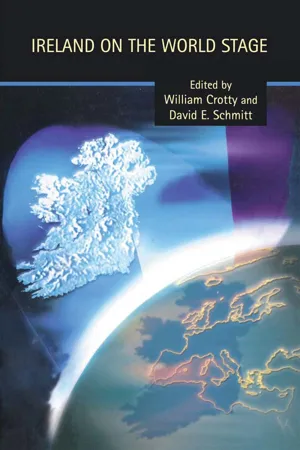
eBook - ePub
Ireland on the World Stage
- 224 pages
- English
- ePUB (mobile friendly)
- Available on iOS & Android
eBook - ePub
Ireland on the World Stage
About this book
For 2nd and 3rd year courses in Irish Politics, European Politics, or Comparative Politics, International Relations or Economic Development. This book provides an up-to-date analysis of Ireland's place on the world stage, exploring its international relations, evolving economic power, changing relationship with the EU, its political role in the world and its changing relationship with England and Northern Ireland. The book traces Ireland's development from a rural and isolated country to one that has emerged as an influential player on the international stage. It looks at the continuing difficulties with the North, Ireland's role of prominence in Europe and the way in which it has benefited from economic globalisation.
Trusted by 375,005 students
Access to over 1.5 million titles for a fair monthly price.
Study more efficiently using our study tools.
Information
Subtopic
Political EconomyChapter 1
Introduction: the Irish way in world affairs
Introduction
Ireland as a world power? Not quite! But Ireland as an international success story, yes. From a small (estimated population 3.6 million) and backward country, traditionally one of the ‘poor cousins’on the fringes of Europe and historically wedded economically and, pre-independence, by force to the needs and colonial ambitions of Great Britain, Ireland has emerged in recent decades as a country reborn – prosperous, self-confident, and a player of consequence on the international scene. Marked by a newly evolving social culture and a demand for more of the fruits of prosperity, it is a nation that through careful planning, discipline, and a skilful use of the resources at its disposal has taken an aggressive approach to international trade and finance, self-consciously positioning itself to benefit from the regional interdependence and globalised marketplace now in place. The strategies being followed are not without risk, but the successes to date far outdistance the trouble spots that remain in its society and the potential problems of future years are (as of now) seemingly far off.
It is a story worth telling in its own right; the case of a country redirecting its priorities and marshalling its energies to break from a traditional past and competitively challenge, with a high degree of success eventually, for a place in the economic developments of its age. There are few success stories like it.
This is not to say that Ireland has suddenly emerged as a Super Power (in itself a small group of one). But the country has transformed itself from an impoverished, isolationist, rural and sectarian nation largely bypassed by the Industrial Revolution into a more cosmopolitan, wealthier and economically competitive force in Europe and also, if to a lesser extent, in the newly globalised economy.
The primarily domestic and internal aspects (along with considerations of its relationship to Northern Ireland and England) of the changes underway are developed in our earlier Ireland and the Politics of Change (1998). In the studies in this volume, we and our co-authors explore the nature of the changes that have taken place in Ireland's international relations and the ramifications these have for the society. The present volume is in many respects a companion piece to the earlier one, this time with the focus on Ireland's external presence and the place the country has carved for itself in the international arena.
Ireland prior to the contemporary era
From its founding in 1922 until the late 1950s (and a transfer of power and the beginning of a new political age), Ireland was a nation content to go its own way, shielding itself from the political currents and upheavals of the day. Its focus was on asserting its own nationhood, and its distinctive cultural and societal values, freed of the obligations of world citizenship and removed from the struggles that were to engulf Europe (Brown 1985; Lee 1995; Kennedy 1996).
In large part, this was a conditioned response to centuries of suppression and oppression by its ruler and more powerful neighbour, Great Britain. After Independence, its political life had been shaped by the bitter and divisive civil war that followed (Garvin 1996). The intense and emotional divisions revolved around the Anglo-Irish Treaty of 1922 that divided Ireland North and South and led to the Civil War (Garvin 1981). This conflict was to form the basis for the structural divisions of the two major political parties, Fianna Fail and Fine Gael, ones that have continued to this day.
The dominant political presence of the post-independence decades was Eamon de Valera, a founder of Fianna Fail in 1926 and its leader until 1959. His contributions to the evolving state were legendary: President of the Executive Council, 1932–37; Taoiseach (Prime Minister), 1937–48, 1951–54 and 1957–59; and President of the Republic, 1959–75. De Valera was to put his stamp on the newly independent Ireland. He was responsible for removing all official traces of association with Great Britain and for framing the Irish Constitution that codified not only government structures and powers and the assumptions underlying its laws but also spelled out the values and ambitions he held for the newly evolving developing state. The ‘Age of de Valera’was noted for its emphasis on a ‘rural economy and rural virtues’; its sectarianism (the special position of the Catholic Church was acknowledged in the 1937 Constitution and the people were overwhelmingly Catholic in religion) (Berger 1973; Whyte 1980; MacGréil 1991; Drudy and Lynch 1993; Fahey 1994; Hornsby-Smith 1994; Hornsby-Smith and Whelan 1994; Inglis 1998); its antipathy toward England, resulting in long-term economic battles particularly notable during the 1930s; its social solidarity and cultural traditionalism; a subordinate position for women in society with an emphasis on their roles as homemakers and mothers (Whelan and Fahey 1994; Galligan 1998a and b, 1993); and its independence and neutrality in world affairs (as an example of the latter, Ireland remained neutral in World War II despite intense lobbying by both the United States and Great Britain) (Sloan 1997a and b; Fanning 1998; Fitz Gerald 1998). Ireland during these years was an inward-looking nation, one that chose to build on its cultural strengths, qualities that had contributed to its cohesiveness and shaped its world views and social institutions during the centuries of British domination. In effect, this can be seen as a healing period when the patterns of social conduct, the forms of government, its perception of the ways in which the world operated and the qualities that would come to distinguish the new state were put into place. A major consequence of this inward-looking nation-building, as indicated, was a withdrawal from world politics, a reluctance to engage in international trade and a form of ardent isolationism that closed the nation to external concerns (Fisk 1985; Dwyer 1988; Keogh 1988).
All of this was to change, and change dramatically, with de Valera's stepping down as Taoiseach and the choice of his long-time associate and deputy, Sean Lemass, to succeed him. Lemass’career lines and political resume was strikingly similar to de Valera's: a founding member of Fianna Fail in 1926 and its leader from 1959 to 1966; a veteran of the War of Independence and the Civil War; Vice-President of the Executive Council (Deputy Head of Government) when de Valera served as Taoiseach from 1937 on; and the holder of ministerial portfolios virtually non-stop in Fianna Fáil governments beginning in 1932. While his political pedigree resembled de Valera's, his political and, most importantly, economic objectives did not. Lemass was a proponent of free trade and an advocate of systematic government planning to develop in the Irish economy an ability to compete internationally. He saw this approach as an antidote to the poverty and social backwardness of the country whose leadership he had inherited, the avenue to a more prosperous and economically more rewarding future for its citizens. His government introduced the first of what were to be a series of national plans to establish the nation's priorities; mobilise its resources; foster a consensus among government, business and the trade unions as to wage restraints (best exemplified by the 1987 business-labour agreement to curtail labour costs in return for job growth); and provide marking points for the transition to an internationally competitive economy. It bears repeated emphasis that the fundamental changes instituted and the prosperity that followed in time were the consequences of deliberate, reasoned choice made by successive governments committed to strengthening the economy and forcing Ireland to compete in the international marketplace (Goldthorpe and Whelan 1994; Kennedy, Giblin and McHugh 1994; Burke 1995; Girvin 1997; Murphy 1997).
There was nothing accidental or providential about the course chosen or any ambiguity as to who set the priorities or what they were to be (Munck 1993; Ó Gráda 1995, 1997; O'Hagan 1995). The role of government in instituting the transformation from the Old Ireland to the New Ireland is a distinguishing feature of what has occurred (Shirlow 1995; Sweeney 1998; Crotty 2001). It is a potential reference point for countries wishing to follow the same course that has served the Irish so well. Yet it is an approach that makes certain assumptions and builds on a distinctive set of national advantages (see below). It should be noted also that there are competing models of government intervention in the economy (Korea, Taiwan, Malaysia and, on a different scale, Japan as examples) that despite their difficulties might be more applicable in some cases.
The Lemass'government of the 1950s and early 1960s then and the earliest of the national plans thus set the course for Ireland's economic development and a refashioning of its international relationships. While highly successful, the ride has been anything but trouble-free, however. My colleague David E. Schmitt writes:
Progress from the late 1950s through the 1990s … was by no means smooth. The country sustained a serious recession as well as inflation during the late 1970s to early 1980s. Indeed, through 1985 Ireland had low income and consumption growth as well as high unemployment and national debt compared with other EC [European Community] members … basic structural and international factors limiting the effectiveness of economic planning were the oil crises of the 1970s and inflationary pressures resulting in part from Ireland's close economic linkage to Britain … as Ireland modernized economically later than the small, open economies of states such as Norway, Sweden, Switzerland, and Austria, the government had to oversee fundamental changes … the limited policy and class differentiation among the major political parties as well as a relatively weak and fragmented labor movement provided less coherence to efforts aimed at developing a national pay and wage policy during the 1970s and early 1980s … These attributes contributed to labor unrest and inflation. (2000: 788–9)
The 1980s provided some of the most serious of the setbacks encountered (Goldthorpe and Whelan 1994; Jacobsen 1994; Guiomard 1995; Haughton 1998; Tansey 1998). The manner in which these were handled established the contours for economic policy up through the ensuing decade and into the new century and are credited with realising the prosperity Ireland has come to enjoy.
Richard Rapaport explains:
If a new economic paradigm is being born in Ireland, it is the result of a long-shot wager made by government planners in the dark days of the ′80s when Ireland's unemployment reached a high of 18%, the national debt was a staggering 125% of the country's gross national product, and 1,000 people a week were emigrating. During one dismal year in the early ‘80s recruiters from Sweden poached an entire gr...
Table of contents
- Cover
- Half Title
- Title Page
- Copyright Page
- Table of Contents
- Contributors
- Preface
- Publisher's Acknowledgements
- Dedication
- 1 Introduction: the Irish way in world affairs
- 2 Irish foreign policy
- 3 The Irish economy in international perspective
- 4 Ireland – a multicultural economy
- 5 Ireland and the European Union
- 6 Irish-American relations
- 7 The Northern Ireland conflict and the impact of globalization
- 8 Northern Ireland and the international system
- 9 Ireland and the international security environment: changing police and military roles
- 10 Ireland and human rights
- 11 The political economy of growth
- 12 Ireland on the world stage: conclusions and challenges
- Index
Frequently asked questions
Yes, you can cancel anytime from the Subscription tab in your account settings on the Perlego website. Your subscription will stay active until the end of your current billing period. Learn how to cancel your subscription
No, books cannot be downloaded as external files, such as PDFs, for use outside of Perlego. However, you can download books within the Perlego app for offline reading on mobile or tablet. Learn how to download books offline
Perlego offers two plans: Essential and Complete
- Essential is ideal for learners and professionals who enjoy exploring a wide range of subjects. Access the Essential Library with 800,000+ trusted titles and best-sellers across business, personal growth, and the humanities. Includes unlimited reading time and Standard Read Aloud voice.
- Complete: Perfect for advanced learners and researchers needing full, unrestricted access. Unlock 1.5M+ books across hundreds of subjects, including academic and specialized titles. The Complete Plan also includes advanced features like Premium Read Aloud and Research Assistant.
We are an online textbook subscription service, where you can get access to an entire online library for less than the price of a single book per month. With over 1.5 million books across 990+ topics, we’ve got you covered! Learn about our mission
Look out for the read-aloud symbol on your next book to see if you can listen to it. The read-aloud tool reads text aloud for you, highlighting the text as it is being read. You can pause it, speed it up and slow it down. Learn more about Read Aloud
Yes! You can use the Perlego app on both iOS and Android devices to read anytime, anywhere — even offline. Perfect for commutes or when you’re on the go.
Please note we cannot support devices running on iOS 13 and Android 7 or earlier. Learn more about using the app
Please note we cannot support devices running on iOS 13 and Android 7 or earlier. Learn more about using the app
Yes, you can access Ireland on the World Stage by William J. Crotty,David Schmitt, William Crotty,David E. Schmitt, William Crotty, David E. Schmitt in PDF and/or ePUB format, as well as other popular books in Politics & International Relations & Political Economy. We have over 1.5 million books available in our catalogue for you to explore.