![]()
Section 1: getting things done
![]()
The problem: inattention
The recipe: listening and following instructions
What you need to know
Hearing levels: Many children below the age of seven have intermittent conductive hearing loss and although they can hear sounds they may not be able to make out the meaning of what is being said, especially in a noisy classroom. Check what they can hear when facing you compared to when they are looking away. NB: hearing gets worse when they have a cold.
Language skills: Does the child understand what is being asked? Young children may come to school without having had much in the way of interactive conversation so their vocabulary is limited. This is especially important if the child’s first language is not English.
Attention skills: Does the child have dual attention channels? Can they listen and do things at the same time or not?
Too much information: Does the child listen at first but then switch off? Do they start working, then stop? Memory difficulties can include: short term memory (immediate); working memory (working with two or more pieces of information); or long term memory (e.g. connecting what they are doing now to what was taught last week). Might there be a need to give shorter or fewer directions at a time, repeat, summarize or paraphrase?
Strengths: When does the child listen best? What time of day, any specific activities?
Ability level: Is the child able to do what they are being asked to do?
At home: What have the parents noticed about their child and their ability to listen? Have they got strategies to share? Are there concerns about developmental milestones?
Today in the classroom
With the whole class:
- When giving instructions ensure the light is not behind you.
- Give short, clear instructions with visual cues where possible.
- Use names for the children you need to re-focus but otherwise do not single out.
- *Paula Pane
- *Proximity praise
With this child:
- Have the child sit near you.
- Ask them to look at you so they can lip-read if necessary – some children find eye-contact either challenging or culturally conflicting so ask them to look at your mouth.
- Give one instruction at a time and ask them to tell you what they are going to do in their own words.
- Make sure they know what it means to have ‘finished’ that task.
- Say you will come back to see how they are doing (*take-up time).
- When you return give positive feedback for anything completed and ask for *feelings feedback.
- If they have failed to do anything, ask them to complete a more familiar task so they experience a level of success.
- *Peer support
- *Visual cues
Longer term change
Differentiated learning so that tasks are at the right level.
*Structure success opportunities and praise effort.
*Circle Solutions activities to enhance listening skills, e.g. paired interview where children find out something about their partner and then feed back to the Circle.
Give attention to classroom layout and set up work stations with minimum distractions.
Build on anything that motivates or interests the child.
Provide visual support including charts of progress through a task.
For older children, self-monitoring with regular breaks may help. Ask them what they think they can manage and raise the time on task incrementally.
*Feelings feedback
*Personal bests
![]()
The problem: avoidance strategies
The recipe: focusing on directed tasks
This is where the pupil frequently engages in a range of avoidance strategies such as sharpening pencils or going to the toilet to avoid settling to work.
The aim is a student who is confident about beginning a task and motivated to stick with it. This behaviour is not uncommon for pupils who struggle with academic tasks.
What you need to know
Avoidance strategies: What is the student actually doing – does this give you any clues?
Which activities: Are there specific activities that the child avoids?
Situational clues: Does this happen in particular lessons, times of day, particular teachers, other pupils? When is the pupil most engaged, motivated and organized?
Equipment: Does the student have the equipment they need? If they have to bring it from home what are the issues here?
At home: Are there genuine toileting concerns?
Emotional cues: What does the pupil feel about the tasks they are being asked to do?
Today in the classroom
Ensure all materials needed are within easy reach.
Clarify *task priority and be clear about the very first thing to do.
Highlight key words or instructions.
Give *take up time.
Clarify times for toilet breaks to everyone – you may need to gently and privately remind the student to go at these times if this is an issue.
Give positive feedback for effort on any completion, however small.
Longer term change
Ensure all students understand what is involved in independent working. Give them a framework for beginning, continuing and finishing.
Build confidence by starting the student on familiar activities in which they have experienced success.
*Task analysis and checklist of steps.
Give students the following guidelines:
- 1 Do as much as you can yourself first.
- 2 Ask another student if you are not sure what to do next – *peer support.
- 3 If you’re still stuck put your hand up to ask the teacher.
*Cooperative working with clear role for each member of the group.
Give responsibility for classroom tasks.
Have clear expectations of time on task alongside regular physical breaks.
*Traffic lights for needing to go to the toilet if this is an issue/excuse.
![]()
The problem: disorganization
The recipe: having the right things for a task and getting down to it
These strategies are for students who are disorganized and may be described as ‘all over the place’. They need to learn to organize their belongings, their tasks, their time or all of these.
Being organized means:
- having what you need for a particular task (or lesson)
- knowing where things are kept
- understanding the importance of sequence and doing things in the right order
- knowing how to prioritize
- being able to manage time well rather than spending it all on one thing
- being independent and not relying on others.
What you need to know
When: Is this a problem in all contexts or just some?
What: Is the student struggling with time management, organization of equipment or organization of tasks? Or all of these?
Memory: Is memory a problem generally?
Sequencing: How skillful is the student in putting things in order?
Prioritizing: Can the student tell you the most important thing to do first?
Classroom layout: Can the pupil show you where everything is kept?
Putting things away: Does the student put things away in an agreed place when they are finished with them? Or is this haphazard?
Independence: Is the pupil used to other people doing everything for them?
Shared parenting: Are things in the other parent’s house?
Today in the classroom
Ask all students to check equipment at the beginning of an activity.
*Proximity praise
Verbal and visual prompts
Longer term change
All students need to know the basics of good organization – independent working may need direct instruction.
Colour coded equipment may help.
Older students may need practice in setting out a task with its component parts and allocating time to each within the time allowed.
*Mnemonics
Work with parents so the student has visible reminders at home for what they need each day – perhaps pinned onto the inside of the front door.
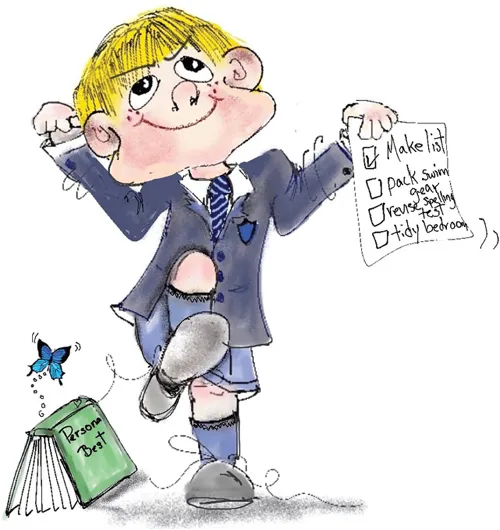
Encourage use of lists with the pupil, constructing them in the first place then crossing things off.
Practice sequencing games to raise awareness of order. These could be simple to start with, such as what do you need to do when you are going for a swim/make a cup of tea/have friends over to watch a film.
Give responsibility for aspects of classroom organization.
Teach and reinforce *routines.
Work with parents to increase independence.
See Oliver and the Organization Owl in the Wellbeing Stories (see Resources and further reading) for more ideas and whole class activities.
![]()
The problem: helplessness
The recipe: increasing independence
A student who says ‘I can’t’ as their first response is either anxious about making a mistake or is used to other people doing things for them. It is possible they are not able to make sense of what is required. If a student is to work independently they need to feel confident to have a go in the first place and experience success, however small.
What you need to know
When: Does this happen with all tasks or just with some? When is the student most confident about starting something?
Circumstances: Does the pupil behave differently depending on whether tasks are individual, paired or in a small group? Does giving the student a choice or a task that matches their interest or strengths make a difference?
At home: What happens there? Is the pupil encouraged to be independent or is everything done for them? Are they given praise for attempting things even if they don’t get it right? Might they get into trouble or be given negative messages about themselves if they don’t succeed first time or take too long?
Ability: Does the student understand what they are being asked to do and have the skills to start?
Today in the classroom
*Task Analysis: Focus on the first step and link to prior knowledge/familiarity. Tell the pupil that the aim of this activity is to make a start and that is more important than getting it right – *mistakes as part of learning.
*‘Take Two’: Start the task with the pupil using the phrase ‘We can do this’ and th...