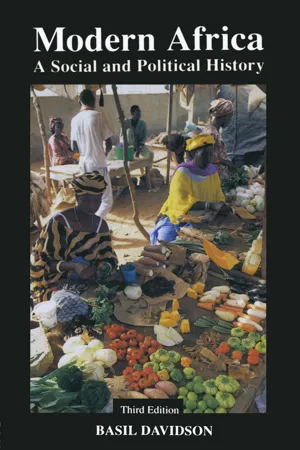
- 312 pages
- English
- ePUB (mobile friendly)
- Available on iOS & Android
eBook - ePub
About this book
Basil Davidson's famous book -- now updated in a welcome Third Edition -- reviews the social and political history of Africa in the twentieth century. It takes the reader from the colonial era through the liberation movements to independence and beyond. It faces squarely the disappointments and breakdowns that have dulled the early successes of the post-colonial era; yet, for all the sorrows and uncertainties of Africa today, Basil Davidson shows how much has been achieved since decolonization, and the mood of his new final chapter is hopeful and buoyant.
PART ONE
Under Foreign Flags: 1914–1930
PART ONE studies changes and developments in the years 1914–1930. Among questions examined in its chapters are:
Chapter One The Early Years of the Twentieth Century
● What was the colonial partition?
● How did the First World War (1914–1918) affect Africans?
Chapter Two Colonial Africa: to 1930
● How did the colonial systems work?
● Who paid for them, and how?
● What did the colonial systems do to African land, labour, and trade?
Chapter Three African Responses: to 1930
● What was colonial ‘pacification’?
● Who were the early leaders of anti-colonial protest?
● What were the Ethiopianist and other religious movements?
● What was the migrant labour system, and how did it work?
● Who were the ‘educated few’, and why were they important?
Chapter Four Key Ideas for Progress
● Who began the Pan-African movement, and why?
● How did the ideas of modern nationalism begin and spread in Africa?
● What was the National Congress of British West Africa, and what is the African National Congress of South Africa?
● What was the policy of ‘assimilation’?
● How did nationalism take shape in North Africa? Who were the early leaders of Islamic nationalism?
● What were the Salajiyyah, the Wafd, the Destour, the Etoile Nord-Africaine?
CHAPTER ONE
The Early Years of the Twentieth Century
THE HERITAGE OF HISTORY
Africa is probably the oldest continent. Most of it consists of ancient rocks which have changed little in structure since they first took shape some 200 million years ago. Still larger than the Africa of today, that most ancient continent has been named Gondwanaland. Huge fragments then broke away from Gondwanaland and became India, Australia, and South America. This is the explanation of the theory known as ‘continental drift’.
Whether or not this theory is right, Africa can certainly claim to be the birthplace of mankind. Science in the past half-century has shown that the earliest ancestors of ourselves evolved in Africa, and, from Africa, spread around the world in developing the various branches of mankind that we know today.
Africa's own civilisations are seen to have developed from the onset of the Neolithic or New Stone Age some 10,000 years ago. Their most important region of early development was the vast plainland of the Sahara before it began drying to a desert. From the plainland of the green Sahara, as it then was, the black peoples multiplied and spread, eventually creating the great civilisations of Pharaonic Egypt and the Nile Valley.
Elsewhere, across the vast tropical and southern regions of the continent the black peoples of ancient times progressed from one phase of development to another. They introduced cattle. They invented methods of growing food-crops under tropical conditions. After about 500 BC they began smelting and forging iron for tools. They tamed their difficult continent. At the same time they evolved their own religious and social beliefs, methods of self-government, and ways of keeping the peace.
All this has had to be done against the problems of an often very hostile ecology and climate. Not only is Africa big – so big that the whole of the USA could be contained within it several times over – but Africa is also a continent of great natural variation. Most of it stretches between the latitudes of 35° North and 35° South of the Equator. Within this huge area there are countless differences of rainfall, soil fertility, plant and animal life; and each of these differences has challenged the survival of mankind. That survival has required a constant self-adjustment. Nothing has been easy; nothing has been guaranteed.
But a new challenge to the black peoples, a different kind of challenge offering new opportunities but bringing new dangers, began some 500 years ago. That was when the ‘outside world’ – largely, the European ‘world’ – first reached the African scene in a direct and frequent way. This new contact with Europe brought gains to Africa as well as to Europe, especially in the exchange of goods and ideas. But it also brought the long and painful tragedy of the trans-Atlantic trade in Africans captured into slavery and sent to the Americas. This was helpful for the development of the Americas, but very bad for the development of Africa. And this slave trade lasted more than 300 years.
Another challenge followed. By the middle of the nineteenth century the leading countries of Europe lost interest in exporting African labour to the Americas. Now they wanted to be able to use African labour in Africa itself. For that purpose they needed to take control of the black people's continent. So Europe invaded Africa, took possession of Africa, and divided Africa into colonies of Europe.
The period of invasion, lasting some twenty years, was more or less completed by 1900. There followed a longer period, between sixty and ninety years, of direct European rule, called colonial rule. This was a time of profound upheaval for all of Africa's peoples. It brought irreversible changes. Nothing would ever be the same.
The colonial period began to come to an end in 1951. But the process of‘decolonisation’, of Africa's struggle to win freedom from foreign rule, has had to be long and difficult. Many colonies were able to become independent states during the 1960s. Yet only in 1990 did Namibia cease to be a colony of racist South Africa, while the black majority of South Africans continued to suffer the persecutions of apartheid.
All this is the history of Modern Africa. It is a history of great human dramas: of conflict and courage, sorrows and setbacks, stubborn progress. These dramas of the black peoples have lain at the very heart of the world we know.
We investigate this history step by step, and begin with the colonial partition.
PARTITION OF AFRICA
Partition means ‘dividing up’ or ‘sharing out’; and colonial means ‘foreign rule’ or ‘foreign settlement’ or both. The colonial partition was the sharing out of Africa among strong empire-building powers such as Britain, France and Germany; and several weaker ones such as Portugal, Italy, Belgium and Spain.
For a long time during the nineteenth century, these powers quarrelled over the shares of Africa that each wanted to get. But in 1884–85, at a conference in Berlin (then capital of a German empire) they agreed to invade and take Africa without fighting each other. They marked out ‘spheres of interest’. Then each invaded the continent within its own ‘sphere’.
Many African peoples tried to defeat these invasions. But the Europeans were too strong in technology and organisation, especially in the use of rifles and machine-guns; and the partition was almost complete by about 1900. Most of the colonial frontiers – the frontiers, today, of independent African states – were fixed on the map by the end of 1901. Only Ethiopia, and in a lesser way Liberia, continued to rule themselves.
That is how the colonial systems or empires came into existence: seven of them until 1918, when Germany's system was ended, and then six. These systems differed greatly in detail, as we shall see. Sometimes, wherever kings or chiefs were willing and able to work with colonial government, the systems operated by what was called ‘indirect rule’. Otherwise, the colonial governments ruled ‘directly’ through their own white officials and African servants.
But all systems, in essential ways, operated with the same assumptions and for the same purpose. Each of them was racist and exploitative. They used colonial power to treat Africans as inferior to Europeans, justifying this by a whole range of myths about a supposed ‘white superiority’. The purpose of using colonial power in this way was to make Africans serve the interests of European colony-owners.
These systems brought some gains as well as many losses, for their history was a contradictory process. We study it in three main periods. First, from the First World War of 1914–18 to the great economic depression which began in 1929–30. Secondly, through the 1930s to the end of the Second World War of 1939–45. Thirdly, through the struggles of modern nationalism to the end of the colonial empires. After that, in the fourth part of this book, we consider the years of Africa's regained independence.
Before 1914
The colonial powers partitioned Africa by agreement with each other. But they still had to invade and occupy the colonies thus marked by the lines on the map. They did this by crushing African resistance wherever it appeared. At first, European troops were used, as well as troops from other colonies such as India and the West Indies. After 1900, African troops under European officers did most of this work.
Military occupation was far advanced by 1914. Even so, colonial rule by military force was often weak or incomplete; large areas remained outside its control. Yet the colonial systems were now in place; and the time was ripe to make them produce wealth for their owners. At this point, however, there came a mighty interruption.
THE FIRST WORLD WAR, 1914–1918
The colonial powers managed to keep the peace between each other in Africa. But they could not keep it in Europe. In 1914 a vast and terrible conflict broke out between Britain, France and Russia on one side, and Germany with Austria-Hungary on the other. This spread through Europe and killed millions.
Each power drew upon its colonies for men and money. For the first time on any scale, Africa was pulled into the quarrels of the outside world. The consequences were many and deep. They were military, social and economic, and political.
On the military side, African men were taken into the European colonial armies either as soldiers or as porters and servants. Sometimes this was done by enlarging colonial regiments already in existence, such as the British West African Frontier Force, the French Tirailleurs, the German Schutztruppen, the Belgian Force Publique.Men joined for the wages that were paid, or in obedience to orders imposed on them by their chiefs.
Yet these small colonial forces were not enough. Huge French losses on the ‘Western Front’ in France (so called to distinguish it from the ‘Eastern Front’ in Russia) soon led the French government to demand more African troops, and conscription (forcing men to join an army) then began. Much the same was done by the British on a smaller scale, especially in East Africa, to obtain porters and other service personnel needed in Britain's war against the Germans in Tanganyika (the mainland country of modern Tanzania).
Armies of men vanished into the jaws of this monstrous war. From first to last, the French raised about 211,000 troops from their West and Equatorial colonies, some 270,000 from their North African colonies, and about 40,000 from Madagascar. Exactly how many of these died has never been found out. But it is generally accepted that about 200,000 Africans lost their lives in French war service.
For the British forces, Nigeria provided some 17,000 fighting men and 58.000 service personnel; many were sent to East Africa, where about 1.000 were killed. The Gold Coast (Ghana) raised some 10,000 men with losses on the same scale; Sierra Leone and The Gambia also played their part. The greatest African losses were in the British campaign against the Germans in Tanganyika. Upwards of one million East Africans were forced to become porters for the British. Of these, perhaps as many as 100.000 were killed by military action, hunger or disease. The Germans, Portuguese and Belgian colonial authorities also relied on ‘call-up’ of African troops and porters, at times in large numbers and often by force. As with much else in the colonial period, overall figures of African losses through one or other form of war service have remained a matter for dispute; but it seems unlikely that total African losses were less than 300.000 men. The true figure may have been higher still.
BROADER CONSEQUENCES OF THE WAR
Colonial governments were obliged to give money, as a contribution to war expenses, to their respective home governments in Europe. This scarcely applied to the German colonies, which were quickly taken over by Britain, France and Belgium (and by South Africa in the case of Namibia), or, like Tanganyika, were cut off from Germany. But most of the British and French territories had to provide money from taxation. Even as small a territory as The Gambia provided £10,000 out of its total budget for 1914 of £122,225.
The war was a profoundly disturbing influence as well as an expensive one. Many rural communities were shaken or undermined. Countless families were deprived of active men taken for war service. Others tried to evade recruitment by hiding themselves or moving to another territory. There was frequent armed resistance to war service in several of the territories of French West Africa; and clashes with the colonial authorities were many. Natural disasters such as the spread of epidemics combined with food shortages to spread hunger and death. All this was a prelude to the great rural poverty of later years.
There were long-term consequences of a different kind. Especially in British West Africa, such African traders who had managed to remain active in the export market were squeezed out of business. British firms took advantage of war conditions to strengthen their hold on export-import trade. They took over, for example, the share of that trade formerly held by German firms. The war years were in fact the period in which a handful of major British trading companies secured control of all big-scale business; and much the same was true of French companies in the French territories. In this important respect, the war years completed the dispossession of Africans that the colonial conquests had begun.
As a political result, the colonial ‘share out’ was revised. Germany, in losing the war, lost its colonies: one in East Africa (Tanganyika, with Ruanda/Urundi); one in South-West Africa (Namibia); two in West Africa (Kamerun – or Cameroun as it was afterwards called – and Togo). Each of these was attacked by the powers allied against Germany, and chiefly by the British. German resistance lasted longer in Kamerun, and was ended only in February 1916. But in Tanganyika a skilful German commander, General Paul von Lettow Vorbeck, fought a guerrilla war aga...
Table of contents
- Cover
- Half Title
- Title Page
- Copyright Page
- Table of Contents
- List of maps
- Preface
- Part One: Under Foreign Flags, 1914–1930
- Part Two: Colonialism under Strain: 1930–1945
- Part Three: The Nationalists Win Through
- Part Four: New Freedoms: Progress and Problems
- Appendix 1: Key periods and events
- Appendix 2: Independence dates
- A few notes on further reading
- Index
Trusted by 375,005 students
Access to over 1.5 million titles for a fair monthly price.
Study more efficiently using our study tools.
Frequently asked questions
Yes, you can cancel anytime from the Subscription tab in your account settings on the Perlego website. Your subscription will stay active until the end of your current billing period. Learn how to cancel your subscription
No, books cannot be downloaded as external files, such as PDFs, for use outside of Perlego. However, you can download books within the Perlego app for offline reading on mobile or tablet. Learn how to download books offline
Perlego offers two plans: Essential and Complete
- Essential is ideal for learners and professionals who enjoy exploring a wide range of subjects. Access the Essential Library with 800,000+ trusted titles and best-sellers across business, personal growth, and the humanities. Includes unlimited reading time and Standard Read Aloud voice.
- Complete: Perfect for advanced learners and researchers needing full, unrestricted access. Unlock 1.5M+ books across hundreds of subjects, including academic and specialized titles. The Complete Plan also includes advanced features like Premium Read Aloud and Research Assistant.
We are an online textbook subscription service, where you can get access to an entire online library for less than the price of a single book per month. With over 1.5 million books across 990+ topics, we’ve got you covered! Learn about our mission
Look out for the read-aloud symbol on your next book to see if you can listen to it. The read-aloud tool reads text aloud for you, highlighting the text as it is being read. You can pause it, speed it up and slow it down. Learn more about Read Aloud
Yes! You can use the Perlego app on both iOS and Android devices to read anytime, anywhere — even offline. Perfect for commutes or when you’re on the go.
Please note we cannot support devices running on iOS 13 and Android 7 or earlier. Learn more about using the app
Please note we cannot support devices running on iOS 13 and Android 7 or earlier. Learn more about using the app
Yes, you can access Modern Africa by Basil Davidson in PDF and/or ePUB format, as well as other popular books in History & African History. We have over 1.5 million books available in our catalogue for you to explore.