![]()
Chapter 1
Application Service Providers: An Overview
Introduction
This chapter provides a general introduction to application service providers (ASPs) and the business context in which they operate. It gives various definitions of ASPs, describes the diverse functions individual ASPs perform, and provides a focus on a commonly accepted general definition. It also describes the main features of the ASP business model and its benefits to end users and the rising market need for ASPs globally, through a discussion of the multiple dynamic drivers underlying ASPs’ formation and development. The chapter then examines the broad variety of ASP offerings. A brief literature review of this dynamic phenomenon is also included, followed by an overview of its anticipated substantial opportunities and potential market growth, looking beyond the severe industry shakeout and consolidation in 2001. Then the multinational nature of the ASP industry is discussed. This perspective reflects the inherently global nature of the ASP industry and the multinational orientation of its major successful players.
Research indicates potentially many opportunities for application service to survive and prosper in the current and future business environment. These opportunities have also generated intense debate among analysts and information technology (IT) industry leaders. Problems noted in this debate especially include lack of homogeneity in functions and services provided, which have led to this book’s multidimensional analysis of the ASP model.
ASP Defined
This section examines various kinds of ASPs and provides a commonly accepted definition of application service providers. The ASP Industry Consortium, a global advocacy group that was formed in May 1999 to promote the industry, defines ASPs as companies that host, deliver, and manage computer software applications and services from remote data centers to multiple users across a wide area network (WAN) via the Internet or other private dedicated networks. An ASP provides computer applications and the infrastructure (physical infrastructure: IT plus delivery and communication networks; human infrastructure: skilled and well-trained workforce) and support services necessary to deliver them to customers on a subscription basis (ASP Industry Consortium, 2001a). There are, however, other definitions of ASP. International Data Corporation (IDC), for example, defines an application service provider as a company that gives a contractual service offering to deploy, host, manage, and provide access to computer software applications from a facility other than the customer’s site.
Another useful definition is offered by Gartner Group’s Dataquest, which defines an ASP as the provision (and servicing) of business process-enabling applications delivered over a network via a subscription-based outsourcing contract. Not included in this category is the providing of pure infrastructure—the physical systems and networks necessary to deliver the application from the ASP to end users. The infrastructure provider does not become an ASP “until there is some application functionality” being delivered (Haskins, 2000). In essence, what characterizes the ASP is the provision and management of business software applications on behalf of the end user, a somewhat incomplete definition given the study of actual ASPs in this book. In light of the later discussion of actual ASP developments, which also involves some important ASP Industry Consortium initiatives, the ASP Industry Consortium’s description of ASP characteristics is used as a formal definition in this book.
ASP Models’ Main Features
The basic value function of ASPs is that they rent out technology rather than sell it, get revenues from the sale, and deliver it online, either over the Internet or via other private or dedicated networks. ASPs are a way for customer companies to outsource some or sometimes almost all aspects of their IT-related needs. The main difference between an ASP and a traditional outsourcer, which underlies its power, is that ASPs manage commercially available application servers in a centrally controlled and remotely managed location rather than on a customer’s site. The defining characteristics of an ASP are as follows (Mizoras, 2001; Stanco, 2000; Gillan et al., 1999):
- Application centric: ASPs provide access to, and management of, an application that is commercially available or especially developed for the ASP.
- Renting application access: ASP services offer customers access to a new application environment without making investments in licenses, servers, people, and other resources. The ASP either owns the software or has a contractual agreement with the software vendor to license access to the software.
- Centrally managed: ASP services are managed from a central location rather than at each customer’s site. Customers access applications remotely, such as over the Internet or via leased lines.
- One-to-many offerings: The ASP often partners with other vendors to package standardized offerings that many companies will subscribe to over a specific contract period.
- Delivering on the contract: The ASP is responsible, in the customer’s eyes, for delivering on the customer contract, ensuring that the service is provided as promised.
Common features in formal ASP services are, therefore,
- owning and operating software applications;
- owning, operating, and maintaining the servers that run the applications;
- employing the workforce needed to maintain the applications;
- making applications available to customers everywhere via the Web (Internet) or other dedicated networks; and
- billing the service on a per-user basis.
ASPs give customers an alternative to procuring and implementing complex information and enterprise management systems in-house, which can be very costly and time-consuming. These costs include up-front capital expenses, implementation tasks, and a constant need for maintenance, upgrades, and customization. With data processing performed off-site by a third party, organizations have time and resources to adequately and efficiently focus on their core business without diverting their attention to support activities. In some cases, ASPs even provide customers with a comprehensive, fully customized solution, which gives customers the ability to control more precisely the cost of technology use and ownership through scheduled payment programs. Generally the ASP owns the software license and gives the end user access to the application, so costs associated with application ownership are spread over the lifetime of the contract, thus lowering the up-front entry costs. Recently, licenses have also been sold separately to give end users a more secure relationship with software developers.
ASPs supply not only hardware- and software-related services but also human assets and expertise that may be unavailable or prohibitively expensive for companies to acquire individually. This is especially true for small and medium-sized firms or high-growth companies of all sizes, where large investments are required—but where resources are restricted—for IT. The ASP model simplifies life for companies that would rather not, or are unable to, purchase the software applications, buy the computer, storage, and networking systems, or hire experts to install and maintain their own entire system.
ASPs evolved from a concept that was in fashion approximately thirty years ago—the computer bureaus that emerged in the 1970s, when the high cost of computing made companies rush to rent computer-processing time from external suppliers. The (re)birth of the ASP model was, in part, due to Traver Gruen-Kennedy, who founded the ASP Industry Consortium in 1999. He devised the concept in 1997 while working as a consultant and took it to Citrix Systems. He spent most of 1998 talking to companies that would provide the essential components of an ASP: telecommunication companies to provide the links between the applications and the clients; hardware providers and data centers to host the applications; and software companies that would have to customize their software to run in an ASP environment (Howarth, 1999).
The following timeline shows the evolution from hosting to ASP (Marks, 2001):
- 1969: The U.S. Department of Defense commissions ARPANET, the first variant of the Internet, developed by the Advanced Research Project Agency (ARPA).
- 1979: ARPA establishes the Internet Configuration Control Board, a further significant step toward the Internet.
- 1982: The TCP/IP (Transmission Control Protocol/Internet Protocol) model for connectivity in telecommunications networks, developed by the U.S. Department of Defense in 1972, is established as the protocol suite for ARPANET, leading to one of the first definitions of “Internet.”
- 1984: DNS (Domain Name System, a hierarchical system of servers maintaining databases enabling the conversion of domain names [the unique name of a node on the Internet] to their IP addresses) is introduced. By the end of the year, there are over 1,000 hosts.
- 1986: The Internet Engineering Task Force and the Internet Research Task Force are established.
- 1987: By the end of the year, there are over 10,000 Internet hosts.
- 1989: With seventeen countries online in the National Science Foundation Network (NSFNET), the number of Internet hosts breaks 100,000.
- 1991: The World Wide Web (WWW) is released, and the National Science Foundation (NSF) lifts restrictions on commercial access to the Internet.
- 1995: Mobile code, such as Java (a programming language developed by Sun Microsystems, designed to run on any computer or computing device regardless of the specific microprocessor or operating system it uses) is developed, adding online interactivity to e-commerce.
- 2000: ASP technology comes of age. Microsoft unveils its .Net Strategy (a new way to deliver applications), expected to turn many of its applications into ASP services by utilizing XML (eXtensible Markup Language) protocol-based Web communication code, which makes information in documents usable in computer programs.
The discussion so far has highlighted the basic ASP delivery model’s features and some of the benefits to end users. The following section describes various interconnected factors that contributed to the origin and expansion of the ASP phenomenon.
ASP Drivers
This section presents the major drivers underlying the formation and development of the ASP business model. These factors are not exclusive to the ASP environment, as they are encountered in most developing IT-related industries.
ASPs and the robust physical infrastructure necessary to support them are being driven by the desire to meet the specific needs of businesses that do not have the time, money, or resources to purchase, deploy, and manage software applications on their own. These businesses need software to help run their companies more efficiently, improve customer service, and gain competitive advantage. Application hosting and remote management as performed by ASPs are the solution for many businesses, especially small and medium-sized ones.
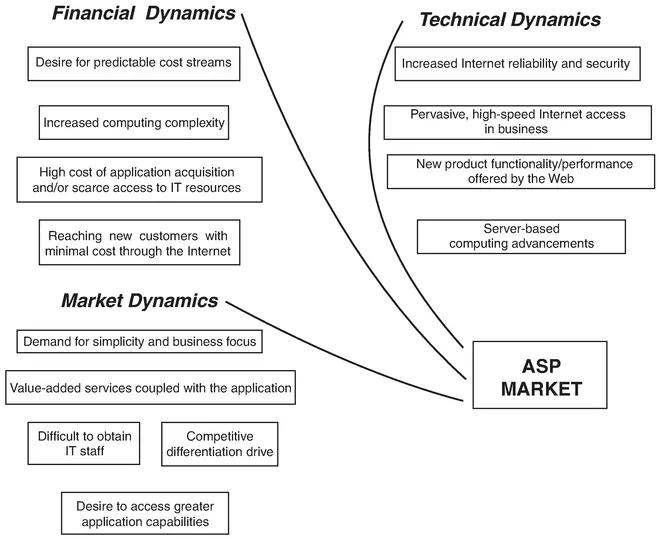
Fundamentally, ASPs have become possible because of advances in technology, notably the Internet. Basically, it takes only an Internet connection and a Web browser for the end user to be able to utilize ASP-managed applications. The end user is freed from the need to build or control all the infrastructure elements required by a traditional IT-related system. ASP growth, then, is being driven by several converging dynamic forces, including financial, technical, and market dynamics (Gartner Group, 2001a; Sound Consulting, 2000; CIO.com, 2000):
Financial Dynamics
- Desire for predictable cost streams at business level
- Increased computing complexity
- Escalating IT infrastructure and application costs; rapidly evolving business environments; rapidly changing technology
- Ability to reach new customers with minimal cost through the Internet
Technical Dynamics
- Increased reliability and security of the Internet (on which software, IT services, and telecommunications industries have converged)
- Pervasive, high-speed access from virtually every computer anywhere in the world, which allows users to link into a massive network, backed up by growing standards
- A user interface—the Web browser—widely embraced by end users everywhere thanks to new, higher-level functionality/performance
- Server-based computing advancements
Market Dynamics
- Demand for simplicity and business focus driven by the e-business transformation
- Desire to access greater application capabilities and value-added services around the application
- Difficulty in hiring IT staffs
- Competitive differentiation drives
- Recognition of value-added services tied to outsourced software applications
Figure 1.1 summarizes and dynamically captures these multiple dynamics.
In particular, the broad acceptance of server-based technologies has been instrumental in the development of the ASP market. Server-based computing enables existing applications to be deployed, managed, and supported 100 percent from an off-site server. Server-based computing incorporates a multiuser operating system that allows multiple, concurrent users to log on and run standard applications simultaneously in separate sessions—each session being insulated, to prevent accidental or malicious third-party intrusion—on a single server. Server-based computing has successfully overcome many of the bandwidth and management limitations that have historically caused high expense and fast obsolescence associated with providing extensive connectivity over wide area networks (Sound Consulting, 2000).
The ASP market was also made possible because cost-effective delivery methods became available to interconnect ASPs with enterprises. In the early 1990s, when dedicated connections and high-speed Internet access were affordable only for the largest enterprises, the ASP market was nonexistent. Large enterprises had IT staff to
FIGURE 1.1. The birth of the ASP market. Source: Adapted from Sound Consulting (2000). “Understanding the ASP Market,” Software Information Industry Association, June. <www.siaa.net/software/pubs/GASP-00.pdf>. Accessed September 29, 2004.
write or customize software to meet internal needs and ample cash processes to pay for expensive private or frame relay networks. Smaller enterprises could not afford the expense of complex enterprise management application systems, such as enterprise resource planning (ERP) or customer relationship management (CRM). With the emergence and wide availability of affordable bandwidth to corporations of all sizes, ASPs are now able to offer valuable applications and related services that are also financially appealing.
Beyond specific technological advances, what has played an important role in the growth of ASPs is the push to tailor technology to individual business needs. Of all the resources available to a business, computer-based applications for the management of business functions and resources are among the most critical. These applications enable organizations to generate more revenue in that they maximize the company’s internal efficiency and strengthen ties with customers, and thus boost new and repeated sales by offering new and better services, increasing levels of user knowledge, and enhancing overall productivity. However, many internal and external barriers prevent organizations from fully exploiting mission-critical applications, which make the ASP business model a necessity and a cost-effective solution, since many kinds of ASPs not only can provide a more efficient employment of software applications that reduces costs and increases productivity, but also can adapt them to specific individual company needs. Outsourcing to ASPs the delivery and management of applications enables business entities to specialize and grow faster.
When studied by experts from another perspective, top drivers of ASP application outsourcing include the following end user demand factors (ASP Industry Consortium, 2001b; Sound Consulting, 2000; Corbett, 2000):
- Focus: Executives know that anything that distracts the company from its core expertise should ideally be moved outside the organization. Such operational freedom is probably the most fundamental justification underlying the adoption of the ASP model in any industry or company. ASP contracts put the...