eBook - ePub
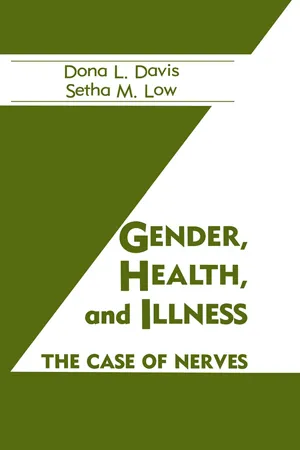
Gender, Health And Illness
The Case Of Nerves
- 175 pages
- English
- ePUB (mobile friendly)
- Available on iOS & Android
eBook - ePub
About this book
This offers a varied perspective on the popular health/illness category of nerves. Relationships between gender and nerves are investigated in terms of biology and epidemiology, interpersonal and social relations, social construction of gender, affective and symbolic qualities of nerves.
Trusted by 375,005 students
Access to over 1.5 million titles for a fair monthly price.
Study more efficiently using our study tools.
Information
Subtopic
History & Theory in PsychologyIndex
PsychologySection III
The United States
Experience of Nervousness and Anxiety Disorders in Puerto Rican Women: Psychiatric and Ethnopsychological Perspectives

Department of Psychiatry, University of New Mexico
School of Medicine, Albuquerque, New Mexico
School of Medicine, Albuquerque, New Mexico
Analyses of case materials describe variations in the experiences of Puerto Rican women diagnosed as having an anxiety disorder, in treatment with mental health clinicians, physicians, or traditional healers. Their common complaints are examined as core symbolic elements in culturally patterned complexes of meanings focused around personal trauma, stressful life events, personal and social reactions, expectations about treatment, and the course of illness. Many of these women report themselves to be “nervous,” to be “sick from nerves,” or to have had an “ataque de nervios.” “Nervousness” is the base symbolic domain in Puerto Rico of what psychiatry labels “anxiety disorder,” although it is also a common complaint of many disorders. What “nervousness” means to patients/clients and their clinicians or healers is examined within the frames of multilayered popular and biomedical interpretations. The special difficulties of women in Puerto Rico are highlighted, and psychiatric and ethnopsychological (Spiritist) models of etiology and treatment are compared.
“Nerves are almost always physical.”
An espiritista, 1987
In a recent review of studies in culture and anxiety, Good and Kleinman (1985) observed that there are relatively few able to inform us about the full range of variations in the phenomenology of anxiety or the type of emotional distress classified as “anxiety disorders” by psychiatry. Among the questions these authors raise for future research the most interesting for clinicians are, “What is the relationship of different anxiety disorders to different styles of illness behavior and idioms of distress?” “Are there cross-cultural differences in the cognitive, affective, and communicative processes that contribute to the development and expression of anxiety disorders?” (Good & Kleinman, 1985, p. 323). My goal in writing this article is to contribute to the literature on cultural variations in the expression, course, and treatment of anxiety disorders, with a special focus on women. I record and analyze their and their clinicians’ descriptions of experiences of suffering, identified by mental health professionals as due to “anxiety disorders” and by Spiritist healers as variations on spirit-caused distress that include the popular illness complaint (sometimes referred to as a syndrome) of nervios or “nervousness” (see Garrison, 1977; Koss, 1975, 1977). By comparing cases seen by mental health professionals and Spiritist healers (a widespread traditional healing system in Puerto Rico), I have the advantage of teasing out both popular and professional variations on the cultural construction of a Western medical nosologic category of emotional disorder. I also describe some of the ways in which Puerto Rican culture structures situations and stresses for women that render them vulnerable to both severe “nervousness” and “anxiety.”
Material for this study was collected as part of the Therapist-Spiritist Project in Puerto Rico (see Koss, 1980, for a description of the project). Its goals were to foster a mutual understanding of biomedicine (particularly mental health/psychiatry) and of traditional healing among health professionals and Spiritist medium/healers. We carried out programs in three communities aimed at formalizing and structuring the interface between biomedical and popular healing systems in Puerto Rico and collected thousands of observations on how physicians, mental health workers, and Spiritist mediums worked with men and women who sought help with a variety of physical, emotional, and social problems. The case histories reported in this article were drawn from three opportunity samples: (a) recordings (video and audio) of all cases (990 women) seen over two 1-month periods by physicians, mental health professionals, and Spiritists who were core participants in the project’s seminars; (b) cases jointly reviewed by various groups of healers and health professionals at project sessions (also tape recorded); and (c) cases collected by interviewing three new patients or clients of all core participants.
Methodology
My general approach to this paper is that of semantic network analysis following Good and Delvecchio-Good (1982), who define it as “based on an understanding of meaning as configurations of semantic fields which link key public symbols both to primary social values and to personal affects” (p. 148). In a study reported elsewhere (Koss-Chioino, 1988), complaint profiles for six psychiatric higher rank categories, a “deferred diagnosis” category, and a nonpsychiatric (medical) category, were generated in a multivariate discriminant analysis of 770 cases of women seen by mental health professionals and physicians. The profiles are composed of frequent core complaints that are at the center of symbolic complexes made up of a number of personal/social meanings, stressful life events, interpersonal problems, somatic distress, failure in role expectations, and moral dilemmas (Good & Kleinman, 1985). Each complex significantly differs according to variations in a complaint profile typical of one type of experience of distress that corresponds to a psychiatric or medical category.
I describe the key symbolic domains reflected in cases of anxiety disorders of women who share common life events and stressful situations, such as the loss through death or abandonment of a loved person who gave them much-needed security, or marital dissolution.
Cases of Spiritist healers were also classified as anxiety disorders by discriminant analysis when the pattern of complaints would have led a mental health professional to diagnose that individual as suffering from that type of emotional distress. Both similar and distinctive complaints of Spiritist clients (as compared with therapist clients’ profiles) are accounted for in the descriptions of symbolic complexes. The base symbolic complex in anxiety disorders is “nervios/nervousness.” This complex is also found in affective disorders (major depression and dysthymia) as well as other psychiatric diagnostic categories, though not to the same extent.
Nerves and Anxiety in Women
To say that there are many reasons why women in Puerto Rico are anxious is only to repeat the dreary litany of their marital and family problems, as well as point to deep feelings of abandonment and the fear that they cannot “make it” alone. As described elsewhere, both men and women find Puerto Rico a difficult society to negotiate. Women find their lives especially full of problems because they so often lack a sense of personal power. Surprisingly, many middle class women abrogate the potential power they acquire, via a good salary or prestige gained in professional life, to significant male others. Their spouses or partners much more often feel empowered to make decisions that can disregard these womens’ achievements. The women described in this article who are patients or clients come largely from poorer social groups who lack education and opportunities to acquire personal power in whatever form. Their feelings of hopelessness over a personal future are often a realistic appraisal of the difficulties of trying to support themselves and their children without a partner’s help. This unhappy realism exacerbates attitudes of dependence associated with being a woman and seems to arouse even a fear of independence.
Given the indeterminancy of Puerto Rico’s political status and the continuing onslaught of cultural, social, and economic changes that typify its social life, it is no wonder that most Puerto Ricans have doubts and considerable difficulty applying themselves to future dreams or plans. Distress over social problems (such as teenage rebellion and substance abuse) aligns itself with the strains that poor, uneducated women already feel as a result of their predisposition to personal indeterminacy. The effect (and affect) of this dual source of stress is vividly illustrated by one of the Spiritist healers, Evangelina, who without prompting described herself as a “very nervous person,” “very tense physically,” and sometimes so “dizzy” that she “cannot walk.” Possessed of a very sensitive, intelligent nature, but only a fifth grade education, she worked for years at routine and often menial jobs in a tobacco factory. Evangelina reports that she suffered a series of ataques during this period. But one day something snapped and she felt she could “never again roll another cigar,” whatever happened. She suffered a prolonged illness that she describes as initiated by a crisis, an “ataque de nervios” (in her words), in which she felt her body weaken, and a “momento fugaz” (mental block). Evangelina succumbed to the crisis for almost 2 years, and was left without income or family members who cared about her. A childhood friend took care of her; she also began to develop as a medium.
Viewed from a psychiatric perspective, Evangelina suffers from “agoraphobia” (American Psychiatric Association [APA], 1987), initiated by “panic attacks.” She describes her condition as chronic “nervousness” that keeps her from leaving the house except on special occasions.
Further details of Evangelina’s story are given below. It is of considerable interest because she so well illustrates how one individual can simultaneously incorporate both patient and healer characteristics. “Nervios” (or nerviosidad, “nervousness”), the idiom of distress that she uses, is a very popular expression that identifies severe anxiety, but is also at the center of a network of associated complaints that incorporates references to somatic distress as well as interpersonal problems. The two terms, “nervousness” and “anxiety,” as descriptions of experience of emotional distress, are not commensurate. “Anxiety” as “intensive apprehension, fearfulness, or terror associated with feelings of impending doom” (APA, 1987), implies a distressful inner state or emotion, that if severe can manifest in disordered behavior causing distress to both sufferer and others. In contrast, “nervios” or “nervousness” simultaneously implicates body structure, a chaotic emotional state, many somatic complaints, and especially a sense of loss of control over one’s perception, behavior, and surroundings. As illustrated below, these idioms also connote feelings of bad treatment or rejection at the hands of family members, together with a sense of combined physical and social instability (see also Guarnaccia, de la Cancela, & Carillo, 1989; Guarnaccia & Farias, 1988). The remainder of this chapter explores the meanings nervousness has for women who complain of it and also the frequent core complaints that make up a network of meanings associated with the overlapping psychiatric concept of “anxiety” as disorder. As elsewhere (Koss-Chioino, 1988), I include descriptions of the ways each type of healer explains and diagnoses, locates the cause, and strategizes to treat illness centered either on severe anxiety or permutations of the condition of “nervousness.”
The Nature of Nervousness, Intranquility, and Ataques De Nervios
Perhaps through the popularization of early medical notions, some stemming from 16th and 17th century folk Spanish medicine, “nervousness” has become a general label for disordered emotions and behavior in Puerto Rico, as elsewhere. Without necessarily being associated with serious or chronic conditions of illness, “nerves” basically refers to temperament and to emotions that disturb and prevent “tranquility.” However, compared with other societies such as Costa Rica (Low, 1981, 1985), the pattern of meanings connoted by the term “nerves” and the particular conditions it refers to (or accounts for) have some unique features.
Taken together, “intranquility,” “nerves,” and “nervousness” vie with sleep disturb...
Table of contents
- Cover
- Half Title
- Title page
- Copyright Page
- Table of Contents
- Contributors
- Foreword
- Preface
- George Beard and Lydia Pinkham: Gender, Class, and Nerves in Late 19th Century America
- Section I: Latin America
- Section II: Mediterranean and Northern Europe
- Section III: The United States
- Index
Frequently asked questions
Yes, you can cancel anytime from the Subscription tab in your account settings on the Perlego website. Your subscription will stay active until the end of your current billing period. Learn how to cancel your subscription
No, books cannot be downloaded as external files, such as PDFs, for use outside of Perlego. However, you can download books within the Perlego app for offline reading on mobile or tablet. Learn how to download books offline
Perlego offers two plans: Essential and Complete
- Essential is ideal for learners and professionals who enjoy exploring a wide range of subjects. Access the Essential Library with 800,000+ trusted titles and best-sellers across business, personal growth, and the humanities. Includes unlimited reading time and Standard Read Aloud voice.
- Complete: Perfect for advanced learners and researchers needing full, unrestricted access. Unlock 1.5M+ books across hundreds of subjects, including academic and specialized titles. The Complete Plan also includes advanced features like Premium Read Aloud and Research Assistant.
We are an online textbook subscription service, where you can get access to an entire online library for less than the price of a single book per month. With over 1.5 million books across 990+ topics, we’ve got you covered! Learn about our mission
Look out for the read-aloud symbol on your next book to see if you can listen to it. The read-aloud tool reads text aloud for you, highlighting the text as it is being read. You can pause it, speed it up and slow it down. Learn more about Read Aloud
Yes! You can use the Perlego app on both iOS and Android devices to read anytime, anywhere — even offline. Perfect for commutes or when you’re on the go.
Please note we cannot support devices running on iOS 13 and Android 7 or earlier. Learn more about using the app
Please note we cannot support devices running on iOS 13 and Android 7 or earlier. Learn more about using the app
Yes, you can access Gender, Health And Illness by Dona L. Davis, Setha M. Low, Dona L. Davis,Setha M. Low in PDF and/or ePUB format, as well as other popular books in Psychology & History & Theory in Psychology. We have over 1.5 million books available in our catalogue for you to explore.