- 136 pages
- English
- ePUB (mobile friendly)
- Available on iOS & Android
eBook - ePub
About this book
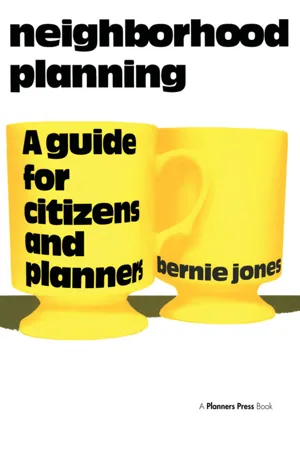
First published in 1990. Routledge is an imprint of Taylor & Francis, an informa company. This guide explains neighborhood planning for both citizens and professionals. It explains what information to collect, where to get it, and how to assess it; how to pinpoint key issues, set clear goals, and devise strategies to achieve them; and how to package, implement, and update the final plan. Although this book could be used by citizens working alone, Jones advocates a team approach—citizens and professionals planning together. He highlights which tasks are best suited to the professional and how the planner should manage his role as intermediary between the city administration and residents. Jones also takes a detailed look at the neighborhood plan itself. Numerous maps illustrate how to inventory environmental features, land uses, circulation systems, and design features.
Information
Chapter
1
An Introduction to Neighborhood Planning
The City's Planning Process
Reasons for Planning
Planning is nothing more than systematically thinking through a situation in order to come up with a better decision. In our everyday lives, each of us engages in various instances of planning: deciding how we need to look as we select our clothes, determining how to avoid a rush-hour traffic jam, selecting where to take a vacation, or calculating how to be financially ready for retirement. A city, being far more complex than any one of us, also needs to engage in planning so that it can accommodate the needs and wishes of its residents for housing, schools, parks, roads, stores, offices, social services, garbage collection, water, and so on. Planners work not only in city planning offices, but in public works, parks and recreation, budgeting, social service, and other city hall agencies.
Planning has become a basic city function in all but the smallest communities.1 Those of you who have been professional planners for any length of time have undoubtedly seen your ranks grow as planning has become a taken-for-granted activity in our cities. Planning is needed (at least) on the basis of order, empowerment, economy, and the environment.
Planning goes on all the time in our cities as individual persons, institutions, corporations, and governments make decisions. Many of those decisions (to put a new awning on my storefront, to resod my lawn, to change the route of the garbage truck) are small and do not add up to much. Others are larger ones: closing a store, building a new school, changing the street pattern. If these kinds of decisions are not coordinated, even though they may meet the needs of the party making the decision, they may not be in the general public interest. The world is made up of interconnected people, places, and spaces, and the actions of one affect others. Thus, in an effort to bring some order into the world, we plan.
Increasingly in our society, there are entities whose decisions are anything but small. A decision by a real estate developer to construct a 300 unit residential complex can radically alter a neighborhood, as can the decision by a school board to close down the elementary school, or the decision of a multinational corporation to close/open/expand a factory near your neighborhood. If residents are to have any impact on their surroundings, they need to develop a plan for its future, rather than trusting that their interests will be taken into account and protected by those various large decisionmakers. If residents wish to be empowered, they need to act in the systematic fashion that characterizes planning.
Planning can pave the way for the most efficient use of the scarce resources of our cities. Through planning, we can identify the highest priorities to which we'll direct our resources. We can devise alternative, and maybe less costly, ways to address some problem. We can mount projects that meet several needs at once, thus ''killing two birds with one stone." We can pinpoint purchases that can be made at today's lower prices to meet future needs. In other words, planning can bring a measure of economy to public decisionmaking.
Finally, our fragile environment demands that we plan. Natural resources are not so inexhaustible that we can afford to be wasteful with land, water, or clean air. And the natural environment is not so resilient that we can disregard how human activities affect the land, the water, and the air.
So, for all those and probably many other reasons, cities engage in planning. My defense of planning should not be taken as a defense for those who would abuse and have abused planning by doing it in an elitist way, a way that excludes citizens from participation, a way that is secretive, or a way that uses planning as a way to oppress people. This kind of planning does go on and is to be condemned. But its existence should not be used to condemn all planning.
Kinds of City Plans
City planners (either hired staff or consultants retained by the city) prepare various forms of plans. First is the comprehensive or master plan, which is a broad brushstroke kind of plan. It usually takes the form of a series of interrelated policy statements, with some maps showing areas of generally preferred uses. The comp plan will address such topics as land use, housing, transportation, economy, culture, utilities, services, parks, and neighborhoods. What the comp plan says about neighborhoods will generally be at a rather general level, because the city's neighborhoods are all so different.
A second kind of plan some cities draft is a more detailed plan for some functional area, such as housing, human services, capital improvements, or for some city-owned facility, such as parks or health facilities. In fact, to qualify for certain federal housing programs, a city will often be required to complete a housing assistance plan. This kind of plan may make reference to specific neighborhoods, where a certain kind of public action is needed, such as housing rehabilitation or storm sewer construction.
Increasingly cities are engaging in social planning, to address such issues as homelessness, hunger, cultural arts, and the like. Again, references to neighborhoods in this third type of plan will either be very general or aimed at a few specific neighborhoods.
Fourth, cities engage in small area or subarea planning, which means a plan for some area less than the entire city. Two chief examples are plans for downtown areas and neighborhood plans.
So, the neighborhood plan, though a relatively recent arrival on the scene, is nothing very different than the other varieties of plans cities produce. It just deals with a smaller geographic area and rounds out the picture of what forms of planning are needed: from the comprehensive plan to the neighborhood plan, from the physical plan to the social plan.
The Citywide Neighborhood Conservation Plan
The Need
Rare is the city that has a citywide plan for the conservation of neighborhoods, although they may have conservation plans for particular neighborhoods and a citywide comprehensive plan. A citywide neighborhood conservation plan is something different. Such a plan is needed for a number of reasons. It provides a framework within which each specific neighborhood plan fits. The citywide neighborhood conservation plan identifies the different neighborhoods and categorizes them. It recognizes the individuality of each neighborhood in the city and its value as part of the mosaic that is the city. Looking at the city as a mosaic, a citywide neighborhood conservation plan states how neighborhoods relate to each other and to citywide uses and areas.
Any neighborhood in a city faces some issue that warrants conservation efforts to be sure the neighborhood does not start to decline. When neighborhood decline occurs, those problems sometimes spill over to adjacent neighborhoods. Thus, neighborhoods whose problems are left unattended may adversely affect adjacent areas. Public officials need to know how the problems in a given area and actions proposed for that area or requests made by that neighborhood might affect other neighborhoods. The identification of the neighborhood mosaic in a citywide neighborhood conservation plan, therefore, can represent a very valuable document. Why we do not see more such plans is anyone's guess. One city that does have a citywide neighborhood conservation plan is Cheyenne, Wyoming, and some of this section is based on that plan,
Contents
A citywide neighborhood conservation plan is different from the comprehensive plan or separate neighborhood plan. It is at a finer scale (i.e., more detailed) than a normal comprehensive plan; it focuses strictly on the issue of livability; it doesn't address some citywide or central business district issues. A comprehensive plan is at a broad brushstroke policy level and identifies areas for general types of uses. It does not usually say much about neighborhoods except at a very general level. The contents of a citywide neighborhood conservation plan would include:
- definition of each neighborhood and its agreed-on boundaries.
- identification, for each neighborhood, of what should be . . .preservedaddedremovedkept out.
- identification of the agents (implementers) of conservation and their respective tasks.
- identification of conservation tasks by types of neighborhoods (neighborhoods can be categorized by the type of conservation work they require),
- steps for implementation.
- process for evaluation of the plan.
If such a plan is available for a city, the task of doing specific neighborhood plans is then greatly eased because some of the necessary analysis and thinking about needed actions has already been accomplished. Conversely, as a separate neighborhood plan is finished, it provides useful information to help modify the citywide neighborhood conservation plan.
Agents of Neighborhood Conservation
The key agents of conservation are neighborhood organizations, public officials, and developers; others might include schools, businesses, and social agencies. Identifying these parties as agents of neighborhood conservation is not to say that they always act in the best interests of neighborhoods.
Neighborhood organizations act as a stabilizing force in a neighborhood by bringing people together to address problems. Those organizations provide a repository or memory of what has gone on so the cumulative impacts of many small changes made over time can be detected. Neighborhood organizations offer a forum where pressing issues can be discussed. They give an identifiable spokesperson or contact point for those outside the neighborhood. Organizations tend to be more thoughtful than individual residents. Finally, once they are recognized and seen as legitimate, such organizations tend to act even more reasonably. Some planning officials may read this with great doubt, and, based on some past experiences, that doubt may be justified. The point being made here is that when neighborhood organizations are looked on as a full partner in the planning process, they do act as responsibly as any other entity in the city.
Public officials constitute agents of neighborhood conservation, because they are charged with looking at the larger picture of what occurs in a city even as many small changes go on within various sections of the city. Their role is to state publicly accepted principles, based on constituents' values, and make decisions. They bring technical expertise to the neighborhood. Last, they represent the citywide institutional memory. Some citizens reading this may react with skepticism as well! Again, start with a positive picture of the city officials and hold their feet to the fire should they veer away from their responsibilities toward the city's neighborhoods.
Developers can be agents of neighborhood conservation because they are bearers of resources to provide things the neighborhood may need, thus increasing the area's economic base. They trigger change in a neighborhood by forcing a healthy questioning of what has been taken for granted.
Other agents of neighborhood conservation, such as schools, businesses, and social agencies, by the resources they possess and the services they offer, help create the quality of life of a neighborhood.
The Nature of a Neighborhood Plan
Neighborhood plans are sets of recommendations about how to improve a given area of a city. They are based on an analysis of a large amount of data collected about that area and generally represent the consensus among those stakeholders (residents and others) who have participated in drafting the plan. A professional planner, employed by the city, usually guides a neighborhood through the preparation of its plan, but as we are now seeing, residents often do the job on their own. The plan's recommendations are usually in two forms: written statements about some actions that should be taken and maps of the conditions the plan is designed to achieve. Just because a plan has been drafted, however, does not guarantee that any of the recommendations will be implemented: its contents are just that—recommendations. (Later parts of this guide will discuss how plans tend to get implemented.)
In most cities, there is a master or comprehensive plan to guide overall development of the city. Neighborhood plans are usually drafted in such a way as to be consistent (or at least not inconsistent) with the comprehensive plan and are often officially adopted as amendments to the comp plan. It is also possible to reverse that process, first drafting the neighborhood plans, and then combining them together into the comp plan. However, this approach is not the one usually taken.
Reasons for Doing a Neighborhood Plan
Neighborhood plans are usually completed for a number of interrelated reasons. Such documents provide a guide for future development of the area since, if prepared correctly, they represent articulated shared visions about the future. At the same time, they identify tasks that need to be carried out to improve the area. Neighborhood plans get implemented, in fact, only if residents, with assistance from their neighborhood planner, systematically work to get the plan's recommendations acted on by the appropriate parties. Because the plan's recommendations are based on information systematically collected, they offer good support for positions that the neighborhood may wish to take on specific proposed changes. When a project is proposed that is inconsistent with the neighborhood plan, pointing out that inconsistency to city council, the planning board, or whomever, gives some weight to the residents' argument. In addition, that information can be used to justify requests or proposals made to the city (or to other funding sources) for services or funds. Sometimes, in fact, a particular funding source will not grant a request unless there is a neighborhood plan in place. These are the usual intended uses of a neighborhood plan.
In addition, there are likely to be side benefits, depending on how the planning work is done. Those might include increased citizen involvement, the development of leadership among the residents, and an increase in knowledge about and commitment to the neighborhood. All these can be collectively referred to as community development. These side benefits come about only if the planning process has been one that actively involves residents. For a neighborhood without an existing organization, the drafting of a plan can be the genesis of an organization as residents come together for the first time, learn more about each other and their neighborhood, and start developing a common vision about what they want it to be like. Working with planning students a few years ago, I saw that happen as our team assembled residents in an area without any prior organization. By the end of the semester, there were the beginnings of a viable organization, which I am happy to say is still alive at last report.
Researchers William Rohe and Lauren Gates (1985) have shown that compared to traditional planning approaches, neighborhood planning programs generally are more responsive to local characteristics, desires, and problems; may get more people involved in planning activities; generally result in more physical improvements actually being made; help strengthen communities through the increased interaction for those people involved in the plan; help leaders become more involved in citywide affairs; often lead to a fairer distribution of public resources; and may increase citizen access to and trust of local government. Sounds almost like a magic elixir, does it not? Note the qualifiers such as "generally" and "may." Still, neighborhood planning brings local government closer to people, if people insist on it and take advantage of it! That is a two-way street: the city has to take steps to foster neighborhood plannin...
Table of contents
- Cover
- Half Title
- Title
- Copyright
- Acknowledgments
- Contents
- Illustrations
- A Word of Inspiration
- How to Use This Guide
- 1. An Introduction to Neighborhood Planning
- The Citywide Neighborhood Conservation Plan
- The Nature of a Neighborhood Plan
- Reasons for Doing a Neighborhood Plan
- Defining Your Neighborhood
- 2. Democratic Neighborhood Planning
- 3. The Substance of the Plan
- 4. After the Planning
- Appendix A Computers in Neighborhood Planning
- Appendix Β Citizen Survey
- Appendix C Goal-Setting Exercise
- References
- Index
Trusted by 375,005 students
Access to over 1.5 million titles for a fair monthly price.
Study more efficiently using our study tools.
Frequently asked questions
Yes, you can cancel anytime from the Subscription tab in your account settings on the Perlego website. Your subscription will stay active until the end of your current billing period. Learn how to cancel your subscription
No, books cannot be downloaded as external files, such as PDFs, for use outside of Perlego. However, you can download books within the Perlego app for offline reading on mobile or tablet. Learn how to download books offline
We are an online textbook subscription service, where you can get access to an entire online library for less than the price of a single book per month. With over 1.5 million books across 990+ topics, we’ve got you covered! Learn about our mission
Look out for the read-aloud symbol on your next book to see if you can listen to it. The read-aloud tool reads text aloud for you, highlighting the text as it is being read. You can pause it, speed it up and slow it down. Learn more about Read Aloud
Yes! You can use the Perlego app on both iOS and Android devices to read anytime, anywhere — even offline. Perfect for commutes or when you’re on the go.
Please note we cannot support devices running on iOS 13 and Android 7 or earlier. Learn more about using the app
Please note we cannot support devices running on iOS 13 and Android 7 or earlier. Learn more about using the app
Yes, you can access Neighborhood Planning by Bernie Jones in PDF and/or ePUB format, as well as other popular books in Politique et relations internationales & Aménagement urbain et paysager. We have over 1.5 million books available in our catalogue for you to explore.