- 210 pages
- English
- ePUB (mobile friendly)
- Available on iOS & Android
eBook - ePub
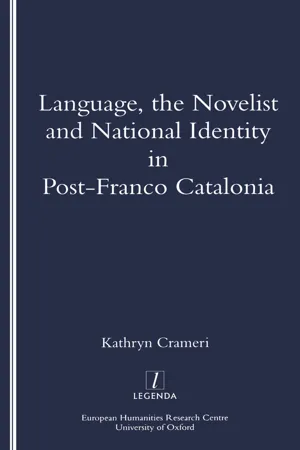
Language, the Novelist and National Identity in Post-Franco Catalonia
About this book
"Kathryn Crameri reveals some of the complex responses of writers and literary critics to the new possibilities for the expression of Catalan identities which resulted from Spain's transition from dictatorship to democracy. The study begins by considering the cultural and political context of the Catalan novel from the 'Renaixenca' to the present day, and then offers a detailed analysis of novels by four very different writers - Montserrat Roig, Manuel de Pedrolo, Juan Marse (who writes in Spanish) and Biel Mesquida - all of whom seem to share an underlying thematic preoccupation with both individual and national 'transitions' and the intricate relationship between language and identity. These writers challenge institutionalised visions of the link between Catalanism, the Catalan language and Catalan literature, and offer a more pluralistic and personalised version of what it is to call oneself a Catalan."
Trusted by 375,005 students
Access to over 1.5 million titles for a fair monthly price.
Study more efficiently using our study tools.
Information
Chapter 1
Catalanisme Literari
According to Joan Fuster, there came a point in Catalonia's modern history beyond which 'Llengua, literatura i catalanisme semblen identificar-se per sempre més'.1 From the second quarter of the nineteenth century until the end of that century, literature in Catalan struggled to re-establish itself as a legitimate cultural form. By the time it had done so, the equation of 'language, literature and Catalanism' was firmly fixed at the heart of Catalan identity.
It is therefore my intention in this chapter to examine the role which literature has played within modern Catalanism.2 The chapter is divided into two main sections: first, a discussion of the importance of Catalan-language literature to political Catalanism in the nineteenth and early twentieth centuries, and secondly an examination of how the dictatorship of Franco affected the relationship between the two. The aim of this is twofold: to establish the reasons for the equation of literature with Catalanism, and to show how Catalan literature has been politicized as a result. This will then pave the way for subsequent discussions of similar phenomena during the Transition.
From ‘Rebirth’ to Exile: 1800—1939
The revival of Catalan-language literature in the nineteenth century has long been seen as central to the beginnings of political Catalanism. In the Middle Ages, Catalan was extensively used for literature, troubadour poetry, and legal, historical and philosophical writings, among other things. After the union of the Kingdoms of Aragon and Castile, Catalan slowly lost credibility as a literary language, mainly because the language of the Court (and, later, of official documents and interactions with the authorities) was Castilian. By the nineteenth century there was a widespread perception, especially among sections of the upper and middle classes, that the Catalan language was fit for use only in everyday settings: as a family, social or workplace language, or in church. The use of Castilian had come to be seen as more elegant and refined.
The fact that Castilian was supposed to be the only language of official communication in the early 1800s might lead to the erroneous conclusion that the Castilian language was dominant in the region at that point. However, in a recent study of the use of Catalan in the nineteenth century, Pere Anguera has shown that in fact Catalan was still the main language of the majority of Catalans, to the extent that many Catalans did not understand Castilian at all and even those who had been educated in it often spoke or wrote it badly.3 As a result of this basic ignorance of Castilian, Anguera argues, certain written interactions in which Catalan was supposed to have given way to Castilian were actually still being conducted mainly in Catalan, for purely practical reasons. These included 'la redacció majoritàriament en català d'actes municipals fins als volts de 1808, dels papers gremials pràcticament fins a la desaparició dels gremis, de les escriptures notarials fins a la llei de 1862 o dels llibres sacramentals fins a la mateixa dècada' (p. 11). The Catalan language could not be ignored because it was the only way of communicating with a large percentage of the population.
So, in the first half of the nineteenth century, Catalan was very much alive as a language, if limited in its spheres of use. According to Anguera, it was being widely used in popular cultural forms related to 'la barrila i la devoció popular', and he even cites the example of a translation of the New Testament into Catalan printed in 1836 which sold 600 copies in five days (at which point further copies were impounded by the authorities) (p. 132). Its use in modern 'high' literary forms, however, had seemed an odd idea until it was given a (now mythical) boost by Bonaventura Carles Aribau's poem 'Oda a la Pàtria' of 1833. It is easy to exaggerate the impact of this one poem on the revival of Catalan literature, but it has at least become a symbolic starting point for the Renaixença: the name given to the revival of Catalan language and culture in the mid-1800s, which preceded political Catalanism. As Daniele Conversi points out, the Catalan poetry of Joaquim Rubió i Ors had a much greater practical impact than Aribau, in that he published far more and made an explicit plea for the revival of Catalan-language literature.4 In short, Aribau and Rubió i Ors had shown that writing poetry in Catalan was not such an absurd idea; besides, the influences of Neo-Classicism and Romanticism encouraged intellectuals to explore Catalonia's past and paved the way for a renewal of interest in what it meant to be Catalan. As Albert Balcells says, 'No one disputes the role of the Renaixença [...] in creating the atmosphere in which Catalan nationalism was to be born.'5
The next mythical date in the revival of Catalan literature is 1859, the year that the first modern Jocs Florals (Catalan poetry competitions) were held. Both Pere Anguera and Joan-Lluís Marfany are scathing about the quality of the poetry involved: Anguera calls the poems 'mediocres i carrinclons' (p. 189), while Marfany lambasts Catalanists' literary efforts in general: 'La qualitat de tot això era en general infecta i no hi ajudava en absolut la disposició d'entusiasme vital permanent [...] que tendia a traduir-se, a l'hora de l'escriptura, en una verborrea incontenible' (p. 276). However, quality was not the issue: it was the fact of writing in Catalan and gathering together in groups to read and admire each other's work which was important as a catalyst for Catalanism. Also, this mediocre output was actually the amniotic fluid out of which were born the likes of Jacint Verdaguer, Àngel Guimerà and Narcís Oiler, whose literary credentials are of course a great deal more respectable, and who have become emblematic of the maturation of Catalan literature towards the end of the nineteenth century.6 Between them they represent not only poetry (Verdaguer), which as we have seen was the main literary activity of Catalanist 'lletraferits', but also theatre (Guimerà) and narrative (Oller). Their success paved the way for subsequent writers, who had been brought up in an atmosphere of Catalanism and had the benefit of examples which showed that Catalan was a legitimate literary language, for any genre.
As Anguera points out, the renewed interest in Catalan by intellectuals in the mid-1800s was paradoxical, both because it took off so quickly after the symbolic watershed of 1833 (before which few people cared whether or not Catalan could be used for literature), and because it came at a time when the institutional repression of Catalan was increasing rather than decreasing (p. 183). He resolves this paradox by arguing that it was precisely the renewed repression which sparked greater interest in the language:
Durant temps l'Estat tampoc tingué una voluntat excessiva de castellanitzar la vida quotidiana: en tenia prou amb descatalanitzar l'oficial. Ara bé, a mesura que avança el segle XIX, l'estat centralista agafa un progressiu afany d'esdevenir homogeni, d'igualar en tot i pertot, inclosa la llengua de relació habitual, el seus súbdits. Si davant la primera situació n'hi havia prou amb mantenir-se fidel al català, i la gent s'hi mantenia, en entrar a la segona cal emprendre mesures de resistència, i si se'm permet continuar amb el símil bel·licista, d'atac contra la voluntat de substitució lingüística. (p. 12)
This argument is logical. Thanks to prevailing literary trends and a couple of trail-blazing examples, an influential group of Catalan intellectuals had come to identify their authochthonous language as a crucial part of their collective identity, and furthermore they no longer had to feel ashamed of its 'provincial' dimension, because if it was respectable enough to use for poetry then it was respectable enough for anything. If centralizing policies then threatened their language, this was also a threat to their collective identity.
There were two main ways in which this threat could be fought. Firstly, the use of Catalan could be encouraged and stimulated; secondly, political channels could be used for protests and counter-demands. Both of these methods were used increasingly, the first from about 1860 onwards, and the second from roughly 1880. Cultural Catalanism gave a basis upon which political Catalanism could be founded, because its main task was the definition of Catalan identity, which then gave rise to a political project for the defence and promotion of that identity.7 (The motivations which attracted different Catalanists to the cause were, of course, various; for example, perceived economic disadvantage as a result of central government attitudes was a potent factor in stimulating political Catalanism amongst the bourgeoisie.) Once Catalanism had become politicized, cultural and linguistic matters became part of political demands and doctrines. For example, a motion which stated that Catalan should have co-officiality with Castilian was passed by the Second Catalanist Congress of the Centre Català in 1883, and by the time of the Bases de Manresa of 1892 (a major Catalanist meeting with subsequent written proposals directed at the Spanish government), this document's authors were daring to suggest that Catalan should be the only official language of the region.8
The issue of the survival of the Catalan language was therefore a cornerstone of both cultural and political Catalanism. One way of improving its chances of survival was, as we have seen, to promote its use in 'high' cultural forms, but equally, as Joan Fuster quite rightly says, 'en una llengua condemnada a l'extinció, qualsevol projecte literari perdria sentit.'9 The only way of resolving this paradox, or 'l'únic recurs Salvador, previsible' as Fuster puts it, was through political manoeuvres designed to safeguard the language. The identification of literary and linguistic survival with politics then exposed both language and literature to even greater threat: 'El catalanisme considerat sediciós, l'Estat no sabrà combatre'l sense atacar alhora la llengua i, per tant, la literatura' (p. 13). Ironically, the result of this attack was to reinforce rather than to weaken the bond between language, literature and Catalanism. Once Catalanist political pressure had become too great for the central government to bear (especially considering the large number of other problems it was facing at the turn of the century), certain limited concessions to Catalanism were granted. The most important of these was the establishment of the Mancomunitat, an amalgamation of the four provincial deputations of Catalonia in certain areas of their jurisdiction. Enric Prat de la Riba, author of the seminal Catalanist text La nacionalitat catalana (1906), was its first President, and one of its main aims was the protection and promotion of Catalan culture, especially through education.
By this stage, literature in Catalan had become, as Anguera puts it, 'força normalitzada' (p. 181). Two major literary movements had followed the Renaixença: Modernisme (roughly 1882–1906) and then Noucentisme.10 Politically conscious, and often progressive liberals, yet still directing their work towards a bourgeois audience, the members of the Catalan Modernista movement sought to reinvigorate art and literature through removing all constraints and searching freely for newness and dynamism. The Modernists' aim was to create a culture which could compete with any of Catalonia's neighbours by combining nationalist feelings with European influences. Noucentisme was a reaction against Modernisme, seeking order and discipline, and, if anything, moving towards the opposite political extreme—reactionary conservatism. Noucentisme was also deeply concerned with the revitalization of the language, culture and identity of the Catalan people.11 It was this combination of ideas which produced the first proper Catalan dictionary and grammar—the result of the attempts of Eugeni d'Ors and Pompeu Fabra to standardize the language. The movement also completed the process of Europeanizing Catalan culture. Apart from some difficult times under Primo de Rivera, and despite continuing struggles to promote and stabilize the Catalan language, writing in Catalan was a surprisingly 'normal' activity in the first third of the twentieth century, until banned by Franco.
‘Fer Art’ = ‘Fer Pàtria’
So far, I have concentrated on one aspect of the process by which literature came to be linked with political Catalanism: the belief that by saving the Catalan language one could also save the nation. However, there is another related but separate motivation behind the link which helps to explain the great emphasis placed on literature during the history of Catalan nationalism. To understand this link, we need to begin once again at the beginning, with the Renaixença, and the Catalan language.
In its theoretical form, Catalanism has always been profoundly influenced by the thinking of J. G. Herder (1744–1803). For Herder, the mother-tongue of a nation was the only legitimate means of expression for the national soul and character, and its literature was therefore also vital; he perceived an organic relationship between language, literature and nationality. His equation of 'language–literature–nationality' parallels the Renaixetiça's 'language–literature–Catalanism' equation which has already been discussed, and which of course refers to the politicized version of Catalan nationality, Catalanism. Herders philosophies were useful in justifying the move towards political Catalanism, since they postulated a concept of nationality based on natural justice and organic continuity. If the existence of the nation was natural, then surely the defence of that nation was right and proper.
Herder's influence seems to have been felt within Catalanism throughout the period 1833–1939. Montserrat Reguant traces Herder's (and Fichte's) ideas on nationality in Aribau's Oda a la Pàtria, suggesting that they had a direct influence on the way Aribau chose to depict his country and its essential nature.12 Herder's presence in Prat de la Riba's La nacionalitat catalana is even more explicit, since he quotes Herder directly and also expresses admiration for him: 'La individualitat de les nacions surt de vivíssim relleu en les obres dels pensadors d'aquell sigle [XVIII], sobretot en les de l'home de les grans intuicions, Herder' (p. 47). On the subject of language, Prat de la Riba reproduces ideas such as these (one apparently a direct translation and the other a paraphrase):
'Una lletigua—deia el H...
Table of contents
- Cover
- Half Title
- Title
- Copyright
- Contents
- Acknowledgements
- List of Abbreviations
- Introduction
- 1 Catalanisme Literari
- 2 Catalonia during the Transition
- 3 The Politicization of Literary Issues, 1970-1990
- 4 Manuel de Pedrolo: Tales of the Mother Country
- 5 Biel Mesquida: The Act of Expression as a Force for Decolonization
- 6 Montserrat Roig and Juan Marsé: Storytelling and the Collective Memory
- 7 Epilogue: El amante bilingüe
- Conclusion
- Bibliography
- Index
Frequently asked questions
Yes, you can cancel anytime from the Subscription tab in your account settings on the Perlego website. Your subscription will stay active until the end of your current billing period. Learn how to cancel your subscription
No, books cannot be downloaded as external files, such as PDFs, for use outside of Perlego. However, you can download books within the Perlego app for offline reading on mobile or tablet. Learn how to download books offline
Perlego offers two plans: Essential and Complete
- Essential is ideal for learners and professionals who enjoy exploring a wide range of subjects. Access the Essential Library with 800,000+ trusted titles and best-sellers across business, personal growth, and the humanities. Includes unlimited reading time and Standard Read Aloud voice.
- Complete: Perfect for advanced learners and researchers needing full, unrestricted access. Unlock 1.5M+ books across hundreds of subjects, including academic and specialized titles. The Complete Plan also includes advanced features like Premium Read Aloud and Research Assistant.
We are an online textbook subscription service, where you can get access to an entire online library for less than the price of a single book per month. With over 1.5 million books across 990+ topics, we’ve got you covered! Learn about our mission
Look out for the read-aloud symbol on your next book to see if you can listen to it. The read-aloud tool reads text aloud for you, highlighting the text as it is being read. You can pause it, speed it up and slow it down. Learn more about Read Aloud
Yes! You can use the Perlego app on both iOS and Android devices to read anytime, anywhere — even offline. Perfect for commutes or when you’re on the go.
Please note we cannot support devices running on iOS 13 and Android 7 or earlier. Learn more about using the app
Please note we cannot support devices running on iOS 13 and Android 7 or earlier. Learn more about using the app
Yes, you can access Language, the Novelist and National Identity in Post-Franco Catalonia by Kathryn Crameri in PDF and/or ePUB format, as well as other popular books in Languages & Linguistics & Linguistics. We have over 1.5 million books available in our catalogue for you to explore.