The major goal of this book is to explore and integrate all that is scientifically known about the utility of magical plans and strategies for coping with life's inevitable absurdities. Make-believe has great adaptive value and helps the average individual to function better in cultures saturated with puzzling contradictions. This book traces the origins of pretending (illusion-construction) and the developmental phases of this skill. Further, it analyzes how parents depend on pretending to secure conformity and self-control from their children. It unravels the ways in which make-believe is utilized to defend against death-anxiety and feelings of fragility. It examines the relationship between pretending and the classical defense mechanisms -- and particularly weighs the evidence bearing on the potential protective power of embracing religious beliefs. Finally, it defines the diverse contributions of make-believe to the construction of the self-concept, the defensive maneuvers typifying psychopathology, and the maintenance of somatic health. In short, this book pulls together a spectrum of scientific information concerning the defensive value of illusory make-believe in coping with those aspects of life -- such as death, loss, suffering, and injustice -- that are experienced as unreasonable and beyond understanding.
The volume is unique not only in the breadth of the literature it analyzes but also in demonstrating the contribution of make-believe to both the psychological and somatic aspects of behavior. No previous work has documented in such detail and across so many domains how basic the capacity to engage in make-believe is to human adaptation.
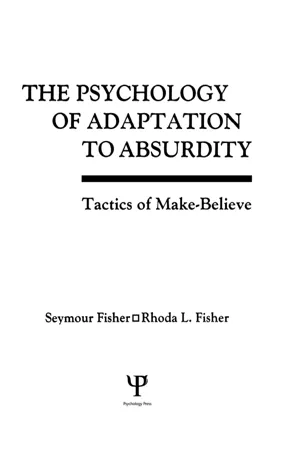
eBook - ePub
The Psychology of Adaptation To Absurdity
Tactics of Make-believe
- 248 pages
- English
- ePUB (mobile friendly)
- Available on iOS & Android
eBook - ePub
The Psychology of Adaptation To Absurdity
Tactics of Make-believe
About this book
Information
Publisher
Psychology PressYear
2014Print ISBN
9781138876309
9780805812053
Edition
1eBook ISBN
9781317781998
CHAPTER
1
WHAT TO DO ABOUT ABSURDITY?
The comedians of the world have known from the beginning that the conditions of human existence, if viewed directly and rationally, appear somewhat absurd. In an earlier book (Fisher & Fisher, 1981), we studied a variety of comedians and clowns by means of interviews and formal psychological tests and learned a good deal about their personal conflicts and comedic strategies. One of the points that particularly impressed us about these people, who are so dedicated to being funny, is that they forever feel called upon to shield people from the threats and forebodings typifying modal life on this planet. As the result of early transactions with their parents they feel obligated to soothe others and to interpose themselves against the bad things “out there.” They are weighted down by a poignant sense of duty to help those who come asking for the antidote provided by humor against human misfortune.
It is apropos in this respect that the early court jesters were assigned the role of protecting the king against the chaotic and uncontrolled forces in the universe. The jesters were considered to be qualified for such a role because their foolish strangeness and deviance intimated they were in contact with, and could potentially influence, analogous outlandish phenomena. Paradoxically, even as the funny ones soothe and protect, they also provoke. They go out of their way to conjure up images of threatening, forbidden stuff (variously relating to sex, death, anality, and hypocrisy). But each provocation is bathed in humor and the reassurance that there is nothing to fear from the threatening theme because it is, after all, only one more example of something ridiculous and absurd. The provocation functions in a fashion analogous to an injection of an attenuated virus intended to initiate the body’s manufacture of a proper antibody. Much of the power of comedians resides in the fact that they can infuse images of the world with the flavor of unreal absurdity. We (Fisher & Fisher, 1981) originally depicted comedians as “Einsteins of the moral world” who do not respect one set of rules or moral principles more than any other. They communicate to their audiences that nothing is sacred. They scorn convention. They repeatedly shift their perspectives on events. With one joke they belittle the radical and in the next they make fun of the conservative. They are loyal only to the novel and the paradoxical.
Comedians revel in their play with potentially universal nonsense. They dramatize this apparent nonsense and simultaneously tell us it is nothing to worry about. We have suggested further (Fisher & Fisher, 1981) that comics love to intimate that anything is possible. They dramatize the unpredictable nature of things. They tell people that they are involved with forces that inevitably will go off into unexpected trajectories. They conjure up images of a Dali-like landscape pervaded by the surrealistic. They know that stark surprise faces all of us. Their comedy leads one to expect novel intrusion by highlighting that customary and apparently dependable rules are illusory. Because they ridicule the very nature of logic, how is it possible to reason or control? Basically, comedians prepare their audiences for chaos and perhaps even persuade them that chaos can be fun.
It is an interesting paradox that although comics are sensitizing the audience to the unexpected they imply that they have control over it. Court jesters and similar funny fools had a special, although strange status, because it was widely believed that they were capable of defending against chaos. Modern comics, in their play with funny images and nonsensical unpredictability, also convey a sense of ease with the chaotic stuff. They are apparently relaxed and happy in the midst of this stuff. They imply that they can influence what will happen and that there is probably nothing to fear. They arouse anxiety about concealed dangers, but at the same time provide soothing reassurance.
In other words, comics stand before us as outstanding practitioners of absurd images. They tease us with the idea that life is silly and ridiculous. They mock us with the possibility that there is only absurdity. But more fundamentally, they seduce us with the illusory protective promises of humor. They even suggest that absurdity is preferable to worse things that exist.
We know (Fisher & Fisher, 1981) that just about all cultures have reserved a valued niche for clowns and other kinds of clever “fools” in one guise or another. The near universality of the comic role is intriguing. It is as if there is a need in most cultures to have people around who are experts at playing with the idea of absurdity: to propose it, retract it, and experiment with it in all sorts of creative ways. Relatedly, it is obvious that there is a widespread fascination in everyday life with nonsense and potential absurdity. As people interact, much “kidding” and joking prevail in which it is implied that what appears to be serious and important has little or no significance. Such kidding often iconoclastically implies too that certain basic value systems and beliefs are just plain silly. It is not unusual in the course of a joking exchange to challenge persons’ long-held beliefs about self and also about the solidity and meaningfulness of honored customs and institutions. People are forever titillating each other with the possibility that things are not what they appear to be, that there is the potential for reality to be turned upside down. In short, people keep alerting each other to consider that accepted world structures and values may be illusory. Solid meanings are humorously, cyclically, and repeatedly dissolved for a millisecond and then restored. Images highlighting the possibility that life is jumbled nonsense are featured in dreams, in The Theater of the Absurd (Esslin, 1961), in modern paintings, in schizophrenic imaginings, in the special context of children’s television cartoons, and so forth. Of course, an opposite trend is even more strongly present. Tremendous quantities of societal energy go into affirming that basic values, ideas, and institutions are sensibly sound. We see this in many aspects of the community’s educational apparatus, in the divinely reinforced pronouncements of the established religions, and in the confident urgings of parents.
Why are people so preoccupied with absurdity? Is it because they entertain secret doubts about whether their values, their beliefs, and even their very existence are meaningful? Does flirting with absurdity mirror persistent suspicions? Do we toy with absurdity as a way of preparing ourselves? That is, do we practice touching and tasting it with the hope that we can develop some expertise in coping with it as a chronically imminent event? As is well known, numerous observers (e.g., Frankl, 1955) have commented on what a struggle it is to make consistent sense of the whole process of living. Indeed, they have further suggested that unless individuals infiltrate their life perceptions with good solid self-protective illusions they become overwhelmed by the absurdity of it all. They argue that one can survive psychologically only by elaborate self-deceptions designed to put an acceptable face on what living is all about. Literary figures have been in the forefront of those urging the need for such illusory self-deception (e.g., Eugene O’Neill in The Iceman Cometh; Henrik Ibsen in The Wild Duck; Pirandello in Henry IV). Using a more empirical framework, Lazarus (1983) and others (e.g., Becker, 1973; Tiger, 1979) similarly hypothesized the need for defensive illusions to buffer life’s sheer toughness.
They picture humans as having to face up to the gnawing implications of being biologically anchored creatures inhabiting an astral speck and inevitably subject not only to illness but also death. No one has more vividly pictured the dilemma posed by existential threats than has Becker (1973):
Man is reluctant to move out into the overwhelmingness of his world, the real dangers of it; he shrinks back from losing himself in the all-consuming appetites of others, from spinning out of control in the clutchings and clawings of men, beasts, and machines. As an animal organism man senses the kind of planet he has been put on, the nightmarish, demonic frenzy of individual organismic appetites of all kinds—not to mention earthquakes, meteors, and hurricanes—Above all there is the danger of a slip-up, an accident, a chance disease, and of course death, the final sucking up, the total submergence and negation. (pp. 53–54)
Becker referred, in addition, to the illusory strategies people have to adopt in order to shut out the threat of the world:
Everything that man does in his symbolic world is an attempt to deny and overcome his grotesque fate. He literally drives himself into a blind obliviousness with social games, psychological tricks, personal preoccupations so far removed from the reality of his situation that there are forms of madness–agreed madness, shared madness, disguised and signified madness, but madness all the same. (p. 27)
Becker’s statement is theatrical in its intensity and well beyond the tone of scientific discourse. However, this intensity may have a useful function in alerting the theoreticians and practitioners of the social sciences that they have been grossly blind to the role of existential anxiety in human behavior. Scientific journals are crammed full of studies concerned with the mediating effects upon behavior of variables like family structure, socioeconomic status, ethnic background, intelligence, personality, and so forth. However, one rarely finds studies concerned with the impact on behavior of the fact that humans live on a tiny planet moving in an untracked endlessness. The sheer fragility of the human condition is largely dismissed, as if it were a mere background factor. There seems to have been reluctance to get seriously involved with such a potentially overwhelming theme. From a common sense perspective, it is hard to believe that persons are not shadowed by their cognitive maps of where they stand in the universe and how far along they are on the mortal line into the future. A detailed analysis of the empirical data bearing on these matters is presented later.
THE DISCOMFORT OF REALISM
Is there any scientific evidence that human psychological survival requires the creation of self-reassuring myths? Does a sense of safety or happiness require a lot of pretending and the Pollyannish shutting out of life’s negativities? Let us, by way of introduction to this matter, look at several sectors of relevant research.
One area that has been thoroughly reviewed by Watson and Clark (1984) relates to negative affectivity, which is a disposition to experience aversive emotional states. Multiple studies have shown that a whole variety of measures pertaining to psychological discomfort (e.g., trait anxiety, neuroticism, maladjustment) are highly intercorrelated and really refer to the same basic tendency to feel distress and discomfort over time, regardless of the situation and even when specific identifiable stress is absent. Some individuals go around feeling persistently distressed and others do not. Investigators have tried to identify basic factors that would distinguish such persons high and low in negative affectivity. Watson and Clark, after reviewing this research, concluded that those low in negative affectivity
are most content and satisfied with life and eschew the ruthless honesty of high-Negative Affectivity individuals, both with regard to self and others, in favor of smoothing over life’s rocky road. They focus on themselves less and, when they do, are more pleased with what they find, enabling them to maintain a better mood, a more favorable self-view, perhaps to the point of glossing over (repressing?) some harsh truths. (1984, p. 484)
There is actually evidence that persons high in negative affectivity are more accurate in some of their social perceptions than are persons low in this respect. For example, Kaplan (1968) reported that individuals high in negative affectivity are significantly more accurate in ratings of peers than are those in the low to middle negative affectivity category. The low negative affectivity group is depicted by Watson and Clark as more “defensive,” but “better adjusted.” Block (1965) concluded from a longitudinal study that persons low in negative affectivity handle “anxiety and conflicts by, in effect, refusing to recognize their presence” (pp. 100–101). The more defensive, denying style of individuals low in negative affectivity stands out, although it is difficult to boldly generalize that these individuals are, in most respects, lower in their level of realism. Overall, it is fair to say that they evidence a lower degree of psychological disturbance and a greater degree of “glossing over” and denial in some of life’s “harsh truths.” Watson and Clark (1984) analogously concluded that, “Insofar as high Negative Affectivity subjects are more focused on themselves and their feelings, they are more emotionally self-aware and honest with themselves. At the same time, however, they are highly distressed and poorly adjusted” (p. 481). What emerges is the simple tendency for an inverse relationship to exist between how happy and satisfied one feels and how open and nondefensive one is in witnessing life’s difficulties. Those persons who are distressed seem not to be sufficiently selective (excluding) in what they allow themselves to witness and make part of their awareness.
Relatedly, there is an even more extensive and somewhat startling body of research tying depression to enhanced realism. Incidentally, one finds an ever-increasing amount of preoccupation in the psychiatric and psychological literature with the phenomena of depression. Investigators seem to be uneasily impressed that so many people experience the blues; and they assiduously spin out explanations as to likely causes. Many of the prominent theorists (e.g., Beck, 1976; Seligman, 1975) portrayed depression as arising from distorted interpretations concerning the nature of the world. It has been proposed that depressed persons are caught up in basic disheartening biases, such as grossly underestimating their own ability to influence outcomes or unrealistically exaggerating the probability of unpleasant negative events. From this perspective, people are depressed because they have constructed a view of life that mistakenly exaggerates its down side. Indeed, there are numerous studies in the literature that, as one might expect, do demonstrate that depressed persons’ cognitions are more sad and unhappy than are those of nondepressives. Such observations and others of a related character suggest that depression derives from habitually and unrealistically expecting things to be more negative than they truly are. But note that some evidence has accumulated that depressed persons have actually had more unhappy childhoods and adult lives than nondepressives (e.g., Ilfeld, 1977; Lloyd, 1980). Thus, the pessimism of depressives could be regarded as just as realistic as the relative optimism of nondepressives who have had less discouraging experiences.
A variety of studies of depressive phenomena have accumulated that point to even more surprising contradictions concerning the presumed distorted perspective of the depressed individual. Researchers have come upon the fact that depressives are more realistic than nondepressives in a number of judgmental areas. A particularly novel illustration of this point involves the phenomenon of “illusion of control” described by Langer (1975). She observed that when persons are asked to perform tasks with only a chance probability of success, they succumb fairly easily to the illusion that they can exert personal powers that will produce better than chance results. For example, if they are asked to pull cards from a deck in an attempt to obtain higher cards than those of a competitor, most can, after relatively simple experimental manipulations, be persuaded that there is an element of personal influence governing the cards drawn. This illusion of control is, of course, widely evident in gambling behavior.
Alloy and Abramson (1979, 1982) demonstrated in clever experiments that depressed persons are less susceptible than nondepressed to such an illusion. In one instance (1979), subjects were given the impression that they could control whether a light would go on or off by either pressing or not pressing a button. A series of trials was run and the button-pressing process was manipulated so that only chance success was achieved. Subjects rated how much control they thought their button pressing gave them over the light. A variety of special conditions (e.g., degree of effective contingency) were introduced into the several experiments. The results indicated that “Depressed students’ judgments of contingency were surprisingly accurate.… Nondepressed students, on the other hand, overestimated the degree of contingency between their responses and outcomes when noncontingent outcomes were frequent and/or desired and underestimated the degree of contingency when contingent outcomes were undesired” (p. 441).
In another instance, Alloy and Abramson (1982) exposed depressed and nondepressed college students to either controllable noise (90 db tone), uncontrollable noise, or no noise. The students were then asked to perform a task equivalent to that just described involving the pressing of a button to turn a light on or off; and they were to judge how much control they actually exerted over the light. During certain trials it was arranged that some subjects would, despite the noncontingency, experience apparent success and other subjects would experience apparent failure. The depressed subjects showed high accuracy in their judgments of control no matter what the condition to which they were exposed. But the nondepressed “previously exposed to uncontrollable noises showed a robust illusion of control in the conditions in which events were noncontingent but associated with success” (p. 1114).1 Analogous findings have been reported by Golin, Terrell, and Johnson (1977) and Golin, Terrell, Weitz, and Drost (1979) not only in mildly depressed individuals but also in depressed and nondepressed psychiatric patients.
Alloy, Abramson, and Viscusi (1981) showed, too, that if depressed and nondepressed persons are manipulated so that their mood states are transiently reversed, susceptibility to the illusion of control changes accordingly. Depressed subjects were exposed to statements that made them feel more elated and nondepressed subjects were exposed to statements that made them feel more depressed. While under the influence of such mood states, the subjects participated in the “press button—light on or off” procedure and judged how much control they felt they had exerted on the on-off behavior of the light. The data indicated that “naturally nondepressed women made temporarily depressed gave accurate judgments of control while naturally depressed women made temporarily elated showed an illusion of control and overestimated their impact on an objectively uncontrollable outcome” (p. 1129).
Lewinsohn, Chaplin, and Barton (1980) arranged for depressed and nondepressed patients and also normals to engage in a series of group interactions. The patients’ behaviors in these group situations were rated by observers for such variables as friendliness, warmth, humor, and social skillfulness. The patients also rated themselves for the same variables. Analyses were then undertaken to ascertain how much agreement there was between observer and self-evaluations. The greater the agreement between the sets of ratings, the greater the realism implied on the part of individuals in their appraisals of their own social behavior. Both the normals and the nondepressed psychiatric patients were found to be significantly less realistic than the depressed psychiatric patients. Lewinsohn et al. noted, “Nondepressed people may thus be characterized with a halo or glow that involves an illusory self-enhancement in which one sees oneself more positively than others see one” (p. 210).2
Quite a number of other studies have reinforced the image of the nondepressed surrounding themselves with an illusory glow. E. R. Nelson and Craighead (1977) discovered that a dep...
Table of contents
- Cover
- Half Title
- Title Page
- Copyright Page
- Dedication
- Table of Contents
- Preface
- 1 What to Do About Absurdity?
- 2 How Difficult Is It to Be Human?
- 3 What Is Death Anxiety and How Pervasive Is It?
- 4 The Problems of Uncertainty and Insignificance
- 5 Testing the Buffering Power of Religious Imagery
- 6 Learning How to Pretend and Make Things Up
- 7 Classical Defense Mechanisms
- 8 How Do Make-Believe and Psychopathology Intersect?
- 9 Conjuring Up a Self
- 10 Somatic Consequences of Illusions
- 11 Larger Perspectives
- References
- Author Index
- Subject Index
Trusted by 375,005 students
Access to over 1.5 million titles for a fair monthly price.
Study more efficiently using our study tools.
Frequently asked questions
Yes, you can cancel anytime from the Subscription tab in your account settings on the Perlego website. Your subscription will stay active until the end of your current billing period. Learn how to cancel your subscription
No, books cannot be downloaded as external files, such as PDFs, for use outside of Perlego. However, you can download books within the Perlego app for offline reading on mobile or tablet. Learn how to download books offline
Perlego offers two plans: Essential and Complete
- Essential is ideal for learners and professionals who enjoy exploring a wide range of subjects. Access the Essential Library with 800,000+ trusted titles and best-sellers across business, personal growth, and the humanities. Includes unlimited reading time and Standard Read Aloud voice.
- Complete: Perfect for advanced learners and researchers needing full, unrestricted access. Unlock 1.5M+ books across hundreds of subjects, including academic and specialized titles. The Complete Plan also includes advanced features like Premium Read Aloud and Research Assistant.
We are an online textbook subscription service, where you can get access to an entire online library for less than the price of a single book per month. With over 1.5 million books across 990+ topics, we’ve got you covered! Learn about our mission
Look out for the read-aloud symbol on your next book to see if you can listen to it. The read-aloud tool reads text aloud for you, highlighting the text as it is being read. You can pause it, speed it up and slow it down. Learn more about Read Aloud
Yes! You can use the Perlego app on both iOS and Android devices to read anytime, anywhere — even offline. Perfect for commutes or when you’re on the go.
Please note we cannot support devices running on iOS 13 and Android 7 or earlier. Learn more about using the app
Please note we cannot support devices running on iOS 13 and Android 7 or earlier. Learn more about using the app
Yes, you can access The Psychology of Adaptation To Absurdity by Seymour Fisher,Rhoda L. Fisher,Rhoda Fisher in PDF and/or ePUB format, as well as other popular books in Psychology & History & Theory in Psychology. We have over 1.5 million books available in our catalogue for you to explore.