- 128 pages
- English
- ePUB (mobile friendly)
- Available on iOS & Android
eBook - ePub
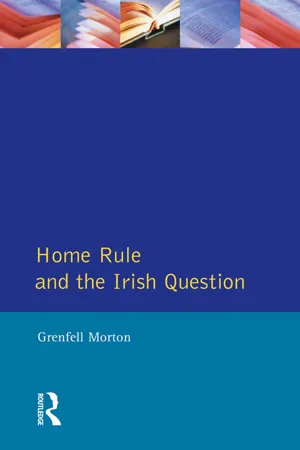
Home Rule and the Irish Question
About this book
Taking the years 1800-1920, the book considers the four Home Rule Bills and discusses the role of leading figures such as Charles Stewart Parnell and Isaac Butt. This is a careful study of the rise in political consciousness- it addresses the relationship between nationalism and the Catholic faith, and popular support for the Union amongst Ulster Protestants- providing clear analysis of a troubled period.
Trusted by 375,005 students
Access to over 1.5 million titles for a fair monthly price.
Study more efficiently using our study tools.
Information
Part One: Background
1 The United Kingdom of Great Britain and Ireland
I shall not make the Italians a subject race to the Trojans, Nor do I seek this realm for my own: let both our peoples, Unconquered, as equal partners be joined in a league for ever.
Virgil, Aeneid xii, 189–91, translated by Cecil Day Lewis
The Act of Union in 1800, by which the United Kingdom of Great Britain and Ireland was established, brought to an end the historic Kingdom of Ireland established by Henry VIII in 1534. It also terminated the long-standing institution of an Irish parliament, a body originating in the medieval Lordship of Ireland in the thirteenth century. Even though the Irish parliament represented the lords and communities of the Pale, and those areas which accepted English law, yet a distinctive tradition evolved, not unlike that of the Three Estaits in Scotland. Indeed, by 1494, Henry VII's Lord Deputy, Sir Edward Poynings, was forced to curb the growing independence of the Irish parliament by bringing proposed legislation under the joint control of the Irish and English Privy Councils.
Under the Tudor monarchs parliament, although seldom summoned, remained an essential part of the constitution, so that when the parallel process of plantation in Ulster, Virginia and New England began, it was as natural for James I to strengthen the Irish parliament by the creation of new boroughs as it was for the House of Burgesses to arise in Virginia (114). The ‘Glorious Revolution’ at the end of the seventeenth century established civil and religious liberty in England, but made people in both Ireland and the American colonies more aware of their subordinate status. William Penn's proposal for colonial unity in 1697 was mirrored in Ireland by the publication in 1698 of William Molyneux's pamphlet The Case of Ireland being bound by Acts of Parliament in England, stated, in which he condemned the undermining of the Irish parliament's authority by a series of English legislative encroachments.
The union of the English and Scottish parliaments in 1707 provided a striking parallel with the later measure of 1800. The Scots parliament, meeting in Edinburgh, came to an end amidst widespread opposition, riots in the capital and corruption of the nobility. Henceforward Scottish constituencies were to be represented in the House of Commons at Westminster, and the nobles by a contingent of representative peers. A Scottish identity was preserved by the recognition of the established Kirk and the continuity of her distinctive legal system. Yet this union, though strongly opposed as a ‘sell-out’, was, on balance, destined to operate successfully (11).
The eighteenth-century parliament
Daniel Defoe, in his History of the Scotch Union, argued in favour of a further union of Great Britain and Ireland, and in July 1707 there was a current of opinion in the House of Commons which favoured a ‘more comprehensive union’. However, political ineptitude and commercial jealousy combined to thwart this statesmanlike course, a design which stood as good a chance of ultimate success as did the union with Scotland, a union which required to be sealed and consolidated in the bloody suppression of the Jacobite Highlanders in 1745–6. Instead, Ireland suffered the indignity of being subjected to the Declaratory Act 1719 (6 Geo. I), by which the legislative supremacy of the English parliament was affirmed, particularly in the matter of being able to legislate directly for Ireland. Significantly, an Act couched in similar terms was passed in 1766 to affirm the supremacy of Westminster over the colonial assemblies in America. The Protestant ruling class in Ireland resented their kingdom and its parliament being placed on a par with some remote colonial dependency, and their increasing resentment was brilliantly expressed by Jonathan Swift, the Tory pamphleteer who had toppled Marlborough and who now occupied the Deanery of St Patrick's cathedral in Dublin. Beginning with an attack on the commercial restrictions imposed on Ireland, Swift in his Drapier's Letters (1724) not only exposed the corrupt scandal by which Walpole allowed Wood to coin debased halfpence for circulation in Ireland, but proceeded to reassert the independence and integrity of the historic Kingdom of Ireland, and the consequent nullity of measures which had not been sanctioned by the domestic legislature; ‘government without the consent of the governed was the very definition of slavery’ (8, 9).
In the 1750s the Irish parliament refused to transmit surplus revenue to the Exchequer in London, and thenceforward such moneys were spent on such public works as the widening of the streets in Georgian Dublin, the construction of inland waterways and grants to the University of Dublin. This nascent body of ‘Patriot’ opinion amongst the Irish parliamentarians, country gentlemen and the enterprising merchants of Belfast was greatly stimulated and inspired by the rapidity with which changes began to occur in the American colonies after 1763. The Stamp Act crisis, the Declaratory Act, the Townshend duties and the successive troubles in Boston were all followed with deep interest in Ireland, as the cause of the colonists came to be regarded as identical with that of the ‘Patriots’ (12).
The ‘Patriot’ interest, led by Henry Grattan in parliament, was, however, in a different situation from that of the colonial merchants of Boston or Philadelphia, or the plantation owners in Virginia. For one thing, America was separated from Great Britain by the Atlantic Ocean, whereas Ireland was but one of the British Isles: as Grattan himself said, ‘The ocean forbids union, the channel forbids separation’. For another, apart from negro slaves and white indentured servants, male franchise was virtually the norm in the American colonies, whereas in Ireland both Roman Catholics and Dissenters (mainly Presbyterians) were excluded from active citizenship. Finally, simple geographical proximity made it easier for the Irish parliament to be kept in a subordinate position than the thirteen separate assemblies in America. The Irish parliament was ‘corrupt, unrepresentative, unable to control the executive, its very laws still subject to a royal veto exercised on behalf of the British government of the day’ (121). The Lord Lieutenant and the officials of the adminis-tration in Dublin Castle were appointed by and responsible to the ministry in London. This continued to be the case even after the repeal of 6 Geo. I in 1782 and the Renunciation Act of 1783, insisted upon by Henry Flood, by which the British parliament specifically renounced all claim to legislate for Ireland (97).
Henry Grattan was regarded as the hero of the hour in 1782. But it was a hollow victory: Grattan did not lead a disciplined political party, but a changing and amorphous ‘interest group’, the parliament remained unreformed and it had no control over the executive (3, 1). This formed a striking contrast to the solid achievements of the American colonists in successfully uniting to defeat the British, and in creating their federal constitution. The American Revolution was the fulfilment of that heritage of English law and constitutional practice which the original settlers had brought with them to the New World. Locke and Blackstone meant more to men like Otis, Dickinson and John Adams than did Rousseau or Voltaire. The Declaration of Independence with its listing of specific grievances contrasted sharply with the Declaration of the Rights of Man. As an Atlantic island and a European country Ireland was bound to be influenced by both (8, 9, 12).
To radicals generally in the British Isles the events and ideas of the French Revolution appeared to offer solutions to the continuing frustrations presented by unreformed and unrepresentative parliaments. In 1791 the young Dublin lawyer, Wolfe Tone (1763–98), helped to found the Society of United Irishmen in Belfast, then the leading centre of liberal and radical thought in Ireland. This body aimed at parliamentary reform and catholic emancipation, and sought to achieve these ends by uniting together ‘Catholic, Protestant and Dissenter under the common name of Irishman’ (8, 12). When war began in 1793 the United Irishmen became a treasonable organization, and after 1794 they became a secret, oath-bound association, preparing for an uprising with French help, aiming at the establishment of an independent Irish republic. There followed the bloody but ineffective rebellion in 1798. Confined to the north-east and south-east of Ireland – areas where the population was largely of immigrant, non-Irish stock, and lacking widespread support throughout the country or effective help from France – it was soon crushed. Its chief legacy to later Irish history was the creation of a tradition of revolutionary violence, which manifested itself again in 1803 with Robert Emmet's abortive rebellion in Dublin, with the Young Irelanders in 1848, the Fenians (the Irish Republican Brotherhood) in 1867, the rising in Easter week 1916, and during the guerrilla warfare of 1919–21. Unlike the American Revolution, which achieved its · objective of securing independence at the first attempt, this Irish revolutionary tradition was similar to those in France (1789 to 1968) and Russia from 1825 onwards (7, 10). Yet it must be stressed that this revolutionary and separatist tradition was a minority tradition, standing in sharp contrast to the parliamentary and legalistic approach which aimed at securing legislative independence and appealed more widely to the underlying conservatism of Irish political and social life.
The Union
The 1798 rebellion forced Pitt to face what the Victorians labelled the ‘Irish Question’ [doc. 1], that is the problem of what constitutional relationship, if any, should exist between Great Britain and Ireland. He had to ask himself whether ‘there was any middle course between the extremes of Union with Great Britain and total separation’. Pitt reached the conclusion that Union was the answer, being the solution to the Irish problem ‘most likely to give Ireland security, quiet, and internal repose; that it would remove the chief bar to her advancement in wealth and civilization; that it would vastly augment her material prosperity, and that it would tend powerfully to unite the higher and lower orders of her people’. To these arguments Pitt added the suggestion that the admission of Catholics to parliament could be part of the Union arrangements, as ‘a United legislative body promises a more effectual remedy for their grievances, than could be likely to result from any local arrangements’ (4, 8).
Grattan strenuously opposed these proposals for the ending of that parliament of whose constitutional liberties he was the champion. He condemned the ‘corruption, threats, and stratagems’ being used by Pitt and his ministry to silence opposition; methods, it must be added, quite usual in eighteenth-century politics, but in this case employed on a very large scale. Under such conditions a union might be inevitable, but it would be unlikely to become perpetual: ‘the Constitution may, for a time, be so lost… the character of the country cannot be so lost. The ministers of the Crown may, at length find that it is not so easy to put down for ever an ancient and respectable nation by abilities, however great, by power and corruption, however irrestible. Liberty may repair her golden beams, and with redoubled heart animate the country’ (9).
The Act of Union received the royal assent on 1 August 1800. As from 1 January 1801 the parliaments of Great Britain and Ireland were to be united. Ireland was to be represented in the House of Lords by four spiritual and twenty-eight ordinary peers, while one hundred M.P.s were to represent Irish constituencies in the House of Commons. Non-representative Irish peers were eligible for election to the Commons; Palmerston, for example, was so elected in 1807. The established churches of England and Ireland were to be united into one protestant episcopal church, ‘and the continuance and preservation of the said church … shall be taken to be an essential and fundamental part of the union.’ Trading privileges and bounties were to apply equally to the citizens of Great Britain and Ireland, although for a time the two kingdoms were to retain their separate exchequers and national debts, the proportionate contributions of the two partners to United Kingdom expenditure being fixed in the ratio of 15: 2, a formula indicative of the vast difference in wealth between agrarian Ireland and the rising fortunes of ‘the first industrial nation’ (4, 5).
Like Scotland, Ireland preserved something of her identity as a distinct kingdom. The courts of law, the twenty-two departments of the administration supervised by the Chief Secretary's office in Dublin Castle, the separate army establishment based at Kilmainham, the Church establishment, and at the head of affairs, a Lord Lieutenant representing the Sovereign, all these indicated that the new United Kingdom was not a fully integrated political organism (25). Nonetheless, it was perfectly reasonable to suppose that the union of Great Britain and Ireland would prove as durable and successful as the union of England and Scotland in 1707. The circumstances of the two Acts of Union were superficially similar: both introduced during a major European war, both strongly opposed at home, both apparently consolidating the military security and the political unity of the British Isles. However, it can be argued that England and the Scottish Lowlands had more in common than had Britain and Ireland in 1800. By then the ‘take-off into sustained economic growth’ caused by the industrial and agricultural revolutions had begun to transform the economy of parts of England and the Scottish Lowlands (5, 11), while on the international scene the French Revolution, in destroying the institutions and assumptions of the ancien régime, stimulated both democracy and nationalism throughout Europe. It was not for nothing that Wolfe Tone's search for outside help should have led him to Paris via Philadelphia.
Irish history in the nineteenth and early twentieth centuries was dominated politically by the struggle to modify or terminate the Act of Union. This struggle was fuelled by the involvement of the Catholic masses in the fight for Catholic em...
Table of contents
- Cover Page
- Title Page
- Copyright Page
- Contents
- Introduction to the Series
- Acknowledgements
- Part One Background
- Part Two The Home Rule Solution
- Part Three Assessment
- Part Four Documents
- Bibliography
- Index
Frequently asked questions
Yes, you can cancel anytime from the Subscription tab in your account settings on the Perlego website. Your subscription will stay active until the end of your current billing period. Learn how to cancel your subscription
No, books cannot be downloaded as external files, such as PDFs, for use outside of Perlego. However, you can download books within the Perlego app for offline reading on mobile or tablet. Learn how to download books offline
Perlego offers two plans: Essential and Complete
- Essential is ideal for learners and professionals who enjoy exploring a wide range of subjects. Access the Essential Library with 800,000+ trusted titles and best-sellers across business, personal growth, and the humanities. Includes unlimited reading time and Standard Read Aloud voice.
- Complete: Perfect for advanced learners and researchers needing full, unrestricted access. Unlock 1.5M+ books across hundreds of subjects, including academic and specialized titles. The Complete Plan also includes advanced features like Premium Read Aloud and Research Assistant.
We are an online textbook subscription service, where you can get access to an entire online library for less than the price of a single book per month. With over 1.5 million books across 990+ topics, we’ve got you covered! Learn about our mission
Look out for the read-aloud symbol on your next book to see if you can listen to it. The read-aloud tool reads text aloud for you, highlighting the text as it is being read. You can pause it, speed it up and slow it down. Learn more about Read Aloud
Yes! You can use the Perlego app on both iOS and Android devices to read anytime, anywhere — even offline. Perfect for commutes or when you’re on the go.
Please note we cannot support devices running on iOS 13 and Android 7 or earlier. Learn more about using the app
Please note we cannot support devices running on iOS 13 and Android 7 or earlier. Learn more about using the app
Yes, you can access Home Rule and the Irish Question by Grenfell Morton in PDF and/or ePUB format, as well as other popular books in History & British History. We have over 1.5 million books available in our catalogue for you to explore.