'Every man would like to be God, if it were possible; some few find it difficult to admit the impossibility.' - Bertrand Russell
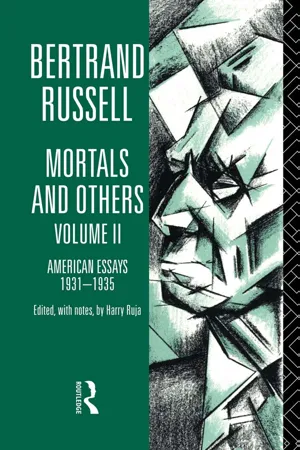
From 1931-1935 Bertrand Russell was one of the regular contributors to the literary pages of the New York American, together with other distinguished authors, such as Aldous Huxley and Vita Sackville-West. Mortals and Others Volume II presents a further selection of his essays, ranging from the politically correct, to the perfectly obscure: from The Prospects of Democracy to Men Versus Insects.
Even though written in the politically heated climate of the 1930s, these essays are surprisingly topical and engaging for the present day reader. Volume II of Mortals and Others serves as a splendid, fresh introduction to the compassionate eclecticism of Bertrand Russell's mind.
- 192 pages
- English
- ePUB (mobile friendly)
- Available on iOS & Android
eBook - ePub
About this book
Information
Notes
1 Russell is referring to a case of refusal of British seamen to set out to sea because of pay cuts. The incident was more often characterised as an instance of ‘unrest’ than as a mutiny, and none of the ‘mutinous’ seamen was court-martialled. See The Times (London), 17 September 1931, pp. 7, 12; 21 September, p. 12; 22 September, p. 9; 5 October, p. 11. See also The New York Times, 25 September, p. 13. None of these accounts, however, says anything of concessions on piano payments which the Admiralty obtained.
2 See Watson, Behavior: an Introduction to Comparative Psychology (New York: Holt, 1914); Psychology from the Standpoint of a Behaviorist (Philadelphia, PA: Lippincott, 1919; 2nd edn, 1924; 3rd edn, 1929).
3 See Ivan P. Pavlov, Conditioned Reflexes, trans. G. V. Anrep (London: Humphrey Milford, 1927); Lectures on Conditioned Reflexes, trans. W. H. Gantt, 2 vols (London: Martin Lawrence; New York: International Publishers, 1929).
4 See Wolfgang Kohler, The Mentality of Apes, trans. E. Winter (London: Kegan Paul; New York: Harcourt Brace, 1925; 2nd edn, 1926); Solly Zuckerman, The Social Life of Monkeys and Apes (London: Kegan Paul, 1931; New York: Harcourt Brace, 1932).
5 See Edward L. Thorndike, Animal Intelligence (New York: Macmillan, 1911).
6 Quoted in Philip Guedalla, Wellington (New York and London: Harper, 1931), p. 259.
7 French poet and dramatist, 1810–57.
8 Pseudonym of Amandine-Aurore Lucille Dupin, Baroness Dudevant, 1804–76. She wrote about their love affair in Elk et lui (1859). De Musset was already dead, but his brother published in reply another version of their affair in Lui et elle.
9 Tobias Smollett, The Adventures of Roderick Random (1748).
10 Simon de Montfort, 1208–65, leader of the revolt of the barons against Henry III of England in 1263 and military dictator of England, 1265.
11 Edward I, 1239–1307, King of England, 1272–1307.
12 Charlotte Brontë, English novelist, 1816–55; Jane Eyre (1847).
13 Thomas Carlyle, 1795–1881, Scottish-born English prose writer; The French Revolution, Sartor Resartus.
14 Friedrich Nietzsche, 1844–1900, German philosopher; Thus Spake Zarathustra.
15 David H. Lawrence, 1885–1930, English novelist and essayist; Lady Chatterley 's Lover, Women in Love, Sons and Lovers.
16 This essay was written soon after the Nazis had captured power and were turning Germany into a racist, militaristic dictatorship.
17 Russell's time schedule on these space exploits was overly pessimistic. On 4 October 1957, less than one-quarter of a century after this essay appeared, the first space vehicle (‘sputnik I’) circled the earth; and just twelve years after that, the first men landed on the moon and returned to earth safely. The acceleration of the programme was due no doubt to the determination of the two great powers, the United States and the Soviet Union, to devote huge sums of money and massive amounts of scientific and technological manpower to the mastery of space. Already, talk of travel to Venus and Mars has begun. A United States satellite (‘Mariner 2’) has indeed already approached within 22,000 miles of Venus.
Even in his later years, Russell continued to feel that space travel was frivolous. See his ‘Let's stay off the moon’, Maclean's Magazine 71 (18) (30 August 1958): 7, 45–6; reprinted with slight changes in The Times, London, 15 July 1969, p. 9, and The Wall Street Journal, 16 July 1969, p. 12.
18 ‘Annual income twenty pounds, annual expenditure nineteen nineteen six, result happiness. Annual income twenty pounds, annual expenditure twenty pounds ought and six, result misery’ (Mr Micawber in Charles Dickens, David Copperfield, Chapter 12).
19 Thomas Bowdler, 1754–1825, editor of The Family Shakespeare, an expurgated edition.
20 William Wilberforce, 1759–1833, credited, with Thomas Clarkson, with abolishing the slave trade and slave ownership in the British Empire. See biographies by Robert Wilberforce (1838), J. C. Col-quhon, and R. Coupland.
21 Frances (Milton) Trollope, 1780-1863, mother of Anthony Trollope and author of Domestic Manners of the Americans (1832).
22 See the introduction by Michael Sadleir in the edition by George Routledge and Sons (London, 1927), for generous extracts from this anonymous preface.
23 This essay was published before the civil war which broke out in 1936 and brought Fascism to Spain.
24 Viz., that of F. D. Roosevelt.
25 Death in the Afternoon.
26 When this essay was first published, Spain was a republic with a socialistic constitution. In 1936, however, it became a fascistic state under the dictatorship of General Francisco Franco, changing with his death in 1975 to a constitutional monarchy.
27 At a series of international disarmament conferences from 1927 to 1932, delegates from member nations of the League of Nations discussed the reduction of armaments but failed to make progress towards that goal.
This essay was reprinted in Russell's In Praise of Idleness and Let the People Think.
28 Russell is referring to the World Disarmament Conference which convened in February 1932 under the auspices of the League of Nations. It adjourned without agreeing to anything. It reconvened in January 1933, again without results. Subseq...
Table of contents
- Cover
- Half Title
- Title Page
- Copyright Page
- Dedication
- Table of Contents
- Preface
- Christmas at Sea
- How People Economise
- Do Dogs Think?
- How People Take Failure
- On Conceit
- On Bores
- Politics and Sport
- On Reticence
- The Good Old Days
- On Becoming Civilised
- On the Art of Persuading
- The Prospects of Democracy
- The Admiration of Strength
- The Triumph of Stupidity
- On Utilitarianism
- On Race Hatred
- The Spirit of Adventure
- What Makes People Likeable
- On Self-Righteousness
- Emotions About Spending Money
- The Origin of Victorian Virtue
- On Propriety
- I Escape from Progress
- Experts and Oligarchs
- Fugitive and Cloistered Virtue
- On Being Ashamed of Virtue
- Men versus Insects
- The Paralysis of Statesmanship
- On Orthodoxies
- Means to Ends
- Individualist Ethics
- The Cult of the Individual
- On Being Argumentative
- On Mediaevalism
- In Praise of Dullness
- The End of Pioneering
- Combating Cruelty
- Can We Think Quickly Enough?
- On Discipline
- Expecting the Millennium
- The Churches and War
- On Loving Our Neighbours
- On Self-Control
- Respect for Law
- On Euthanasia
- On Equality
- The Father of the Family
- On the Origins of Common Customs
- On Transferring One's Anger
- On Adult Education
- On Curious Beliefs
- Competitive Ethics
- Is Anybody Normal?
- Egoism
- Back to Nature?
- Parental Affection
- Benevolence and Love of Power
- Irrational Opinions
- Science and Happiness
- Social Sciences in Schools
- Race and Nationality
- The Problem of Leisure
- What to Believe
- Instinct in Human Beings
- Fashions in Virtues
- On Comets
- Fear and Amusement
- On Curious Learning
- On Being Important
- Censorship by Progressives
- Protecting the Ego
- Climate and Saintliness
- Why Travel?
- Obscure Fame
- Insanity and Insight
- On Ceremony
- Love of Money
- On Specialising
- Good Manners and Hypocrisy
- On Being Insulting
- Vigorous and Feeble Epochs
- The Decrease of Knowledge
- Notes
- Published Essay Titles
Trusted by 375,005 students
Access to over 1.5 million titles for a fair monthly price.
Study more efficiently using our study tools.
Frequently asked questions
Yes, you can cancel anytime from the Subscription tab in your account settings on the Perlego website. Your subscription will stay active until the end of your current billing period. Learn how to cancel your subscription
No, books cannot be downloaded as external files, such as PDFs, for use outside of Perlego. However, you can download books within the Perlego app for offline reading on mobile or tablet. Learn how to download books offline
Perlego offers two plans: Essential and Complete
- Essential is ideal for learners and professionals who enjoy exploring a wide range of subjects. Access the Essential Library with 800,000+ trusted titles and best-sellers across business, personal growth, and the humanities. Includes unlimited reading time and Standard Read Aloud voice.
- Complete: Perfect for advanced learners and researchers needing full, unrestricted access. Unlock 1.5M+ books across hundreds of subjects, including academic and specialized titles. The Complete Plan also includes advanced features like Premium Read Aloud and Research Assistant.
We are an online textbook subscription service, where you can get access to an entire online library for less than the price of a single book per month. With over 1.5 million books across 990+ topics, we’ve got you covered! Learn about our mission
Look out for the read-aloud symbol on your next book to see if you can listen to it. The read-aloud tool reads text aloud for you, highlighting the text as it is being read. You can pause it, speed it up and slow it down. Learn more about Read Aloud
Yes! You can use the Perlego app on both iOS and Android devices to read anytime, anywhere — even offline. Perfect for commutes or when you’re on the go.
Please note we cannot support devices running on iOS 13 and Android 7 or earlier. Learn more about using the app
Please note we cannot support devices running on iOS 13 and Android 7 or earlier. Learn more about using the app
Yes, you can access Mortals and Others, Volume II by Bertrand Russell, Harry Ruja in PDF and/or ePUB format, as well as other popular books in Literature & Literary Essays. We have over 1.5 million books available in our catalogue for you to explore.