The Mind's Affective Life is a refreshing and innovative examination of the relationship between feeling and thinking. Our thoughts and behaviour are shaped by both our emotions and reason; yet until recently most of the literature analysing thought has concentrated largely on philosophical reasoning and neglected emotions.
This book is an original and provocative contribution to the rapidly growing literature on the neglected "affective" dimensions of modern thought. The author draws on contemporary psychoanalysis, philosophy, feminist theory and recent innovations in neuroscience to argue that in order to to understand thought, we need to consider not only both emotional and rational aspects of thought but also the complex interactions between these different aspects. Only through such a rich and complicated understanding of modern thought can we hope to avoid what the author identifies as a significant contemporary problems for individuals and cultures; that is, suppression or denial of intolerable states of feeling.
The Mind's Affective Life will appeal to and inspire students and practitioners of philosophy, psychoanalysis, psychotherapy and women's studies. It will also be of great interest to anyone interested in the interaction of feeling and thinking.
eBook - ePub
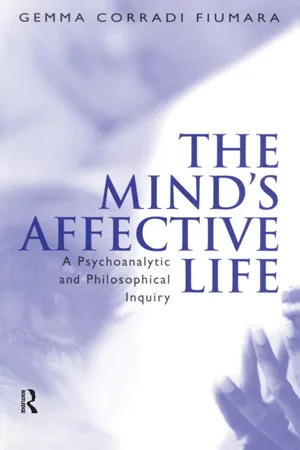
The Mind's Affective Life
A Psychoanalytic and Philosophical Inquiry
- 184 pages
- English
- ePUB (mobile friendly)
- Available on iOS & Android
eBook - ePub
About this book
Information
Chapter 1
The fragility of ‘pure reason’
The island of ‘pure reason’ and the sea of passions
In a revealing passage of his first Critique, Kant seems to eloquently express both a concern for the purity of reason and an interest in whatever is left out of it. An emblematic figure in the affirmation and ‘idealisation’ of reason, Kant indirectly recognises our intense curiosity for whatever terrain surrounds the circumscribed enclosure of our conscious and coherent mind: ‘We have … traversed the whole domain of the pure understanding, … and assigned to everything in it its proper place. This domain, however, is an island and enclosed by nature itself within limits that can never be changed. It is the country of truth (a very attractive name), but surrounded by a wide and stormy ocean, the true home of illusion, where many a fog bank and ice that soon melts away tempt us to believe in new lands, while constantly deceiving the adventurous mariner with vain hopes, and involving him in adventures which he can never leave, and yet can never bring to an end.’1
As soon as one tries to talk about anything outside ‘the island of truth’, anything exceeding the conscious, rational mind, we seem bound to use a metaphoric language of ‘fog banks’ and ‘melting icebergs’. Yet, what primarily transpires is both a fascination for the surrounding ocean and a clear intent to discourage any venture which might take place outside canonic domains. Following this Kantian similitude, we may say that the irresistible attraction for the ‘stormy ocean of illusions’ could be interpreted as a paradoxical recognition of the value and potential of exploring whatever exceeds the boundaries of ‘pure reason’, as a concern for its profound origins. Indeed, why should he warn us against something that no one would be interested in pursuing? There is in fact an incoercible interest for what constitutes the receptacle, terrain, or surroundings of whatever ‘pure reason’ seems to prevail in a given epoch. Contemporary views of rationality deriving from psychoanalytic culture are among the constant examples of challenge to existing islands of pure reason and to their ‘natural’ boundaries, which are inexorably made more problematic, and often recognised as defensive forms of insulation from the stormy ocean of our affective life. Moreover, it seems inadequate to think constantly about the relation between affective life and ‘rationality’, only in terms of ‘inside’ and ‘outside’. Such a spatial view proves too simplistic, in that affects simultaneously inhabit philosophy’s illusively empty interiority, while remaining exterior to the productions that would confer legitimacy and voice onto them.
Why should we begin evoking our rationalist tradition on the way to an exploration of the mind’s affectual texture? Why not start right away with human emotions? The problem is that in our Western culture anything that has to do with the mind is frequently considered simply ‘rational’, and somehow quite thinkable. It is therefore necessary, at the beginning, to acknowledge our pervasive rationality – almost second nature to us – in order to let our affective life emerge more clearly in the only context in which it can manifest itself: the mainstream of our contemporary epistemologies. It is, I believe, the best way to proceed if we are to avoid the risk that rationality may silently presume to be independent from its affective components. On the other hand, the fact that instincts and affects can only begin to operate psychically at the level of mental ego functions – and are thus dependent on reasoning – is more readily accepted and comprehensible.
Reigning epistemologies, in fact, appear to somehow both rely upon and disavow the role of affects in their epistemic constructions and in the affirmation of rationality. There would be no Kantian ‘islands’ of homogeneous pure reason if they were not sustained and allowed for by the innumerable connecting functions of our affective and metaphoric resources. Certain not so ‘pure’ areas of culture and mental functioning seem to meet the challenge of life problems so efficiently as to relieve epistemic domains of abstract thought from these burdens. Such ‘lesser’ areas of our culture almost protect the lucid intraepistemic games of the ‘higher’ levels by steadily coping with coexistential vicissitudes and ‘foreign affairs’ on their behalf. It is unlikely that any epistemology will begin to cope with alarming problems of external relations and of its own affective depths, as long as the more hermeneutic and affect-prone disciplines will laboriously perform this function. If the ‘lesser’ human languages were to monitor the inclination to be hyper-functional and to solve problems for the sedate and solemn ‘pure reason’ is possible that also the more ‘insular’, lucid, and serious intellectual domains of culture might have to confront their hypo-functional policies. Perhaps official philosophy resists recognition of its dependence upon resources that it draws from the mind’s affective life. Certain areas of philosophy systematically tend to eschew a number of difficult questions on the grounds that they are peripheral or not quite to the point; obtruding emotional issues, in fact, are usually ‘described’ as tangentially connected to truth claims, insufficiently clear, unfocused, inappropriately articulated, excessively controversial, or sub-rational. According to Le Doeuff, since the activity of separation and division is philosophically productive (as the proper ‘field’, or Kantian island, is created by its exclusions), philosophy ultimately creates itself through what it represses – almost as if the ‘psychoanalytic’ function of repression were essential to its practices. It should be interesting, then, to districate the corporate cohesion of rationality so as to allow our affective life to speak out from the centre of our culture, rather than letting it mutely function in there.2
Most inquiries in a variety of fields proclaim an appreciation of dialectical criticism even while they are relentlessly focused on securing consensus and winning adhesions. They ultimately appear to base their cultural enterprises upon a conviction that consensus is a powerful ‘instrument’ and that, if properly constituted, it might even provide for the quality of rational solutions to problems – almost as if consensus were an essential component of rationality. Indeed, why should reason, logic and truth-oriented argument ever fail to win consensus? Thus the paradox of strenuous search for qualified consensus, in conjunction with the alleged purity and putative autonomy of rational truth, seems to elicit enough curiosity about the cherished idea of our human ‘pure reason’, and of its contemporary variants.
Of course, agreement among epistemic subjects across geographical and historical domains is not something that customarily happens in our world. The variegated specificities of cultures and experiences make the goal of generalised consensus in cognitive or evaluative issues rather ideal and unrealistic.3 Only by abstracting from embodied contingencies, and by shifting to the level of idealisation, could we expect or even, ultimately, require consensus. To insist tacitly on cognitive homogeneity is perhaps comparable to maintaining that in ideal circumstances subjects would necessarily reach agreement, as if truth were essentially irresistible. To reach out insistently for ideal circumstances seems profoundly interwoven with an idealisation of our all too human rationality.
The generic suggestion that truth and correctness should be able to elicit consensus sounds of course quite appropriate in our culture. But the ‘truth’ in matters of human endeavours can in fact be made evidentially secure only in ideal insulated circumstances, and not in general, under the imperfect conditions in which we necessarily conduct our cognitive affairs.4 Truth as such would ultimately command agreement in and of itself only from those subjects whose epistemic situation is ‘suitably’ favourable, those willing to inhabit any Kantian islands of ‘pure understanding’. In the contingencies of our language and subjectivity, consensus would be too much to expect – or to ask for. But then, we are easily seduced by the generality and ‘objectivity’ of rational judgements because we probably perceive them as potentially implementing admirable ‘universal’ principles. Consensuality, moreover, is not something that we could demand here and now, for ‘truth’ and general agreement only seem to converge in a remote, ideal locus. A locus that we can speculate about in terms of a desire for the agreement that would be reached by ideally rational inquirers functioning in ideally favourable circumstances.5 But, again, idealisation is ultimately the result of a laborious emotional experience and not only part of a reasoning process.6 In this outlook, therefore, we should somehow distinguish between our ‘ideals’ and our ‘idealisations’. An ideal as such may belong to the practical order, as it is something that can function as a guideline in our actual proceedings, providing a goal of appropriate endeavour; an ideal may represent a state of things whose implementation – even if only in part – is to be positively evaluated and which should, by its very nature, be seen as desirable. An idealisation, on the other hand, is inherently different, for it involves the projection of profound affective components that disregard limits or limitations of various kinds; an idealisation is, accordingly, the affective production and expression of a hypothetical state of things – something that ultimately represents the result of profound psychic yearning.
The story of Babel,7 for instance, evokes the nostalgia for an ideal, original condition which has had to be relinquished in the process of developing more complex constructions. Such an ideal antecedent state may be regarded as a condition of total, unequivocal communication. The myth proclaims the need for an emancipatory separation as a condition for the development of what might be more powerful forms of world control. Yet the suspicion remains that the laborious quest for truth at the core of our philosophical games might be thought of as capable of ultimately ‘re-establishing’ an ideal condition of total communication in our technological era; such an ideal might explain our inexhaustible search for truth conditions and standards of meaning. Our longing for a ‘lost’ condition of unequivocal language might be what sustains our persistent search for standards of accurate representation and objectivity. Should the flourishing research on truth conditions reach a cluster of conclusive convergences, the result might be sufficient to virtually reproduce a pre-Babelic structure of consensual communication.8
Rescher suggests that the ‘consensus theory of truth’, with respect to the ideal situation or case, is not something that rests on the nature of consensus, but rather on our affective attachment to the notion of an ideal rationality; by ‘ideal rationality’ we could mean a condition of ‘identical circumstances’ in which ‘ideally rational’ inquirers will proceed in the same way and onto the same conclusions, ‘But it is rationality and not consensus that is doing the work for us here’, he concludes.9 What matters for rationality is not that agents finally come to accept something in common, but indeed how rationally they come to do so. In the final analysis we seem to rescue our celebrated Western logos not through consensuality as such, but through the ideal process by which consensus should come about.10 And it is here that some quality of idealisation must perforce be introduced as a further item imported from inner emotional dimensions which are perplexingly regarded as heterogeneous to our rigorous rational enterprises; it is almost as if the affective components which are expelled from the ‘island of pure understanding’ were at the same time consistently utilised to sustain the idealised quality of the non-contingent rationality which is propagated. And the unavoidable vociferations which accompany the lucid parsimony of the ‘ideal’ rationality at any given moment, eventually exhibit the insistent ‘irrational’, which is customarily excluded as sub-rational or corporeal, as affectual or banal. If we could seriously listen to the dense and intricate sound of voices that one can hear during the intervals of scientific meetings, in the pause between classes, or in the corridors of courts, one could perhaps get in touch with the acumen of concerned creatures intent upon seeking connections with whatever is excluded by pure reason: human beings trying to reconnect an ‘unlivable’ idealised rationality with their own affective lives.
In order to explore further the necessity to reconnect thinking and feeling, we could also note that some affective atmosphere inevitably shadows our debates. Yet, paradoxically, only the kindlier sort of emotions seem to be identified, duly deplored, and thus latently delegitimised. By contrast, anger, as a serious and legitimate reaction in defence of purity and consistency, is not usually recognised as a ‘deplorable’ emotion, and remains an acceptable part of mainstream discourse. It almost seems that in argumentative interactions we ultimately seek to produce arguments so powerful that they just cannot be refused, so cogent that they reverberate into the very life of the interlocutor and cause an ‘illness’ unless they are accepted. Nozick remarks that perhaps philosophers ‘need arguments so powerful that they set up reverberations in the brain: if the person refuses to accept the conclusion, he dies. How is that for a powerful argument? … A “perfect” philosophical argument would leave no choice.’11 The lucid elegance of scholarly anger is an integral part of our cultural games; as such it is rarely identified or deplored. Abundant testimony could be provided for expressions of intense ‘righteous’ rage at the highest levels of inquiry; and a derivative of righteous rage is of course the legitimisation of split...
Table of contents
- Cover
- Half Title
- Title Page
- Copyright Page
- Dedication
- Table of Contents
- 1 The fragility of ‘pure reason’
- 2 From philosophy to epistemophily
- 3 Thinking affects
- 4 A passion for reason
- 5 Minding the body
- 6 The terminology of affects
- 7 Affective knowledge
- 8 The price of maturity
- 9 Towards affective literacy
- 10 Affects and narratives
- 11 Affects and identity
- 12 Affects and indifference
- Bibliography
- Index
Trusted by 375,005 students
Access to over 1.5 million titles for a fair monthly price.
Study more efficiently using our study tools.
Frequently asked questions
Yes, you can cancel anytime from the Subscription tab in your account settings on the Perlego website. Your subscription will stay active until the end of your current billing period. Learn how to cancel your subscription
No, books cannot be downloaded as external files, such as PDFs, for use outside of Perlego. However, you can download books within the Perlego app for offline reading on mobile or tablet. Learn how to download books offline
Perlego offers two plans: Essential and Complete
- Essential is ideal for learners and professionals who enjoy exploring a wide range of subjects. Access the Essential Library with 800,000+ trusted titles and best-sellers across business, personal growth, and the humanities. Includes unlimited reading time and Standard Read Aloud voice.
- Complete: Perfect for advanced learners and researchers needing full, unrestricted access. Unlock 1.5M+ books across hundreds of subjects, including academic and specialized titles. The Complete Plan also includes advanced features like Premium Read Aloud and Research Assistant.
We are an online textbook subscription service, where you can get access to an entire online library for less than the price of a single book per month. With over 1.5 million books across 990+ topics, we’ve got you covered! Learn about our mission
Look out for the read-aloud symbol on your next book to see if you can listen to it. The read-aloud tool reads text aloud for you, highlighting the text as it is being read. You can pause it, speed it up and slow it down. Learn more about Read Aloud
Yes! You can use the Perlego app on both iOS and Android devices to read anytime, anywhere — even offline. Perfect for commutes or when you’re on the go.
Please note we cannot support devices running on iOS 13 and Android 7 or earlier. Learn more about using the app
Please note we cannot support devices running on iOS 13 and Android 7 or earlier. Learn more about using the app
Yes, you can access The Mind's Affective Life by Gemma Fiumara Corradi in PDF and/or ePUB format, as well as other popular books in Psychology & Mental Health in Psychology. We have over 1.5 million books available in our catalogue for you to explore.