- 220 pages
- English
- ePUB (mobile friendly)
- Available on iOS & Android
eBook - ePub
About this book
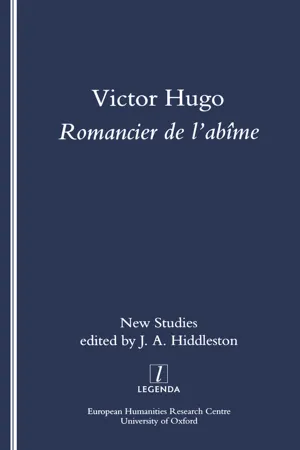
"This study of Victor Hugo's work aims to uncover the diversity, the thematic and narrative singularity, and the shifting ironies and resistance to interpretative closure of his writing. Novels examined include: ""Notre-Dame de Paris"", ""Les Miserables"", ""Les Travailleurs de la Mer"", ""Quatre vingt-treize"", and ""L'Homme qui Rit"". The 11 essays in the volume bring together various critical approaches from French, British and American scholars, in an attempt to provide a new point of departure and to provoke discussion of Victor Hugo's novels. This publication marks the bicentenary of Hugo's birth in 1802."
Trusted by 375,005 students
Access to over 1.5 million titles for a fair monthly price.
Study more efficiently using our study tools.
Information
Subtopic
LanguagesChapter 1
Politics, Family and the Authorial Preconscious in Hugo’s Han d’Islande and Bug-Jargal
Laurence M. Porter
By the authorial 'preconscious' in texts I mean traces of ambivalent thoughts and feelings that occasionally rise to awareness only to be suppressed. Such mental contents differ from those of a 'political unconscious', repressed, unwelcome notions never brought to light, or at best, permanently buried through the operation of a Sartrean 'bad faith'. The repressed manifests itself through parapraxes—doing and saying things one doesn't intend—and through dreams. The absurdities are guides to meaning. The suppressed is deliberately expressed, but deflected. For example, to write 'Babylon' instead of 'imperial Rome' in Revelation allows the author to evade censorship. For the axiological shifts of irony (e.g. 'that's good' means 'that's bad'), suppression substitutes an ontological disguise, an alias. Suppression can be inferred from an author's social and historical context: the line of Han d'Islande/ the French monarchy, perpetuated by a single son (legitimate heir) in each generation, will die out.
In identifying, linking and analysing such materials, a critic must speculate, creating a web of merely circumstantial evidence. To the questionable assumption that fictions are autobiographies, one thus adds the singular methodology of a Georges Poulet, who combined on an equal footing all manner of texts from all periods of an author's career. Uncertainty persists even when an author overtly expounds the political views of an omniscient narrator. Such declarations of faith, opinion, influence or intent may be self-protective, manipulative or deliberately untrue. Nevertheless, Hugo's early work particularly invites analysis of its crypto-political dimensions. Between 1817 and 1830, he shrewdly promoted his career by ingratiating himself with the monarchy and the academies, while apparently chafing at the very restraints he had embraced. From the beginning, his works reflect ambivalence towards divine-right monarchy, an ambivalence strongly marked in his early novels Han d'Islande and Bug-Jargal.
All his life, Hugo sought to effect reconciliations. During his youth, the political was personal. The king whose patronage he sought was a surrogate father chosen to replace the biological father who had led armies for the republic and the empire and had separated from his mother. He inaccurately believed his mother to be a devoted royalist, because she came from the Vendée, hid a lover who conspired against Napoleon, and became a royalist of convenience under the Restoration. The psychic solution of finding a royalist 'father' for himself and his 'royalist' mother had its flaws. The king's approval depended on Hugo's stifling his artistic and political self-expression as a Romantic writer. And his mother's disapproval blocked the emotional fulfilment sought in marriage to the idealized Adèle Foucher, which would have allowed him to become a father himself, symbolically supplanting his own. Loyalty to any one of these four crucial, clashing figures—mother, beloved, king, father—ensured frustration and inspired guilt. And to win Adele, Hugo had to convince his potential father-in-law that he could earn his living as a writer. To this end, historical erudition became an intermediate goal, a soothing distraction, and a psychic refuge where Hugo could vicariously work out his emotional problems.
To Hugo, a dazzlingly precocious and preternaturally gifted writer, technical mastery came easily. During the 1820s, learning his trade mainly meant learning how to write for himself while writing for the monarchy. During the transition from an absolute to a constitutional monarchy between 1815 and 1830, however, he like other writers became aware of the expanding middle-class public created by the continuing rise of the bourgeoisie and the expansion of public literacy, together with the spread of standard French as a first language. The burgeoning book industry and public theatres allowed him to diversify the investments of his talent, so he developed a schizophrenic artistic persona, writing melodramas and frenetic novels for this broadening public while he composed odes praising the monarchy.
Partly to avoid contesting the royal power that was their main patron from 1815 to 1830, the French Romantics evaded the issue of political compliance by exploring new subjects in four dimensions: time (creating a Active past to stage revolutions and the passing of older orders, a stage that could coexist innocuously, sheltered by the excuse of frenzy, beside the official ideal expressed in the odes: a continuous series of legitimate hereditary kings), space (exotic lands and customs, the treatment of which was implicitly 'unpatriotic' for the state-sponsored author whose job was to cheer on the powers that be), the non-rational individual psyche (second states of consciousness such as dreams, hallucinations and madness, the depiction of which allowed authors respite from their duties as public citizens) and the supernatural (personal revelations by the visionary author who deviously speculated on a future where traditional kings would become irrelevant). In his prose fiction, Hugo's most powerful assimilation of the 'subjective' dimensions of the Romantic quest—non-rational mental states, and religious revelations—was to await Les Misérables. There Jean Valjean's conscience unites these two facets in a single redemptive experience. In Hugo's verse, visionary revelations of punitive reincarnation and universal redemption begin to appear around 1830.
Regarding his allegiance to the monarchy, Hugo's first two novels committed the relatively venial sins of investigating the ostensibly 'objective' dimensions of non-French time and space. Only in Le Dernier Jour d'un condamné (1829) does he indirectly undermine royal power by opposing the death penalty in the here and now—for the divine right to pardon his subjects or to condemn them to death, the exercise of the supreme sanction, was what most closely linked the king to God The liberal political preconscious, however, already rumbles menacingly in each of Hugo's early novels before erupting in 1830:
Ecoutez, écoutez, à l'horizon immense,
Ce bruit qui parfois tombe et soudain recommence,
Ce murmure confus, ce sourd frémissement
Qui roule et qui s'accroît de moment en moment,
C'est ie peuple qui vient! C'est la haute marée
[...]
Rois, hâtez-vous! rentrez dans le siècle où nous sommes,
Quittez l'ancien rivage! — A cette mer des homines
Faites place, ou voyez si vous voulez périr
Sur le siècle passé que son flot doit couvrir!
Ce bruit qui parfois tombe et soudain recommence,
Ce murmure confus, ce sourd frémissement
Qui roule et qui s'accroît de moment en moment,
C'est ie peuple qui vient! C'est la haute marée
[...]
Rois, hâtez-vous! rentrez dans le siècle où nous sommes,
Quittez l'ancien rivage! — A cette mer des homines
Faites place, ou voyez si vous voulez périr
Sur le siècle passé que son flot doit couvrir!
(P1 574)1
Kings are instructed to escape this rising tide of democracy through the compromise of a constitutional monarchy.
The brief version of Bug-Jargal that Hugo rapidly composed in 1818 seems superficially to exploit the 'noble savage' motif traceable to Montaigne. But set in literary history, the eponymous, enslaved black African king acquires new meanings. At the height of the 'frenetic' movement inspired by Lord Byron and the German Sturm und Drang, Bug-Jargal's status suggests that of the French Romantic writer under a conservative monarchy. Both figures exist within a system of subjugation, but independently of it. Their own unquestionable royal authority—albeit unrecognized by the French establishment—derives from an exotic elsewhere (Africa or genius respectively). They resist only injustice; heedless of self-preservation or advancement in the alien world where chance has thrust them, they remain always ready for the sublime gesture of self-sacrifice in the name of humanitarian or aesthetic truth. This parallel between the black African king and the Romantic poet seems less far-fetched when one realizes that in the 1826 version Bug-Jargal becomes, in his love song for the heroine, one of the very few serious authors in Hugo's prose corpus. Contrast Gringoire, in Notre-Dame de Paris, who composes ludicrous, outmoded allegorical plays to celebrate the monarchy: in 1831, he embodies for Hugo a despised, dependent past self. Gringoire becomes a psychological scapegoat, as suggested by the pince-sans-rire tenor of his last appearance in the novel, when he chooses to save the life of the trained goat Djali rather than that of Djali's mistress, Esmeralda (who in aesthetic terms, not only as a beautiful young woman but also as a busker like her goat, represents a form of art nobler than that elected by Gringoire).2
In the 1818 version of Bug-Jargal, the hero, Captain Delmar, reluctantly relives his painful memories of the slave uprising that engulfed him when he went to Haiti in 1791 to marry his cousin, the daughter of a cruel, wealthy slaveholder. Delmar sympathizes with the slaves, and a deep friendship develops between him and one of them, the noble, courageous, idealistic Pierrot (the alias for the African king Bug-Jargal, and the actual name of a black rebel leader at the time) The whites had killed Pierrots parents and wife, and enslaved him and his children. Once Delmar secures his release from the uncle's prison, Pierrot hastens to rescue his children from the hands of a ferocious master, only to find the last of them dying from mistreatment. This atrocity incites the slaves on that plantation to revolt and to elect Pierrot to lead them.
Pierrot cannot stop the slaves from burning the plantations in order to avenge him, but he saves and hides Delmar's uncle and his youngest son, whom the uncle was trying to rescue from the fire. Delmar sees Pierrot carrying off his uncle and his little cousin, and thinks his friend has betrayed him. Delmar's squadron, pursuing the rebels, is ambushed and captured by the mulatto general Biassou's troops. But Pierrot intervenes to save his life, and the two friends are reconciled. Their sense of honour makes both return to captivity: Delmar had given Biassou his word to return if he were temporarily released; and Pierrot feels morally compelled to surrender to the whites so that ten black hostages will not be killed to avenge Delmar's death. Thanks to Pierrot, Delmar escapes execution and hurries to the whites' encampment to save his friend. Just out of sight of the camp, Delmar is shot and wounded, so he cannot arrive in time, and his distraught aide-de-camp Thadée mistakenly orders Pierrot's execution. Afterwards Delmar and Thadée (whose life had also been spared by Pierrot) cannot forget the black leader whom they greatly admire, and bitterly regret his death. Fifteen years later, Delmar says, 'je reconnais que rien d'aussi noble et d'aussi original ne s'est encore offert à moi parmi les homines' (887). With this figure, 'Western literature acquires one of its first wholly admirable Black heroes.'3
Working with tag-names, Hugo characteristically 'signs' his creation (Hugo/Bug. Compare the mention of a certain 'Hogu. Negre' in Les Misérables, R2 575). The black hero's grotesque name anticipates the later motif in Hugo's work (traceable to traditional representations of Socrates as an ugly container with precious contents) of superficial deformity concealing hidden moral excellence in both the writer and his subjects. As he puts it in 'Réponse à un acte d'accusation', 'je suis ce monstre énorme, /Je suis le démagogue horrible et débordé' (P2 264). In Bug-Jargal, Hugo's rejection of slavery is reflected in the affinities between the black and the white hero, both of whom, moreover, come 'from across the sea' (the meaning of Delmar's name in Spanish).
Han d'Islande, set in 1699, is a classic initiation story where marriage to the idealized woman rewards the hero for surmounting a series of dangerous tests. The villainous local ruler Count Ahlefeld and his evil secretary Musdœmon have unjustly imprisoned Ahlefeld's benefactor Schumacker and his daughter Ethel for life. The villains scheme to dishonour Schumacker by having Ahlefeld's son Frédéric seduce Ethel, and then by falsely accusing him of fomenting a revolt against the absent king. To this end, they try to bribe the supernatural cannibal monster Han d'Islande to lead an insurrection of miners discontented by a new royal tax. Han scorns them, and produces the corpse of Frédéric, whose arm he has devoured.
Meanwhile, the hero, Prince Ordener Guldenlew, the son of the Viceroy of Norway, raised incognito in the fortress where Schumacker is imprisoned, has fallen in love with Ethel. But his father is one of Schumacker's mortal enemies. To effect a reconciliation, Ordener seeks the casket containing documents that will exonerate Schumacker. Han d'Islande supposedly possesses it. Ordener finds Han and fights a duel with him, but their fight is interrupted. Next Han lures the royal troops, who are pursuing the insurgent miners, into a ravine. He rains rocks on them from above, and then rushes to the battlefield, indiscriminately slaying fighters from both sides.
When the surviving rebels go on trial, Ordener saves Schumacker from execution by taking all the blame upon himself. He and Ethel secretly marry in prison (recalling the secret engagement of Hugo and Adèle). The bishop arrives to exculpate Ordener just before his execution. The missing documents have been found in a lake. They prove that Musdœmon engineered the revolt, and also that he fathered Ahlefeld's children. He is arrested and hanged by Orugix, the executioner brother he had rejected. Schumacker is restored to his post of viceroy; Ethel and Ordener announce their marriage.
In an inversion characteristic of Hugo's experimental imagination as he moves from one work to the next, Han d'Islande is no longer a transplanted royal victim of slavery like Bug-Jargal, but a genius loci. In Han d'Islande, the closest analogue to divine-right hereditary monarchy is the line of the supernatural eponymous monster and his forebears, who can have only one son per generation (read: one son who matters, because he will rule). Han, the last of a four-hundred-year-old line, had lost his son at the beginning of the novel. He habitually drinks his enemies' blood from his son's skull, in a parody of the Mass. Knowing he cannot perpetuate his race, he finally surrenders and kills himself and the entire garrison of the fortress by setting it on fire. The foredoomed extinction of his line parallels the effects of the French Revolution and its aftermath on the French monarchy. In another implied archetype of inversion in Han d'Islande, the name of Schumacker ('shoemaker') associates him with the lowest part of the body, the foot, from which he will reascend to the highest power. His tag-name anticipates the same subversive motif of revolution more directly displayed in Jacques Coppenole, the cordonnier of Notre-Dame de Paris. Coppenole leads the people of Flanders, associates familiarly with the beggar king who is Louis XI's pop-cultural counterpart, and treats with Louis XI as an equal.
In a further unflatt...
Table of contents
- Cover
- Half Title
- Title
- Copyright
- Contents
- List of Contributors
- Acknowledgements
- Abbreviations
- Introduction
- 1 Politics, Family and the Authorial Preconscious in Hugo's Han d'hlande and Bug-Jargal
- 2 L'Intertextualité du Dernier Jour d'un condamné
- 3 Notre-Dame de Paris as Cinema: From Myth to Commodity
- 4 Circonscription de 1'abime
- 5 'The Dawn of a Hope so Horrible': Javert and the Absurd
- 6 Genèse des formes. Textes et dessins autour des Travailleurs de la mer
- 7 'Pleine mer, Plein ciel': The Wave of the Future in Les Travailleurs de la mer
- 8 L'Art du costume: L'Homme qui rit ou le drame de l'apparence
- 9 Alternance et adherence des contraires dans Quatrevingt-Treize
- 10 Victor Hugo rôdeur de barrières et de frontières
- 11 Suicide in the Novels of Victor Hugo
- Bibliography
- Index
Frequently asked questions
Yes, you can cancel anytime from the Subscription tab in your account settings on the Perlego website. Your subscription will stay active until the end of your current billing period. Learn how to cancel your subscription
No, books cannot be downloaded as external files, such as PDFs, for use outside of Perlego. However, you can download books within the Perlego app for offline reading on mobile or tablet. Learn how to download books offline
Perlego offers two plans: Essential and Complete
- Essential is ideal for learners and professionals who enjoy exploring a wide range of subjects. Access the Essential Library with 800,000+ trusted titles and best-sellers across business, personal growth, and the humanities. Includes unlimited reading time and Standard Read Aloud voice.
- Complete: Perfect for advanced learners and researchers needing full, unrestricted access. Unlock 1.5M+ books across hundreds of subjects, including academic and specialized titles. The Complete Plan also includes advanced features like Premium Read Aloud and Research Assistant.
We are an online textbook subscription service, where you can get access to an entire online library for less than the price of a single book per month. With over 1.5 million books across 990+ topics, we’ve got you covered! Learn about our mission
Look out for the read-aloud symbol on your next book to see if you can listen to it. The read-aloud tool reads text aloud for you, highlighting the text as it is being read. You can pause it, speed it up and slow it down. Learn more about Read Aloud
Yes! You can use the Perlego app on both iOS and Android devices to read anytime, anywhere — even offline. Perfect for commutes or when you’re on the go.
Please note we cannot support devices running on iOS 13 and Android 7 or earlier. Learn more about using the app
Please note we cannot support devices running on iOS 13 and Android 7 or earlier. Learn more about using the app
Yes, you can access Victor Hugo, Romancier de l'Abime by James Hiddleston in PDF and/or ePUB format, as well as other popular books in Languages & Linguistics & Languages. We have over 1.5 million books available in our catalogue for you to explore.