- 248 pages
- English
- ePUB (mobile friendly)
- Available on iOS & Android
eBook - ePub
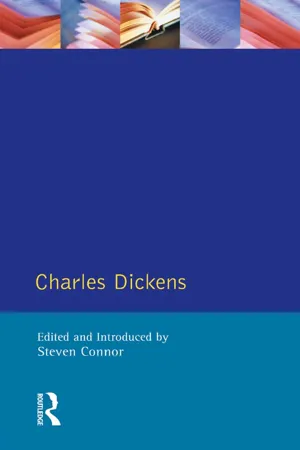
Charles Dickens
About this book
Dickens is second only to Shakespeare in the range and intensity of critical discussion which his work has provoked. His writing is central to literature and culture across the English-speaking world. In this important new anthology, Steven Connor gathers together representative examples of the range of new critical approaches to Dickens over the last two decades.
Trusted by 375,005 students
Access to over 1 million titles for a fair monthly price.
Study more efficiently using our study tools.
Information
1 Introduction
Dead or Alive
If Dickens is a difficult writer, then it is in an unusual, and really rather a difficult sense. The difficulty of Dickens is not that of identifying some enigmatic and fugitive essence, of piecing together a dispersed but everywhere impending truth about him. For, where another writer may seem to deliver too little of their essence, Dickens gives us too much, too indefatigably, in too many versions. His is a writing of raw and excessive self-evidence, of a visibility pushed to a certain painful, perplexing limit. The essential reality of Dickens's writing is not masked by its appearance, for it is writing that functions in the mode of apparition, or of appearance heightened into hallucination. The Dickens world is lit with the lurid glare of melodrama or pantomime, rather than the discreet chiaroscuro of chamber realism. If there is mystery and strangeness in Dickens's work, then they come, not from its sly dissimulation of latent truth, but from the worrying exorbitance of its manifestness. As many have in praise or blame observed, Dickens's characters do not give the sense of psychological depth, nor hint at that secret, dark interiority which has been the guarantee of the plausible in realist writing for the last couple of centuries; in Dickens's art of crass and flagrant caricature, the superficiality goes, so to speak, all the way down. One must add to this all the other kinds of excessiveness that seem to characterise Dickens's writing; the swaggering extravagance of his language, or the Babelian cacophony of his languages; the celebration of the physical body, both in the splendour of its appetite and in the grotesqueness of its ruin; the unabashed excess of the emotional investment in character and situation; and in the sheer associative overload, the ‘opulence and great, careless prodigality’, in Kafka's phrase, of his plots and narrative structures.1
All of these characteristics have proved a recurrent source of trouble for criticism from the nineteenth century onwards, not least because this is the period in which the dignity and cultural centrality of the novel, the form with which Dickens is so famously associated, has been under patient, painful construction. If the gratuity of Dickens's writing is a worry for literary critics, it is as part of the wider problem of the novel as a form, the problem of how to spruce up into respectability this most unruly, polymorphous and, as we might say, polygeneous of genres. As such, Dickens's work presents a miniature version of the general problem of distinguishing authentic culture from the degraded or parasitic forms of popular culture, a problem which came to focus on the novel as a borderline or test-case, since, for all of its aesthetic and cultural aspiration as a literary form, the novel consorted so stubbornly with the threatening energies of mass and popular culture. Nearly all of the nineteenth-century readers of Dickens acknowledge the qualities of energy, excess and invention in his work; but from mid-century onwards, the problem comes to be seen as the absence of a sense of the general forms, aesthetic, moral and social, which might convincingly curb and contain its delinquent particularity. As early as 1865, Henry James, who was to be the chief upholder of the aesthetic dignity of the novel over the next 50 years, was intricately appalled by the lack of a common standard of humanity in Our Mutual Friend, in which the characters ‘have nothing in common with humanity at large’.2 By 1913, Swinburne was criticising in a similar way – and in a sentence which seems unconsciously to mimic the Dickensian dilapidation it laments – ‘the incomparable incoherence of the parts which pretend in vain to compose the incomposite story’ in Little Dorrit.3
For the mid-nineteenth century onwards, the problem of Dickens seems to have been laid out, if not yet laid to rest, in the following way; how is the urgent but dissociative force of his writing to be reconciled with the constraining demands of form? For the nineteenth century, the question of form became bound up in a complicated way with the idea of biological life. Central to the work of many mid-century social critics, such as Ruskin, Arnold and Carlyle, was the concept of ‘organic form’, an ideal of self-creating and self-sustaining natural forms of order. Organicist social criticism very rapidly became a form of social critique, a form of resistance to what were increasingly perceived as the blind, inhuman and mechanical energies associated with industrial and urban expansion. The question of Dickens's relation to the ideal of organic life is a difficult one for critics to resolve. Assuredly, everyone agrees, there is an abundance of ‘life’ to be found in Dickens, but it is a heaving, surging, uncontrollable kind of life, that vandalises the organic ideals of spontaneous, self-creating unity, the orderly unfolding of natural and immanent design and the alloying of inner essence and outward appearance.
Walter Bagehot gives voice to this anxiety in 1858 when he runs together Dickens's particular capacity to register the unnatural fragmentation of city life (‘Everything is there, and everything is disconnected … each scene, to his mind, is a separate scene, – each street a separate street’) with what he calls his faculty of ‘vivification’, by which he means the intensification of external characteristics to the point where they assume the whole life of the characters. In such a world, he says, characters do not have attributes, they are their attributes, enlarged, multiplied, and grotesquely animated:
[Dickens] sees people in the street, doing certain things, talking in a certain way, and his fancy petrifies them in the act. He goes on fancying hundreds of reduplications of that act and that speech; he frames an existence in which there is nothing else but that aspect which attracted his attention.4
What is striking here is the way in which vivification and petrification, death and life, natural and unnatural production, cross and cooperate. For Bagehot, Dickens's vivification is in reality founded upon a lethal reductiveness, propagating life out of an a priori of petrifaction. The metaphor which silently animates Bagehot's evocation of distorted growth is surely that of industrial mass production; with its ‘hundreds of reduplications’, and its uncanny blending of multiplicity and repetition, of difference and similitude, mass production seemed to the tradition of critique that grew through the nineteenth century to be most threatening not because it was merely deathly, but because of its disturbing deployment of death and life as cooperative principles. The problem seems to be that, while Dickens's work can obviously be recruited to the tradition of organic critique, and represented as standing on the side of life against the mechanism of materialist ideology, the very form of his writing draws deeply on the dangerous energies of modern capitalist production and the dissociated kinds of life it requires and procures.
Henry James's criticism of Our Mutual Friend is corrugated by a similar kind of anxiety about the life-in-death of Dickens's later writing. The book, he seems to claim, is grotesquely both dead and alive:
In all Mr Dickens's works the fantastic has been his great resource; and while his fancy was lively and vigorous it accomplished great things. But the fantastic, when the fancy is dead, is a very poor business. The movement of Mr Dickens's fancy in Mrs Wilfer and Mr Boffin and Lady Tippins, and the Lammles and Miss Wren, and even in Eugene Wrayburn, is, to our mind, a movement lifeless, forced, mechanical.5
A moment earlier, James has said that he can bring himself only to congratulate Dickens ‘on his success in what we should call the manufacture of fiction [my emphasis] … Seldom, we reflected, had we read a book so intensely written, so little seen, known, or felt/6 Like the worlds of commerce, industry and the steadily growing State institutions that accompanied and shadowed them, Dickens's writing is at once excessive and deficient; the thinness and lack of real, recognisable ‘life’ that James laments in Our Mutual Friend is contradicted by the continuing sense of extravagance and abundance. There is both too much and too little life’ in this writing that is at once intensely alive and disturbingly drained of vigour. Margaret Oliphant had struck a similar note in 1862 in complaining of the falling away of ‘fertile fullness’ in Dickens's later writing. The ‘forcible and abundant’ art of Dickens's early novels is imaged as a kind of handicraft, which has given way to something like abstract mass production:
He now carves his furniture grotesquely and makes quaint marks upon his friezes; but he has no longer patience to keep up the strain so long as it is necessary for the perfection of a character… The book [Great Expectations] reminds us of a painter's rapid memoranda of some picture, in which he uses his pencil to help his memory. After he has dashed in the outline and composition, he scribbles a hasty ‘carmine’ or ‘ultramarine’ where those colours come. So the reds and blues of Mr Dickens's picture are only written in. He means us to fill in the glow of the natural hue from the feeble symbol of the word which represents it, or perhaps to go back in our own memory to those forcible and abundant days when he wrought out his own odd conceptions minutely as if he loved them.7
From Force to Form
Nearly a century later, Dorothy Van Ghent's famous essay on Great Expectations from The English Novel: Form and Function (1953) evidences an abiding concern with the problem of the spurious forms of life in Dickens's writing, and with the relation between the animate and the inanimate. Like Bagehot, she observes the strange process of interchange in which objects in the material world accrue a malicious and unnatural vitality, while human beings are reduced to the condition of inert objects or endlessly repeated mechanical processes. But, in contrast to Bagehot's baffled intuitiveness, Van Ghent is quite clear and explicit about the connection between formal principles and the processes of industrial production. Dickens's art, she suggests, is a direct response to the processes of nineteenth-century reification, or the reduction of processes to things:
People were becoming things, and things (the things that money can buy or that are the means for making money or for exalting prestige in the abstract) were becoming more important than people. People were being de-animated, robbed of their souls, and things were usurping the prerogatives of animate creatures.8
The most striking difference between Bagehot and the many other writers of the nineteenth and early twentieth centuries who were concerned by the bizarre life-in-death of Dickens's writing lies in the question of literary form. For Bagehot, as we have seen, it seems to be the unconscious congruence between Dickens's own narrative modes and the dissociating world of urban capitalism that is perturbing. For Van Ghent, by contrast, it is necessary to make a distinction between the force of Dickens's writing and its form, between the thwarted and distorted patterns of life that are the subject of Dickens's writing and the patterning effect of that writing itself. This marks a very important transition in the critical reception and constitution of Dickens. According to the account that had become customary by the middle of our century, the life of Dickens's writing is to be found in its moral form rather than in the spasmodic and adventitious energies of its content. Thus, if the inner life of what Van Ghent calls the ‘fungoid’ Miss Havisham is unimaginable, nevertheless, ‘in the art of Dickens (distinguishing that moral dialectic that arises not solely from the ‘characters’ in a novel but from all the elements in the aesthetic structure) there is a great deal of “inner life” ‘.9 Here, the intricate responsiveness of novelistic form, balancing and contrasting different attitudes, rounding into a whole the disaggregated gratuity of human difference, serves to compensate for the lack of obvious or exemplary value or moral sensibility within the individual characters, or in the person of the narrator.
Obscure and difficult though this notion of ‘moral form’ is, it has a very successful career in different versions of Dickens criticism throughout the twentieth century. One may say that, where earlier criticism tended to exclude Dickens's work from the kind of organic critique that the form of the novel came to represent, the maturing of that cultural critique into its literary-aesthetic form in the twentieth century was accompanied by a growing sense of the necessity of recruiting Dickens. Dickens's exceptional status was what made it more than ever necessary to present his work as exemplary. The history of twentieth-century attempts to read Dickens is the history of attempts to accommodate his unruly vitality to the odd, but powerful, blend of vitalism and formalism which dominated literary and cultural theory up to about the 1960s.
One can begin to find some early signs of this process of accommodation in the work of the Jamesian critic Percy Lubbock. In his remarks on Bleak House in The Craft of Fiction (1921), Lubbock suggests that Dickens's writing, for all its effect of spreading and ungoverned accretion, is in fact highly structured. Following in his customarily formulaic way the Jamesian recommendations of dramatisation over summary, direct ‘showing’ rather than secondhand ‘telling’, and looking for the characteristic Jamesian coordination of immediacy and elaborate structural artifice, Lubbock discovers a principle of unity in Bleak House which had escaped many earlier commentators. Unlike Balzac's, writes Lubbock, Dickens's imagination ‘is not… divided against itself. The world which he peopled with Skimpole and Guppy and the Bayham Badgers was a world that could easily include Lady Dedlock.’10 The principle of unity is to be found not in any particular encompassing theory or vision, but in a more abstract principle of structural isomorphism, in the fact that ‘They and she alike are at the same angle to literal fact, they diverging one way, she another.’11 Oddly, the very feature which for most critics hitherto had militated against that wholeness of vision required of the novel, Dickens's tendency to abstract and enlarge incidental characteristics in place of rounded characters, becomes for Lubbock a mark of Dickens's structural attentiveness, his determination to frame and organise his work in the most dr...
Table of contents
- Cover
- Half Title
- Title Page
- Copyright Page
- Table of Contents
- General Editors' Preface
- Acknowledgements
- 1 Introduction
- 2 Repetition, Repression and Return: The Plotting of Great Expectations
- 3 Dickens's Bleak House
- 4 The Bad Faith of Pip's Bad Faith: Deconstructing Great Expectations
- 5 Heteroglossia in the Novel: Little Dorrit
- 6 Polyphony and Problematic in Hard Times
- 7 Prison-bound: Dickens and Foucault (Great Expectations)
- 8 Discipline in Different Voices: Bureaucracy, Police, Family, and Bleak House
- 9 Ideology and Literary Form: Charles Dickens
- 10 Writing as a Woman: Dickens, Hard Times and Feminine Discourses
- 11 Homophobia, Misogyny and Capital: The Example of Our Mutual Friend
- 12 Repression and Representation: Dickens's General Economy (Our Mutual Friend)
- 13 Space, Place and the Body of Riot in Barnaby Rudge
- Further Reading
- Index
Frequently asked questions
Yes, you can cancel anytime from the Subscription tab in your account settings on the Perlego website. Your subscription will stay active until the end of your current billing period. Learn how to cancel your subscription
No, books cannot be downloaded as external files, such as PDFs, for use outside of Perlego. However, you can download books within the Perlego app for offline reading on mobile or tablet. Learn how to download books offline
Perlego offers two plans: Essential and Complete
- Essential is ideal for learners and professionals who enjoy exploring a wide range of subjects. Access the Essential Library with 800,000+ trusted titles and best-sellers across business, personal growth, and the humanities. Includes unlimited reading time and Standard Read Aloud voice.
- Complete: Perfect for advanced learners and researchers needing full, unrestricted access. Unlock 1.4M+ books across hundreds of subjects, including academic and specialized titles. The Complete Plan also includes advanced features like Premium Read Aloud and Research Assistant.
We are an online textbook subscription service, where you can get access to an entire online library for less than the price of a single book per month. With over 1 million books across 990+ topics, we’ve got you covered! Learn about our mission
Look out for the read-aloud symbol on your next book to see if you can listen to it. The read-aloud tool reads text aloud for you, highlighting the text as it is being read. You can pause it, speed it up and slow it down. Learn more about Read Aloud
Yes! You can use the Perlego app on both iOS and Android devices to read anytime, anywhere — even offline. Perfect for commutes or when you’re on the go.
Please note we cannot support devices running on iOS 13 and Android 7 or earlier. Learn more about using the app
Please note we cannot support devices running on iOS 13 and Android 7 or earlier. Learn more about using the app
Yes, you can access Charles Dickens by Steven Connor in PDF and/or ePUB format, as well as other popular books in Literature & Literary Criticism. We have over one million books available in our catalogue for you to explore.