eBook - ePub
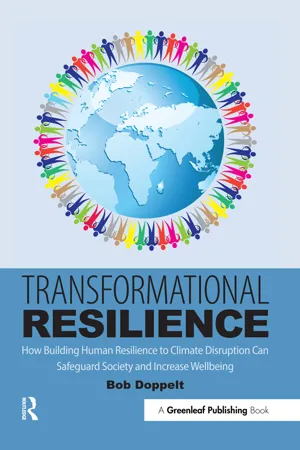
Transformational Resilience
How Building Human Resilience to Climate Disruption Can Safeguard Society and Increase Wellbeing
- 368 pages
- English
- ePUB (mobile friendly)
- Available on iOS & Android
eBook - ePub
Transformational Resilience
How Building Human Resilience to Climate Disruption Can Safeguard Society and Increase Wellbeing
About this book
Using the author's extensive experience of advising public, private and non-profit sectors on personal, organization, and community behavioral and systems change knowledge and tools, this book applies a new lens to the question of how to respond to climate change. It offers a scientifically rigorous understanding of the negative mental health and psychosocial impacts of climate change and argues that overlooking these issues will have very damaging consequences. The practical assessment of various methods to build human resilience offered by Transformational Resilience then makes a powerful case for the need to quickly expand beyond emission reductions and hardening physical infrastructure to enhance the capacity of individuals and groups to cope with the inevitable changes affecting all levels of society.Applying a trauma-informed mental health and psychosocial perspective, Transformational Resilience offers a groundbreaking approach to responding to climate disruption. The book describes how climate disruption traumatizes societies and how effective responses can catalyze positive learning, growth, and change.
Information
Part 1:
The personal mental health and psycho-social-spiritual impacts of climate disruption
1
The psychological effects of climate disruption on individuals
As Superstorm Sandy roared through her town destroying buildings and flooding streets, Kathy Michaels and her family took refuge in the attic of their home. “We were holding hands. We thought it would maybe be our last night on Earth,” she said. They survived, and since that time Michaels has tried antidepressants, psychotherapy, and weekly support groups to cope with the trauma she experienced. But the distress persists. “You don’t like things like this to define your life, but I don’t think I’ll ever be the same,” she concluded.17
A record drought in Queensland, Australia has dragged on since 2013, causing much more than financial loss to farmers. “I can say from personal experience, the effects of the drought will lead many to suffer depression and a number to commit suicide. The mental stress suffered by watching your stock die, your family’s livelihood and in some cases generations of family work fail is crushing,” said Brian Egan, founder of Aussie Helpers.18
These stories illustrate how the traumas and toxic stresses generated by fast-moving extreme weather events and slow-growing climate impacts can undermine the mental health of individuals. These psychological problems, and much more, will become widespread as global temperatures heat up. As more people become psychologically and emotionally distressed, psychosocial-spiritual maladies will also increase, including interpersonal aggression, crime, violence, extremism, terrorism, and more.
However, virtually no attention has been given to preparing individuals and groups for the psychological and psycho-social-spiritual woes generated by climate disruption. This is a monumental mistake. Unless efforts are rapidly launched to help people learn how these events might affect their minds and bodies as well as skills to respond constructively to these adversities, the negative reactions will undermine the health and wellbeing of individuals, families, organizations, communities, and entire societies. They also threaten to stall or completely sink efforts to cut emissions and prepare for climate impacts, making it even more difficult to reduce climate disruption to manageable levels. On the other hand, if people learn simple resilience skills, they will have a much greater likelihood of using adversities such as those generated by rising global temperatures to learn, grow, and thrive.
This underscores that today’s two dominant responses to climate disruption—emission reductions (usually called mitigation) and preparing physical infrastructure and natural resources to adapt to impacts (called adaptation)—while essential, are by themselves woefully insufficient for the challenges that lie ahead. A third major focus is needed: building the capacity of individuals and groups of all types to cope with climate-disruption-related traumas as toxic stresses in ways that not only prevent personally and socially harmful reactions, but also increase individual and collective well being and the condition of the natural environment and climate substantially above current levels. This is the capacity for Transformational Resilience.
No matter how fast emissions are reduced significant physical damage is now inevitable
To understand the need for building the capacity of individuals and groups for Transformational Resilience, it is important to have a solid understanding of the types of physical damage rising temperatures will produce, and how those impacts are likely to negatively affect human psychological, social, and spiritual well being. Remember, reading the information that follows can be distressing. If it becomes too much to bear, I suggest you skip to Chapters 3 and beyond to learn about how building widespread capacity for Transformational Resilience can minimize some of the problems. But the information presented in this chapter and the next is too important to ignore, so when you are ready, circle back and read it.
In 2014, the UN-sponsored Intergovernmental Panel on Climate Change’s (IPCC) Fifth Assessment Report released a report stating that that average global surface temperatures have already increased by 0.85°C (about 1.3°F) above the levels that existed in the late 1800s. In late 2015 the National Oceanic and Atmospheric Administration (NOAA), the National Aeronautics and Space Administration (NASA), and other global temperature monitoring organizations said that global temperatures have now risen by 1°C (1.8°F).19 In order to avoid triggering runaway climate disruption, at the UN Climate Summit in Copenhagen in 2009, the international community agreed to limit the rise in global temperatures to 2°C above pre-industrial levels, and we are already halfway there. However, Dr. James Hansen, former head of NASA’s Goddard Institute of Space Studies, who is considered the god father of climate research, along with 16 colleagues, says that 2°C is too high. In a report released in July of 2015 they said that anything more than a 1.5°C temperature increase above pre-industrial levels would pose a significant chance of unleashing civilization-altering climate disruption.20
Hansen and his colleagues also said that it is still technically possible to keep temperatures from rising more than 1.5°C above pre-industrial levels. However, that means further temperature increases must be limited to 0.5°C. This will require a massive full-out global undertaking. Researchers at the International Institute for Applied Systems Analysis and the Potsdam Institute for Climate Impact, for instance, calculated in 2015 that enough greenhouse gasses are already concentrated in the atmosphere to lock in at least another 0.5°C temperature increase. This indicates that global temperatures will rise beyond 1.5°C to at least 2°C by mid-century. Reinforcing Hansen’s statement, those researchers also calculate that, with big rapid cuts in emissions, it is possible to bring temperatures back down to 1.5°C by 2100.21 But the rise in temperatures to 2°C indicates big trouble ahead.
Further, even though the UN Climate Summit held in Paris in December of 2015 led to a global agreement to limit global temperatures to “well below” 2°C, no legally binding targets were included in the accord and it was left to each nation to determine how to cut their emissions. Consequently, following the summit, Dr. Hansen called the process “a fraud really, a fake.” He went on to say that “It’s just worthless words. There is no action, just promises.”22 I dearly hope Dr. Hansen is wrong and that the Paris summit is the wakeup call political, business, and community leaders worldwide need to grasp the risks and make quick dramatic cuts in emissions. But, so far, very few have been willing to initiate the changes required to slash emissions to levels that the best science says are needed to prevent catastrophe.
The bottom line is that, even if the international community begins to rapidly cut emissions, temperatures will still rise to levels that guarantee a wide range of destructive physical impacts.
The physical impacts of climate disruption
What types of impact can be expected? For the sake of simplicity I’ve divided them into three categories: fast-moving direct physical impacts; slow-growing direct physical impacts; and Black Swan events.
Fast-moving direct physical impacts
The consequences that most people associate with climate disruption are the direct physical impacts generated by major windstorms, rainstorms, snowstorms, floods, heat waves, cold spells, and other quickly developing extreme weather events. Research in 2015 by the Commonwealth Scientific and Industrial Research Organization (CISRO), one of Australia’s leading climate science organizations, projected that climate disruption would double the number of extreme weather events in coming years.23
Indeed, extreme weather is increasing across the planet. Since 2007 extraordinary floods have impacted Pakistan, China, England, Italy, and other nations on every continent on Earth. Major heat waves and wildfires have impacted Russia. Record heat waves, cold snaps, snowstorms, wildfires, floods and hurricanes have hammered the U.S.
Research by Georgia Tech University and the National Center for Atmospheric Research found that since the 1970s the number of Category 4 and 5 hurricanes, which are the most powerful, have increased by 20–35% around the world.24 A few years after that study was released, research found that about twice as many Atlantic hurricanes form each year on average compared with a century ago. Both studies concluded that warmer sea surface temperatures and altered wind patterns associated with climate disruption are fueling much of the increase.25
Many more frequent and intense fast-moving extreme weather events can be expected in coming years as global temperatures rise.
Slow-growing direct physical impacts
Less obvious to some people but equally important are a wide variety of slowly developing destructive physical impacts produced by climate disruption. These include drought, desertification, glacial melting that contributes to sea-level rise, coastal erosion, acidification of the oceans and fresh water, land subsidence due to depleted water tables, decreased air quality, soil impairment, forest degradation, biodiversity loss, disease expansion, and other gradual changes with majorly detrimental effects.26
Record drought, for example, hit the U.S. state of California particularly hard in 2014 and 2015. January is usually San Francisco’s wettest month, averaging four and a half inches of rain since 1850. However, the city saw no rain at all in January 2015—not a drop. In the previous 165 years, that had never happened. The closest the city came to a rainless January before that was when it got 0.06 inches—and that occurred the year before—in 2014.
Sea levels are rising slowly, though at a faster rate than climate scientists originally projected. Already in many locations around the world the result is flooded estuaries and lowlands, higher tides, larger and more destructive storm surges, increased coastal erosion, and the salinization of ground-water and soils.27
Conservative estimates suggest that about a 0.6 m (2 feet) sea-level rise is likely by the year 2100. New research suggests, however, that the high end might be a 6 m (20 feet) rise over the long term due to melting ice sheets and glaciers.28 No matter what the actual increase turns out to be, by the end of the century—and maybe much sooner—densely populated coastal areas on every continent ranging from London to Mumbai and New York will be continually threatened by flooding or completely submerged. The physical safety as well the homes, businesses, and other assets of millions of people will be lost unless gargantuan amounts of money are spent to build dykes, install pumps, and implement other actions to prevent it. Even then, in many cases it will be impossible to prevent significant ongoing damage.
Black Swan events
Another type of damaging physical impact that will become increasingly common as climate disruption unfolds is a Black Swan event.29 This term describes a change that occurs somewhere at the global or regional levels which, like one domino pushing over another, slowly cascades through multiple systems producing surprising harmful effects.
An example is the growing body of research that suggests that the contrasting weather extremes experienced in the U.S. in the winter of 2015, when the east coast was exceptionally cold and snowy and the west coast was unusually warm and dry, resulted at least in part from the accelerated warming taking place in the Arctic. Additional warmth in one part of the globe—the Arctic—appears to have weakened the polar jet stream and increased the frequency of periods where frigid Arctic air was pushed south into the eastern U.S. impacting people and ecosystems, while warmer air moved north into the western half of the country leading to drought and other impacts.30 Many other surprising and often counterintuitive Black Swan events can be expected as the Earth’s climate system heats up.
The physical impacts directly affect society
The physical damage caused by climate disruption will continually degrade or destroy human-built structures and systems as well as the natural resources society depends on. For example, residential and commercial buildings can be impaired or totally ruined by extreme weather events, as can transportation, water delivery, sewage, energy supply, and communications systems. Crop production and food supplies can be reduced or completely wiped out by extreme heat, drought, catastrophic storm, or new diseases and insects. Supply chains can be disrupted and businesses can be temporari...
Table of contents
- Cover
- Half Title
- Title
- Copyright
- Dedication
- Contents
- List of figures, tables and boxes
- Acknowledgments
- Introduction: Climate disruption can be humanity’s greatest teacher
- Part 1: The personal mental health and psycho-social-spiritual impacts of climate disruption
- Part 2: Presencing—the first building block of Transformational Resilience
- Part 3: Purposing—the second building block of Transformational Resilience
- Part 4: Building Transformational Resilience in organizations and communities
- Notes
- About the author
- Index
Trusted by 375,005 students
Access to over 1.5 million titles for a fair monthly price.
Study more efficiently using our study tools.
Frequently asked questions
Yes, you can cancel anytime from the Subscription tab in your account settings on the Perlego website. Your subscription will stay active until the end of your current billing period. Learn how to cancel your subscription
No, books cannot be downloaded as external files, such as PDFs, for use outside of Perlego. However, you can download books within the Perlego app for offline reading on mobile or tablet. Learn how to download books offline
Perlego offers two plans: Essential and Complete
- Essential is ideal for learners and professionals who enjoy exploring a wide range of subjects. Access the Essential Library with 800,000+ trusted titles and best-sellers across business, personal growth, and the humanities. Includes unlimited reading time and Standard Read Aloud voice.
- Complete: Perfect for advanced learners and researchers needing full, unrestricted access. Unlock 1.5M+ books across hundreds of subjects, including academic and specialized titles. The Complete Plan also includes advanced features like Premium Read Aloud and Research Assistant.
We are an online textbook subscription service, where you can get access to an entire online library for less than the price of a single book per month. With over 1.5 million books across 990+ topics, we’ve got you covered! Learn about our mission
Look out for the read-aloud symbol on your next book to see if you can listen to it. The read-aloud tool reads text aloud for you, highlighting the text as it is being read. You can pause it, speed it up and slow it down. Learn more about Read Aloud
Yes! You can use the Perlego app on both iOS and Android devices to read anytime, anywhere — even offline. Perfect for commutes or when you’re on the go.
Please note we cannot support devices running on iOS 13 and Android 7 or earlier. Learn more about using the app
Please note we cannot support devices running on iOS 13 and Android 7 or earlier. Learn more about using the app
Yes, you can access Transformational Resilience by Bob Doppelt in PDF and/or ePUB format, as well as other popular books in Commerce & Déontologie des affaires. We have over 1.5 million books available in our catalogue for you to explore.