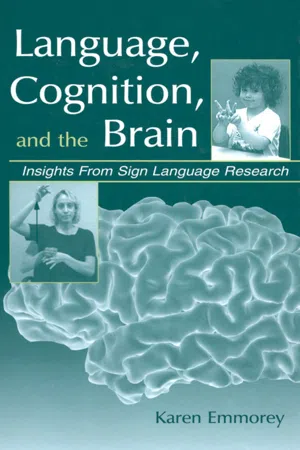
Once signed languages are recognized as natural human languages, a world of exploration opens up. Signed languages provide a powerful tool for investigating the nature of human language and language processing, the relation between cognition and language, and the neural organization of language. The value of sign languages lies in their modality. Specifically, for perception, signed languages depend upon high-level vision and motion processing systems, and for production, they require the integration of motor systems involving the hands and face. These facts raise many questions: What impact does this different biological base have for grammatical systems? For online language processing? For the acquisition of language? How does it affect nonlinguistic cognitive structures and processing? Are the same neural systems involved?
These are some of the questions that this book aims at addressing. The answers provide insight into what constrains grammatical form, language processing, linguistic working memory, and hemispheric specialization for language. The study of signed languages allows researchers to address questions about the nature of linguistic and cognitive systems that otherwise could not be easily addressed.
- 408 pages
- English
- ePUB (mobile friendly)
- Available on iOS & Android
eBook - ePub
About this book
Information
Publisher
Psychology PressYear
2001Print ISBN
9780805833997
9780805833980
Edition
1eBook ISBN
9781135664800
Chapter 1
Introduction
Once signed languages are recognized as natural human languages, a world of exploration opens up. Signed languages provide a powerful tool for investigating the nature of human language and language processing, the relation between cognition and language, and the neural organization for language. The value of signed languages lies in their modality. Specifically, for perception, signed languages depend on high-level vision and motion-processing systems, and for production, they require the integration of motor systems involving the hands and face. These facts raise many questions: What impact does this different biological base have for grammatical systems? For online language processing? For the acquisition of language? How does it affect nonlinguistic cognitive structures and processing? Are the same neural systems involved? These are some of the questions that this book addresses. The answers provide insight into what constrains grammatical form (chap. 2), language processing (chap. 4), linguistic working memory (chap. 7), and hemispheric specialization for language (chap. 9). As we see throughout the volume, the study of signed languages allows researchers to address questions about the nature of linguistic and cognitive systems that could not otherwise be easily addressed.
Before we begin, however, it is important to quickly debunk several common myths and misconceptions about sign language.
Myth Number 1: There is a universal sign language. No sign language is shared by deaf people of the world. There are many distinct sign languages that have evolved independently of each other. Just as spoken languages differ in their lexicon, in the types of grammatical rules they contain and in historical relationships, signed languages also differ along these parameters. For example, despite the fact that American Sign Language (ASL) and British Sign Language are surrounded by the same spoken language, they are mutually unintelligible. Sign languages are most often named for the country or area in which they are used (e.g., Mexican Sign Language, Swedish Sign Language, Taiwanese Sign Language). The exact number of sign languages in the world is not known. The signed languages that will concern us in this book are not “secondary” sign languages, such as the sign system used by Trappist monks or the sign language used by hearing Australian Aborigines during mourning (when silence is required; Kendon, 1984). These systems differ from the primary signed languages of Deaf1communities in ways that suggest strong links to an associated spoken language.
Myth Number 2: Sign languages are made up of pictorial gestures and are similar to mime. As will become apparent in chapter 2, sign languages have an intricate compositional structure in which smaller units (such as words) are combined to create higher level structures (such as sentences), and this compositional structure is found at all linguistic levels (phonology, morphology, syntax, and discourse). It may seem odd to use the term phonology here because there is no sound in sign language; however, it turns out that sign languages exhibit systematic variations in form that are unrelated to meaning distinctions. That is, there is a componential level of structure below the level of the morpheme (the smallest meaningful unit) that is akin to phonological structure in spoken languages (see chap. 2). Such complex and hierarchical levels of structure are not present in pantomime. Pantomime differs from a linguistic system of signs in other important and systematic ways as well. For example, pantomime is always transparent and iconic, but signs can be opaque and arbitrary. The space in which signs are articulated is much more restricted than that available for pantomime—pantomime can involve movement of the entire body, whereas signing is constrained to a space extending from just below the waist to the top of the head. As discussed in chapter 9, the ability to pantomime and the ability to sign can be differentially affected by brain damage, indicating nonidentical neural systems are involved.
Myth Number 3: Sign languages are based on oral languages. American Sign Language has been mistakenly thought to be “English on the hands.” However, ASL has an independent grammar that is quite different from the grammar of English (see chap. 2). For example, ASL allows much freer word order compared to English. English contains tense markers (e.g., -ed to express past tense), but ASL (like many languages) does not have tense markers that are part of the morphology of a word; rather tense is often expressed lexically (e.g., by adverbs such as “yesterday”). There are no indigenous signed languages that are simply a transformation of a spoken language to the hands. There are invented systems used in educational settings that manually code spoken language, but they are not acquired in the same manner as natural signed languages, and they do not arise spontaneously.
One might ask, “If sign languages are not based on spoken languages, then where did they come from?” However, this question is as difficult to answer as the question, “Where did language come from?” We know very little about the very first spoken or signed languages of the world, but research is beginning to uncover the historical relationships between sign languages, as has been done for spoken languages (e.g., McKee & Kennedy, 2000; Woodward, 2000). For example, the origin of American Sign Language can be traced to the existence of a large community of Deaf people in France in the 18th century (Lane, 1984; Woodward, 1978). These people attended the first public school for the deaf, and the sign language that arose within this community is still used today in France. In 1817, Laurent Clerc, a Deaf teacher from this French school, along with Thomas Gallaudet, established the first public school for the deaf in the United States. Clerc introduced French Sign Language into the school, and the gestural systems and indigenous signs of the American children attending this school mixed with French Sign Language to create a new form that was no longer recognizable as French Sign Language. ASL still retains a historical resemblance to French Sign Language, but both are now distinct languages.
Myth Number 4: Sign languages cannot convey the same subtleties and complex meanings that spoken languages can. On the contrary, sign languages are equipped with the same expressive power that is inherent in spoken languages. Sign languages can express complicated and intricate concepts with the same degree of explicitness and eloquence as spoken languages. The linguistic structuring that permits such expressive power is described in chapter 2, and examples of ASL literature and poetry are listed at the end of that chapter. This particular myth apparently stems from the misconception that there are “primitive” languages. This label is often applied to oppressed peoples. For example, it was used by turn-of-thecentury Westerners to describe African languages (see Baynton, 1996).
There are two main objectives of this introductory chapter. First, I want to highlight a domain in which sign language research has recently had an important impact, namely, our understanding of the forces that drive language genesis. This research is tremendously exciting because it begins to answer basic questions about the nature of language origins (e.g., Does language creation occur gradually or abruptly?) and the critical role that children play in language change (e.g., What are the contributions of the child vs. the adult in the evolution of language?). Second, we examine the nature of the Deaf community in the United States. The research described throughout this book is primarily concerned with the members of this community, and, as we will see, the very nature of the Deaf population provides a unique opportunity to investigate the critical period hypothesis for language acquisition (chap. 6) and the effects of auditory deprivation versus linguistic experience on spatial cognition (chap. 8). It is also important to set ASL within a sociolinguistic context by characterizing language variation within the Deaf community and by contrasting ASL with other sign systems. Although research on other sign languages is presented throughout this book, the primary focus is on American Sign Language for two reasons: (1) The majority of research has been conducted with this language and (2) Focusing on a single language provides a coherent thread within the book. Nonetheless, we begin, not with American Sign Language, but with a new sign language that is emerging in Nicaragua. This project touches on issues that we will examine throughout the book, for example, the critical period for language acquisition, the gestural roots of sign languages, and the nature of linguistic structure in human languages.
DOCUMENTING THE BIRTH OF A LANGUAGE: THE NICARAGUAN SIGN LANGUAGE PROJECT
In 1979, the Sandinistas overthrew the Somoza government of Nicaragua and shortly thereafter began to establish educational reforms and public schools throughout the country. In Managua, a primary school for special education was opened to deaf children from all over the country (Polich, 1998). Prior to entering this school, deaf children had been generally kept isolated within their families (there was a great stigma attached to being deaf), and there was no interaction among these isolated deaf individuals. Kegl, Senghas, Coppola, and colleagues have been investigating what happened when these previously isolated children and adolescents came together and began to interact with each other (Kegl, 1994; Kegl & Iwata, 1989; Kegl, A. Senghas, & Coppola, 1999; A. Senghas, 1994, 1995a, 1995b, 2000; A. Senghas & Coppola, 2001; A. Senghas, Coppola, Newport, & Supalla, 1997; R. Senghas & Kegl, 1994). What these authors report is that even though the school initially advocated an oral (rather than a signing) approach to education, the children nonetheless immediately began gesturing and signing with each other on the playground, on the buses, and in class (behind the teacher’s back). A language had evidently begun to emerge where none had previously existed.
Kegl, Senghas, and Coppola (1999) argued that the first step in this process was home sign, called mimicas by the Nicaraguans. Home sign is an idiosyncratic gesture system that is the sole means of communication between an isolated deaf person and his or her hearing family (see chap. 6). The home signs of isolated deaf Nicaraguans tend to be action based (i.e., pantomime like) rather than expressing names for things, and single gestures cover a range of concepts (e.g., “beard” for man, brother, father, etc.; Kegl & McWhorter, 1997; Morford & Kegl, 2000). Notions such as colors, emotions, or tense tend not to be encoded, and family members can usually list the small repertoire of gestures under the command of the home signer. Home signers also do not use multiple signs in a relational way that resemble syntactic organization. Thus, Kegl and McWhorter (1997) concluded “older Nicaraguan home signers, while possibly developing conventionality in their home sign systems, do not end up spontaneously generating a language” (p. 32). For a language to emerge, a community of users is necessary, and this is what the Managua school provided. Over 400 deaf children came together within a few short years after the school opened.
As previously isolated deaf individuals began to interact with one another, a form of intercommunication arose—a “pidgin” between home sign systems. This pidgin form constituted an intermediate stage between home sign and the emergence of a full-fledged sign language. Evidence for a distinction between this intermediate home sign pidgin and the full blown Nicaraguan Sign Language comes from comparing the signing of individuals who entered the signing community at different years in the community’s history. A. Senghas (1995a, 1995b) and Kegl, Senghas, and Coppola (1999) compared narrative samples from individuals who entered the Deaf community either prior to 1983 or after 1983 and who were younger than age 10 when they entered (i.e., before the critical period for language learning; see chap. 6). This grouping compares the first generation of signers within the community (the pidgin signers) with a second generation of signers who were exposed to this pidgin as children. The linguistic distinctions between these two groups of signers (and isolated Nicaraguan home signers) are listed in Appendix B. Briefly, the generation of signers who came to Managua in the mid-to-late 1980s are more fluent, express more information in less time, and exhibit more grammatical complexity. These linguistic distinctions indicate that the second generation of signers acquired a much richer linguistic system than those who entered the community earlier (in the late 1970s or early 1980s). But how did this linguistic change come about? Was the evolution of Nicaraguan Sign Language into a fullblown language a gradual process or was there an abrupt discontinuity between the early pidgin form and what is now called Nicaraguan Sign Language? The data from A. Senghas (1995a, 1995b) and Kegl, Senghas, and Coppola (1999) argue for the latter hypothesis.
Specifically, A. Senghas directly compared year of entry (before or after 1983) and age of entry into the signing environment: young (birth–6½ years old), medium (6½–10 years old), and old (10½–30 years old). The year of entry results are those presented in Appendix B; that is, signers who entered the community earlier use a less complex pidgin form, whereas more complex signing is observed for those who entered the Deaf community after 1983. In addition, A. Senghas found that the chronological age at which a deaf person entered the signing community had a strong effect on fluency and on the ability to command more complex structures. Specifically, the younger group signed more rapidly, produced more arguments per verb, used spatial agreement to mark verb arguments (see chap. 2), and used more object classifiers (see chap. 3). Furthermore, the more recently the two younger groups entered the community, the more complex their language, but for the oldest group, the year of entry had little effect on the fluency or grammatical complexity of their language. This last finding provides evidence that there is a critical period for optimal language learning (see chap. 6) and, perhaps more importantly, that the changes in Nicaraguan Sign Language were being driven by the youngest children—not by adult members of the community. It is striking that the signing of a 7-year-old Deaf child exceeds the complexity and fluency of a 30-year-old Deaf adult who entered the community 20 years earlier— but this is in fact what Kegl, A. Senghas, and colleagues observed.
These findings indicate that Nicaraguan Sign Language arose abruptly when very young children began to restructure and regularize the highly variable and arguably impoverished sign pidgin. Why children, but not adults, have this capacity is discussed in more detail in chapter 6. The basic explanation stems from several factors: Children appear to be predisposed to find certain types of structure within their linguistic input, they have a limited memory capacity that acts as a noise filter, and the neurological substrate for language learning is still malleable and capable of change. The findings also show that the period of language emergence is extremely rapid—within a generation. Although the pidgin form is still used today by signers who were adolescents when they came to Managua in the early 1980s, this pidgin could easily disappear when these older signers are no longer in the community. The gift that Kegl and colleagues have given us is a record of a language as it is born, before the traces of its birth disappear with history.
Finally, it is worth noting that this type of research project could not be carried out with a spoken language simply because the circumstances that give rise to the emergence of a signed language do not exist for hearing people. Nonetheless, the type of language genesis and evolution observed in Nicaragua is not unique to signed languages and is found in spoken languages as the process of creolization (Bickerton, 1981; Kegl & Iwata, 1989). Spoken language pidgins arise when distinct languages come into contact via trade or domination. Pidgins, such as Tok Pisin, used in Papua, New Guinea, have relatively small vocabularies, limited morphology, and simple rule systems. It is important to note that the pidgin in Nicaragua arose, not from contact between already existing languages, but from contact between idiosyncratic home sign systems (Kegl, Senghas, & Coppola, 1999). However, pidgin languages are not anyone’s native language, either spoken or signed. When a pidgin is adopted by a community and children begin to learn it as a first language, the pidgin becomes a creole language. For example, Haitian Creole is used by the descendants of slaves who arrived on plantations speaking many different African languages. These early arrivals first created a pidgin to communicate, which then became a creole when it was acquired by their children as a first language. Creole languages exhibit more complex word structure with a larger array of grammatical rules, compared to pidgins. For spoken languages, the study of the evolution of a pidgin into a full-blown language is quite difficult because evidence of the pidgin form quickly disappears—only historical records are left. The Nicaraguan case is unprecedented because researchers have been able to observe the creolization process firsthand.
THE AMERICAN DEAF COMMUNITY AND SOCIOLINGUISTIC CONTEXT
Approximately 2million people in the United States are deaf and cannot hear or understand speech even with amplification; however, only about 300,000 people make up the Deaf community (Schein, 1989; Schein & Stewart, 1995). Members of the American Deaf community not only use ASL as their primary and preferred language, they also cherish it as a part of their identity (just as American Indians value Navajo or Cherokee as part of their individual and cultural identity). People who are deafened later in life seldom use sign language, and some deaf people educated in an oral environment also may not use ASL. Members of the Deaf community do not see themselves as disabled, preferring to be called “Deaf,” rather than “hearing impaired” (Padden & Humphries, 1988). Deaf people form a community by virtue of shared values, interests, customs, and social goals, and Deaf culture is unique in its world view, artistic expression, and humor. Deaf people seek each other out and join together in many social, political, and athletic organizations both locally and nationally (as well as internationally). For excellent discussions of Deaf culture and the Deaf community see A Journey Into the DEAF-WORLD (Lane, Hoffmeister, & Bahan, 1996) and Deaf in America: Voices From a Culture (Padden & Humphries, 1988).
Although most Deaf people use ASL as their primary language in adulthood, they vary widely as to when they were first exposed to the language. Deaf children born to Deaf signing parents are the exception; these children acquire sign language in a manner parallel to hearing children acquiring a spoken language (see chap. 5). However, only about 10% of Deaf children have Deaf parents (Schein & Delk, 1974), and thus over 90% of Deaf children are born to parents who do not know sign language.2 Therefore, these children may have no effective language exposure in infancy and early childhood. A second reason sign language is often acquired late in childhood by many Deaf children is that, until recently, the majority of elementary schools prohibited signing in classrooms and discouraged hearing parents from signing (Lane et al., 1996). Deaf children with hearing parents typically acquire sign language when they enter a residential school and become immersed with other Deaf children and adults. ASL is not formally taught in these schools; rather, ASL is the everyday language of the children. Age of exposure to language often occurs around 4 to 6 years when many Deaf children enter residential schools; however, if the parents first send their child to a school that successfully suppresses signing, then age of exposure may not occur until much later. The educational and genetic factors of deafness thus create situations in which primary language acquisition begins at different ages, ranging from birth to quite late in childhood. The effects of such delayed exposure to language are discussed in chapter 6.
Much of the research described in this volume has been conducted with native ASL signers; that is, Deaf (and sometimes hearing) people with Deaf signing parents wh...
Table of contents
- Cover Page
- Title Page
- Copyright Page
- Preface
- Notation Conventions
- Chapter 1 Introduction
- Chapter 2 The Structure of American Sign Language: Linguistic Universals and Modality Effects
- Chapter 3 The Confluence of Language and Space
- Chapter 4 Psycholinguistic Studies of Sign Perception, Online Processing, and Production
- Chapter 5 Sign Language Acquisition
- Chapter 6 The Critical Period Hypothesis and the Effects of Late Language Acquisition
- Chapter 7 Memory for Sign Language: Implications for the Structure of Working Memory
- Chapter 8 The Impact of Sign Language Use on Visuospatial Cognition
- Chapter 9 Sign Language and the Brain
- Epilogue
- Appendix A: Handshapes in American Sign Language
- Appendix B: Linguistic Distinctions Among Communication Forms in Nicaragua
- References
Trusted by 375,005 students
Access to over 1.5 million titles for a fair monthly price.
Study more efficiently using our study tools.
Frequently asked questions
Yes, you can cancel anytime from the Subscription tab in your account settings on the Perlego website. Your subscription will stay active until the end of your current billing period. Learn how to cancel your subscription
No, books cannot be downloaded as external files, such as PDFs, for use outside of Perlego. However, you can download books within the Perlego app for offline reading on mobile or tablet. Learn how to download books offline
Perlego offers two plans: Essential and Complete
- Essential is ideal for learners and professionals who enjoy exploring a wide range of subjects. Access the Essential Library with 800,000+ trusted titles and best-sellers across business, personal growth, and the humanities. Includes unlimited reading time and Standard Read Aloud voice.
- Complete: Perfect for advanced learners and researchers needing full, unrestricted access. Unlock 1.5M+ books across hundreds of subjects, including academic and specialized titles. The Complete Plan also includes advanced features like Premium Read Aloud and Research Assistant.
We are an online textbook subscription service, where you can get access to an entire online library for less than the price of a single book per month. With over 1.5 million books across 990+ topics, we’ve got you covered! Learn about our mission
Look out for the read-aloud symbol on your next book to see if you can listen to it. The read-aloud tool reads text aloud for you, highlighting the text as it is being read. You can pause it, speed it up and slow it down. Learn more about Read Aloud
Yes! You can use the Perlego app on both iOS and Android devices to read anytime, anywhere — even offline. Perfect for commutes or when you’re on the go.
Please note we cannot support devices running on iOS 13 and Android 7 or earlier. Learn more about using the app
Please note we cannot support devices running on iOS 13 and Android 7 or earlier. Learn more about using the app
Yes, you can access Language, Cognition, and the Brain by Karen Emmorey in PDF and/or ePUB format, as well as other popular books in Psychology & History & Theory in Psychology. We have over 1.5 million books available in our catalogue for you to explore.