- 156 pages
- English
- ePUB (mobile friendly)
- Available on iOS & Android
eBook - ePub
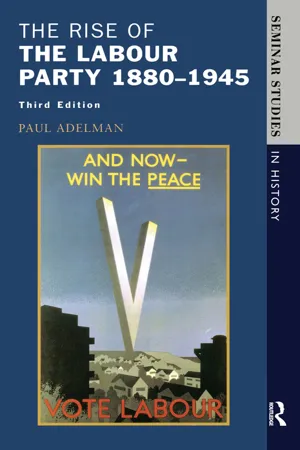
The Rise of the Labour Party 1880-1945
About this book
This popular study covers two major topics: the formation of the Labour Party and its emergence as the main rival to the conservatives. This transformation of the British political scene has been accounted for in a variety of ways. Dr Adelman examines these explanations and concludes that while there is a consensus about the reasons for the creation of the Labour Party there is no agreement about why it rose to such prominence.
Trusted by 375,005 students
Access to over 1.5 million titles for a fair monthly price.
Study more efficiently using our study tools.
Information
PART ONE: ORIGINS
1 SOCIALISM AND TRADE UNIONISM
THE SOCIALIST REVIVAL OF THE 1880S
Between the decline of Chartism in the 1850s and the early 1880s there was no organised socialist movement in Great Britain. Socialism existed, but it was confined almost entirely to discussions in a few obscure working men’s clubs, mainly in London, and these were dominated by socialist refugees from the Continent [73], The greatest of these, Karl Marx, was to die in 1883, almost unknown after thirty years residence in the capital, with not one of his major works yet translated into English. By the end of the decade, however, at least two important socialist societies existed, the Social Democratic Federation and the Fabian Society, as well as a number of splinter groups; and although their total membership was small, their influence was considerable. Socialism, if still a dirty word to the employing and governing classes, could no longer be ignored as an intellectual creed by the thinking public.
The origins of modern British socialism lie deep in the history of mid-Victorian society [42]. But there are a number of particular factors which enable us to pinpoint the socialist revival of the early 1880s. First, there was the growing disillusionment of many radicals with the record of official Liberalism: not only Gladstone’s tenderness to the Whigs and his reluctance to embark on a programme of further social and political reform, but his apparent continuation of Disraeli’s imperialistic policies in Egypt and South Africa; and, above all, the government’s support for coercion in Ireland which seemed the utter negation of all that Liberalism stood for [8]. Second, there was the very different influence of the American, Henry George, and his famous work, Progress and Poverty, first published in the United States in 1879 and in England the following year. It is difficult for us today to appreciate the extraordinary impact on his contemporaries, particularly in England, of this forgotten man and his unread masterpiece, whose thesis – that the ills of society are due to the ‘unearned increment’ obtained by the landlord – seems now largely irrelevant to the problems of his age [Doc. 1]. But Progress and Poverty is that rara avis, an economics textbook which became a world best-seller. In England alone in the 1880s Kegan Paul, the publisher, sold 109,000 copies in a cheap sixpenny edition, thus making it ‘the greatest single educational force moulding the British working class’ [63, p. 54]. Henry George followed up this publishing success by carrying out a triumphant personal tour of the British Isles in 1881. He was welcomed by the Rev. Stewart Headlam, the Christian Socialist, as ‘a man sent from God’, and his forceful personality and ethical appeal had a remarkable effect on his audiences. He made five more similar tours during the next nine years.
How are we to account for this unique success? One point may be suggested: Progress and Poverty fitted in closely with the mood of the moment among radical circles in England and Ireland [9]. For not only was the year 1879 a year of intense agricultural depression, but the late 1870s and early 1880s witnessed bitter attacks in England on the evils of landlordism by a whole variety of land reformers and land reform associations, summed up in Joseph Chamberlain’s notorious phrase of 1883 about ‘the class that toil not neither do they spin’ [8, p. 41]. In Ireland, unhappily, these attacks were not confined to the written or spoken word. What Henry George did, therefore, was to make men, particularly working men, think about the contrasts that existed in a society of ‘tramps at one end, millionaires at the other’; and, as J. A. Hobson pointed out in an acute contemporary article, to ‘give definiteness to the feeling of discontent by assigning an easily intelligible economic cause’ [61]. George was no socialist; but it was an easy transition from the evils of landlordism, through the gospel of land taxation to socialist ideas. It was in this way that Henry George influenced men and women like Bernard Shaw, H. H. Champion, Keir Hardie, H. M. Hyndman and Beatrice Webb, all in their diverse ways to become important representatives of the socialist movement of the 1880s.
Most of these people were members of the middle class, and indeed the socialist revival of the 1880s was primarily a middle class phenomenon. Hence Progress and Poverty is also part of that wider and deeper ferment of ideas which the young Beatrice Webb saw stirring the hearts and minds of so many of her cultivated and prosperous contemporaries, what she called, characteristically, ‘the consciousness of sin’.
I do not mean [she wrote] the consciousness of personal sin … the consciousness of sin was a collective or class consciousness; a growing uneasiness, amounting to conviction, that the industrial organisation, which had yielded rent, interest and profits on a stupendous scale, had failed to provide a decent livelihood and tolerable conditions for a majority of the inhabitants of Great Britain [206, i, 204–6].
It was, indeed, a distinctly bourgeois figure, H. M. Hyndman, who founded in 1884 the Social Democratic Federation, ‘the first modern socialist organisation of national importance in Britain’ [152, p. 231]. Hyndman was, however, in many ways a curious and contradictory person to head a socialist party. Educated at Eton and Trinity College, Cambridge, he was always conscious of his status as a gentleman, and normally wore the customary top hat and frock coat of members of that class. He also continued his family’s associations with the City and, moreover, was a strong supporter of the Empire and British naval power. His political instincts were therefore basically Tory rather than Liberal; and it was his persistent antipathy to Liberalism that later cut him off so clearly from the majority of British labour leaders, and often from his own associates. In 1881 he was converted to Marxism after reading Das Kapital in a French translation (the first English translation only appeared in 1887) while on a trip to the United States; and in the same year he published his own Marxist exposition, England for All. This was in many ways, as Hyndman’s biographer suggests, ‘a text-book of English “Tory Democracy” rather than of continental Social Democracy’ [205, p. 42]; moreover, it committed the grave solecism of not mentioning the master by name. This annoyed Marx intensely, and he remained aloof from Hyndman until his death two years later; while Engels, as a result of the ‘shabby treatment’ meted out to his friend and collaborator, maintained a personal vendetta with Hyndman until his own death fourteen years later.
The origins of the SDF, however, lie not in Hyndman’s Marxism, but in his opposition to current Liberalism. In June 1881 a number of working men from the London radical clubs, together with Hyndman and a group of prominent left-wing Liberals, held an inaugural meeting in London ‘to unite, if possible, all societies willing to adopt a Radical programme with a powerful Democratic party’ [205, p. 12]. As a result, the Democratic Federation was born; a radical rather than a socialist body, whose interests lay primarily in Irish policy and land reform. But the increasing virulence of Hyndman’s opposition to Gladstone led to the gradual withdrawal of most of the Federation’s radical supporters, and in 1883 Hyndman, as President, was able to convert it into a purely socialist body: in 1884 it was rechristened the Social Democratic Federation. By that year, in fact, the society had recruited a number of remarkable young socialists: H. H. Champion, an ex-army officer and, like Hyndman himself, something of a Tory in outlook; Eleanor Marx, her famous father’s beloved youngest daughter; Belfort Bax, journalist and Marxist; Tom Mann and John Burns, skilled working men; and – the biggest catch of all – William Morris, artist, poet and designer and, in addition, wealthy enough to help the society financially [Doc. 2]. It was Morris who became Treasurer of the Federation, with Champion, who owned and edited the newspaper Justice, as Secretary.
The major problem of Hyndman and his companions as leaders of an ostensibly revolutionary socialist party was: what tactics should be pursued in order to bring about the socialist revolution? Should the party preach the Marxist doctrine of the class struggle and, relying on growing working-class discontent, lead the embattled proletariat into an immediate conflict with the state power? Or should it rely on a campaign of remorseless Marxist propaganda until, at some future date, the established order collapsed through its own internal contradictions and the working class spontaneously began the socialist revolution? Though Hyndman has often been condemned for his rigid political views, he never came down firmly on one side of the fence or the other. In practice, his policies were a mixture of prejudice, dogma and expediency, as well as a passionate though muddle-headed devotion to the socialist cause; he was never, for example, really prepared to work directly with the trade union leaders, and they in turn were bitterly opposed to his godless and illiberal creed [Doc. 3].
On the one hand, therefore, Hyndman did his best throughout the 1880s to spread the gospel of socialism through his own multifarious writings and public debates with prominent radicals like Charles Bradlaugh. The party also produced its own programme of short-term radical reforms – the despised ‘palliatives’ – land reform, municipalisation, and the rest; and in 1885 (with the help of funds from a Tory agent, Maltman Barry) even put up parliamentary candidates at the unlikely constituencies of Hampstead and Kennington. They polled fifty-nine votes between them, though John Burns did better at Nottingham. On the other hand, even apart from questions of theory, there was much to tempt the SDF in the economic conditions of the 1880s towards more extreme courses. For 1884 and 1886 in particular were years of severe hardship for many sections of the working class; and the SDF members seized the opportunity to help in strike actions in the provinces and, more dramatically, to assume the leadership of the unemployed demonstrations in London, 1886–87. It was in this way that John Burns first displayed his magnetism as a London labour leader. But the agitation was partly discredited by the ‘West End riots’ in the winter of 1886, which were followed by the well-publicised trial and subsequent acquittal of the SDF leaders – Burns, Champion and Hyndman. This trial of strength with the authorities culminated in the shambles of ‘Bloody Sunday’ in November 1887, when Trafalgar Square was cleared forcibly by the police [Doc. 4]. These tactics brought excellent publicity for the SDF but achieved little else, since with the coming of better times later in the year, the agitation died away. Thus ‘Bloody Sunday’, though it has its place in the martyrology of the British Labour Movement, proved to be an end rather than a beginning. It did, however, lead to important heart-searchings within the Social Democratic Federation itself.
As early as December 1884 a small but important group of members led by William Morris and Eleanor Marx, incensed by Hyndman’s domineering methods and extremist tactics, seceded from the society to form the Socialist League. ‘As Hyndman considers the SDF his property’, wrote Morris, ‘let him take it and make what he can of it, and try if he can really make up a bogy of it to frighten the Government …. We will begin again quite cleanhanded to try the more humdrum method of quiet propaganda’ [149, pp. 222–3].
The loss of Morris’s prestige – and his money – was a severe blow to the Federation; and two years later, owing to the electoral scandal over ‘Tory Gold’, another tiny group left the party. But the worst was yet to come. For in 1887, H. H. Champion, disillusioned with the use of force as a political weapon, came out strongly in favour of building up a more widely based socialist party which would cooperate with the trade unions and appeal directly to the ‘labour interest’. Burns and Mann were prepared to back Champion’s views; but, despite Burns’s attack on ‘cliqueism’ and ‘despotism’ at the 1888 Annual Conference of the SDF, Hyndman retained his hold over the majority of members, and it was Champion who left the party, taking Justice with him, to be followed shortly afterwards by Burns and Mann.
Impressed particularly by the strength and single-mindedness of the Irish Party in the House of Commons, Champion now aimed at pushing forward labour questions at by-elections and increasing the labour representation in the House. His instruments for this purpose were the Labour Electoral Association (founded by the Trades Union Congress in 1886), and his old paper Justice, now converted into the Labour Elector. His most famous intervention was in support of Keir Hardie at the mid-Lanark by-election in 1888. This campaign, though unsuccessful, helped to begin the ‘labour revolt’ against the domination of the Liberal Associations, and thus, as Henry Pelling has argued in a sympathetic appraisal, marks out Champion as an important figure in the rise of the Labour Party [182]. Unfortunately, his insights were not appreciated at the time, and he was never able in any case to allay completely the working men’s suspicions of his earlier Tory associations. His group broke up, and in 1893 he himself departed for Australia, where he died in obscurity in 1928.
Despite these vicissitudes the SDF survived, and Hyndman carried on as undisputed master. By the end of the 1880s, although the party’s membership was still small, it had built up important centres of power among the skilled workers, particularly in Lancashire, and in London where it dominated the Trades Council. Moreover, its revelations about labour conditions were beginning to affect the unskilled workers in the capital. It was, indeed, these aspects of its work, rather than its support for a socialist revolution, that were in the end to be the SDF’s real contribution to the rise of the Labour Party. As Hobsbawm writes: ‘Its greatest achievement was to provide an introduction to the labour movement and a training-school for a succession of the most gifted working-class militants’ [152, p. 232].
The Fabian Society, the other important socialist organisation founded in 1884, emerged out of the ethical Fellowship of the New Life when a group of more socially committed members agreed ‘that an association be formed whose ultimate aim shall be the reconstruction of Society in accordance with the highest moral possibilities’ [57, p. 31]. It was when they concluded that this implied socialist reconstruction that the Fabian Society, as it came to be called, became a distinctly socialist body. The leading members of the new society were Frank Podmore, E. R. Pease and Hubert Bland; and it was Podmore who thought up the tantalising motto from which the society got its name: ‘For the right moment you must wait, as Fabius did most patiently, when warring against Hannibal, though many censured his delays; but when the time comes you must strike hard, as Fabius did, or your waiting will be in vain, and fruitless’ [68, p. 39].
They were soon joined by Bernard Shaw, then a struggling young writer, who had in quick succession passed through Georgeism and Marxism; by Annie Besant; and, in the following year, by Sidney Webb and Sydney Olivier, both young clerks in the Colonial Office, who were recruited by Shaw [166]. There were also other less serious recruits, as the latter recalled: ‘It was a silly business. They had one elderly retired workman …. There were anarchists led by Mrs Wilson. There were young ladies on the lookout for husbands, who left when they succeeded. There were atheists and Anglo-Catholics’ [71, p. 7]. In its early days, in fact, there was no clearcut distinction between the Fabian and other socialist societies (especially in the provinces), and members often could and did belong to more than one group. But the London Fabian Society soon developed a distinctive flavour of its own – middle-class, intellectual, vivacious, tolerant and slightly otherworldly – which was to colour its whole history, and which Shaw has captured so marvellously in his letters and writings of this period [Doc. 5]. As Shaw says, justifying his own decision to join the Fabians, it was ‘an instinctive feeling that the Fabians … would attract the men of my own bias and intellectual habits … we were then middle-class all through, rank and file as well as leaders’ [72, pp. 130–1].
What then, given this common ethos, were the basic ideas of the Fabians? Two main influences helped to shape Fabian thought. First, there was the English liberal-utilitarian tradition, as exemplified particularly by the writings of John Stuart Mill. Indeed, one historian sees the ideas of mid-Victorian Radicalism as the major determining factor in the evolution of Fabian Socialism [76]. But to this native tradition there was added a strong tincture of Marxism: not Marx’s economic views (which the Fabians rejected in favour of Jevons’s marginal utility theories), but his conception of historical change and the nature of capitalist society. It was this historical and sociological insight that made the Fabians true socialists rather than just radicals of the school of Morley or Chamberlain which they could so easily have become. This, as McBriar argues, enables us to see them as a genuine part of the European socialist movement [66].
The starting point of Fabian thought, therefore, was their view of capitalist society. Capitalist society was, they believed, as contemporary evidence showed in overwhelming and appalling detail, an unjust and also an inefficient society. But just as capitalism had itself evolved out of feudal society, so contemporary capitalism, under the impact of technological and institutional change, democracy, and the pressures generated by working-class discontent, was itself evolving, through increasing state intervention and municipal enterprise, into a socialist society. There will never be a point’, wrote Annie Besant in Fabian Essays in 1889, ‘at which a society crosses from Individualism to Socialism. The change is ever going forward; and our society is well on the way to Socialism’ [57, p. 141]. For the Fabian, indeed, socialism meant basically state and municipal socialism – ‘Gas-and-Water Socialism’, in the famous phrase; a view which reached its reductio ad absurdum in Sidney Webb’s extraordinary account in Fabian Essays of the remarkable victories being totted up each day for socialism, as the state enlarged its control over ‘dairies, milk-shops, bakeries,...
Table of contents
- Cover Page
- Halftitle Page
- Title Page
- Copyright Page
- Table of Contents
- Editorial foreword
- Note on referencing system
- Note on the second edition
- Note on the third edition
- Acknowledgements
- Foreword
- PART ONE: ORIGINS
- PART TWO: THE STRUGGLE FOR POWER
- PART THREE: ASSESSMENT
- PART FOUR: DOCUMENTS
- Appendix: The Labour Vote
- Bibliography
- Index
- Related Titles
Frequently asked questions
Yes, you can cancel anytime from the Subscription tab in your account settings on the Perlego website. Your subscription will stay active until the end of your current billing period. Learn how to cancel your subscription
No, books cannot be downloaded as external files, such as PDFs, for use outside of Perlego. However, you can download books within the Perlego app for offline reading on mobile or tablet. Learn how to download books offline
Perlego offers two plans: Essential and Complete
- Essential is ideal for learners and professionals who enjoy exploring a wide range of subjects. Access the Essential Library with 800,000+ trusted titles and best-sellers across business, personal growth, and the humanities. Includes unlimited reading time and Standard Read Aloud voice.
- Complete: Perfect for advanced learners and researchers needing full, unrestricted access. Unlock 1.5M+ books across hundreds of subjects, including academic and specialized titles. The Complete Plan also includes advanced features like Premium Read Aloud and Research Assistant.
We are an online textbook subscription service, where you can get access to an entire online library for less than the price of a single book per month. With over 1.5 million books across 990+ topics, we’ve got you covered! Learn about our mission
Look out for the read-aloud symbol on your next book to see if you can listen to it. The read-aloud tool reads text aloud for you, highlighting the text as it is being read. You can pause it, speed it up and slow it down. Learn more about Read Aloud
Yes! You can use the Perlego app on both iOS and Android devices to read anytime, anywhere — even offline. Perfect for commutes or when you’re on the go.
Please note we cannot support devices running on iOS 13 and Android 7 or earlier. Learn more about using the app
Please note we cannot support devices running on iOS 13 and Android 7 or earlier. Learn more about using the app
Yes, you can access The Rise of the Labour Party 1880-1945 by Paul Adelman in PDF and/or ePUB format, as well as other popular books in History & British History. We have over 1.5 million books available in our catalogue for you to explore.