- 291 pages
- English
- ePUB (mobile friendly)
- Available on iOS & Android
eBook - ePub
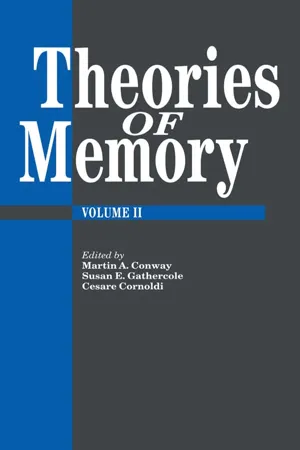
Theories Of Memory II
About this book
This work is a collection of theoretical statements from a broad range of memory researchers. Each chapter was derived from a presentation given at the 2nd International Conference on Memory, held at Abano Termi, Italy, 15th to 19th July 1996. The contributions cover imagery, implicit and explicit memory, encoding and retrieval processes, neuroimaging, age- related changes in memory, development of conceptual knowledge, spatial memory, the ecological approach to memory, processes mediating false memories, and cognitive models of memory.
Trusted by 375,005 students
Access to over 1.5 million titles for a fair monthly price.
Study more efficiently using our study tools.
Information
Topic
Psychologie1 | Working Memory and Consciousness: An Empirical Approach |
Centre for the Study of Memory & Learning, University of Bristol, UK
Department of Psychology, University of Sheffield, UK
After almost a century in the wilderness, the study of consciousness has, in the last decade, become not only respectable, but also highly fashionable. New journals have been created, and many books edited, with contributions not only from the traditional sources of philosophy and psychology, but from many other disciplines. While much of this work is based on an empirical core, typically derived from neuropsychology or cognitive psychology, much of it still represents armchair speculation from philosophers, mystically inclined physicists, and religiously inspired biologists. Although the armchairs available for speculation may be of a better quality than a hundred years ago, our own view is that if the study of consciousness is to avoid returning to the intellectual morass that engulfed it in the middle years of this century, it is important that the speculations are based on empirical evidence, and that this in turn depends on the development of a suitable theoretical framework, and adequate empirical tools. A framework based on the concept of working memory was presented at the first meeting of this group (Baddeley, 1993; see also Baddeley, 1997). The present chapter outlines three areas in which the framework has been applied, beginning with research using anaesthetics to alter level of consciousness, then describing experiments on mind-wandering and the control of conscious awareness, and concluding with an account of an experimental programme concerned with the qualitative aspects of consciousness as reflected in the analysis of the subjective vividness of imagery.
A THEORETICAL FRAMEWORK
Bisiach (1988) distinguishes three aspects of consciousness. The first of these is consciousness as a mysterious entity or property, which typically resembles the concept of the soul in differentiating man from the beasts. We regard such a quasi-theological concept as neither necessary nor desirable, and as having little or no relevance to the empirical study of conscious awareness.
The second aspect, phenomenal consciousness (see also Block, 1995), refers to our sensory experience of the world. The basic units of this experience are termed qualia; the taste of chocolate, the smell of woodsmoke, the sound of rain, the feel of pain, are examples of qualia. Regarding qualia as the essence of conscious experience raises important questions about how physical events transform themselves into mental events, why we experience those events in the way we do, and whether our experience is the same as someone else’s experience. Why, for instance, does light with a wavelength of 660nm falling on the retina result in the experience of seeing red rather than green? When I stub my toe, is my pain the same as the feeling you have when you stub your toe? The problem of answering questions such as these, of explaining conscious experience even with a perfect understanding of the underlying brain processes, has been termed the explanatory gap (Levine, 1983). While some authors have claimed that “at present the gap remains dauntingly large” (Young & Block, 1996, p.150), others argue that it arises only from the mistaken assumption that consciousness is based on irreducible, private experiences (Baddeley, 1993, 1997; Dennett, 1988) and from our current lack of knowledge about how the brain works (Churchland, 1995; Dennett, 1991).
Bisiach’s third aspect of consciousness refers to the availability of mental representations for use in other cognitive processes. Mental states are conscious if they can be reported, reasoned about, voluntarily acted on, or recollected. Block (1995) describes such states and their contents as access-conscious, i.e. other cognitive processes have access to them. This aspect of consciousness presents a more fruitful area for empirical research, as illustrated by recent studies of topics as diverse as the neurobiological basis of visual perception (Crick & Koch, 1990), the anatomical regions important for conscious or explicit memory (Shallice et al., 1994), and the cognitive processes needed for the voluntary control of action (Norman & Shallice, 1986). This research treats consciousness as an empirical, biological, and psychological phenomenon; a solution that has evolved to cope with certain problems. We share this approach and believe that it may also lead the way to explaining phenomenal consciousness.
We introduce our account through a quasi-biological speculation concerning the problems facing an evolving organism and the solution offered by consciousness. Although we regard biological plausibility as an ultimately necessary feature of any model of consciousness, such plausibility is not of course in and of itself evidence for any given view. In the present instance, it is used primarily as an expository device. We suggest furthermore that the value, if any, of our model does not lie in the ultimate validity, or indeed testability, of the biological speculation, but in its capacity to provide a framework for conceptualising existing evidence, and a platform for making further empirical progress.
A Quasi-biological Speculation
Suppose we were trying to develop an organism that could flourish in the ordered but far from predictable world that we live in, what capacities would it find useful? Our organism should clearly have some sensory channels to tell it about the surrounding environment. Given that many objects are detectable by a number of different sensory channels, vision, touch, smell, and often sound, then it makes sense to have a system that is capable of registering the fact that these many channels have a common source. This task is sometimes known as the binding problem, and is currently the focus of intensive neurobiological research activity (e.g. Crick & Koch, 1990; Pöppel & Schwender, 1993; Singer, 1996).
If our organism is to interpret the source of this incoming sensory information as dangerous or safe, learn whether it is edible or poisonous, or decide to flee from it, then the bound information must persist for long enough to influence other cognitive processes. We suggest that working memory is the mechanism that achieves this persistence of representations, making them available to other cognitive processes (see also Baars, 1988), and also that it is the mechanism for focusing on, selecting, and if necessary manipulating selected aspects of the representation (for a more detailed discussion see Baddeley, 1997, Chapters 18, 19, and 20).
We are of course well aware that the proposed link between consciousness and the binding problem is far from novel. The particular virtue, if any, of our approach lies in our linking it with a relatively well-developed model of working memory. This makes available a ready-made conceptual framework, together with a range of empirical techniques that provide ways of investigating the multifarious aspects of conscious awareness. For example, research has already considered the role of the central executive in encoding and retrieving information in long-term memory (Baddeley, Lewis, Eldridge, & Thomson, 1984), the nature of articulatory and visuo-spatial maintenance or rehearsal processes (Baddeley, 1986; Logie, 1995) and the role of the executive in selective attention (Baddeley, 1996).
The working memory model has guided research into diverse areas of everyday cognition such as language learning (Ellis & Sinclair, 1996; Gathercole & Baddeley, 1993), comprehending speech (Vallar & Baddeley, 1984), and doing two things at once (Baddeley et al., 1991, 1997). We aim to continue this approach, looking at a broad range of everyday conscious behaviour rather than attempting a fine-grained analysis of one aspect of conscious awareness. The remainder of this chapter describes three strands of our research into consciousness. The first strand uses general anaesthetic agents to impair consciousness and addresses issues such as how can we measure global changes in level of conscious awareness and what is the role of consciousness in other aspects of cognition? The second strand, on mind-wandering, seeks to characterise normal, conscious mental life as a state in which cognitive processes are driven internally as well as by external stimulation. This research explores the role of working memory in daydreaming, concentration, and focused attention, i.e. the control of conscious awareness. The third strand investigates the role of working memory in mental imagery, attempting to elucidate the cognitive processes associated with the subjective experience of vivid imagery.
ANAESTHESIA AS A TOOL FOR RESEARCHING CONSCIOUSNESS
General anaesthetics are a chemically diverse group of drugs that have in common the effect of temporarily abolishing consciousness. Brain imaging studies of anaesthesia (e.g. Alkire et al., 1995) show a global depression of cerebral metabolism. Single-cell electrophysiological recordings suggest this may be caused by inhibition of information flow through the thalamus to the frontal cortex (Angel, 1993). The cognitive effects of anaesthetics are consistent with reduced frontal activity (Caseley-Rondi, 1996). For example, even very small doses of anaesthetics have been shown to impair attention (Bruce & Bach, 1975, 1976) and decision making (Bentin, Collins, & Adam, 1978). Functionally, therefore, anaesthetics seem to impair the executive processes, such as focusing attention and selecting responses, that we associate with conscious awareness.
At first sight, anaesthetics appear to offer a useful tool for researching cognition in the absence of consciousness. Of particular interest has been the issue of whether people continue to learn new information during surgery under general anaesthesia. There have been many demonstrations of implicit memory for intra-operative events (see Andrade, 1995, for review). Jelicic, de Roode, Bovill, and Bonke (1992), for example, played a tape of fictitious names to one group of patients and answers to Trivial Pursuit-type questions to another group during surgery. Memory test performance on recovery suggested that some of this information had been encoded during surgery—thus the first group was more likely to incorrectly identify the fictitious names as famous (the false fame effect) and the second was more likely to answer the Trivial Pursuit questions correctly. Findings such as these raise concerns about the effects of operating theatre conversations on patients’ recovery from surgery. However, there are also many studies that failed to show learning during surgery, including an attempt by Jelicic to replicate his own findings (Jelicic, Asbury, Millar, & Bonke, 1993). The methodology of these studies varies widely, but no single factor such as anaesthetic technique or type of memory test is sufficient to distinguish the studies that found intra-operative learning from those that did not (Andrade, 1995).
One important variable, depth of anaesthesia or level of unconsciousness, was not measured in the majority of these studies, leaving open the possibility that patients who learned the intra-operative stimuli were more lightly anaesthetised—or more conscious—than those who did not. Depth of anaesthesia fluctuates during an operation even if the dose of anaesthetic remains constant because there is a trade-off between the sedative effects of the anaesthetic and the arousing effects of surgery. A good measure of depth of anaesthesia must therefore reflect changes in cognitive function and not simply the amount of anaesthetic in the patient’s bloodstream. There is not yet agreement on how best to measure depth of anaesthesia, hence the absence of information about level of unconsciousness in the reports of studies of learning during surgery. Several potential measures of depth of anaesthesia are currently under investigation, including various aspects of the raw and processed EEG (see Andrade & Jones, 1997, for review), but none is routinely used in operating theatres.
A recent study (Andrade, Munglani, Jones, & Baddeley, 1994) suggests that a measure of steady state auditory-evoked responding called the coherent frequency provides an objective measure of cognitive function during sedation with anaesthetic drugs. Volunteers in this study received varying subclinical doses of a volatile anaesthetic, isoflurane. At each dose of isoflurane, we assessed cognitive function in two ways, first by asking participants to raise their hand whenever they heard an example of a particular category in a spoken list of common nouns, and second by a within-list recognition test. This memory test required participants to listen to a sequence of words and raise their hand every time a word was repeated, with the repetitions occurring after delays ranging from 0 to 16 intervening words. This test therefore relies on participants’ working memory function, both in terms of their ability to maintain words in memory over short intervals and in terms of their ability to sustain attention throughout a supra-span list. If we are correct in our assumption that consciousness depends on working memory function, then performance on this task should be very sensitive to the effects of anaesthetics.
Performance on both the within-list recognition and category judgement tests declined as the dose of isoflurane increased, and so did the coherent frequency in the EEG recording. Scores on all three measures returned gradually to baseline as the dose of anaesthetic decreased again. Performance on the category judgement task is instructive: when participants were inhaling 0.4% isoflurane (the higher dose at which cognitive tests were attempted), they correctly responded to a mean of 4 of the 10 category exemplars. Electrical stimulation of the ulnar nerve, intended to mimic the arousing effect of surgery, improved performance to 6 of 10 exemplars identified even though the dose of isoflurane remained constant. On recovery from the anaesthetic, participants performed at chance on a test of recognition of the exemplars presented at this dose (pre-stimulation).
This study shows that cognitive function declines gradually as the dose of anaesthetic increases, and that this decline can be measured by recording the brain’s electrical responses to auditory stimuli. The finding that words could be heard, understood, and responded to, without later being recognised, suggests that conscious awareness during anaesthesia is not sufficient for explicit memory formation.
Using a measure such as coherent frequency in studies of learning during surgery would help to answer the question of whether learning occurs only during periods of light anaesthesia. However, it would not conclusively reveal whether this learning were explicit or implicit because coherent frequency, like most other potential measures of anaesthetic depth, indicates only the relative level of cognitive function and not awareness of a particular stimulus. We believe the advantage of anaesthetics as a tool for psychological research lies less in their potential for proving that we can learn without awareness, than in their ability to gradually impair the executive processes that contribute to conscious awareness. Studies of the effects of small doses of anaesthetics suggest that impairing these processes has a similar effect on implicit memory as on explicit memory. This contrasts with studies of, say, subliminal perception, where implicit memory is relatively unimpaired by manipulations that abolish explicit memory. One interpretation of these findings is that executive processes associated with consciousness, and impaired by low doses of anaesthetic, are essential for implicit memory formation even if conscious awareness of the stimulus is not (see Andrade, 1996, for further discussion). Future volunteer studies of anaesthesia may reveal the role of consciousness in other aspects of cognition—not, that is, the function of conscious awareness, but more simply the effect on general cognitive function of the processes that we associate with consciousness.
MIND-WANDERING AND THE CONTROL OF ATTENTION
One of the most important aspects of conscious awareness is the way in which it may be focused and controlled. Indeed, the question of attentional control was the first aspect of the study of consciousness to regain respectability through the study of selective attention (Broadbent, 1958). There are, however, occasions on which active control is relinquished, as in daydreaming, or indeed dr...
Table of contents
- Cover
- Half Title
- Title Page
- Copyright Page
- Table of Contents
- List of contributors
- Preface
- 1. Working Memory and Consciousness: An Empirical Approach
- 2. An Associative Theory of Implicit and Explicit Memory
- 3. Encoding and Retrieval Processes: Similarities and Differences
- 4. Memory and Imagery: A Visual Trace is Not a Mental Image
- 5. Age-related Deficits in Memory: Theory and Application
- 6. Imaginary Memories
- 7. The Rise and Fall of Semantic Memory
- 8. Stories, Selves, and Schemata: A Review of Ecological Findings
- 9. The Role of Associative Processes in Creating False Memories
- 10. The Functional Imaging of Recall
- 11. Three Dimensions of Spatial Cognition
- Author Index
- Subject Index
Frequently asked questions
Yes, you can cancel anytime from the Subscription tab in your account settings on the Perlego website. Your subscription will stay active until the end of your current billing period. Learn how to cancel your subscription
No, books cannot be downloaded as external files, such as PDFs, for use outside of Perlego. However, you can download books within the Perlego app for offline reading on mobile or tablet. Learn how to download books offline
Perlego offers two plans: Essential and Complete
- Essential is ideal for learners and professionals who enjoy exploring a wide range of subjects. Access the Essential Library with 800,000+ trusted titles and best-sellers across business, personal growth, and the humanities. Includes unlimited reading time and Standard Read Aloud voice.
- Complete: Perfect for advanced learners and researchers needing full, unrestricted access. Unlock 1.5M+ books across hundreds of subjects, including academic and specialized titles. The Complete Plan also includes advanced features like Premium Read Aloud and Research Assistant.
We are an online textbook subscription service, where you can get access to an entire online library for less than the price of a single book per month. With over 1.5 million books across 990+ topics, we’ve got you covered! Learn about our mission
Look out for the read-aloud symbol on your next book to see if you can listen to it. The read-aloud tool reads text aloud for you, highlighting the text as it is being read. You can pause it, speed it up and slow it down. Learn more about Read Aloud
Yes! You can use the Perlego app on both iOS and Android devices to read anytime, anywhere — even offline. Perfect for commutes or when you’re on the go.
Please note we cannot support devices running on iOS 13 and Android 7 or earlier. Learn more about using the app
Please note we cannot support devices running on iOS 13 and Android 7 or earlier. Learn more about using the app
Yes, you can access Theories Of Memory II by Martin A. Conway,Susan E. Gathercole,Cesare Cornoldi in PDF and/or ePUB format, as well as other popular books in Psychologie & Kognitive Psychologie & Kognition. We have over 1.5 million books available in our catalogue for you to explore.