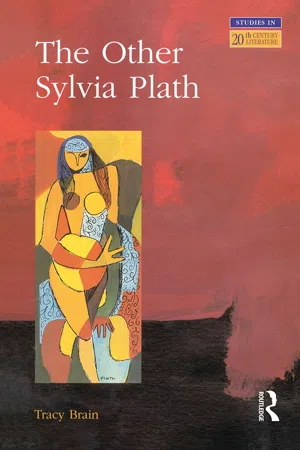
Despite being widely studied on both undergraduate and postgraduate courses the writing of Sylvia Plath has been relatively neglected in relation to the attention given to her life and what drove her to suicide. Tracy Brain aims to remedy this by introducing completely new approaches to Plath's writing, taking the studies away from the familiar concentration to reveal that Plath as a writer was concerned with a much wider range of important cultural and political topics. Unlike most of the existing literary criticism it shifts the focus away from biographical readings and encompasses the full range of Plath's poetry, prose, journals and letters using a variety of critical methods.
- 252 pages
- English
- ePUB (mobile friendly)
- Available on iOS & Android
eBook - ePub
The Other Sylvia Plath
About this book
Trusted by 375,005 students
Access to over 1.5 million titles for a fair monthly price.
Study more efficiently using our study tools.
Information
Subtopic
Literary CriticismIndex
LiteratureCHAPTER 1 The Outline of the World Comes Clear
DOI: 10.4324/9781315840017-1
A poem can’t take the place of a plum or an apple. But just as a painting can recreate, by illusion, the dimension it loses by being confined to canvas, so a poem, by its own system of illusions, can set up a rich and apparently living world within its particular limits.Most of the poems I am going to introduce in the next minutes attempt to recreate, in their own way, definite situations and landscapes. They are, quite emphatically, about the ‘things of this world’.1
Packaging Sylvia Plath
The packaging and physical design of any book can never be innocent. Books need to be sold, and this is often a much more pressing concern for publishers, agents, and sometimes even for writers, than if – or how – books are subsequently read. With Sylvia Plath’s work, these commercial pressures are manifested in unusual ways, and magnified to an unusual degree.
This has been the case from the start. William Heinemann published the first edition of The Bell Jar early in 1963, just a few weeks before Plath took her own life on 11 February that same year.2 Not surprisingly, nothing on the cover of this first edition, no aspect of its packaging, would have made the reader suspect that Victoria Lucas was a pseudonym, much less that the pseudonym was a mask worn by Sylvia Plath. Between The Bell Jar’s first edition, and its second (Heinemann’s Contemporary Fiction edition of 1964, published one year after Plath’s death), something made Heinemann decide that it was necessary to call attention to this pen-name, while explicitly refusing to name the author. This 1964 edition announces on the back of its dust jacket: ‘Victoria Lucas is a pseudonym, and we are not in a position to disclose any details of the author’s identity’.3 With hindsight and even a rudimentary knowledge of Plath’s work, this is a statement that may well raise goose bumps. At the beginning of the twenty-first century, when most people know very well that Sylvia Plath wrote The Bell Jar, it seems almost impossible to imagine a moment where such a lack of awareness was possible. Even as early as 1964, only a year after Plath’s death, such a disclaimer would have aroused suspicion and curiosity where before there was none – or at least only a relatively small amount of it. Frances McCullough reminds us that ‘everyone in literary London knew Plath was the author’4 (though it is worth remembering what a tiny population of individuals ‘literary London’ actually was). The moment of The Bell Jar’s initial publication in early 1963 was a moment relatively free of preconceptions about what the novel was ‘about’. It was a moment where each element of plot and language was not assumed to refer directly to the writer’s life.
At the outset of Plath criticism, before we all knew too much, reviewers were able to discuss her work with originality, responding to what was actually in her books instead of confirming their expectations. ‘Few writers are able to create a different world for you to live in; yet Miss Lucas in The Bell Jar has done just this’,5 wrote an unnamed critic in the Times Literary Supplement three weeks before Plath’s death. Two weeks before Plath died, Laurence Lerner observed in The Listener that The Belt Jar offered intelligent ‘criticisms of American society’ and managed, unusually, to be both ‘tremendously readable’ and achieve ‘an almost poetic delicacy of perception’.6 Lerner and the unnamed reviewer react instead of imitate. Such moments have been rare in the history of Plath publishing, and occur only in relation to the two publications that appeared while Plath was still alive, and – outside of poetry circles – little known.
Retrospectively, we can see that like The Bell Jar, The Colossus marked a moment of relative innocence. The brief biography included in the first American edition of The Colossus actually says something helpful and imaginative about Plath’s writing, something that has been lost to reviewers and critics since Plath died and her ‘own story’ became public property. Potential readers are informed that Plath’s ‘work reflects both her New England heritage and the landscape of England where she now makes her home’.7 Here, the central thing about Plath’s work is seen as geographical and cultural: the presence of two nationalities and two landscapes in her writing. This strand of Plath’s thought is every bit as important and prevalent as her alleged obsession with depression and death, yet national identity has all but vanished as a theme that might help us to understand her work. It is a strand to which I will be giving careful consideration in this book.
The back cover of the American first edition of The Colossus prints the text of ‘Watercolor of Grantchester Meadows’, while the inside front cover provides excerpts of notices that are entirely non-personal. These excerpts, like the reference to Plath’s landscapes in the brief biography, again suggest ways of reading that have evaporated since Plath’s death. The text on the inside of The Colossus’s dust jacket begins startlingly. ‘Sylvia Plath’, we are told, ‘is a young American poet whose work has appeared widely in recent years on both sides of the Atlantic’.8 Again, it is difficult to imagine such a moment: when few knew who Sylvia Plath was, or what her story might be. It was a moment where Plath needed to be introduced to readers in the simplest of terms: when she was ‘young’, and above all, alive. Reviewers got the point, in those too few days before Plath died. They discussed her work in terms, and posed questions, that I want to revisit. To do so, we must try to simulate the vantage point of those early critics, and step outside the shadow cast by Plath’s death when we look at her work. First, these initial reviewers of The Colossus detected the unstable complexity through which Plath speaks about gender in her writing, the difficulty of pinning down her speakers and tones as purely masculine or feminine. Second, they acknowledged the technical proficiency of her poetry.
The Colossus’s inside front cover quotes A. Alvarez’s assertion that ‘Miss Plath neither asks excuses for her work nor offers them. She steers clear of feminine charm, deliciousness, gentility, supersensitivity and the act of being a poetess.’ Some feminist critics might take issue with the implicit disparagement of Alvarez’s allusion to ‘feminine’ qualities. Others might share his appreciation of a woman writer’s refusal to be feminine. Whatever political judgement we might make, Alvarez is right to identify the tricks Plath plays with gender, the refusal of so many of her poetic voices to be categorised as either masculine or feminine, their insistence on constantly shifting and surprising and above all challenging the reader. Plath has often been accused of using her writing to express her anger at men, and in particular her resentment of her father and husband. We will see that this is an injustice to her work. Such crude misreading overlooks Plath’s concern that men as well as women are put under terrible pressures to comply with the rules and constraints imposed upon them by gender. Another critic quoted inside The Colossus’s front dust jacket rightly noted ‘a skill with language that is curiously masculine in its knotted, vigorous quality, combined with an alert, gay, sometimes rather whimsical sensibility that is wholly feminine’. In the years since Plath’s death, her ability to create voices that might be described as hermaphrodite in their ability to slip between masculinity and femininity, or blend the two, has too often been ignored.
Alvarez goes on to discuss the technical accomplishment of Plath’s work. ‘She simply writes good poetry’, he writes. ‘And she does so with a seriousness that demands only that she be judged equally seriously.’ Two of the other reviewers quoted on The Colossus’s inside front cover praise the book along these same lines. ‘The book is a revelation suitcase’, wrote a critic from Poetry Review, ‘bulging, always accurate, humor completely unforced, wresting a certain beauty from the perhaps too-often-preferred ugly, but with a control and power of expression unsurpassed in modern poetry’. A third commentator asserts that ‘Miss Plath possesses astonishing skill … She has learnt her craft all the way.’9 Since her death, the terms by which Plath’s work has largely been judged have tended to evaluate her writing with reference to biographical ‘fact’. If Alvarez was right in his characterisation of Plath’s ‘seriousness’ about her writing and her wish to produce ‘good poetry’, as I believe he was, the terms of Plath’s later critics are far from those she would have wished for. In the years since Plath died, Plath criticism, reviews and cover blurbs have been increasingly dominated by a vocabulary of confessionality, depression, and the death drive. The first commentaries, however, are distinguished by a very different vocabulary. It is a vocabulary of ‘humor’, ‘control and power of expression’, ‘astonishing skill’, and ‘craft’. These are terms against which poetry should be measured, discussed and judged, and Plath’s no less than any other. Yet it is a vocabulary that has all but disappeared from Plath criticism. I want to recover this vocabulary, this way of seeing, and develop it further.
Subsequent, posthumous publications of Plath’s work have moved forcefully away from the tenor of those early editions of The Bell Jar and The Colossus, announcing in the bluntest of ways the presence of the book’s author, and manipulating the reader’s interpretation before he or she can even begin to read. Contrast the reviewers’ excerpts printed in the first edition of The Colossus, during Plath’s lifetime, with the text on the inside front cover of the first English edition of the posthumous Ariel. On an otherwise plain design, beneath the book’s title and Plath’s name, Ariel’s cover gives us the beginning of an excerpt from an essay by Robert Lowell that is printed in full as a Foreword. ‘In these poems, written in the last months of her life, and often rushed out at the rate of two or three a day, Sylvia Plath becomes herself, becomes something imaginary, newly, wildly and subtly created.’10 This is continued on the inside front cover of the book, where for Lowell Plath becomes
hardly a person at all, or a woman, certainly not another “poetess,” but one of those super-real, hypnotic, great classical heroines …There is a peculiar, haunting challenge to these poems. Probably many, after reading Ariel, will recoil from their first overawed shock, and painfully wonder why so much of it leaves them feeling empty, evasive and inarticulate. In her lines, I often hear the serpent whisper, ‘Come, if only you had the courage, you too could have my rightness, audacity and ease of inspiration.’ But most of us will turn back. These poems are playing Russian roulette with six cartridges in the cylinder …
Relatively early in the history of Plath publishing, the collection for which Plath is most famous, Ariel, establishes the connection between Plath’s poems and her death.
The excerpts and Foreword in the first edition of Ariel frame Plath’s own writing, and suggest that the poems themselves made their author’s death inevitable. Before the reader can even begin to read Plath’s own words, this idea is repeated again and again. The other extracts inside the book’s front cover appear to take their cue from Lowell. Robert Penn Warren is quoted, describing the poems as ‘a keen, cold gust of reality’, while George Steiner writes, ‘These ...
Table of contents
- Cover Page
- Half Title Page
- Series Page
- Title Page
- Copyright Page
- Table of Contents
- List of Plates
- Acknowledgements
- CHAPTER 1: THE OUTLINE OF THE WORLD COMES CLEAR
- CHAPTER 2: STRADDLING THE ATLANTIC
- CHAPTER 3: PLATH’S ENVIRONMENTALISM
- CHAPTER 4: THE ORIGINS OF THE BELL JAR
- CHAPTER 5: A WAY OF GETTING THE POEMS
- Bibliography
- Index
Frequently asked questions
Yes, you can cancel anytime from the Subscription tab in your account settings on the Perlego website. Your subscription will stay active until the end of your current billing period. Learn how to cancel your subscription
No, books cannot be downloaded as external files, such as PDFs, for use outside of Perlego. However, you can download books within the Perlego app for offline reading on mobile or tablet. Learn how to download books offline
Perlego offers two plans: Essential and Complete
- Essential is ideal for learners and professionals who enjoy exploring a wide range of subjects. Access the Essential Library with 800,000+ trusted titles and best-sellers across business, personal growth, and the humanities. Includes unlimited reading time and Standard Read Aloud voice.
- Complete: Perfect for advanced learners and researchers needing full, unrestricted access. Unlock 1.5M+ books across hundreds of subjects, including academic and specialized titles. The Complete Plan also includes advanced features like Premium Read Aloud and Research Assistant.
We are an online textbook subscription service, where you can get access to an entire online library for less than the price of a single book per month. With over 1.5 million books across 990+ topics, we’ve got you covered! Learn about our mission
Look out for the read-aloud symbol on your next book to see if you can listen to it. The read-aloud tool reads text aloud for you, highlighting the text as it is being read. You can pause it, speed it up and slow it down. Learn more about Read Aloud
Yes! You can use the Perlego app on both iOS and Android devices to read anytime, anywhere — even offline. Perfect for commutes or when you’re on the go.
Please note we cannot support devices running on iOS 13 and Android 7 or earlier. Learn more about using the app
Please note we cannot support devices running on iOS 13 and Android 7 or earlier. Learn more about using the app
Yes, you can access The Other Sylvia Plath by Tracy Brain in PDF and/or ePUB format, as well as other popular books in Literature & Literary Criticism. We have over 1.5 million books available in our catalogue for you to explore.