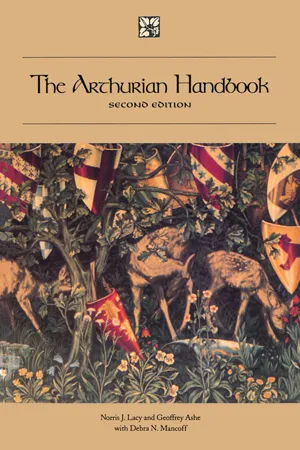
Everything you ever wanted to know about King Arthur and his knights is covered in this fascinating volume: the origins of the Grail legend, the Tristan and Isolde love story in opera and literature, Spielberg's use of Arthurian motifs in Star Wars , the depiction of Arthur in paintings, the presentation of Camelot on the Broadway stage, the twitting of the legend in Monty Python and theHoly Grail and much more.
This critical survey of Arthurian history and legend, archaeology, literature, and the arts from the fifth century to the present provides an introduction for the general reader and a useful summary for the specialist. It offers both historical facts and key discussions on Arthurian subjects, from post-Roman Britain to the most recent novels and films. There is a lengthy glossary of Arthurian characters, motifs, and places, a chronology of major historical and literary items, a guide to pronunciation, and a full bibliography.
What's new inthe Second Edition:All the material has been revised and updated to 1996 since the original 1988 edition; The chapter on modern literature has been thoroughly revised, with new material on writings from France, Germany, England, and America; The coverage of King Arthur in the arts has entirely rewritten by one of the premier authorities in Arthurian studies. Brand-new geneological charts of the ancestry of Arthur and his family and the Grail kings and knights.; A fully up-to-date chronology; Many new illustrations.
- 456 pages
- English
- ePUB (mobile friendly)
- Available on iOS & Android
eBook - ePub
About this book
Information

CHAPTER I
Origins
King Arthur is the central figure of one of the most famous cycles of legend. His name evokes a whole cluster of characters and themes. First is the King himself, magnificent monarch of a glorious realm. Beside him is Guinevere, his fair and high-spirited queen. Close by is Merlin, the enchanter who contrives his birth, guides him from the beginning, and sets him firmly on his throne. We may think, too, of Excalibur, his wonderful sword. Of Camelot, his royal city. Of the Knights of the Round Table, vowed to uphold the noblest ideals. Of Lancelot, the most splendid among them, torn by his love for the Queen. Also of another love affair, the doomed passion of Tristan and Iseut (Isolde). The story of the Grail Quest and the saintly Galahad enshrines a spiritual mystery. At the close is the treason of Mordred, followed by the tragedy of Arthur’s downfall and his passing away to Avalon. Yet even that is not quite the end, because of the prophecy of his return, “King that was, King that shall be.”
The Arthurian legend is multifaceted, a literature in itself, built up by romancers and poets during the Middle Ages in Europe. But it did not expire afterward. Many authors have handled it since, developing its themes or, conversely, turning it into a fairy tale for children. Several modern writers have satirized it, or given it new meanings, or tried to reconstitute a reality underlying it. Such questings are all valid, each in its way, and they have enlarged and enriched the legend. The essential creation, however, is medieval, and King Arthur’s Britain is an idealized medieval kingdom, a sort of chivalric Utopia.
The legend reflects features of medieval storytelling in its more sophisticated forms. To begin with, it is collective, the work of many authors elaborating a shared body of material. King Arthur himself is unusual among legendary heroes in having a biography produced by a single writer, Geoffrey of Monmouth, who published his highly imaginative account in 1136 or a year or two later. But other writers added characters and themes to the structure in all the main languages of Europe. Some of the most important of them were French, such as Chrétien de Troyes. Some were German, such as Wolfram von Eschenbach. Some were English, although the greatest and best known of these, Sir Thomas Malory, came late on the scene, in the fifteenth century, remolding and improving stories already told and interweaving them in a unity not attained before.
Medieval storytellers seldom strove to be original. Originality was not favored as highly as it came to be in later times. Medieval minds valued authority and tradition; medieval authors often claimed to be drawing on previous authors, adapting or translating, even when they were not. Storytellers tended to work with recognized bodies of material. And the Arthurian legend in its great medieval development was one such body, the main constituent of one of three principal “matters,” referred to as the Matter of Britain. Alongside it were the Matter of France and the Matter of Rome. The Matter of France meant chiefly a cycle of heroic tales concerning the emperor Charlemagne, his mighty companion Roland, and the peers of France, round about the year 800. The Matter of Rome meant classical antiquity and could be stretched to cover the Trojan War and Alexander the Great.
Before King Arthur was widely publicized, the Matter of France had produced a major epic, the Song of Roland. But during the twelfth century, the Matter of Britain, dominated by Arthur, surpassed it in popularity. The tales of Charlemagne and his peers were martial and masculine, and a society advancing in culture wanted something with a wider variety. It wanted glamour, love, courtliness, magic. It wanted themes of more interest to women. Political forces were active, too. The French kings, who claimed to be Charlemagne’s heirs, enjoyed the prestige and august ancestry that the Matter of France conferred on them. The Anglo-Norman kings, lately enthroned in England, welcomed the cycle of Arthur as a retort. It gave their island realm a similar glory, and their dynasty a similar dignity, supposedly inherited from another majestic ruler.
If we ask the obvious question “Did King Arthur exist?,” it is clear that the Matter of Britain is more mysterious than the other two Matters. With Charlemagne, or a classical hero like Alexander, the question can be given a straight answer: “Yes.” The hero existed and can easily be discerned behind all fantasies about him. Historical records, older than the fantasies, are sufficient to prove it. With King Arthur, the case is otherwise. “Yes” and “No” are both misleading. “Yes” is misleading because, with Arthur, the emphasis is different. All the imaginative focus is on the legend. That is what Arthur’s name evokes, and to say “Yes, King Arthur existed” implies that the monarch of romance was real, with all the panoply of his court. In that literal sense, he was not. But here we confront a second feature of medieval storytelling, at least the more literary kind, which precludes an unvarnished “No” as well and makes it hard to decide what the answer ought to be.
Romancers not only cared little for originality, they cared little for authenticity. The Matter of Britain shows their attitude in an extreme form. Historical novelists today, telling stories based on the characters and events of a past age, normally try to get it right. They find out how people dressed, what they ate, what sort of houses they lived in, what work they did, what topics they discussed. Medieval romancers did not. They updated. They considered their patrons and readers—mostly of the nobility, or at any rate upper-class—and told stories that those patrons and readers could understand, stories about things belonging to their world, however anachronistic the result. They wrote of chivalry and heraldry, of love affairs following prescribed patterns, of knights wearing showy armor and fighting in tournaments, of witches and magicians such as their audiences believed in. A few facts of history could not be changed (for instance, that people who lived before Christ were not Christians), but generally speaking, whatever the real or supposed historical setting, a story would emerge in the garb, so to speak, of the author’s own time.
So while King Arthur in his familiar guise is plainly fictitious, that alone does not disprove his historicity. The figure of Arthur may be the result of updating and medievalizing a tradition that was truly ancient, and have originated in a real person. To say “No, he didn’t exist” is a snap dismissal that the facts do not warrant, suggesting that the Arthurian legend is a baseless medieval fiction. The issues are more complicated. Perhaps the updating, the medievalizing, may seem to make it impossible to break through to an underlying reality. Yet the reality may be there all the same.
Medieval storytellers believed that it was. An authentic Arthur had existed indeed, a long time before. Most of them probably did not care much. Their main interest was in weaving fictions about his reign, fictions that, although anachronistic, grew into a literature with a validity of its own. But they did accept, if in a vague way, that the reign was there to be fictionalized. They and their audiences viewed Arthur’s kingdom rather as people now regard the Wild West. We know, if in our own vague way, that for a few decades the West was wild, that there were cowboys, sheriffs, gunfights, and so forth, that such persons as Billy the Kid and Calamity Jane existed. Yet for the ordinary reader or viewer of westerns, history does not matter much. Novelists like Owen Wister and Zane Grey, followed by Hollywood and the makers of television programs, transformed the West into a recognized realm of the imagination, the scene of adventures of certain kinds, with many fictitious inhabitants and a few real ones more or less fictionalized. On the one hand, this realm of the imagination is what most people know. On the other, it is understood that there is something behind it all, even if comparatively few are interested. This is roughly how it was, in the Middle Ages, with Arthur’s Britain. Like the Wild West, it was a realm of the imagination, but its creators would have denied that they were simply inventing out of nothing.
A glance back at a remoter past is enough to sustain their claim in some degree. There is no doubt that their stories were based, at however many removes, on something real. The fruitful question to ask is not “Did King Arthur exist?” but “What facts is the legend rooted in, how did it originate?” Inquiry on that line may suggest, in the end, that Arthur was a real individual … or it may not.
We may begin by identifying the period when medieval authors conceived him to have flourished. While they offer few dates that even pretend to be exact, his reign lies within a limited span. Geoffrey of Monmouth, whose account purports to be historical, gives clues that would put a large part of it between, roughly, A.D. 455 and 475. Incompatibly, he also gives the year 542 for Arthur’s departure, although that may be simply an error, as it is certainly an error when another author, paraphrasing Geoffrey in French, turns it into 642. Elsewhere, the Quest of the Holy Grail is stated to have begun in the 480s, and Arthur’s name is linked with a real battle fought about 500. However inconsistent these dates may be, they place the reign somewhere between, say, 450 and 550, in a most obscure period. The scarcity of records, due to wars and plagues and other troubles, is one reason for the Arthurian legend’s flowering. There were so few facts to contradict it.
Britain, which had been part of the Roman Empire, broke away for practical purposes somewhere about 410, and its inhabitants, the Britons, passed almost beyond the ken of the Empire’s historians. During the ensuing decades, a different people began encroaching on them. The new claimants to British territory were Angles, Saxons, and Jutes, closely akin and often called collectively Saxons, who came from across the North Sea. Some had probably been in the island for years, but now they arrived in much larger numbers, multiplied, and expanded their settlements. They were eventually to create the country called England, “Angleland,” and become the English, but their early progress was gradual. The Arthurian timespan puts the King in a phase when the Britons still held most of the land, and he is depicted, plausibly to at least this extent, as a king over them. He is also associated with Brittany across the Channel, which began to be colonized at this time by Britons—whence its name.
Who were these Britons, reputedly Arthur’s subjects, neither Roman nor English? They were one of several peoples of Celtic stock like the Irish. Established in the island during the last centuries B.C., they succumbed to Roman conquest and received the stamp of Roman civilization. Left to their own devices after 410, they slowly broke up politically and lost ground to the Saxon settlers. But the Welsh, Cornish, and Bretons are descendants of these Britons who have kept an identity and have languages derived from the Britons’ Celtic tongue, which survives also in many place-names in England, where the Britons, though overwhelmed and dominated, were not wiped out.
From the Arthurian point of view, the question is what happened in that transition period where the King is said to belong and whether he can be detected in it with any confidence. Certain beliefs about it were fundamental to the legend in its formative days. Post-Roman Britain was said to have fallen into the power of a disastrous ruler called Vortigern. The first Saxons arrived because he was harassed by enemies from the north and invited Saxons to settle in Britain as auxiliary troops. Their leader was Hengist. When more and more of the savage heathens poured in without permission, Vortigern lost control and fell under the domination of Hengist, whose hordes ravaged the country. Finally, the Britons recovered, thanks to new leaders, and Arthur was the greatest leader of all. He routed the Saxons and subdued them. His reign was founded on victory over these and other enemies and the restoration of peace. While he lived, the Britons were in the ascendant, and the Saxons were confined to a limited area and were not dangerous. It was only after his passing that the pendulum began to swing back. When they advanced again, the advance was permanent, because there was now no Arthur to stop them.
These beliefs can be shown to have some basis. Whatever the truth about King Arthur himself, the legend is rooted where medieval authors supposed it was, in Britain’s post-Roman history. Let us go over that history more carefully. It is vague and ill-documented. The little that can be said depends on a hazardous reconstruction from a medley of sources. Nevertheless, the blank is not total.
Roman Britain, Britannia, corresponded approximately to modern England and Wales, plus a semicontrolled portion of Scotland. Beyond were the unconquered and turbulent Picts. Britannia’s end came in confusion. It is often said that the central government gave up trying to hold this outpost and withdrew the legions. Actually, the change was more complex, a sort of unplanned declaration of independence in two stages. Almost cut off from Rome by a Teutonic invasion of Gaul (now France), the army in Britain set up an emperor of its own, a soldier named Constantine. He had a son, Constans, who left a monastery to join him. In 407, they took most of the troops to the Continent, hoping to master the anarchy and reach an agreement with Honorius, the much-reduced emperor in Italy. Four years later, they were both dead. The Britons, represented by city councils and regional governing bodies, had already broken with them and begun taking defensive measures against barbarians assailing Britain itself, chiefly the Picts, and Saxons from across the North Sea, who were raiding but not yet settling in considerable numbers.
After these events, Britain was still theoretically part of the Empire, but in practice Honorius had let it go, and the fiction was gradually abandoned. At least one British plea for imperial aid was unsuccessful. The administrative system went on functioning for a while, and there was a slow growth of regional governments under officials and commanders whose descendants were to become minor kings. A fragile unity persisted for fifty or sixty years. As with the Celts of Ireland, Britain’s regional rulers apparently acknowledged a “high king” above them, at least in name. This is where the man known traditionally as Vortigern comes in. There is little doubt that he existed, since he is mentioned by Anglo-Saxon writers who were certainly not influenced by British legends. “Vortigern” is a Celtic title or designation, meaning simply the “over-chief” or “over-king.” There is little doubt, either, that he did play a part in establishing the Saxons in Britain, although archaeology shows that their advent was piecemeal and widespread and that the story of Vortigern’s deal with Hengist is a simplified and dramatized version. They had been known for a long time as marauding pirates, and some of their early settlement may have been mere squatting. However, Vortigern’s alleged treaty, giving Saxons an authorized foothold as auxiliary troops, is consistent with Late Roman procedures. He, and perhaps other Britons, evidently employed them as foederati, barbarians allotted land and maintenance in return for behaving themselves, keeping order, and repelling other barbarians.
Further immigration, probably without leave, increased the Saxons’ numbers. In the 440s, they were dominating parts of the country, such as Kent and East Anglia, and spreading through Lincolnshire and southwest from the Wash. Their inflated demands for supplies could not be met, and they mutinied. Toward the middle of the fifth century, Britain was drifting into a time of trouble, with Saxon bands raiding at will, and Picts, no longer opposed, acting in concert with them. Many of the Roman towns became derelict as their inhabitants scattered into the countryside for safety and subsistence. The movement of Britons across the Channel to the land known ...
Table of contents
- Cover
- Half Title
- Title Page
- Copyright Page
- Table of Contents
- Illustrations
- Preface to the Second Edition
- Preface to the First Edition
- Chronology
- Genealogy
- Heraldry
- Chapter I: Origins
- Chapter II: Early Arthurian Literature
- Chapter III: Modern Arthurian Literature
- Chapter IV: Arthur in the Arts
- Chapter V: Conclusion
- An Arthurian Glossary
- Bibliography
- Index
Trusted by 375,005 students
Access to over 1.5 million titles for a fair monthly price.
Study more efficiently using our study tools.
Frequently asked questions
Yes, you can cancel anytime from the Subscription tab in your account settings on the Perlego website. Your subscription will stay active until the end of your current billing period. Learn how to cancel your subscription
No, books cannot be downloaded as external files, such as PDFs, for use outside of Perlego. However, you can download books within the Perlego app for offline reading on mobile or tablet. Learn how to download books offline
Perlego offers two plans: Essential and Complete
- Essential is ideal for learners and professionals who enjoy exploring a wide range of subjects. Access the Essential Library with 800,000+ trusted titles and best-sellers across business, personal growth, and the humanities. Includes unlimited reading time and Standard Read Aloud voice.
- Complete: Perfect for advanced learners and researchers needing full, unrestricted access. Unlock 1.5M+ books across hundreds of subjects, including academic and specialized titles. The Complete Plan also includes advanced features like Premium Read Aloud and Research Assistant.
We are an online textbook subscription service, where you can get access to an entire online library for less than the price of a single book per month. With over 1.5 million books across 990+ topics, we’ve got you covered! Learn about our mission
Look out for the read-aloud symbol on your next book to see if you can listen to it. The read-aloud tool reads text aloud for you, highlighting the text as it is being read. You can pause it, speed it up and slow it down. Learn more about Read Aloud
Yes! You can use the Perlego app on both iOS and Android devices to read anytime, anywhere — even offline. Perfect for commutes or when you’re on the go.
Please note we cannot support devices running on iOS 13 and Android 7 or earlier. Learn more about using the app
Please note we cannot support devices running on iOS 13 and Android 7 or earlier. Learn more about using the app
Yes, you can access The Arthurian Handbook by Norris J. Lacy,Geoffrey Ashe,Debra N. Mancoff in PDF and/or ePUB format, as well as other popular books in Literature & History of Art. We have over 1.5 million books available in our catalogue for you to explore.