eBook - ePub
Student Achievement Goal Setting
Using Data to Improve Teaching and Learning
- 160 pages
- English
- ePUB (mobile friendly)
- Available on iOS & Android
eBook - ePub
Student Achievement Goal Setting
Using Data to Improve Teaching and Learning
About this book
The first book in the James H. Stronge Research-to-Practice series focuses on improving student achievement through academic goal setting. It offers the tools and plan of action to use performance data to improve instructional practice and increase student achievement.
Trusted by 375,005 students
Access to over 1 million titles for a fair monthly price.
Study more efficiently using our study tools.
Information
Topic
EducationSubtopic
Education GeneralPart I
How Student Achievement Data Can Be Used to Improve Student Learning
1
What Is Student Achievement Goal Setting?
Introduction
Why do we have schools? Other than safety, we can identify only two reasons why schooling exists as an enterprise:
Reason 1: Teaching and learning
Reason 2: Supporting teaching and learning
The only justification for public (or private, for that matter) education to exist is to improve the quality of life of our students, and the primary way we do this is by helping them learn to read, to understand math, to appreciate the world around them, to be prepared to productively participate in their world, to live healthy and happy lives, and so forth. In other words, everything we do in education—everything—should positively touch the life of a child.
In Student Achievement Goal Setting: Using Data to Improve Teaching and Learning we focus on the ultimate goal of education—improved student achievement. In this introductory chapter, we summarize the research supporting student achievement goal setting in the classroom and discuss how teachers set appropriate goals based on relevant data. More specifically, in this opening chapter we discuss the following questions related to student achievement goal setting:
♦ What is it?
♦ How does it work?
♦ Why use it?
♦ What does the research say about it?
♦ How does it relate to formative assessment?
We address each of these key questions in turn.
Student Achievement Goal Setting: What Is It?
Related Definitions
Assessment for Learning:
“Assessment for learning is any assessment for which the first priority in its design and practice is to serve the purpose of promoting students’ learning. It thus differs from assessment designed primarily to serve the purposes of accountability, or of ranking, or of certifying competence.”1
Curriculum-Based Measurement:
A term used in special education circles in which student needs are assessed in terms of what they should be able to learn and be able to do, teachers set goals in the individualized education plan (IEP) based on perceived gaps, and then teachers continually monitor student progress and make adjustments as needed.2
Progress Monitoring:
“First, teachers determine the students’ current levels of performance... Second, teachers use the students’ current levels of performance to establish ambitious but realistic achievement goals.Third, teachers determine the rate of progress.”3
We reiterate that student achievement goal setting exists for two reasons: improving student learning and supporting teachers in their work with students. We will discuss the former throughout the book, but the latter deserves explanation. One approach to linking student achievement to teacher performance involves building the capacity for teachers and their supervisors to interpret and use student achievement data to set target goals for student improvement. Indeed, school districts across the United States and other countries have incorporated student achievement goal setting as one measure of student progress.4 Setting goals—not just any goals, but goals focused squarely on student performance—is a powerful way to enhance professional performance and, in turn, positively impact student achievement.
Student achievement goal setting is sometimes described as “student progress monitoring.” Student progress monitoring has been described as a process in which:
...the teacher determines a student’s current performance level on skills that the student will be learning that school year, identifies achievement goals that the student needs to reach by the end of the year, and establishes the rate of progress the student must make to meet those goals. The teacher then measures the student’s academic progress regularly (weekly, biweekly, or monthly) using probes, which are brief and easily administered measures.5
These steps provide a succinct definition of student achievement goal setting.
How Does Student Achievement Goal Setting Work?
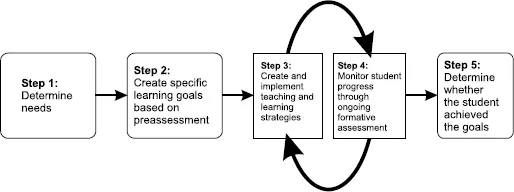
In practical terms, the student achievement goal-setting process can be depicted in the following five steps (Figure 1.1).
Figure 1.1. Student Achievement Goal-Setting Process
♦ Step 1: What is the starting point for strident learning (i.e., documenting where students begin their learning)?
♦ Step 2: What reasonable, but measurable, goals should they be expected to achieve, given where they start?
♦ Step 3: What specific teaching strategies should be used with specific students?
♦ Step 4: Where are the students in terms of achieving their desired learning goals throughout the instructional period? What mid-point corrective action should be taken to enhance student learning (i.e., what adjustments to instruction can be made to enhance learning)?
♦ Step 5: Where are students at the end of the year/term/unit of instruction?
Student achievement goal setting begins with knowing where students are in relation to what is expected of them. This allows teachers to set specific, measurable goals based on both the demands of the curriculum and the needs of the students. The next part of the process is recursive in that the teacher creates and implements strategies and monitors the progress of those strategies. As progress is monitored, the teacher makes adjustments to the teaching and learning strategies. Finally, a summative judgment is made regarding student learning for a specified period of time. The process looks similar to Figure 1.2.
Figure 1.2
Special Education:
A Special Case for Goal Setting
Special education instruction can be considered a special kind of student goal setting. For special education students, the U.S. Individuals with Disabilities Education Act (IDEA) requires an integration between assessment and instruction. Additionally, IDEA mandates that each IEP include a statement of measurable annual goals, including academic and functional goals designed to meet the child’s individual needs.6 Additionally, IDEA requires a description of how the child’s progress toward meeting these goals will be measured.7 In essence, special educators are required to deliver differentiated instruction that is specified in IEPs and which includes procedures for assessing student progress toward goals.8 According to Fuchs and colleagues, this goal-setting process is defined by frequent curriculum-based measurement and evaluation.9
Although full-blown IEPs for all students may not be feasible, nonetheless, it is a close hybrid that we advocate for all students—a process in which we know where our students begin, what we can do to help them maximize their learning, whether our instructional strategies are succeeding, and, most importantly, how well our students have actually learned. This is student achievement goal setting.
Why Student Achievement Goal Setting?
We know that teachers have a definite and powerful impact on student learning and academic performance.10 In this vein, student achievement goal setting allows teachers to focus attention on students and on instructional improvement through the process of determining baseline performance, developing strategies for improvement, and assessing results at the end of the academic year. More specifically, the intent of student achievement goal setting is the following:
♦ To make explicit the connection between teaching and learning,
♦ To make instructional decisions based on student data,
♦ T...
Table of contents
- Cover Page
- Title Page
- Copyright Page
- Dedication
- Table of Contents
- About the Authors
- Acknowledgments
- Preface
- Part I: How Student Achievement Data Can Be Used to Improve Student Learning
- Part II: Practice with Student Achievement Goals: Samples to Consider
- Part III: Annotated Bibliography Related to Student Achievement Goal Setting
Frequently asked questions
Yes, you can cancel anytime from the Subscription tab in your account settings on the Perlego website. Your subscription will stay active until the end of your current billing period. Learn how to cancel your subscription
No, books cannot be downloaded as external files, such as PDFs, for use outside of Perlego. However, you can download books within the Perlego app for offline reading on mobile or tablet. Learn how to download books offline
Perlego offers two plans: Essential and Complete
- Essential is ideal for learners and professionals who enjoy exploring a wide range of subjects. Access the Essential Library with 800,000+ trusted titles and best-sellers across business, personal growth, and the humanities. Includes unlimited reading time and Standard Read Aloud voice.
- Complete: Perfect for advanced learners and researchers needing full, unrestricted access. Unlock 1.4M+ books across hundreds of subjects, including academic and specialized titles. The Complete Plan also includes advanced features like Premium Read Aloud and Research Assistant.
We are an online textbook subscription service, where you can get access to an entire online library for less than the price of a single book per month. With over 1 million books across 990+ topics, we’ve got you covered! Learn about our mission
Look out for the read-aloud symbol on your next book to see if you can listen to it. The read-aloud tool reads text aloud for you, highlighting the text as it is being read. You can pause it, speed it up and slow it down. Learn more about Read Aloud
Yes! You can use the Perlego app on both iOS and Android devices to read anytime, anywhere — even offline. Perfect for commutes or when you’re on the go.
Please note we cannot support devices running on iOS 13 and Android 7 or earlier. Learn more about using the app
Please note we cannot support devices running on iOS 13 and Android 7 or earlier. Learn more about using the app
Yes, you can access Student Achievement Goal Setting by Leslie Grant,James Stronge in PDF and/or ePUB format, as well as other popular books in Education & Education General. We have over one million books available in our catalogue for you to explore.