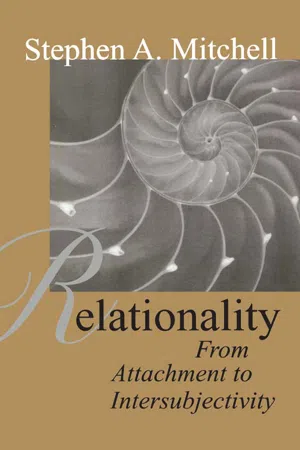
In his final contribution to the psychoanalytic literature published two months before his untimely death on December 21, 2000, the late Stephen A. Mitchell provided a brilliant synthesis of the interrelated ideas that hover around, and describe aspects of, the relational matrix of human experience. Relationality charts the emergence of the relational perspective in psychoanalysis by reviewing the contributions of Loewald, Fairbairn, Bowlby, and Sullivan, whose voices converge in apprehending the fundamental relationality of mind. Mitchell draws on the multiple dimensions of attachment, intersubjectivity, and systems theory in espousing a clinical approach equally notable for its responsiveness and
responsible restraint. Relationality "signals a new height in Mitchell's always illuminating writing" (Nancy Chodorow) and marks the "coming of age" of the relational perspective in psychoanalysis (Peter Fonagy).
- 200 pages
- English
- ePUB (mobile friendly)
- Available on iOS & Android
eBook - ePub
About this book
Trusted by 375,005 students
Access to over 1.5 million titles for a fair monthly price.
Study more efficiently using our study tools.
Information
PART I❖FROM GHOSTS TO ANCESTORS The Psychoanalytic Vision Of Hans Loewald
CHAPTER 1❖LANGUAGE AND REALITY
DOI: 10.4324/9781315803289-1
Cosmologists tell us that our universe began in a primal density in which all the structures and differentiations we take for granted were collapsed in on one another. The constituents of future atoms and molecules were all there, but they were packed together tightly. Our world, the world as we know it, has evolved into atoms and molecules, stars and galaxies, and planets, animals and people, and spaces, vast spaces. The explosive force that powered all that development into differentiated and bounded entities is called the “Big Bang.” But perhaps the greatest mystery of modern astronomy is that the extraordinary centrifugal rush into differentiated structures and boundaries and spaces seems to be balanced by an opposite, centripetal force that keeps all those structures from flying apart, that brakes the force of the Big Bang, that connects the seemingly separate and autonomous elements of our universe, and that may eventually draw them all back together again into yet another cataclysmic rebirth. There is something else, “hidden matter” in the seeming vacancy of all that space, that generates enough gravity to tie together even galaxies rushing apart across mind-numbing distances into a single force field.
Perhaps it is not too fanciful to think of psychoanalysts as astronomers and cosmologists of the mind. Patients begin treatment with fragments, pieces of a life that seem bounded and separate from one another: symptoms, current “reality” problems, memories, dreams, and fantasies. Psychoanalysts have learned to think of these seemingly bounded fragments in psychic space as constituents of a single force field. And psychoanalysts, together with their patients, narrate not cosmologies, but developmental histories in which they speculate about the way that the force field of the patient’s life came to be.
Hans Loewald developed a psychoanalytic vision of the nature and origins of mind, a vision of extraordinary richness and explanatory power. Like contemporary cosmology, it begins with a primal density in which all of the features of our everyday world, which we take to be separate, bounded elements, are collapsed in on one another. We begin, Loewald suggests, with experience in which there is no differentiation between inside and outside, self and other, actuality and fantasy, past and present. All these dichotomies, which we come to think of as givens, as basic features of the way the world simply is, are for Loewald complex constructions. They arise slowly over the course of our early years and operate as an overlay, a parallel mode of organizing experience that accompanies and coexists with experiences generated by the original, primal unity.1 That earliest form of experience, Loewald suggests, never disappears. It underlies the later differentiations and bounded structures that make adult life possible. That original and continuing primal density, in Loewald’s vision of mind, operates as “hidden matter,” tying together dimensions of experience that only appear to be fully separate, bounded, and disconnected. In fact, in Loewald’s view, psychopathology most broadly conceived represents an imbalance between the centrifugal and centripetal forces of mind. In psychosis, the primal density undermines the capacity to make adaptive, normative distinctions between inside and outside, self and other, actuality and fantasy, past and present. In neurosis or, Loewald occasionally suggests, the normative adaptation to our scientistic, hypertechnologized world, the constituents of mind have drifted too far from their original dense unity: inside and outside become separate, impermeable domains; self and other are experienced in isolation from each other; actuality is disconnected from fantasy; and the past has become remote from a shallow, passionless present.
The story of Loewald’s own earliest years (Elizabeth Loewald, personal communication) may serve as the best introduction to his vision of the original dense unity into which we are all born. Hans Loewald was born into his mother’s grief. His father died shortly after Hans’s birth, and thus he drew his first breaths in a world suffused with his mother’s mourning and the powerful presence of his father’s absence. She was a pianist of considerable skill and, as she told him later, consoled herself in the months following the death of her husband by playing Beethoven’s piano sonatas, often with Hans in his crib placed carefully beside the piano stool. Think of the transformative affective power of the “Moonlight” and “Appassionata” sonatas, and then try to imagine the experience of that baby How could he possibly separate his own feelings from his mother’s, his father from Beethoven, an inner world of his own generation from an outer world filled with loss and passion, a past when his father was present from a present from which his father had passed? Perhaps the emotional intensity and drama of Hans Loewald’s early months had something to do with the importance he placed on a primal dense unity as the starting point for the psychic universe that constitutes each individual human mind.
LANGUAGE
Because Loewald understood every dimension of experience as proceeding from the original primal density, any of the major topics Loewald concerned himself with – drives and objects, fantasy and reality, time, memory, and mourning, internalization and sublimation – can be traced back to its entanglements with the others. One could begin anywhere. Yet, somehow it seems most appropriate to ground an initial approach to Loewald’s thought in a consideration of his understanding of language, because he was so mindful (for reasons that I make clear later) of the language in which he chose to present his ideas.
Most philosophers and psychologists of language regard early human development as bifurcated by a fundamental and perhaps unbridgeable divide between the preverbal and the verbal. Increasingly over the course of the 20th century, language has become understood as the material out of which adult mentation is generated, the very stuff of mind. Following Wittgenstein and Ryle, thinking is often discussed as interiorized speech; following Lacan, many understand the unconscious itself in terms of linguistic structures. A divide has opened up between the early months of life, before the child is inducted into the linguistic-semiotic system through which he will become a person, and his later psychological self.
Psychoanalytic theorists of language, depending on their own sensibilities, have different attitudes toward life on either side of the chasm (Cavell, 1993, following Wittgenstein, calls it the “veil of language”) between the preverbal and the verbal. For Sullivan (1950), who valued the precision of language above all else, the movement from the preverbal to the verbal represents the emergence of the distinctively human from the animal.
Don’t permit yourself to think that the animal can be discovered after it has been modified by the incorporation of culture: it is no longer there. It is not a business of a social personality being pinned on or spread over a human animal. It is an initially animal human developing into what the term human properly applies to – a person…. While the many aspects of the physiochemical world are necessary environment for every animal – oxygen being one – culture, social organization, such things as language, formulated ideas, and so on, are an indispensable and equally absolutely necessary part of the environment of the human being, of the person [pp. 210–211].
On the other hand, for Daniel Stern (1985), who is fascinated with the cross-modal sensory textures and affective richness of early experience, the advent of language is a mixed blessing. In its communicative function, language makes possible the generation of what Stern terms “the sense of a verbal self,” making many features of our experience now knowable and shareable, opening up “a new domain of relatedness” (p. 162). Yet, whereas Sullivan sheds no tears over what is lost when the “veil of language” renders inaccessible what has gone before, Stern regards the advent of language as a
double-edged sword. It also makes some parts of our experience less shareable with ourselves and with others. It drives a wedge between two simultaneous forms of interpersonal experience: as it is lived and as it is verbally represented.2 Experience in the domains of emergent, core- and intersubjective relatedness, which continue irrespective of language, can be embraced only very partially in the domain of verbal relatedness. And to the extent that events in the domain of verbal relatedness are held to be what has really happened, experiences in these other domains suffer an alienation. (They can become the nether domains of experience.) Language, then, causes a split in the experience of the self. It also moves relatedness onto the impersonal, abstract level intrinsic to language and away from the personal, immediate level intrinsic to the other domains of relatedness [pp. 162–163].
Stern and Sullivan have quite opposite sensibilities. When words first appear, Sullivan suggests, they embody the particularities of their original context. Thus, when the baby says “ma-ma,” everyone gets very excited. But these “parataxic” features, Sullivan believes, are usefully lost as language use takes on “consensual validity” and moves into the domain that he terms the “syntaxic.” The abstract nature of language strips words of the idiosyncratic features of their first appearance, and this is all to the good. Language can now be used in a way that other speakers can understand precisely, and the residues of the original parataxic contexts remain as autistic pockets that detract from and compromise potentials. Humanity, Sullivan believes, takes place in interpersonal interaction. For Stern, on the other hand, the richest forms of experience emerge in the preverbal realm, with its densely sensual, cross-model textures. This sensual intensity is lost with the advent of language. Like Sullivan, Stern seems to regard the loss as inevitable; unlike Sullivan, Stern regards the loss as tragic, a poignant compromise that inevitably accompanies development into social interaction.
Freud also made a sharp distinction between the preverbal and verbal realms. Language is associated with secondary process, the reality principle, the “word-presentation,” the present-day adult world and is at considerable remove from the “thing-presentation,” the preverbal, fantasy-driven workings of primary process. In fact, consciousness itself is linguistically coded. In order for the unconscious, infantile impulse that generates the motive force of a dream to enter awareness, it has to piggyback onto words provided by the residue of the present day’s experience. Thus Freud too saw a gulf between the preverbal and verbal domains.
The key feature of Loewald’s understanding of language is his challenge of that separation.3 For Loewald, language transcends the distinction between preverbal and verbal; language begins to play an important role in the earliest days of life. The most important distinction is not between preverbal and verbal, or between primary and secondary process, but between the ways in which language operates in these two developmental eras and levels of mental organization.
In the beginning, Loewald (1977a) suggests, language is a key feature of an original “primordial density” (p. 186) in which feelings, perceptions, others, self are all part of a seamless unity.
She [the mother] speaks with or to the infant, not with the expectation that he will grasp the words, but as if speaking to herself with the infant included … he is immersed, embedded in a flow of speech that is part and parcel of a global experience within the mother–child field [p. 185]. While the mother utters words, the infant does not perceive words but is bathed in sound, rhythm, etc., as accentuating ingredients of a uniform experience [p. 187].
Loewald is suggesting that the very distinction between preverbal and verbal developmental epochs is misleading, that there is no preverbal domain per se. Rather, language is an intrinsic dimension of human experience from birth onward. The meaningful distinction is between a developmental era when words, as sound, are embedded in a global, dense undifferentiated experience, and a later era, when the semantic features of language have taken precedence over its sensual, affective features. In his retooling of Freud’s own language, Loewald characterizes the significant divide as a distinction between language in primary process and language in secondary process.
Some recent findings of infant researchers (DeCasper and Fifer, 1980) illustrate Loewald’s point. Pregnant women, during the last trimester, read aloud the Dr. Seuss classic The Cat in the Hat to their fetuses. Shortly after birth, the babies preferred a tape-recording of their mother’s voice reading that story to hearing her read another Dr. Seuss story. As Beebe, Lachmann, and Jaffe (1997) note, these babies are clearly able to “distinguish slight differences in rhythmicity, intonation, frequency variation, and phonetic components of speech” (p. 137). Consider this astounding finding for a moment. Words are a salient feature of babies’ experience, not only after birth but in utero. Babies distinguish remarkably subtle features of spoken words (after all, they tested two different Dr. Seuss stories, not Dr. Seuss and Hegel). Perhaps most important for Loewald, the earliest experience of language is deeply embedded and embodied in the child’s undifferentiated union with the mother inside of whom he slowly grows into awareness.4 In the beginning, the word, the body, affect, relational connection – these are all indistinguishable components of a unified experience.
Gradually, over the first several years of life, language takes on a very, very different quality. The child slowly comes to understand the abstract, semantic significance of words; words have meanings, apart from the immediate sensory, affective context in which they appear. Language takes on an increasingly denotative significance, and language skills entail the ability to use words in a way that anyone, not just mother, can understand, words that have, in Sullivan’s terms, a syntaxic, consensual validity.
Thus Loewald suggests that, over the course of early development, language comes to function in a secondary-process mode rather than in a primary-process mode, facilitating an adaptive competence in dealing rationally with everyday reality.
What happens to the primary-process experience of language after language has become harnessed for secondary process purposes? This question of the fate of earlier modes of organization is always the central issue for Loewald, in every major psychodynamic dimension, in assessing the quality of psychic life. And for Loewald, balance is always the crucial concern. On one hand, if linkage does not become abstracted, sufficiently broadened from its original primary-process context, the child remains entangled in a dysfunctional, incompletely differentiated autistic state. On the other hand, if language has been drawn too completely into secondary-process functions, if the original affective density of language has been almost completely severed, the result is a functionally competent but affectively dead and empty life.
There is a deep link between the same words in their primary-process and secondary-process forms. The key question for Loewald is: How alive is that link? Does language in its adaptive, everyday (secondary-process) form resonate with its earlier sensory, affective, undifferentiated (primary-process) origin, or has a severing split the two realms from each other? Such a delinking becomes definitive of Loewald’s reworking of Freud’s concept of “repression,” no longer the denial of access to awareness for an impulse, fantasy, or memory, but a severing of developmentally earlier from later forms of experience and psychic organization.
An experience with my younger daughter brought these issues home to me in a powerful way.* She was one year old, beginning to use words in an enthusiastic fashion, which was very exciting to me. We would sit at the breakfast table, and she would hold her little cup up to me, saying emphatically something like “Numa numa numa numa joooooose.” I would respond by looking her intently in the eye and saying back, pronouncing the words slowly and very distinctly, something like “Samantha, would you like some more juice?”
Now it just so happened that I was reading Loewald’s “Primary Process, Secondary Process a...
Table of contents
- Cover Page
- Half-Title Page
- Title Page
- Copyright Page
- Dedication
- Table of Contents
- Preface
- Acknowledgments
- Part 1 From Ghosts to Ancestors: The Psychoanalytic Vision of Hans Loewald
- Part II Levels of Organization
- Endnotes
- References
- Index
Frequently asked questions
Yes, you can cancel anytime from the Subscription tab in your account settings on the Perlego website. Your subscription will stay active until the end of your current billing period. Learn how to cancel your subscription
No, books cannot be downloaded as external files, such as PDFs, for use outside of Perlego. However, you can download books within the Perlego app for offline reading on mobile or tablet. Learn how to download books offline
Perlego offers two plans: Essential and Complete
- Essential is ideal for learners and professionals who enjoy exploring a wide range of subjects. Access the Essential Library with 800,000+ trusted titles and best-sellers across business, personal growth, and the humanities. Includes unlimited reading time and Standard Read Aloud voice.
- Complete: Perfect for advanced learners and researchers needing full, unrestricted access. Unlock 1.5M+ books across hundreds of subjects, including academic and specialized titles. The Complete Plan also includes advanced features like Premium Read Aloud and Research Assistant.
We are an online textbook subscription service, where you can get access to an entire online library for less than the price of a single book per month. With over 1.5 million books across 990+ topics, we’ve got you covered! Learn about our mission
Look out for the read-aloud symbol on your next book to see if you can listen to it. The read-aloud tool reads text aloud for you, highlighting the text as it is being read. You can pause it, speed it up and slow it down. Learn more about Read Aloud
Yes! You can use the Perlego app on both iOS and Android devices to read anytime, anywhere — even offline. Perfect for commutes or when you’re on the go.
Please note we cannot support devices running on iOS 13 and Android 7 or earlier. Learn more about using the app
Please note we cannot support devices running on iOS 13 and Android 7 or earlier. Learn more about using the app
Yes, you can access Relationality by Stephen A. Mitchell in PDF and/or ePUB format, as well as other popular books in Psychology & Applied Psychology. We have over 1.5 million books available in our catalogue for you to explore.