- 393 pages
- English
- ePUB (mobile friendly)
- Available on iOS & Android
eBook - ePub
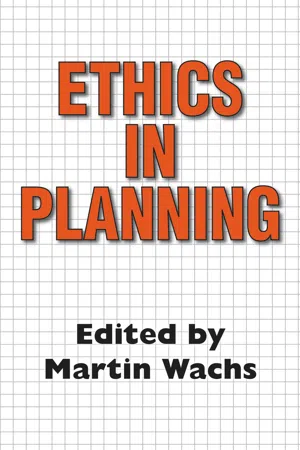
Ethics in Planning
About this book
Some planners limit discussions of ethics to simple, though important, questions about the propriety of their daily activities. This approach to ethics restricts discussion of professional ethics to the propriety of everyday social and professional relationships. It ignores the broader ethical content of planning practice, methods, and policies. While narrow definitions of ethical behavior can easily preoccupy public officials and professional associations, they divert attention from more profound moral issues.Martin Wachs argues that ethical issues are implicit in nearly all planning decisions. For illustrative and educational reasons, it is useful to divide ethics in planning into four distinct categories. The first category includes the moral implications of bureaucratic practices and rules of behavior regarding clients and supervisors. The second category includes ethical judgments which planners make in exercising their "administrative discretion." More complex, and represented by a third category, are the moral implications of methods and the ethical content of criteria built into planning techniques and models. The final type represents the basic choices which society makes - those inherent in the consideration of major policy alternatives.Ethics in Planning contains a variety of representative papers to capture the current state of thinking. This book will be important as a text for survey classes in professional ethics given by university planning programs. It should also supplement short courses in planning ethics for practicing professionals and provide source materials for discussions of planning ethics sponsored by local chapters of the American Planning Association and similar organizations. It gathers together exemplary and critical works, thus it will also interest individual planners in a field that only continues to grow in recognition and importance.
Trusted by 375,005 students
Access to over 1.5 million titles for a fair monthly price.
Study more efficiently using our study tools.
Information
Topic
ArchitectureSubtopic
Business Ethics1
Professional Ethics and Beyond: Values in Planning
Whether planning is a profession is a matter of some dispute: a recent outside opinion suggests it isn’t yet but may make it very soon (Goode). For planners, such a development would not only mean higher social status and better remuneration but also problems of licensing, registration, educational credentialing, and all the paraphernalia of a true profession. The meaning of professional ethics in that context is likely to become of much greater moment for planners than it has been in the past.
At the same time, the apparent end of the social unrest of the '60s, the escalating fiscal crisis of government, and the advent to power of conservative political leadership have resulted in increased soul-searching for many planners. Funded advocacy planning, the solution of the '60s, no longer seems a viable alternative to bureaucratic service in the '70s. New questioning of the role of the profession and its ethical implications is thus understandable.
This article looks at professional ethics in planning from two perspectives. The first is internal. It assumes the social value of the occupation of planning and its professionalization and explores what professional ethics now imply for the conduct of the practicing planner. The second perspective questions the social value of planning and looks at professional ethics in that broader context.
The article begins with several cases suggesting the concrete types of problems with which ethics in planning must deal. It then describes the obligations of existing professional ethics and their application to these issues. It concludes by looking beyond professional ethics to see how broader decision rules might be framed to guide planners' activities.
Cases in Planning Ethics
Five brief examples will set our stage.1
California’s Environmental Scorecards
Many professional planners have gone into the business of preparing environmental impact reports (EIR), now required for many private as well as public projects in California. EIRs are supposed to provide comprehensive information on the environmental consequences of a project so that public decision makers may determine whether to approve that project.
Under the headline, “Ecologists Offer Builder A Deal He Can't Refuse,” one newspaper reported on interviews with a firm of planners active in the field in which they “claimed a 7–1 scoreboard: seven building permits issued on projects covered by their environmental studies since the court ruling (requiring sugh reports), and one project turned down because it was ruled to be inconsistent with official plans for neighborhood land use.”
There was no suggestion that this favorable scoreboard arose out of selectivity in the choice of projects, those presenting environmental problems being rejected at the outset. Quite the contrary, the implication was that the professional preparation of an EIR by professionals was a virtual assurance of the approval of the project on which it reported.
Most local governments do not have the staff capability to do much independent review of privately prepared EIRs. Two alternatives were seen as available to local government: to prepare a list of qualified planners from which a private developer would have to choose or to muddle through with the situation as it is.2
The first alternative was rejected as putting local government in the position of judging the professional competence and integrity of planners. Developers argued it would be a violation of the client-professional relationship; state licensing, a possible answer, was not on the horizon. The second alternative was thus selected with a real feeling of bitterness on the part of many government officials as to the uselessness of professional ethical standards in guaranteeing the integrity of EIRs prepared by professional planners for private clients.
Oldport: The Hazards of Population Projections
In Oldport the mayor retained a planning firm as consultant to develop a comprehensive twenty-year plan for urban renewal, housing, schools, and social service facilities. The planners' preliminary report projected moderate population growth but a dramatic and continuing shift in racial composition, with minority groups reaching a majority in twelve years. A black majority was predicted within five years in the public schools.
The mayor reacted strongly to the preliminary report. If these findings were released, they would become a self-fulfilling prophecy. All hope of preserving an integrated school system and maintaining stable mixed neighborhoods or developing an ethnically heterogeneous city with a strong residential base would disappear.3
The planners were asked to review their figures. They agreed to use the lower range of their projections—minority dominance in the public schools after eight years and a majority in the city in sixteen. The mayor was not satisfied. He told the planners either to change the figures or to cut them out of the report. They refused, feeling they had bent their interpretation of fact as far as they could. Without a discussion of these facts, the balance of the report could not be professionally justified.
The mayor lashed out at them privately for professional arrogance, asked a professional on his own staff to rewrite the report without the projections, and ordered the consultants not to release or disclose their findings on race under any circumstances. The professional on the mayor's staff initially demurred from rewriting the report but ultimately complied. The consultants remained silent, completed the formal requirements of their contract, and left. The mayor never used professional planning consultants again.
Award-Winning Congestion: The Pan Am Building
In 1968 the architect for the Pan Am Building in New York, which added two million square feet of office space to one of the most congested business areas of the world, received an award for structure from the American Institute of Architects. Architectural Forum condemned the land speculation which made the Pan Am Building possible at the same time it praised the architect who built it. Robert Goodman (After the Planners, pp. 93–6) commented
The magazine ends with the moral “as professionals, it seems that architects should try to make the best of the world as it is—before somebody else fouls it up even further.” With this dreary and negative conclusion, the magazine sums up the profession, unself-consciously and without irony. But is the professional really a tool of whatever system he operates in? Does he have a responsibility for his acts other than to do his job better than someone else? Is the engineer who designed a more painless gas chamber to be lauded as a “realist,” or the scientist who designs a cleaner nuclear bomb as a more responsible professional?
Let us assume that a group of Young Turks in the New York AIP chapter, moved by Goodman's eloquence, bring a formal complaint against the planners involved in the project before the executive committee of AIP under AIP’s “Code of Professional Responsibility,” alleging a violation of its first canon:
A planner serves the public interest primarily. He shall accept or continue employment only when he can insure accommodation of the client's or employer's interest with the public interest (AIP 1971).
The Young Turks further point to number 4 of the “Guidelines for the Social Responsibility of Planners” adopted by AIP in 1972 (AIP 1973):
The professional planner should explain clearly to local, state, and national political leaders the seriousness of existing, emerging and anticipated social problems.
The Young Turks argued that the planners should not only have refused to work on the Pan Am project but should also have appeared before the city planning commission to point out its dangers. Expulsion from AIP was asked as the very least penalty for failure to do so.
Evidence presented included a statement from the director of the city planning commission. He himself had recommended approval of the project because he knew that at least four of the five members of the commission favored it. However, citing reasons of congestion, pollution, and inefficiencies of scale, as well as unfair competition to other developments elsewhere in the city, he felt it was against the public interest.
Amid substantial newspaper publicity, the executive committee ruled against the complainants. It found that neither the canons nor the “Guidelines on Social Responsibility” were part of the “Rules of Discipline” of the profession or intended to be enforced by it. For AIP to attempt to arrogate to itself the decision as to whether a given building should be built would be a usurpation of the democratic decision-making process which the committee could not condone.
An editorial in the leading New York newspaper the following day commented on the hypocrisy of the planning profession's claim to serve the public interest and suggested that honesty might dictate repeal by AIP of all references to the public interest anywhere in its canons.
Mass Transit: Planning for Whom?
Central business district revitalization requires the services of a variety of planning professionals. In one large city, a transportation planning firm was engaged by a group of downtown merchants to advise it on the transit aspects of a proposed urban renewal plan for the CBD. The planners recommended a fixed-rail system with lines radiating out from the CBD.
The regional transit agency shortly thereafter (while the planners were still under retainer to the merchants to explain their CBD report on request) also sought a consultant to advise it on the advisability of constructing a fixed-rail system in the region and, if it proved advisable, to suggest routes. The same planning firm was selected; after extensive study it recommended a fixed-rail system with a radial configuration centered on the CBD. A referendum was scheduled on a sales tax to finance construction of the proposed system.
Concern for conflicts of interest on the part of the transportation planners did not surface until the referendum campaign was well under way. Questions were asked about the consultant's recommendations for a radial pattern, which would benefit the CBD, over a grid pattern. How objectively had the arguments for alternatives to fixed-rail been considered? How fairly were they presented? Why was a sales tax recommended as the measure of financing, rather than a special assessment district downtown? How neutral were the technical assumptions used in making the rider ship projections on the basis of which the fixed-rail system was recommended in the first place?
The defense contended that the recommendations were strongly supported by the data and the planners' expert professional judgment. Further, the regional transit agency was fully aware of the planners' work for the CBD merchants. It had in fact considered their familiarity with the CBD situation an asset when the firm was selected. Finally, the planners argued that their recommendations to their two different clients were the same because in both cases they were following AIP's exhortation to “serve the public interest primarily.”
The sales tax proposition was decisively defeated at the polls. In subsequent interviews, the man in the street told reporters that the only beneficiaries of all the years of studying transit needs in the city seemed to be the planning consultants, who couldn't be trusted further than they could be thrown.
Vietnam: Planners and Foreign Policy
President Nixon resumed the bombing of North Vietnam in the fall of 1971. In the September 1972 Journal of the American Institute of Planners, an article appeared entitled “Ecological Effects of the Vietnam War” (Concerned Planners 1972).4 Its opening paragraph read as follows:
Planners have no special claim to omniscience or moral virtue. Yet we feel that we must speak out against the escalation of the war in Vietnam, as professionals as well as citizens, for three reasons: because the tools of planning can help to highlight the ...
Table of contents
- Cover Page
- Title Page
- Copyright Page
- Contents
- Acknowledgments
- About the Contributors
- Introduction
- I. Overview Of Ethical Issues In Urban Planning And Administration
- 1. Professional Ethics and Beyond: Values in Planning
- 2. The Ethics of Contemporary American Planners
- 3. Foundations for Normative Planning
- 4. The Structure of Ethical Choice in Planning Practice
- 5. Realms of Obligation and Virtue
- II. Corruption And Whistle-Blowing In Planning Organizations
- 6. Corruption and Reform in Land-Use and Building Regulation: Incentives and Disincentives
- 7. Corruption as a Feature of Governmental Organization
- 8. Whistle Blowing: Its Nature and Justification
- 9. Ethical Dilemmas in Government: Designing an Organizational Response
- III. Ethical Issues In Policymaking
- 10. The Place of Principles in Policy Analysis
- 11. Utilitarianism and the Presuppositions of Cost-Benefit Analysis: An Essay on the Relevance of Moral Philosophy to the Theory of Bureaucracy
- 12. Cost-Benefit Analysis and Environmental, Safety, and Health Regulation: Ethical and Philosophical Considerations
- Ethical Dilemmas in Forecasting for Public Policy
- 14. Normative Criteria for Organizational Discourse: A Methodological Approach
- IV. The Emergence Of An Environmental Ethic
- 15. Land Planning in an Ethical Perspective
- 16. Is There an Ecological Ethic?
- 17. Are We Ready for an Ecological Morality?
- Appendix
- 2. The Social Responsibility of the Planner, American Institute of Planners, 1973
- 3. American Society for Public Administration: Statement of Principles, 1981
- 4. A Code of Ethics for Government Service, Public Law 96–303, 1980
- Bibliography
- Index
Frequently asked questions
Yes, you can cancel anytime from the Subscription tab in your account settings on the Perlego website. Your subscription will stay active until the end of your current billing period. Learn how to cancel your subscription
No, books cannot be downloaded as external files, such as PDFs, for use outside of Perlego. However, you can download books within the Perlego app for offline reading on mobile or tablet. Learn how to download books offline
Perlego offers two plans: Essential and Complete
- Essential is ideal for learners and professionals who enjoy exploring a wide range of subjects. Access the Essential Library with 800,000+ trusted titles and best-sellers across business, personal growth, and the humanities. Includes unlimited reading time and Standard Read Aloud voice.
- Complete: Perfect for advanced learners and researchers needing full, unrestricted access. Unlock 1.5M+ books across hundreds of subjects, including academic and specialized titles. The Complete Plan also includes advanced features like Premium Read Aloud and Research Assistant.
We are an online textbook subscription service, where you can get access to an entire online library for less than the price of a single book per month. With over 1.5 million books across 990+ topics, we’ve got you covered! Learn about our mission
Look out for the read-aloud symbol on your next book to see if you can listen to it. The read-aloud tool reads text aloud for you, highlighting the text as it is being read. You can pause it, speed it up and slow it down. Learn more about Read Aloud
Yes! You can use the Perlego app on both iOS and Android devices to read anytime, anywhere — even offline. Perfect for commutes or when you’re on the go.
Please note we cannot support devices running on iOS 13 and Android 7 or earlier. Learn more about using the app
Please note we cannot support devices running on iOS 13 and Android 7 or earlier. Learn more about using the app
Yes, you can access Ethics in Planning by Martin Wachs in PDF and/or ePUB format, as well as other popular books in Architecture & Business Ethics. We have over 1.5 million books available in our catalogue for you to explore.