Reimagining Communication: Experience explores the embodied and experiential aspects of media forms across a variety of contemporary platforms, uses, content variations, audiences, and professional roles.
A diverse body of contributions offer a broad range of perspectives on memory, embodiment, time, and more. The volume is organized to reflect a pedagogical approach of carefully laddered and sequenced topics, which supports meaningful, project-based learning in addition to a course's traditional writing requirements. As the field of Communication Studies has been continuously growing and reaching new horizons, this volume presents a survey of the foundational theoretical and methodological approaches that continue to shape the discipline, synthesizing the complex relationship of communication to forms of experience in a uniquely accessible and engaging way.
This is an essential introductory text for advanced undergraduate and graduate students and scholars of communication, media, and interactive technologies, with an interdisciplinary focus and an emphasis on the integration of new technologies.
Seeing the World through Metaphorically Coloured Glasses
Judith Papadopoulos
Introduction
In 1956, the term “artificial intelligence (AI)” was born. The computer scientist John McCarthy created it for a title of an academic conference he conducted together with Marvin Minsky, Nathaniel Rochester, and Claude Shannon: the well-known “Dartmouth College Artificial Intelligence Conference” (cf. Moor, 2006). McCarthy used this metaphorical expression to highlight aspects of machine learning, whereby “artificial” stresses the imitation issue and “intelligence”, the ability of thinking. This idea reflects the definition of AI as “the science of making machines do things that would require intelligence if done by [people]” (Minsky, 1968, p. 5). Typically, scientists differentiate between weak and strong AI. While weak AI describes programs that are limited to single tasks, strong AI refers to programs that are able to solve many problems (e.g. Coppin, 2004). Both terms, weak and strong, are metaphorical again.
At first glance, the use of metaphors within a scientific context might be astonishing. But by taking a closer look we can discover manifold metaphors in science, e. g., physicists talk about a Big Bang, Freud characterized psychological processes as a steam-boiler, or neurologists see our brain as a network. According to Jäkel (1997), 80% of the scientific language is metaphorical. Why? Metaphors help scientists to shape their theories (West & Travis, 1991a, p. 65)—they guide them to uncharted territories and facilitate their understanding of the unknown things by referring to familiar, experience-based concepts (Lakoff & Johnson, 1980). Thus, metaphors must be regarded as a fundamental principle of human thinking: they enable us to construct reality as well as to gain new insights and let us view the world variously (cf. Schildknecht, 1996).
As a universal principle of thinking, we use metaphors not only in science, but everywhere: we talk about time as if it was money (e.g. my time is precious), about emotions as if they were a hot fluid in a container (e.g. we burn with anger), about the World Wide Web as if it was a navigable space (e. g. we meet in chatrooms), or about machines as if they were humans. It is assumed that on average we use four conventionalized and one or two novel metaphorical expressions per two minutes of conversation (cf. Schrott & Jacobs, 2011, p. 212). Sometimes, we are aware of it, but more often we aren’t, even though metaphors influence how we perceive the world (cf. Keefer & Landau, 2016; Thibodeau & Boroditsky, 2011). In this chapter, we will delve deeper into the complex interaction between metaphors and perception to understand the mechanisms behind and their impact on our emotions, thinking or problem solving, behavior as well as our attitudes. Due to these potentials metaphors are a powerful communication tool to promote innovations, which will be reflected in the last part. All considerations refer to AI, the key innovation technology of the current time.
The Essence of Metaphors
The term metaphor comes from the Greek “meta-phorein” and means “to carry over” or “to transport.” This original meaning captures the nature of metaphors very well—metaphors emerge from a “transportation” of features from one concept (source domain) to another (target domain), also termed as the mapping process. While the discussion of metaphors has a long tradition, the cognitive view on this phenomenon is comparably fresh, starting in 1980 as Lakoff observed that the everyday language is highly metaphorical (Lakoff & Johnson, 1980). The key assumption of a cognitive approach is the distinction between the linguistic and the conceptual level—metaphors are no longer a linguistic phenomenon, but rather a conceptual one with access to thinking and action.
A metaphor, after all, is not a linguistic expression. It is a mapping from one conceptual domain to another, and as such it has a three-part structure: two endpoints (the source and the target schemas) and a bridge between them (the detailed mapping).
(Lakoff & Turner, 1989, p. 203)
Consequently, metaphors are multimodal. This means that language is only one mode in which metaphors can be realized; other modes are visuals, music, sound, gestures, smell, taste, and touch (cf. Forceville, 2015).
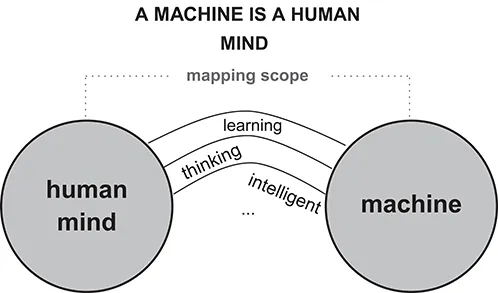
The development and perception in the field of AI is strongly shaped by the metaphor a machine is a human mind, including a mapping of features from the domain human mind (e.g. thinking, learning, intelligent or empathic) to the domain machine (e.g. artificial intelligence is being trained to have empathy) as shown in Figure 1.1
FIGURE 1.1 The mapping process of the metaphor a machine is a human mind
This metaphor involves further metaphors like computing is learning, indicating that “it is a family of closely related metaphors, each of which attributes an aspect of similarity between referents of the objects we call computers and those we call minds” (West & Travis, 1991a, p. 69). This is in line with the idea of metaphor pluralism and the finding that we often use various metaphors to understand complex matters (Lakoff & Johnson, 1980).
In addition, the metaphor a machine is a human mind triggers the broader metaphor a machine is a human, which is clearly visible in the development of humanoid robots. As a result of these mappings, we see machines as human beings. This metaphorical perspective on machines underlines our tendency to anthropomorphize the world around us by attributing humanlike characteristics to nonhuman agents. We do it frequently, referring to artefacts, animals, nature, economy, or religion. According to Schrott and Jacobs (2011), anthropomorphism is a specific type of metaphor, which is also labeled as an “anthropomorphic metaphor” (Krementsov & Todes, 1991).
Apart from the need for social connectedness and a counterforce to an increasing materialization of the world, one of the substantial drivers of anthropomorphism is the need for competence (Epley, Waytz, Akalis, & Cacioppo, 2008; Schroeder & Epley, 2016): we try to understand and control the unknown object of investigation by referring to well-known concepts. Therefore, we project the most familiar concept, namely ourselves, onto the external world to grasp it in dimensions that are comparable to us (Schrott & Jacobs, 2011). In this way, anthropomorphism functions as an instrument of concretization and understanding—just like metaphors in general. Concretization by metaphors rests mainly on the selected source domain: usually, the source domain is anchored in experience and more familiar than the target domain. These experiences and attributes are mapped to the target domain which give it a structure and make it tangible (Lakoff & Turner, 1989).
The Role of Perception in Creating Metaphors
Up to now, the first part of the metaphorical term “artificial intelligence” was ignored. The composition seems to be an oxymoron, because something that is intelligent can’t be artificial at the same time. But when we understand artificial figuratively, then it belongs to the concept of imitation and strengthens the initial idea of AI: the imitation of the human mind. Similar to AI, imitation or mimesis plays a central role in language acquisition. For example, children often do a gesture of eating to communicate a need to eat. In doing so, they imitate the action itself in an intentional, but not linguistical way. These are the first steps in developing an understanding of symbolism which is a substantial principle in language (Zlatev, 2005). The idea of mimesis underlines the role of our body in language processing and strengthens the assumption that language grounds in embodied experience. Consequently, language capability requires a body.
What we call “mind” and “body” are aspects of an ongoing sequence of organism-environment interactions that are at once both physical and mental. […] They recognize that the human mind is embodied–that all of our meaning, thought, and symbolic expressions are grounded in patterns of perception and bodily movement.
(Johnson, 2005, p. 18)
The open question is how do we structure our bodily experiences conceptually? And what role do metaphors play in this structure?
Our Body—The Source of Metaphors
In this context, the term of image schema becomes relevant. Image schemas are based on recurring patterns of our bodily experience (Grady, 2005). They don’t describe the sensory experiences themselves but a “mental representation of fundamental units of sensory experience” (Grady, 2005, p. 44). These representations include perceptions (e.g. sight, hearing) as well as internal states (e.g. pain). For example, from a very early age we perceive our body as a container (CONTAINMENT), to which we can take in (e.g. food) or eliminate something (INSIDE—OUTSIDE). This example illustrates the image schemas containment and inside-outside, as well as its interrelation.
Image schemas play an essential role in structuring our cognitive system because they serve as a perceptual anchor in abstract yet fundamental concepts (e.g. causation, anger, or thoughts) by forming the source domain of a metaphor. These metaphors are called primary metaphors.
The target concepts refer to elements of mental experience which are just as fundamental to our experience as the corresponding source concepts, but are of a different sort. They relate to our interpretations of and responses to the world, our assessment of the physical situation we encounter, their nature and their meaning.
(Grady, 2005, p. 47)
Thus, primary metaphors comprise a basic connection between two concepts which somehow correlate in experience and form. They arise automatically and unconsciously from our everyday experiences by cross-domain associations and mappings which are neurologically connected in our brain (Narayanan, 1997).
In the context of AI, the concept of thinking is important as it is one main function of the mind. Therefore, the common primary metaphor mental functioning is bodily functioning becomes relevant as well as its related metaphors thinking is eating or ideas are food and communication is feeding (see also Lakoff, 2014; Tseng, 2017). The target domains thinking, ideas, and communication refer to our subjective interpretation, evaluation, or reaction to physical situations. These actions are linked to basic correlations such as cause<>effects or presence<>existence (see Ungerer & Schmid, 2006), which constrain the mapping scope: exactly like our body, we perceive our mind as a container to which we can incorporate something (ideas). While we are eating, we digest the food, and while we are thinking, we digest ideas, and sometimes come up with new ones. Eating and thinking share some similar aspects of experiences—both relate to a process in the inner world and need an external input. Accordingly, primary metaphors arise by correlated perceptual experience (e.g. sensory, bodily, emotional) and cognitive assessment (basic co...
Table of contents
Cover
Half Title
Title Page
Copyright Page
Table of Contents
Series Introduction
Introduction
1. Communication, Perception and Innovation: Seeing the World through Metaphorically Coloured Glasses
2. Audio Experience
3. Re-Imagining Embodiment in Communication
4. Reassessing the Importance of Nonverbal Communication in the Age of Social Media
5. Prototyping Interaction: Designing Technology for Communication
6. Communicating Affect: Face-to-Face and Online
7. Synchronicity, or Not: On the Temporal Relations between Journalism and Politics
8. Reimagining Memory: Digital Media and a New Polyphony of Memory
9. Virtual Space: Palestinians Negotiate a Lost Homeland in Film
10. The Mediatization of Politics, Religion, and Science
11. Reimagining Audiences in the Age of Datafication
12. Youth Media Consumption and Privacy Risks in the Digital Era
13. Fan Cultures as Analytic Nexus of Media Audiences and Industries
14. From the Ashes of Ubiquity: Selfie Culture as a New Communication Frontier
15. Receiving the Stranger Through the Exposed Heart
List of contributors
Index
Trusted by 375,005 students
Access to over 1.5 million titles for a fair monthly price.
Study more efficiently using our study tools.
Frequently asked questions
Yes, you can cancel anytime from the Subscription tab in your account settings on the Perlego website. Your subscription will stay active until the end of your current billing period. Learn how to cancel your subscription
No, books cannot be downloaded as external files, such as PDFs, for use outside of Perlego. However, you can download books within the Perlego app for offline reading on mobile or tablet. Learn how to download books offline
Perlego offers two plans: Essential and Complete
Essential is ideal for learners and professionals who enjoy exploring a wide range of subjects. Access the Essential Library with 800,000+ trusted titles and best-sellers across business, personal growth, and the humanities. Includes unlimited reading time and Standard Read Aloud voice.
Complete: Perfect for advanced learners and researchers needing full, unrestricted access. Unlock 1.5M+ books across hundreds of subjects, including academic and specialized titles. The Complete Plan also includes advanced features like Premium Read Aloud and Research Assistant.
Both plans are available with monthly, semester, or annual billing cycles.
We are an online textbook subscription service, where you can get access to an entire online library for less than the price of a single book per month. With over 1.5 million books across 990+ topics, we’ve got you covered! Learn about our mission
Look out for the read-aloud symbol on your next book to see if you can listen to it. The read-aloud tool reads text aloud for you, highlighting the text as it is being read. You can pause it, speed it up and slow it down. Learn more about Read Aloud
Yes! You can use the Perlego app on both iOS and Android devices to read anytime, anywhere — even offline. Perfect for commutes or when you’re on the go. Please note we cannot support devices running on iOS 13 and Android 7 or earlier. Learn more about using the app
Yes, you can access Reimagining Communication: Experience by Michael Filimowicz,Veronika Tzankova in PDF and/or ePUB format, as well as other popular books in Languages & Linguistics & Digital Media. We have over 1.5 million books available in our catalogue for you to explore.