- 268 pages
- English
- ePUB (mobile friendly)
- Available on iOS & Android
eBook - ePub
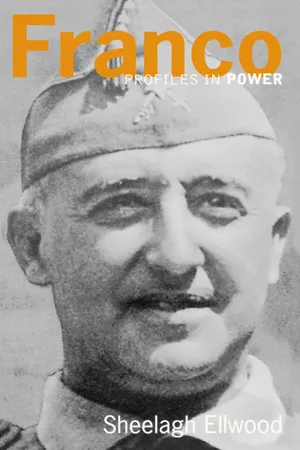
Franco
About this book
An excellent introduction to Franco's rise to power and his four decades as autocratic head of state in Spain.
Trusted by 375,005 students
Access to over 1.5 million titles for a fair monthly price.
Study more efficiently using our study tools.
Information
Chapter 1
FROM GALICIA TO CASTILE AND BACK (1892–1912)
On 4 December 1892, in El Ferrol, a small town on the north-west tip of the Spanish coast, the wife of a naval officer gave birth to a son, the second of their children. The mother, Pilar Bahamonde y Pardo de Andrade, was from a middle-class family which traced its descent from the minor nobility of fifteenth-century rural Galicia. The child’s father, Nicolás Franco Salgado-Araujo, belonged to a well-known local family and was employed, as five generations of his forebears had been, in the administration of the Spanish Navy. The child, shortly christened Francisco Paulino Hermenegildo Teódulo, had been born on the feast-day of Saint Barbara, patroness of artillerymen. This turned out to be portentous indeed, for, in the course of his long life, Francisco Franco Bahamonde was to have a great deal to do with guns and shooting.
Francisco Franco’s childhood was neither more nor less eventful than most. In later life, he recalled that it was ‘short and simple, and scarcely contain (ed) any noteworthy events’. He did not lack companions for, in addition to his elder brother, Nicolás and his younger sister and brother, Pilar and Ramón (born, respectively, in 1894 and 1896), he had numerous cousins on both his mother’s and his father’s side, all of whom lived, as he did, close to the naval base in the port of El Ferrol. His mother, for whom he always showed admiration, was a devoutly Catholic and self-effacing woman, whose caring nature contrasted sharply with that of her husband, whose unfeeling behaviour eventually opened a permanent rift between him and his children. Until the age of twelve, Franco was educated at a private school, run by a Catholic priest, and appears to have been a conscientious, though not outstanding, student. His father was dismissive of his successes, but his mother ‘inculcated in her sons the desire to get on, by the only means possible for those of their social class: study. For to have a career meant achieving social progress.’1 It was, thus, in the bosom of his family that Franco acquired what was to be one of his defining characteristics: ambition. Had doña Pilar lived beyond 1934 she would not have been disappointed by her second-born.
Franco’s immediate surroundings were those of a large, modestly well-off, conservative, middle-class family, but the broader context of his early years was one of isolation and deprivation. The region in which he was brought up, Galicia, is cut off from the rest of Spain on two sides by the sea and on a third borders with Portugal. Moreover, in the 1890s the peripheral regions of the country were linked to each other and to the metropolis by only a rudimentary system of roads and railways. In addition to being geographically isolated, Galicia also suffered acute economic penury. Most of the working population was employed in the fishing industry or agriculture, but both provided only a meagre existence. The highly fragmented system of land tenure made it impossible for agriculture to support a rapidly expanding population, driving thousands of people to overseas emigration or migration to the coastal towns and the larger cities elsewhere in the country. Socially, too, like most of rural Spain, turn-of-the-century Galicia was poor and backward, imbued with the anti-egalitarian values of a society whose different sectors had no contact with each other except in terms defined by the rigidly hierarchical structure of the traditional social order. In Franco’s particular case, this had two extra dimensions, for he belonged to a service family and civilians and forces personnel each lived in separate worlds, as did seafaring and administrative members of the Navy.2
Isolated though life was for this dry-land sailor’s son in a small, provincial town, his native Galicia was not entirely divorced from what was going on in the outside world. On the contrary, towns like El Ferrol on the Atlantic seaboard were particularly important and more than usually busy then, for Spain was at war with her South and Central American colonies, whose struggle for independence had occupied much of the nineteenth century. El Ferrol was one of the Spanish Navy’s three home bases and many of the thousands of sailors who served in the colonial wars came from Galicia. One of Franco’s closest school (and life-long) friends, Camilo Alonso Vega, lost his father in a naval battle in Cuba in 1898. As children, Franco and his companions may have seen the jerky pictures of an early cinematographic newsreel showing a Spanish battleship, the Carlos V, in the Caribbean and the landing of United States troops in the Cuban ports of Daiquiri and Siboney, in June 1898.3 A month later, the Spanish Atlantic fleet was routed and the Spanish land forces in Cuba were forced to surrender. This resounding defeat enabled Cuba to achieve independence and the United States to assume sovereignty over Puerto Rico and the Philippine Islands, thereby bringing to a close four centuries of Spanish imperial power. At the age of six, Franco could not have understood the full impact of what was immediately referred to as the 1898 ‘Disaster’, but his country’s subsequent transition from a long period as a great colonial metropolis to its new role as a lesser power in twentieth-century Europe was a difficult, often violent, process which decisively affected not only the mood of the times in which he grew up but also his own attitudes towards politics and the armed forces. In later life, 1898 meant to him (as to many of his generation) a betrayal of the armed forces by civilian politicians which demanded retribution and redress.
Spain had been at war on a number of occasions since the end of the eighteenth century: against Britain from 1793 to 1805, against a French army of occupation from 1808 to 1814, and against its American colonies from 1810 to 1824 and 1895 to 1898. In terms of domestic politics, too, conflict and instability were the keynotes of the nineteenth century, as the supporters of a traditional, conservative regime in which the monarch both reigned and governed at the top of a hierarchically organized social and political system, sought to exclude from power the partisans of liberal monarchy, in which political power would be based on the popular will expressed in free elections. There were also occasions on which civil war broke out between the partisans of absolutist conservatism and those of more moderate conservative and liberal forms of government. Thus, even when there was a lull in the external fighting, there was war at home. In addition, there was a rising tide of socio-economic unrest, as the mass of the population, who had no say in governmental politics, attempted to make their voice heard against a system which excluded, oppressed and exploited them. The most extreme manifestations of this groundswell of popular discontent were the bombings and assassinations perpetrated by the more radical sector of the anarchist movement. More frequent and more widespread in their effect and level of involvement were the peasant uprisings against the unfair distribution of land, or the strikes staged by industrial workers against low wage levels, poor conditions and inflation. Conservative and liberal governments invariably responded with repression, often carried out by the Army. In so doing, they merely exacerbated the situation, by alienating the working masses further.
In the absence of democratic elections, political change was effected either by the intervention of the monarch or by an appeal to the military. Even when the monarchy was briefly replaced by a Republic (1873–74), the conflict continued between conservative and liberal concepts of how it ought to be organized. The terms of the restoration of the monarchy in 1875, in the person of the Bourbon heir, Alphonso XII, and of the constitution promulgated in 1876 ensured that the liberals were no longer systematically excluded from power. However, it was not until 1885 that a certain political stability was achieved, when the leaders of the Liberal and Conservative parties agreed to take turns in power. But new tensions quickly arose, for military interventionism had simply been replaced by electoral manipulation as the generator of political change. By the turn of the century, the political and administrative effectiveness of the two-party system was in decline, and responsibility for government fell increasingly upon a monarchy which lacked both the expertise and the political and popular support necessary to achieve and sustain political stability.
Above all, nineteenth-century Spain lacked a strong economic base on which to construct a stable political system. Heavy reliance on agriculture (and on a narrow range of crops) made the Spanish economy highly susceptible to factors beyond its control, such as climatic variations, natural disasters or changes in demand. Moreover, in addition to the technical problems posed by an enormous diversity of soil-types, geographic and hydrographic characteristics, and land-holding systems, the whole sector suffered from under-capitalization, under-exploitation and gross inefficiencies in the distribution and use of fertile land. Productivity was generally low and unit costs high, with the exception of labour, of which there was an excessive and, consequently, very cheap supply. The second half of the century saw the beginnings of industrial production in two areas of Spain: Catalonia, where textile manufacture slowly became the main non-agricultural component of the regional economy, and the Basque Country, where rich deposits of iron ore gave rise to ore exporting, steel manufacture, shipbuilding and engineering. By the end of the nineteenth century, however, the gradual loss of Latin American markets made Spanish industry increasingly reliant on domestic consumers whose demand and purchasing power were extremely limited. Neither agriculture nor industry generated surplus capital which might be reinvested, and a state impoverished by a century of war was incapable of providing any assistance other than protectionist policies, which temporarily paliated but did not remedy the underlying structural weaknesses.
The symptoms of decline and crisis manifest throughout the nineteenth century stimulated the idea among politicians, intellectuals and the military that some kind of radical intervention was required to stop the rot and initiate a period of national revival, or ‘regeneration’. The loss of the last remnants of the empire in 1898 increased the already exaggerated nationalistic and patriotic component of ‘regenerationism’, particularly in military circles, where the conviction was growing that it was the ineptitude of politicians and government officials (especially those in the Treasury) that was the cause of Spain’s troubles. This was a view to which Francisco Franco was later to subscribe. Looking back at the early part of the twentieth century, Franco wrote in 1962:
The obsession with public finance prevented Spain from realizing that she was being left behind in everything. The loss of our overseas territories, as a result of an unjust war, submerged us in the negative mood of national politics vis à vis our national territorial ambitions …. I believed in Spain and in her future possibilities. What was inadmissible was the political status quo, the structures of a system which presided over the complete collapse of our Empire.4
The implications of the ferment provoked by the change in his country’s fortunes were brought home to Franco in 1907, when he was fifteen years old. Family tradition and personal vocation indicated that he would join the Navy and he therefore received his secondary education at the Naval School in El Ferrol, in preparation for entry to the Naval Academy.5 However, a century of war and the collapse of the empire had virtually bankrupted the Spanish state and, as part of its efforts to cut military spending, in 1907 the government suspended until further notice the admission of cadets to the Naval Academy. This meant not only the frustration of Franco’s ambition to join the Navy, but also that of his family to see one of its sons cross the invisible but crucial boundary between seafaring and non-seafaring sailors. The shattering of both dreams came as a severe disappointment and added a personal grievance to Franco’s latent class and generational animosity towards the political Establishment. In response to the government’s decision, Franco took what his cousin and life-long companion, Francisco Franco Salgado-Araujo, considered the only option left to ‘the young men of El Ferrol who aspired to joining the Navy’: the Army.6 In so doing, Franco began the ascent which was to lead, twenty-nine years later, to the position of Commander-in-Chief of the Armed Forces, Head of Government and Head of State. It is interesting that, despite doña Pilar Bahamonde’s belief in study as a means to social advancement, a university career was not even entertained as a possibility for her son, because the conservative classes saw the universities as centres of subversion. Franco retained that opinion all his life.
On 29 August 1907, Franco enrolled as a cadet in the Infantry Academy in Toledo, far south of his native Galicia, in the middle of the high meseta which forms the central massif of the Iberian Peninsula. In the absence of his own testimony, it is difficult to know what sentiments that move provoked in the adolescent Franco, but the magnitude of the change cannot but have affected him profoundly. In the first place, having been born and brought up close to the sea, ships and Atlantic rain, he was now in the middle of an arid, land-locked plateau, scorched in summer and frozen in winter. Secondly, the disparate figures of his mother and father were no longer present in his everyday life.7 Thirdly, from the relative liberty and diversity of civilian existence, he was transferred to a closed, all-male social unit which erased individual identities in the interests of discipline, substituted rules and regulations for freedom of choice, and attempted to make contact with the outside world unnecessary by providing internally for all its members’ needs.
Writing of Franco’s time in Toledo, one of his first biographers describes him as ‘always ready to fulfill the duties, however disagreeable, imposed by the discipline of the Academy’.8 The Army was not the origin of that attitude, however, but the catalyst of beliefs received in the bosom of a family whose Catholicism, conservatism and authoritarianism made such concepts as hierarchy, discipline and obedience supreme values. His readiness to obey orders was not merely a formal attribute of his professional role, but a fundamental part of his character. It reflected a preference for hierarchical, rather than egalitarian, relationships, and was intimately bound up with the values which, for him, legitimated the exercise of authority. He was ready to accept orders provided they were given by people he considered empowered to do so by their formal position and their affinity with his own code of behaviour. The second was the key consideration. People and, above all, their opinions, were seen through a Manichaean prism which led him to reject, fear and try to eliminate those views which differed from his own. As his participation in the military rising of 18 July 1936 was to show, however, his obedience was far from guaranteed when he did not subscribe to the ideas of those in power, even when they were his superiors.
If Franco’s strict upbringing had conditioned him to the submissive role required of Army recruits, it seems also to have predisposed him towards embracing the camaraderie of military life. As an institution, the Army did not reproach him with his physical shortcomings – his weedy build and a slight speech impediment – nor did it frown, as other professional circles might have done, on his provincial accent. Dressed in the same way as the other cadets, he ‘belonged’ in the Academy and felt reassured by the outward respectability with which uniforms are intended to invest their wearers. Nevertheless, the military uniform masked only partially Franco’s underlying insecurity. He was constantly reminded of his small stature by the nickname he was given by his companions – the diminutive of his own surname, ‘Franquito’ – while his penchant for ‘swotting’ made him the butt of barrack-room practical jokes, to which he responded with unsmiling abnegation. Unlike the other cadets, he did not take part ‘in the lively sexual forays customary among soldiers’ – a reluctance not due to anti-machismo on Franco’s part, but to his ‘inferiority complex’.9
Despite his reputedly studious nature, Franco’s academic performance was unremarkable. Of the 312 cadets who completed their training at the same time, he came well down the list, in 251st position. He graduated from Toledo on 13 July 1910, with the rank of Second Lieutenant, and was posted to his native El Ferrol, with the 8th ‘Zamora’ Regiment. He had tried to enlist for service in Spanish Morocco, but was unable to do so on account of his junior rank. The return to Galicia, although lacking the promise of rapid promotion, was an opportunity to go home wearing the uniform which was the visible sign of his membership of a respected élite; a chance to show his family and friends that he had made it (rather like the gallego emigrés to Cuba and Argentina, who returned only when and if they had made money overseas). His immediate satisfaction was short-lived, however, for although he now had a distinct role in life, there was nothing prestigious or glamorous about being a low-ranking Army officer in a small, provincial garrison town. Moreover, the salary of a Second Lieutenant was low and, with Spain at peace, promotion would come only slowly, by virtue of years o...
Table of contents
- Cover
- Half Title
- Title Page
- Copyright Page
- Table of Contents
- Preface
- Glossary
- CHAPTER 1 From Galicia to Castile and back (1892–1912)
- CHAPTER 2 Africa, Madrid, Zaragoza (1912–31)
- CHAPTER 3 The Second Republic (1931–36)
- CHAPTER 4 The Civil War (1936–39)
- CHAPTER 5 ‘Franco’s Peace’ (1939–42)
- CHAPTER 6 Weathering the Storm (1943–49)
- CHAPTER 7 The ‘Sentry of the West’ (1950–60)
- CHAPTER 8 The Twilight of the God (1960–75)
- CHAPTER 9 The Beginning of the Post-Franco Era
- Chronology
- Bibliographical Essay
- Map of Spain and Morocco
- Index
Frequently asked questions
Yes, you can cancel anytime from the Subscription tab in your account settings on the Perlego website. Your subscription will stay active until the end of your current billing period. Learn how to cancel your subscription
No, books cannot be downloaded as external files, such as PDFs, for use outside of Perlego. However, you can download books within the Perlego app for offline reading on mobile or tablet. Learn how to download books offline
Perlego offers two plans: Essential and Complete
- Essential is ideal for learners and professionals who enjoy exploring a wide range of subjects. Access the Essential Library with 800,000+ trusted titles and best-sellers across business, personal growth, and the humanities. Includes unlimited reading time and Standard Read Aloud voice.
- Complete: Perfect for advanced learners and researchers needing full, unrestricted access. Unlock 1.5M+ books across hundreds of subjects, including academic and specialized titles. The Complete Plan also includes advanced features like Premium Read Aloud and Research Assistant.
We are an online textbook subscription service, where you can get access to an entire online library for less than the price of a single book per month. With over 1.5 million books across 990+ topics, we’ve got you covered! Learn about our mission
Look out for the read-aloud symbol on your next book to see if you can listen to it. The read-aloud tool reads text aloud for you, highlighting the text as it is being read. You can pause it, speed it up and slow it down. Learn more about Read Aloud
Yes! You can use the Perlego app on both iOS and Android devices to read anytime, anywhere — even offline. Perfect for commutes or when you’re on the go.
Please note we cannot support devices running on iOS 13 and Android 7 or earlier. Learn more about using the app
Please note we cannot support devices running on iOS 13 and Android 7 or earlier. Learn more about using the app
Yes, you can access Franco by Sheelagh M. Ellwood in PDF and/or ePUB format, as well as other popular books in Politik & Internationale Beziehungen & Geschichte des 20. Jahrhunderts. We have over 1.5 million books available in our catalogue for you to explore.