- 134 pages
- English
- ePUB (mobile friendly)
- Available on iOS & Android
eBook - ePub
About this book
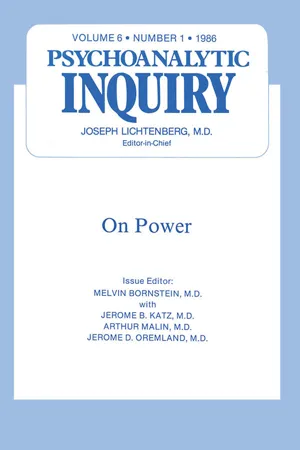
First published in 1995. This is Volume 6, number 1 of Psychoanalytic Inquiry which offers an examination of the dimensions of power in psychoanalytic thought in both mental life and human interactions. This a collection of papers from five contributors to address the problem of power and varies from studies of powerful historical figures to a reformulation of metapsychology.
Information
The Psychology of Powerlessness: Disorders of Self-Regulation and Interactional Regulation as a Newer Paradigm for Psychopathology
WHEN WE ATTEMPT TO UNDERSTAND psychopathology, we are confronted by two separate traditions or approaches, that of psychoanalysis and that of empirical psychiatry. The basic assumptions of the former derive from the considerations of the vicissitudes of drives, manifested in a dynamic matrix of psychical conflict between those drives and nurturing objects that become enmeshed with them. The traditional psychoanalytic conception of psychopathology seems based, consequently, on a theory of power. Empirical psychiatry, on the other hand, offers pathological conceptions which implicate defects or deficiencies in psychical functioning, some of which may be inherited, others of which may develop in infancy and childhood. More recent contributions to psychoanalysis have complicated the seeming simplicity of this duality by suggesting a developmental deficit concept of psychic structure harkening back to Freud’s (1911) concept of decathexis. My contribution represents an attempt to formulate a psychoanalytic metapsychological umbrella that can integrate, not only the conflict (of power) and deficit (powerlessness) theories of psychoanalysis, but also integrate the two of them with the deficit theories which the findings of neurobiology are pressing upon psychoanalysis for integration.
Psychoanalysis seems to have emerged in a cultural milieu in which German Romanticism and Logical Positivism, succeeding Transcendentalism, imparted to that Zeitgeist a legacy of power that included Schopenhauer’s will and Nietszche’s “Superman.” Freud translated this power motif into the concept of instinctual drives and founded his new science as the study of the distribution of and defense against this arcane power. Yet the concept of powerlessness had already begun to emerge with the contributions of Janet (see Strachey, 1974, p. 318) who considered hysteria to be due to a splitting of the personality secondary to an innate psychological weakness. Janet believed that all normal mental functions depended upon a capacity for synthesis, and that hysteria was due to a maladie par faiblesse, a “disease due to weakness.” Freud (1911) himself, as stated above, dealt with the phenomenon of weakness when he considered decathexis as an ego defect in psychosis, a subject to be taken up by Freeman (1959, 1969, 1970) and Wexler (1971).
More recently, the concept of deficit psychology has reemerged in psychoanalytic theory, thanks to the contributions of Bibring (1953), Winnicott (1958, 1965), A. Reich (1960), Lichtenstein (1961), Bion (1962, 1963, 1965, 1970), Balint (1968), Bowlby (1969, 1973, 1980), Broucek (1979), and particularly Kohut (1971, 1977, 1978, 1984).
One of the first major papers after Freud that dealt with the importance of deficiency states was by Bibring (1953), who challenged Freud’s (1917) explanatory hypothesis of melancholia by positing the primacy of ego weakness as opposed to Freud’s view that depression was due to the repression of one’s hostile feelings toward an object.
Bibring (1953) believed that depression was the emotional expression of a state of helplessness and powerlessness irrespective of what may have caused the breakdown of the mechanisms of selfesteem. Instead, he believed that depression resulted from a collapse of the ego’s self-esteem. Bibring’s work foreshadowed the development of the school of ego psychology in this country and the school of object relations in Great Britain, the developments from which introduced the importance of nurture (primarily the maternal object) as a major consideration in the infant’s development. An important inference to be derived from the developments of these two schools was that of an ego deficiency secondary to disappointment in an object. The effect of the contributions of ego psychology were in no small measure to mitigate emphasis on the harsh impact of the power of the child’s instincts and to stress, instead, the modifying factor of the environment as an adaptational, “cog-wheeling” co-factor in development.
Winnicott (1958, 1965) addressed the issue of defective parenting from many perspectives. Principal among these were (a) the failure of the mother to give preoccupied maternal attention at a critical phase during infancy, (b) her failure to create a transitional relatedness with the infant, and (c) her impingement on her infant’s privacy, thereby causing the infant to develop a false self in conformity with the mother and the environment in contrast to an inner, withdrawn true self.
Balint (1968) came forth with the important concept of the basic fault which had to do with the critical background quality that the failure of the early nurturing mother imparts to the child, leaving a legacy of permanent defectiveness, one which he felt was beyond the capacity of analysis to repair.
It is Bowlby (1969, 1973, 1980), however, to whom credit should be given for the most significant theory of powerlessness. Because of his pioneering work in attachment and his designation of pathological forms of attachment, I include his conceptualizations in my own schema so as to state, finally, that all psychopathology constitutes primary or secondary disorders of bonding or attachment and manifests itself as disorders of self and/or interactional regulation.
Broucek (1979), following in Bibring’s footsteps, and those of Papoušek (1969; Papoušek and Papoušek, 1975), Watson (1972), and Bower (1977), emphasizes the importance of the infant’s developing a sense of confidence in being able to protect his or her developing sense of self from the trauma of “failed influence over events which the infant expects on the basis of previous experience, to be able to ‘cause’ or predict” (p. 313). White (1959) called this phenomenon the pleasure of competence and the displeasure of incompetence in infant development.
Lynd’s Shame and the Sense of Identity (1958) highlighted the importance of feelings of shame over behavioral failures and contrasted them with guilt, which was more reflective of aggression and hostility. Lynd pointed out that shame to its victim seemed to be unexpungable whereas guilt could be atoned for and was therefore modifiable.
Wurmser (1981) has also written on the phenomenon shame and links it with low self-esteem and failures of achievement. He details the various masks which it manifests, but he emphasizes that his concept of shame is “riveted to the premise of conflict” (p. 15).
The importance of the concept of deficit seems to have resurfaced recently from different points simultaneously. These include self psychology, studies on alexithymia, the revival of interest in the psychoanalytic treatment of borderline and narcissistic disorders, advances in the psychoanalytic conceptualization and treatment of infantile autistic and childhood psychotic disorders, and from revelations emanating from infant development studies. The concepts of self psychology which have been elaborated by Kohut (1971, 1977) and his followers postulate a psychoanalytic psychology predicated upon the primacy of defect rather than psychic conflict. They postulate that the defect is in the cohesion of the nuclear self because of a defectiveness in its constituency of selfobject support emanating from selfobject experiences in infancy and childhood. The self-selfobject relationships comprise a mirroring, an idealizing, a twinship, and a merger variety. Defects to self psychologists, therefore, would predicate the infant’s failure to have internalized functions that are normally supplied by the parents. The deficiency concepts of self psychology were elaborated in attempts to understand the pathology of the narcissistic personality disorder, which they now call a disorder of the self.
Simultaneously, treatment problems with the borderline disorder came into prominence, and a debate began as to whether these patients were analyzable. Thanks to the contributions of Searles, Giovacchini, Boyer, Masterson and Rinsley, Sullivan, and others on this continent, as well as the Kleinian and British object relations groups in England, considerable progress has been made which warranted a positive verdict as to the analyzability of many cases of this disorder. While some analysts use conflict theory (Giovacchini and Boyer), others (Sullivan, Searles, and Masterson and Rinsley) utilize a deficiency model. Searles (1955, 1959, 1963) spoke of the efficiency of symbiotic relatedness in schizophrenic and borderline patients and also of their attempts to deal with psychosis in their parents. Masterson and Rinsley (1975) postulated a defect in borderlines, experienced most keenly at the rapprochement subphase of separation-individuation.
More recently, other analysts have emphasized defects in primitive mental disorders. Bick (1968) and Meltzer (1975) have formulated the concept of adhesive identity, a disorder that takes place in autistic psychotic children in the early postnatal period, the effect of which is the subjects’ lack of feeling of having a skin boundary. They consequently adhere to object surfaces in order to get a temporary sense of identity. Meltzer links these children with Deutsch’s (1942) “as-if’ patients.
Tustin (1980,1981a, b) formulates that there are two major kinds of psychotic children, the encapsulated type (infantile autistic psychosis proper) and the confusional type (childhood schizophrenia). Both types suffer from premature psychological birth, at-one-ment from the bonding object with the resultant precipitation of a premature “two-ness.” These hapless children seem not to have a transitional bridge to the object and consequently become “auto-sensual,” by which Tustin means that the infant’s senses, which are normally the bridge to the object, no longer extend to the object, who is now experienced as being dangerously far away and alien.
Thus far I have emphasized intrapsychic dysregulation. Interactional dysregulation emerges in a variety of ways. The child’s selfobject function already alluded to is to give cohesiveness, meaningfulness, and fulfillment to the parents and other siblings in a variety of family-regulatory functions normally. If the family belongs to a minority group or to a group that the larger culture has “appointed” as a “prey” subgroup for their “morally predatory” persecution, then the function of one or more of the children in a family may be that of the hero or messiah, the special and gifted one whose future victories and accomplishments remove the stigma of the family’s shame. On a more practical basis, however, families dominated by parents who have marked psychopathology may often impose upon one child the role of hero or messiah and upon the other, as scapegoat, the one on whom they project their own sense of inadequacies and deficits. Often the role of hero or messiah and scapegoat are levied upon the same child. I have elsewhere (1986b) discussed the role of Oedipus as that of a human sacrifice, much like Christ, as a characteristic of families and cultures from the beginning of time – where the innocent child is to suffer in order to redeem the defaulted family or group.
In a parallel contribution, Epstein (1979) describes the unusually high statistical incidence of endogenous-like disorders in children of the Holocaust and postulates that the historic event was of such power as to behave almost as if it had given rise to a “cultural gene” (personal communication).
The concept of alexithymia has thrown additional light on deficiency states. Alexithymia refers to the state of “not knowing the name of one’s feelings,” thereby implicating nonrecognition of the very existence of feelings, which then leads to the somatization of putative emotions. The alexithymic therefore seems to relegate the body, as opposed to the mind, to experience the feelings sub-stitutively as psychosomatic symptoms. Alexithymia has been explored in France by de M’Uzan (1974) and McDougall (1978, 1980), and in this country by Nemiah (1978), Sifneos (1973, 1975, 1977), Krystal (1979), Rickies (1981, 1983a, 1983b), Lesser (1981), Lesser et al. (1979), Lesser and Lesser (1983), and Taylor (1984, 1985). Hoppe (1977, 1978) has found that a syndrome like alexithymia seems to develop in persons subjected to overwhelming stress. The population he studied, concentration camp survivors, allegedly demonstrated a secondary form of alexithymia, which Hoppe suggests was due to a veritable functional commissurotomy of the corpus callosum, which unites the two cerebral hemispheres. The teleological purpose suggested by Hoppe for this commissurotomy was that the alexithymia results from the need to inconsequentialize the significance, and therefore the emotional pain, of the overwhelming experience.
Alexithymia serves as a bridge to the “actual neurosis” first formulated by Freud (1895, 1898) and recently reviewed by Gediman (1983, 1984) and Kaplan (1984). The “actual neurosis” implies the contentless state of the pure, untransformed instincts. Gediman states:
A comprehensive and unitary psychoanalytic approach must acknowledge the importance of the so-called “contentless mental state” of mounting psychic tensions…. Once these states are endowed with meaning through free associations and the joint constructive efforts of analyst and analysand, they may also be drawn into the orbit of neurotic conflict, if they have not already been drawn in by the patient alone, and then they may be dealt with analytically in connexion with the components of compromise formations which have interpretable meaning [1984, p. 200].
Both Gediman and Kaplan offer a separate and a unified status for the “actual neurosis” with the psychoneuroses. The “actual neurosis” first discussed by Freud (1895, 1898) implies the contentlessness state of pure, untransformed instinctual energy and can be correlated with annihilation anxiety or organismic panic (Greenacre, 1967; Jacobson, 1971). This state, also referred to as the traumatic state, has many similarities to the psychotic states of mania and of schizophrenia and has always been viewed in terms of its overwhelming power over the ego. It is my contention that this primitive state of panic represents a state of powerlessness, not only of the ego’s capac...
Table of contents
- Cover
- Copyright Page
- Table of Contents
- Prologue
- Male Sexuality and Power
- Nixon, Hitler, and Power: An Ego Psychological Study
- The Relationship of Psychosexual Development to the Succcessful Exercise of Power in a Woman Ruler: A Study of Catherine dé Medici
- The Plight of the Imposturous Candidate: Learning Amidst the Pressures and Pulls of Power in the Institute
- The Psychology of Powerlessness: Disorders of Self-Regulation and Interactional Regulation as a Newer Paradigm for Psychopathology
- The Power of the Wish and the Wish for Power: A Discussion of Power and Psychoanalysis
- Epilogue
Trusted by 375,005 students
Access to over 1.5 million titles for a fair monthly price.
Study more efficiently using our study tools.
Frequently asked questions
Yes, you can cancel anytime from the Subscription tab in your account settings on the Perlego website. Your subscription will stay active until the end of your current billing period. Learn how to cancel your subscription
No, books cannot be downloaded as external files, such as PDFs, for use outside of Perlego. However, you can download books within the Perlego app for offline reading on mobile or tablet. Learn how to download books offline
Perlego offers two plans: Essential and Complete
- Essential is ideal for learners and professionals who enjoy exploring a wide range of subjects. Access the Essential Library with 800,000+ trusted titles and best-sellers across business, personal growth, and the humanities. Includes unlimited reading time and Standard Read Aloud voice.
- Complete: Perfect for advanced learners and researchers needing full, unrestricted access. Unlock 1.5M+ books across hundreds of subjects, including academic and specialized titles. The Complete Plan also includes advanced features like Premium Read Aloud and Research Assistant.
We are an online textbook subscription service, where you can get access to an entire online library for less than the price of a single book per month. With over 1.5 million books across 990+ topics, we’ve got you covered! Learn about our mission
Look out for the read-aloud symbol on your next book to see if you can listen to it. The read-aloud tool reads text aloud for you, highlighting the text as it is being read. You can pause it, speed it up and slow it down. Learn more about Read Aloud
Yes! You can use the Perlego app on both iOS and Android devices to read anytime, anywhere — even offline. Perfect for commutes or when you’re on the go.
Please note we cannot support devices running on iOS 13 and Android 7 or earlier. Learn more about using the app
Please note we cannot support devices running on iOS 13 and Android 7 or earlier. Learn more about using the app
Yes, you can access On Power by Melvin Bornstein in PDF and/or ePUB format, as well as other popular books in Psychology & Mental Health in Psychology. We have over 1.5 million books available in our catalogue for you to explore.