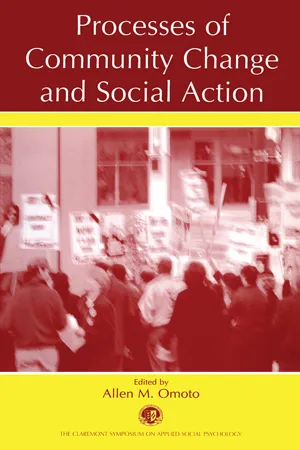
This volume--an outgrowth of the annual meeting of the Claremont Symposium on Applied Social Psychology--focuses on examples of social change and community action, and the processes at work in creating change. The presenters engaged each other and the audience in thinking about how best to create and sustain social change. This volume represents a product of their cumulative insight, research results, and perspectives, including chapters from each of the symposium presenters, as well as a few selected chapters from other noted scholars. Taken as a whole, the volume is highly accessible and presents findings from provocative and programmatic research that offer illuminating lessons for anyone interested in attempts at community change, civic participation, and social action.
Processes of Community Change and Social Action provides cutting-edge and complementary approaches to understanding the causes and effects of broad civic participation. The contributors to this volume are all distinguished researchers and theorists, well known for their work on different aspects of processes of community change and social action. They address topics related to service learning, social movements, political socialization, civil society, and especially volunteerism.
This unique interdisciplinary collection appeals to social, personality, community, and developmental psychologists, sociologists, and public health researchers. It also should be of considerable interest to practitioners of social action and individuals working to create social change.
- 214 pages
- English
- ePUB (mobile friendly)
- Available on iOS & Android
eBook - ePub
Processes of Community Change and Social Action
About this book
Trusted by 375,005 students
Access to over 1.5 million titles for a fair monthly price.
Study more efficiently using our study tools.
Information
1
Some Things Social Surveys Don’t Tell Us About Volunteering
John Wilson
Duke University
The volunteer has long been a subject of curiosity to the sociologist. In a world largely given over to the self-interested pursuit of material gain, how is this altruistic behavior to be accounted for? In this chapter, I describe and comment on the research on volunteering that has relied principally on the survey research method. I point to a number of missed opportunities and to ways in which survey methods, and the theoretical assumptions on which they typically rest, distort our view of volunteering. I suggest improvements in the use of survey methods to study volunteering, illustrating some of these with analyses of data from the National Longitudinal Survey of Labor Market Experience as well as citations to previous findings of my own and those of other scholars working in this field. The purpose of the chapter is less to summarize existing sociological knowledge than it is to provide an agenda for further sociological research on volunteering. Data are presented not for the purpose of testing specific hypotheses but to illustrate the potential for a program of research using survey methods.
The Unit of Analysis Problem
In the vast majority of social surveys, the individual is both the unit of observation and the unit of analysis. As a result, the impact of social relations and social structures on the range of choices open to actors is largely obscured. The research on volunteering using social survey data is typical in this regard. The result is a somewhat myopic view of volunteer behavior. In this section I will describe some of the problems created by focusing too much on the individual.
The Household
Although the people who complete social survey questionnaires are typically members of a household, this is rarely acknowledged in studies of volunteer behavior. This is in contrast to studies of philanthropy, where it is simply assumed that decisions about how much money to give to charity are made as part of the household budget management. In just over one third of all American households, two members of the family volunteer together, rising to nearly one half in middle-class families (Points of Light Foundation, 1994). Spouses encourage each other to volunteer and often volunteer together (Freeman, 1997). Parents take their children with them to share the experience of volunteering. In order to fully understand the practice of volunteering, we must take into account the inner dynamics of the household.
Volunteering often costs money, but personal wage or salary income makes surprisingly little difference to how much people volunteer (Carlin, 2001; Freeman, 1997). The solution to this riddle is that, in most cases, income is a household phenomenon—jointly produced and jointly consumed. How it is spent depends to a great degree on whether one or two people produce it and who contributes the larger share. For example, one study showed that family income had a positive effect on volunteering, but only for women. This is easily explained once we recall that women typically earn less than men, which means they enjoy the benefits of higher family income without paying the high opportunity costs (of volunteering rather than working for pay) that men face. They can switch from paid work to volunteering at less cost to themselves than can the men to whom they are married (Wilson & Musick, 1997a).
Surveys encourage us to believe that people’s paid employment makes a difference regarding how much they volunteer. But this is to ignore entirely the labor inputs of other members of the household. In the typical American household, the hours spouses work are jointly determined. For example, spouses in two-earner families have less time for nonwork activities than those in single breadwinner families. Kingston and Nock (1992) examine rates of “active work” for voluntary associations in a sample of married respondents. They find that wives’ active participation is affected by how their labor force participation combines with their husbands’. “If any group of women can be defined as the ‘joiners’ it is those with part-time employment who are married either to full or part-time employed husbands” (Kingston & Nock, 1992, p. 842). They enjoy the benefits of the social contacts their job provides while at the same time having the leisure granted by the part-time nature of their work. Wives with unemployed husbands have low activity rates, regardless of their own work arrangements. However, the opposite is not true. Husbands’ activity rates are unaffected by how the spouses’ work arrangements are combined.
Focusing on the household rather than the individual makes us more aware of the impact of other kinds of unpaid work on volunteering because we think about the work of running a household as a whole. Caring for kin is usually regarded as a higher priority than volunteering. This would suggest that the more time people spend caring for kin, the less time they have for volunteering. In fact, the data on this topic indicate precisely the opposite (Farkas & Himes, 1997). Also, the more time spouses invest in housework, the more time they contribute to volunteer work, especially wives. Rossi (2001) speculates that “time invested in domestic maintenance may function as an index of commitment to the personal care and pleasures of others at home, which is then generalized to include concern for the welfare of more distant members of the community” (p. 454).
Social Networks
The individual persons who supply the data for social surveys are actually embedded in complex networks of social relations that exert considerable influence over how they behave. Social networks are comprised of friends, extended kin, workmates, fellow church or club members, and so on. These networks connect us to volunteer opportunities and increase the chance of being invited to help. Unfortunately, social surveys typically use inadequate network measures, if they use them at all. Typically, information is drawn from the respondent. The social networks are therefore ego-centered. Because little is known about the linkages between other members of the respondent’s circle of acquaintances, it is a misnomer to call them social networks at all. We know how often the respondent has contact with friends but not how often those friends contact each other. We know if the respondent draws friends from all walks of life but we know nothing of the heterogeneity of the social networks of which he or she is a member. We can therefore examine the impact of the number of friends on volunteering but we cannot examine the impact of different kinds of friendship networks on volunteering.
Neighborhoods and Communities
Focusing on the individual, social surveys leave ecological phenomena such as neighborhoods or communities very much in the background. But neighborhoods shape our lives in many ways, including the kinds of jobs we have, the kinds of houses we live in, whether there are parks nearby, and how safe we feel going to them. A recent study of voluntary association memberships (not volunteering) suggests that context has a powerful effect on volunteering. The study notes that racial differences in memberships are usually attributed to differences in human capital. However, residence also plays a role. Poorer neighborhoods are less likely to have branches of voluntary associations located in them, and they lack the highly educated people who are most likely to act as recruiters. Stoll (2001) found that, in poorer neighborhoods, fewer people belong to voluntary associations. The entire difference between the level of Black and White memberships is attributable to the poor neighborhoods in which Blacks live.
Neighborhoods rich in voluntary associations have high rates of volunteerism for another reason. They help foster “collective volunteering,” in which people volunteer as members of a team. The “team” might be a religious congregation, a youth organization, or the local branch of the American Legion. A team agrees to supply volunteers to the community for a specific purpose, such as mounting a Christmas-gift-to-the needy drive. Many individual members of such groups are drawn into volunteer work in this way. However, this kind of volunteering is not merely the aggregation of individual decisions to volunteer because community characteristics have made the collective mobilization possible. Research methods that focus on the individual, rather than the community, are “inappropriate for fully capturing communal roots of volunteerism” (Eckstein, 2001, p. 847).
It makes sense that more people will volunteer if they live in a neighborhood with strong norms of community building or one that is institutionally well endowed with voluntary organizations. And, since we know that the quality of schools, the availability of parks and clubs, and the outreach programs of religious congregations vary across neighborhoods, we can expect the volunteer rate to vary also. The intriguing point is that an increase in volunteering could be brought about by improving neighborhoods as well as “improving” individuals. Conversely, failure to maintain a given rate of volunteering or community involvement might be attributable to the disintegration of a neighborhood rather than to a decline in altruism.
Political Units
Paradoxically, the most individualistically competitive of all modern nations, the United States, is also the nation with the highest volunteer rate. How could all of these self-interested and materialistic people produce so much altruism? The paradox melts away once demand factors are recognized. Larger structural forces in the United States have combined a free enterprise economy with a relatively small and nonintrusive government, creating a much stronger demand for volunteer labor than is found in most other countries. The nonprofit sector is also more clearly defined in the United States (Salamon, 1997). The result is a high rate of “job-creation” in the nonprofit sector. Recent analysis of data on voluntary association memberships [not volunteering] across 32 countries shows that differences can be explained by pointing to the opportunity structure in each country. “Statism” (the degree to which political power is centralized) and “corporateness” (the degree to which society is organized along corporate, or group, lines) both affect the variation in rate of membership across countries. Statism deters membership whereas corporateness encourages it. These country-level effects “operate strongly over and above individual-level variables such as individual education, employment and marital status, and so on” (Schofer & Fourcade-Gourinchas, 2001, p. 813).
Another theory of cross-national differences in volunteerism focuses on the role of the welfare state. The expansion of the welfare state in many capitalist countries after World War II threatened to crowd out volunteering in many areas. Do national differences in volunteering reflect differences in demand as governments step in and provide services formerly provided on a charitable basis? Or do governments actually serve to stimulate the demand for volunteer workers by funding nonprofit agencies? Intriguing data come from Canadian surveys of volunteering that show a positive correlation between government expenditures in a province and the rate of volunteering. When provincial governments lower welfare expenditures, fewer people volunteer. More detailed examination of the Canadian data reveals that some provincial expenditures increase volunteering (e.g., on recreation and culture), whereas others decrease it (e.g., social services; Day & Devlin, 1996). However, this line of research has yet to be extended to cross-national comparisons.
Cultural Frames
Survey research has been used to examine the impact of attitudes on volunteering in the belief that culture plays a role in shaping volunteer behavior. There is nothing wrong with gathering data on attitudes and beliefs and attempting to link them to behavior. But it is wrong to extrapolate from these data about the culture of the nonprofit sector at the macro level, and it is wrong to anticipate that by changing these attitudes and beliefs changes can be effected at the macro level. I discuss each of these criticisms in turn.
Political scientists do not assume that, having polled Americans concerning their beliefs about democracy, they have determined that America is a democracy. Public culture is not the sum of many private cultures. Deciding whether or not a society has a culture that encourages and warrants volunteering requires institutional analysis and cannot be based on data from individuals. The “health” of the nonprofit sector cannot be determined by conducting opinion polls. Rather, there are pre-existing “cultural frames” that shape the way we think about volunteering. These frames cannot be ...
Table of contents
- Cover
- Half Title
- Title Page
- Copyright Page
- Table of Contents
- Preface
- Understanding Social Change: Introduction to the Volume
- 1. Some Things Social Surveys Don’t Tell Us About Volunteering
- 2. Feeling Good by Doing Good: Health Consequences of Social Service
- 3. Public Health, Race, and the AIDS Movement: The Profile and Consequences of Latino Gay Men’s Community Involvement
- 4. Becoming (and Remaining) a Community Volunteer: Does Personality Matter?
- 5. Psychological Sense of Community: Conceptual Issues and Connections to Volunteerism-Related Activism
- 6. A Benefit-and-Cost Approach to Understanding Social Participation and Volunteerism in Multilevel Organizations
- 7. Social Capital in Democratic Transition: Civil Society in South Africa
- 8. Social Participation and Social Trust in Adolescence: The Importance of Heterogeneous Encounters
- 9. Designing Interventions to Promote Civic Engagement
- About the Contributors
- Name Index
- Subject Index
Frequently asked questions
Yes, you can cancel anytime from the Subscription tab in your account settings on the Perlego website. Your subscription will stay active until the end of your current billing period. Learn how to cancel your subscription
No, books cannot be downloaded as external files, such as PDFs, for use outside of Perlego. However, you can download books within the Perlego app for offline reading on mobile or tablet. Learn how to download books offline
Perlego offers two plans: Essential and Complete
- Essential is ideal for learners and professionals who enjoy exploring a wide range of subjects. Access the Essential Library with 800,000+ trusted titles and best-sellers across business, personal growth, and the humanities. Includes unlimited reading time and Standard Read Aloud voice.
- Complete: Perfect for advanced learners and researchers needing full, unrestricted access. Unlock 1.5M+ books across hundreds of subjects, including academic and specialized titles. The Complete Plan also includes advanced features like Premium Read Aloud and Research Assistant.
We are an online textbook subscription service, where you can get access to an entire online library for less than the price of a single book per month. With over 1.5 million books across 990+ topics, we’ve got you covered! Learn about our mission
Look out for the read-aloud symbol on your next book to see if you can listen to it. The read-aloud tool reads text aloud for you, highlighting the text as it is being read. You can pause it, speed it up and slow it down. Learn more about Read Aloud
Yes! You can use the Perlego app on both iOS and Android devices to read anytime, anywhere — even offline. Perfect for commutes or when you’re on the go.
Please note we cannot support devices running on iOS 13 and Android 7 or earlier. Learn more about using the app
Please note we cannot support devices running on iOS 13 and Android 7 or earlier. Learn more about using the app
Yes, you can access Processes of Community Change and Social Action by Allen M. Omoto in PDF and/or ePUB format, as well as other popular books in Psychology & History & Theory in Psychology. We have over 1.5 million books available in our catalogue for you to explore.