eBook - ePub
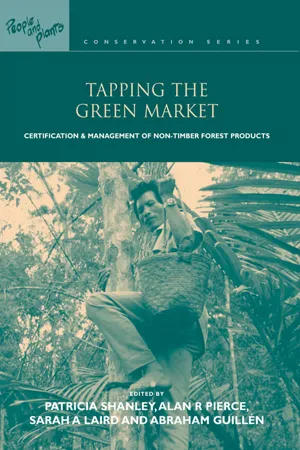
Tapping the Green Market
Management and Certification of Non-timber Forest Products
- 474 pages
- English
- ePUB (mobile friendly)
- Available on iOS & Android
eBook - ePub
Tapping the Green Market
Management and Certification of Non-timber Forest Products
About this book
There is a rapidly growing interest in, and demand for, non-timber forest products (NTFPs). They provide critical resources across the globe fulfilling nutritional, medicinal, financial and cultural needs. However, they have been largely overlooked in mainstream conservation and forestry politics. This volume explains the use and importance of certification and eco-labelling for guaranteeing best management practices of non-timber forest products in the field. Using extensive case studies and global profiles of non-timber forest products, this work not only seeks to further our comprehension of certification processes but also broaden understanding of non-timber forest product management, harvesting and marketing. It should be useful to forest managers, policy-makers and conservation organizations as well as for academics in these areas.
Information
Section II
NTFP SPECIES PROFILES FROM AROUND THE WORLD
Introduction
NTFPs and certification

The following species profiles were gathered from non-timber forest product (NTFP) researchers around the globe. While not exhaustive, the profiles, taken as a whole, provide a glimpse into the diverse, complex and idiosyncratic universe that is encompassed by the term ‘NTFP’. Like the diversity of the forest products they describe, the profiles vary widely in content and style and reflect the views of the individual researchers, the state of information regarding the species and the historic and present use and management of the plant.
The species profiles illustrate the range of product classes that characterize NTFPs and which are found in the indicators and verifiers section of the NTFP certification guidelines (see Appendix I), including exudates, whole plants, vegetative structures, bark, roots and reproductive propagules. Species profiled include:
- exudates: chicle gum, breu resin, amapá latex, copaíba oil, croton latex, maple syrup, mastic gum, pine resin and benzoin resin;
- whole plants: palm heart, rattan;
- vegetative structures: fiddlehead fern croziers, cat’s claw leaves;
- bark: pau d’arco, cat’s claw bark, cork oak, yohimbe, baobab;
- roots: titica, American ginseng;
- reproductive propagules: Brazil nuts, argan fruits, pine nuts, chestnuts, griffonia seeds and amla (‘emblica’) fruits.
Profiles were selected to not only illustrate issues raised by particular classes of products, but also diversity in plant forms (ie trees, vines, herbs), sources (eg primary forest, secondary forest, fallow), uses (eg medicinal, food, incense, construction, handicrafts) and markets (subsistence, local, regional, international).
Many products bridge a number of markets and use categories. For example, while argan, fiddlehead ferns and amla are subsistence goods of local importance, they also have regional markets. Brazil nuts, palm hearts, pine nuts, rattan, cork, pine resin, maple syrup, chestnuts, yohimbe, cat’s claw, griffonia, ginseng and chicle have significant regional and international markets, but are also important locally as food or medicine. A few products with small or neglible international markets, but of significant local importance, were also included to illustrate the relationship of certification to the majority of NTFPs that are consumed or traded locally. Examples include amapá, copaíba, mastic gum, amla, benzoin, baobab bark, titica and breu. In addition, woodcarving and bromeliad case studies are included at the end of this section to provide insight into instances where certification and sustainable management regimes could be developed for non-wood products entering the handicraft and ornamental plant markets.
The profiled species come from a variety of habitats, including primary forests (Brazil nut, titica, pau d’arco), secondary forests (amla, maple), forest gardens (benzoin), riverine forests or seasonally inundated forests (fiddlehead fern, palm heart), lowveld forests (baobab) and agro-forestry/silvo-pastoral systems (cork, argan). More than a few products demonstrate an ability to thrive in a variety of sites and conditions.
The NTFP profiles were drawn from both temperate and tropical regions in order to portray the diversity of products, markets and habitats from which NTFPs are sourced, as well as to underline the importance of NTFPs to populations living in both the North and South. There is a preponderance of species profiles from Latin America due to the geographical focus of the NTFP certification project. NTFPs from boreal forests and oceania are notably absent, while other regions are admittedly underrepresented when compared to Latin America.
Certain classes of critical NTFPs are also prominently missing. Products such as game, fuelwood, fodder and fungi were not purposefully neglected, but rather fell outside of the original plant-oriented focus of the project. Such products present a host of additional issues and sub-texts not covered in the following pages, and have unique economic, management and social/cultural characteristics that will impact their certification.
Despite obvious gaps, the profiles contained herein represent a unique blend of temperate and tropical NTFPs. Together, the profiles paint a portrait of complexity that is intended to further our understanding not only of certification, but also of broader NTFP management, harvest and marketing issues.
Chapter 4
Chicle (Manilkara zapota)
Botany and Ecology of Chicle
‘Chicle’ is a common name that refers to a number of different species of plants, found from Argentina all the way to Florida. These plants either exude a sticky white latex, produce a fleshy brown and very sweet fruit, or were once used in the manufacture of chewing gum. However, only one species can legitimately be referred to as the firstclass chicle of chewing gum fame, and that is Manilkara zapota (L.) Van Royen in the family Sapotaceae. Even within its native range, two additional species are often mistakenly referred to as chicle. Both of these species have also, at one time, been used in the manufacture of chewing gum. Manilkara chicle and Pouteria reticulata are clearly distinct from M. zapota, and are referred to by those who know chicle as second-and third-class chicle, respectively.

Illustration by Antônio Valente da Silva
Chicle (Manilkara zapota)
Manilkara zapota is a tree that can reach over 45 metres (m) in height (Lundell, 1933a) and over 125 centimetres (cm) in diameter (Pennington, 1990). Mature trees are evergreen or semi-deciduous, show pronounced sympodial branching and have spirally arranged, simple leaves clustered at branch tips (Pennington, 1990). The cream-coloured flowers are bisexual and sympetalous, with petals alternating with petallike staminodia. They are axillary, solitary and occur densely packed at branch terminals. The brown, scaly, rough-skinned fruit is about 4cm in diameter and is extremely sweet. The fruit usually contains two to five flat, shiny, dark-brown seeds (personal observation by the author suggests that seeds are, on average, 1.72cm long) with a long basi-ventral hilum scar and thick testa.
In the field, older trees are immediately recognized due to the omnipresent diagonal slashes – testament to the great economic importance of this species and the diligence of chicle harvesters (chicleros) to locate every tappable tree – extending the length of the bole and often well into the lower branches. Trees of 25cm diameter at breast height (dbh) or more are usually conspicuously scarred with this pattern. The bark is usually grey and furrowed on younger trees, becoming very thick, deeply fissured or checked with age. The slash (inner bark) is distinctly pink or occasionally white. The leaves, especially on younger plants, are distinguished from co-occurring species by their coriaceous leaves, thick and abundant white latex, the presence of epiphylls on the upper dark-green surface, and lack of such plants on the lower yellowish surface. The leaves also have a distinct yellow mid-vein and secondaries that join the mid-vein at very uniform, nearly-90-degree angles. Leaf size and shape vary considerably (5 to 15cm long and 3 to 8cm wide) and cause more confusion than elucidation. The tree’s canopy is usually very dense and the sympodial branch form is immediately distinguished.
Chicle is found in various habitats of sub-tropical moist and sub-tropical semi-deciduous forest types. These include both upland and scrub swamp forest types of Belize, both high- and low-stature semi-evergreen forests of Quintana Roo and Campeche, Mexico, and the primary forests of much of the Petén Basin of Guatemala. The species also does quite well, throughout its range, in late secondary forest types.
Chicle is a dominant species in the forests where it occurs, often reaching densities of as high as 85 stems per hectare (>10cm dbh), and is almost always found within the top ten dominant species, in terms of number of stems and total basal area. The species is important to a host of animals that count on its sweet fruit throughout the dry season (though fruiting seems to peak at the end of the dry season, from March to May). Among those animals observed consuming the fruit are howler (Alouatta pigra) and spider (Ateles geoffroyi) monkeys, various parrots (Amazona spp.), kinkajous (Potos flavus), tapir, peccary and various species of bats.
The other disperser that may actually carry chicle seeds from the source habitat to a different habitat is the bat. The potential importance of bats cannot be overstated. In fact, the activities of the bat may have a great deal to do with the present distribution of M. zapota. One possible explanation for the high incidence of chicle trees around Mayan ruins – following the conclusions of Peters (1983), regarding Brosimum alicastrum – is that their seeds are dispersed there by bats, which carry the entire fruits back to their roosts (Hall and Kelson, 1959). Barbour (1945) has also observed that the bat Artibeus jamaicensis parvipes roosts in trees of M. zapota. The popularity of Mayan ruins to roosting bats is well known.
Kinkajous, related to the raccoon, have been observed feeding on chicle fruits, and bats have been observed either taking fruit or visiting the flowers. Heithaus et al (1975) observed entire flowers being consumed by three species of bats (Carollia perspicillata, Artibeus jamaicensis and A. lituratus), all of which are native to the chicle region. Heithaus et al (1975) also mention that it is rare for a plant species to exhibit both bat-pollinated and bat-dispersed syndromes: ‘Only Manilkara zapota had both bat-dispersed pollen and seeds’ (p843). These authors also found that one bat species (Glossophaga soricina), observed in Costa Rica, carried chicle pollen on its fur in 60 per cent of their captures, and that chicle was one of the six plant species most commonly represented by pollen on these bats. Furthermore, Pennington (pers comm) suspects that species of Artibeus bats are the principal pollinators of chicle.
The species has a substantial native range. Manilkara zapota is found in part or all of the Mexican states of Tamaulipas, Mexico (Martinez, 1959), Veracruz (Schwartz, 1990), Oaxaca (Martinez, 1959), Chiapas, Tabasco, Campeche, Yucatan and Quintana Roo (Pennington, 1990). It occurs nearly throughout Belize and the Petén of Guatemala, and has been recorded from isolated locations along the Atlantic coast of Nicaragua (Pennington, 1990). As a result of this broad distribution, chicle is recognized to have been a significant part of both the Aztec and the Maya cultures (Roys, 1931). And yet, almost no information regarding how the plant was used by these peoples is documented.
In the more recent past, chicle has had the distinction of being probably the single most economically (and politically) important plant species in Central America (Schwartz, 1990; Lundell, 1933a, 1933b, 1934). What is known about the species is a direct result of this economic importance. However, only very basic information about productivity, growth rates, distribution, seed germination requirements, etc has been published. The most complete data have been gathered by various ejidos (indigenous forest communities) in Mexico that depend upon the revenues from the harvest of chicle, and these data are not published. Data gathered from various sources (Lundell, 1937; Jorgenson, 1993; Schwartz, 1990) have recorded chicle yield figures of from 0.7 kilograms (kg) per tree in Mexico, to an average of between 1kg and 1.8kg per tree in the Petén. Yield is dependent upon many factors, however, including the size of the tree, how many times it was tapped in the past, how intensively it was tapped, the weather at the time of the previous tapping, and probably many other factors, none of which have been documented. One thing is dramatically clear – yields of 14kg per tree recorded in the early days of the industry are unheard of today.
In a small study in Belize, Alcorn (1994) reported that spacial distribution of chicle trees appeared clumped. Structure of the seedling and sapling population was representative of a healthy and reproductive population. Distribution of seedlings and saplings also appeared to be clumped and indicated that most seeds germinate within the 7m ‘canopy shadow’ of the parent tree. This study also revealed that the highest levels of seedling mortality occur beneath the parent trees, showing only a simple pattern of density-dependent mortality. Probably the most significant information about chicle population dynamics generated from this study is that chicle is likely a gap-dependent species. In other words, its seedlings maintain a slow growth rate on the forest floor until a gap in the canopy opens, at which point the growth rate increases exponentially as the tree grows to reach the top of the canopy. This is a classic primary-species canopy strategy (Hartshorn, 1980), but indicates one of the most important reasons chicle has never been successful in plantations – it simply will not grow tall enough in clearings. The only thorough study of growth rates of mature trees was conducted by Karling in 1934. Karling documented an annual growth rate of approximately 0.5cm dbh per year for trees in the 20 to 30cm dbh size class. However, his study does not indicate sample size and Karling himself notes that huge variations (of up to 1.7cm) were documented.
Economic Background of the Chicle Extraction Industry
Despite the extensive distribution, vast anthropological and economic importance, dominance in forests and exceptional value as a food resource, relatively little is known of the ecology and natural history of chicle (Pennington, pers comm; Egler, 1947). The chewing gum habit, and the industry that feeds it, may never have developed had it not been for the discovery of natural chicle latex. The discovery of chicle at a time when the invention of modern chewing gum was in its infancy meant that the two would become inextricably linked forever. Some of the most incredible fortunes amassed in the United States were chewing gum riches in the early 1900s. These fortunes were almost as quickly lo...
Table of contents
- Cover
- Half Title
- Title Page
- Copyright
- Contents
- List of figures, tables and boxes
- About the contributors
- The NTFP certification project team
- The People and Plants initiative
- People and Plants partners
- Acknowledgements
- Section I: Overview
- Section II: NTFP species profiles from around the world
- Section III: The core elements of NTFP certification
- Section IV: Conclusions and recommendations
- Appendices
- Acronyms and abbreviations
- References
- Index
Trusted by 375,005 students
Access to over 1.5 million titles for a fair monthly price.
Study more efficiently using our study tools.
Frequently asked questions
Yes, you can cancel anytime from the Subscription tab in your account settings on the Perlego website. Your subscription will stay active until the end of your current billing period. Learn how to cancel your subscription
No, books cannot be downloaded as external files, such as PDFs, for use outside of Perlego. However, you can download books within the Perlego app for offline reading on mobile or tablet. Learn how to download books offline
Perlego offers two plans: Essential and Complete
- Essential is ideal for learners and professionals who enjoy exploring a wide range of subjects. Access the Essential Library with 800,000+ trusted titles and best-sellers across business, personal growth, and the humanities. Includes unlimited reading time and Standard Read Aloud voice.
- Complete: Perfect for advanced learners and researchers needing full, unrestricted access. Unlock 1.5M+ books across hundreds of subjects, including academic and specialized titles. The Complete Plan also includes advanced features like Premium Read Aloud and Research Assistant.
We are an online textbook subscription service, where you can get access to an entire online library for less than the price of a single book per month. With over 1.5 million books across 990+ topics, we’ve got you covered! Learn about our mission
Look out for the read-aloud symbol on your next book to see if you can listen to it. The read-aloud tool reads text aloud for you, highlighting the text as it is being read. You can pause it, speed it up and slow it down. Learn more about Read Aloud
Yes! You can use the Perlego app on both iOS and Android devices to read anytime, anywhere — even offline. Perfect for commutes or when you’re on the go.
Please note we cannot support devices running on iOS 13 and Android 7 or earlier. Learn more about using the app
Please note we cannot support devices running on iOS 13 and Android 7 or earlier. Learn more about using the app
Yes, you can access Tapping the Green Market by Abraham Guillen,Sarah A Laird,Alan R Pierce,Patricia Shanley,Alan Robert Pierce,Sarah A. Laird,S. Abraham Guillen in PDF and/or ePUB format, as well as other popular books in Technology & Engineering & Environmental Management. We have over 1.5 million books available in our catalogue for you to explore.