- 432 pages
- English
- ePUB (mobile friendly)
- Available on iOS & Android
eBook - ePub
About this book
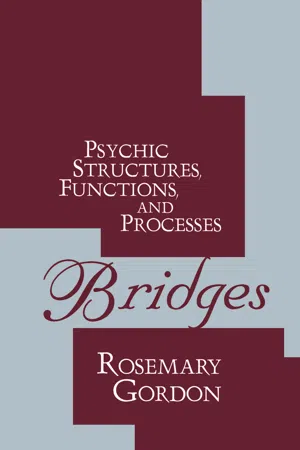
This book encompasses a wide range of author's diverse explorations and provides readers with rich food for thought—whether their interest is in clinical or cultural issues of the psyche. It re-examines the idea of the self, and explores the distinction between symbols and symbolic experience.
Trusted by 375,005 students
Access to over 1.5 million titles for a fair monthly price.
Study more efficiently using our study tools.
Information
Part One
Bridges: Intrapsychic Structures and functions
CHAPTER FIVE
Penis as bridge
patient’s bridge dream, the work we did with it, and the insights and understanding it rendered us first roused my interest and led me then to become profoundly aware of the ubiquitous importance and probably archetypal roots of the bridge symbol and its functions. There can hardly be a more apt example than the penis, the bridge between a man and a woman, between the masculine and the feminine, and between the familiar and the strange, the unfamiliar.
Sexual organs themselves, contrary perhaps to the theories of the earlier psychoanalysts, are not only the objects of the symbolizing process, but are themselves rich in symbolic meaning and significance. This seems to have been an implicit assumption for Jung, who believed that every phenomenon can be a symbol in so far as it entails otherness and something additional which is somehow foreknown or foreshown or of which one has an inkling.
The symbolic meaning of the penis derives naturally from its structure and form, but also, perhaps more importantly, from its functions. Some of these symbolic associations are described and discussed in the literature.
The penis is first and foremost the organ of fertilization, and hence lends itself to be the most powerful symbol of all creative work and of all creative inspiration.
But the penis is also the organ that ruptures, that opens and penetrates, breaks and enters; indeed, its fertilization function depends on this. Consequently its association with aggression, with weapons, and with cutting instruments is not surprising. Moreover, apart from life-giving semen, the penis also produces urine, and as a result of this it may also be experienced as poisonous and soiling.
Again, the penis can be experienced as an organ that feeds, and so it is available to be used—or abused—by the needy or greedy female: the identification of the penis with the milk-giving nipple has been pointed out by Melanie Klein.
Finally—and here I come to the thesis I want to develop—the penis is the organ that relates, in a veiy physical and basic way, two separate and unlike persons. Because of this function, a symbolic link between the penis and the bridge may strike one as obvious: for, like a bridge that spans the intervening space between two adjacent, yet separate lands, so the penis establishes a meaningful communication between the separate existence of the man and the separate existence of the woman. In intercourse the penis is cast, just like a bridge, into a foreign soil. Or, as Hobson’s patient has said very clearly, quoted in his paper on circumcision: ‘You emerge into another world inside the woman’ (Hobson, 1961, p. 8).
Remaining aware and exploring this symbolic link may help us gain further insight into the meaning of such sexual difficulties as impotence, castration anxiety, venereal disease phobia, etc. It may also help us to understand why such specific sexual difficulties have usually far-reaching effects on social and personal relationships, on work, and on intellectual efficiency. If the penis really represents the bridge, then it may be experienced as that organ whose possession gives one the courage to venture out of one’s essential isolation and move instead towards the making of relationships and more real and trusting intimate contacts.
When a people decide to make a bridge, then there must exist a certain configuration of incentives and expectations: they must want to get across to the other side. They must believe that the group on the other side is relatively friendly and will stay friendly; or, if the group is thought to be hostile, then it is thought of as too weak to offer any effective resistance to conquest. On the other hand, if a people fear invasions, conquest, or absorption from the group on the other side, it will oppose all bridge-building projects.
Think of how many years it took to agree to build the Channel Tunnel.
In order to experience the penis as a bridge, in order to allow it to function as a bridge, a person must, I suggest, have felt and become aware of the anxiety and the depression of his essential separateness. In other words, in order to think of a bridge, one must first of all perceive and experience that which divides and cuts one off.
After an initial acknowledgement of one’s separateness, after the achievement of some differentiation and self-identity, one’s boundaries may still be experienced as so fragile and so flimsy that the building of a bridge may be felt as a deathly threat. This maybe so either because the temptation to regress to the original union is still exceedingly great, or else because the regressive needs have been split off and projected, so that the ‘other’, the one on the other side, appears excessively dangerous and destructive. If absorption and fusion—that is, individual death—is expected to result from copulation, then there will be impotence and frigidity as protection and defence. Consequently, the more vulnerable a person feels himself to be, the less can he risk to test his boundaries; for whether experienced as temptation or as threat, the disintegration or collapse of the fragile ego structure is then felt to be an ever-present possibility.
The symbolic link between a bridge and a penis first suggested itself to me when a patient, Paul, brought me the following short dream:
Iamina Japanese prison camp. A man is to fix an attachment to the struts of a drawbridge; he fails. So he is given the sack. Later he is pursued and beaten up.
Associating to this dream, Paul explained that he does feel as if he is inside a prison camp, but he wants to find a way out. He has at times the fantasy that only the ‘good woman’ can release him from his unhappiness and his imprisonment. He must get out, he insists, he must get to the other side; after all, he cannot live like a monk all his life.
The patient had this dream while on a walking holiday. He had met there a woman to whom he felt vaguely attracted. The woman had then suggested that they might go together on another holiday. This suggestion had made Paul extremely anxious, for, as he explained, if there should be flirtation between them without actual sexual intercourse, then the veins in his leg would ‘blow up’; then he would not be able to walk. He would injure himself and do himself permanent damage. And while talking about the dream and associating to it, he asked me angrily what I am doing about the veins in his legs, all the while kicking the couch violently with his leg.
Looking at the transference feelings at the time, it is clear to me that Paul found it impossible to keep a bridge anchored on its two sides. He experienced me both as a possessive mother, who would not let him go off and make love to a girl, and also as the rejecting mother who wanted to push him off on to some girl and so be rid of him. The possibility of having analysis and an affair with some girl was inconceivable to him. No wonder, therefore, that the struts of his bridge needed mending.
Paul was a schizoid man of 28, who worked as an acupuncturist. His predominant psychic technique was splitting: his body was split, and everything above the solar plexus was felt as relatively good; everything below the solar plexus was decidedly bad. Masturbation, sexual excitement, and fantasies, as well as actual sexual intercourse produced a swelling of the veins in his legs, varicosed them and so interfered with his great passion-walking and mountaineering. Sexual activity could also lead to what he described as urethritis, toexcemaonthepenis, or, if anal masturbation has been practised, to haemorrhoids. Hence walking and sexuality were experienced as opposed and inimical to each other. So were introspection and the sensuous experience of objects; so was mind and body. For instance, talking about having been obsessed by the fantasy of a penis penetrating him, he remarked:
Anuses were not made for penises. It is only happening in the stupid monkey fashion of one’s psyche. It is a stupid part of my psyche which juggles with those ideas; but it is wrong to think that my anus wants a penis. The psyche is amoral, it is a polymorphous pervert. It is just like a monkey in a cage. It puts a bit of the banana into its mouth and another bit up its arse. It is an ape-man, that is what it is.
And a few weeks later:
The whole unconscious is sordid as far as it affects me. Masturbation is inconvenient and messy I resent the fact that one’s mind mucks about with the basic physical facts and that the body becomes the victim of the mental confusion. The body is a good thing; leave it alone, it is only that ridiculous, confused junk acting on it that makes it go wrong. It is dreary, sordid, sad, and confused, this damned vagina/anus identification.
Though he daydreamed of travel and adventure, the patient still lived at home with his parents. His mother had suffered from varicose veins while pregnant with his next brother.
Paul felt that he had inside him a grinning devil, who blocked every step forward that he, Paul, might try to take. This devil, he thought, probably represented the father’ unconscious sadistic side.
Early in the analysis he had brought along a key fantasy: father is raping mother while she is pregnant with him. Thus he actually participated in the parental intercourse. It is probably a development of this fantasy that led him to tell me a few months later that he had had the following ‘insight’:
I was wondering why my father takes on that negative form for me; and I thought maybe I wanted mother. I wanted to possess mother—probably at the time when I came back home and found a new baby in the place—but you cannot possess mother or anybody; so the next-best thing is to become mother; but the main obstacle to mother is father. Therefore one becomes mother, but one also becomes father, because all mothers have fathers. Perhaps this is why I cannot make contact with women; mother gets in the way.
It was after telling me about this ‘insight’ that he discussed the ‘good’ body that gets damaged by the ‘bad’ psyche.
In fact he tended to feel as if‘assaulted’ and raped by his own sexual wishes and fantasies. On the other hand, at times he experienced his whole body as if it were a penis in erection; he had in fact a very stiff and unbending posture.
He felt considerable envy of the woman’s sexual experiences and could get very excited when he tried to imagine the sensation of a penis going into the vagina. He thought that this sensation must give the woman a sense of completion, which is denied to the man. The woman’s experience is ‘more intense and it lasts longer; a man just loses something and that exhausts him’. This made me remember Tyresius, who was blinded by Hera for expressing this same view.
About a year earlier, for a period of a few months, Paul began to complain that I was too passive; that I was merely receptive; that analysis was impotent. He had all along complained that he hated being analysed by a woman, though in actual life he seemed to make no real social contact with men at all. I began to share his experience of me as very impotent and felt that he demanded to be penetrated by a powerful penis. Only looking back over my notes did I discover that, at that time, I began to smoke in this patient’s sessions; it may have been my cigarette and holder that provoked another period of overwhelming anal fantasies, which he then had to act out in private in masturbation.
After a session in which we had both been very active, he produced a homosexual dream. In this dream he is anally penetrated. But he then claimed, with some bitterness, that he had never had homosexual fantasies before coming into analysis. When I suggested that my interpretations seemed to be experienced by him as a penetration by my penis, he remarked:
If you think that I associate you with my father, you are
wrong: you are the very antithesis. He has no insights, he
cannot penetrate anything
But then he added:
but your type of penetration is essentially feminine, because you are a woman . . . there really is no wise old man. The old wise man is really a woman. It is nothing to do with a man, it is the sphinx if you like, or the cat. This sphinx is the keeper of riddles, she never gives the answers, therefore she is annoying to most men.
Perhaps the clearest statement of why Paul felt too vulnerable to contemplate the building of a bridge came three months later, when he seemed to put into words my vague reflections about the symbolism of the penis and the bridge.
I don’t trust women. As far as men are concerned, they are dangerous. Women don’t do men any good. Women like to look after men and make them conform to their ideal. A woman’s interest in a man is dangerous to a man being a man. A woman emasculates a man ... A woman stands still. In a sense she does not move out from herself. But the man moves out from himself. This makes him vulnerable. He must almost become a woman in order to go to a woman. That is something that is unfortunate. Women do it, have intercourse, when their foundations are firm. So you, the man, must move out into her sphere to meet a woman. Take work; you leave home, you go to work and you go back home to the woman, to be taken care of. It is man’s fault anyway. Men start by exploiting women, women end by exploiting men ... So you leave your own masculine world and get trapped in her feminine world, and before you know where you are you feel like a woman and you react like a woman . . . This idea of sharing—it is just a myth . . . there is always competitiveness . . . why do you have to open your gate to the enemy . . . If you have a raiding party and move from a safe position into the enemy’s country, the enemy is much safer ... he is in his own country. Men take risks . . . women do less so . . . women know they are safe . . . why should one stick one’s neck out? ... all women are mothers . . . if you raid them you have no chance to get away whole ... we all have had mothers ... that can’t be eliminated, but it is unfortunate. Women are indestructible, men are expendable . . . that is the tragi-comedy of sex: it’s on her terms, in her time, on her conditions and in her territory . . . Some people just don’t like being made a fool of.
Obviously he was very suspicious about the things that I may put into him. During the same night in which he had dreamed the bridge dream, Paul had another dream which showed this well.
A doctor wants to give me a blue pill, as an anti-polio treatment. But I refuse this, because I know that it will not do me any good. Then he offers to give me an injection into my bottom from a long needle. Although I know that this will be painful, I accept to have it.
This dream and his other homosexual fantasies seemed to express this patient’s great need to receive the good penis; for with it he might then be able to relate actively to others and to bring together inside himself the many split-off fragments. In other words, the penis would act as the bridge, which would help him to bring into contact the bits and pieces inside him and to communicate with the people around him. But instead of a bridging penis, Paul seemed to feel that there was available to him only either the father’s impotent penis or his sadistic, raping, and poisonous penis. In his sexual adventures, Paul lived out in his body fantasized sadistic intercourse of the parents, from which all emerged injured.
I have tried to find some references to the penis-bridge association in the psychoanalytic literature. To my surprise I have found very little indeed. There is, however, a passage in Melanie Klein’s paper ‘Infant Analysis’ (1923). I quote:
I have repeatedly in analysis discovered birth anxiety to be castration anxiety reviving earlier material and have found that resolving the castration anxiety dissipated the birth anxiety. For instance, I came across the fear in a child that when he was on the ice it would give way beneath him or that he would fall through a hole in a bridge—both obviously birth anxiety. Repeatedly I found that these fears were actuated by the far less obvious wishes—brought into play as a result of the sexual-symbolic meaning of skating and bridges, etc.—to force his way back into the mother by means of coitus, and these wishes gave rise to the dread of castration, [p. 92]
But apart from this passage I have not been able to find anything else. Is this association so obvious that nobody has bothered to write about it? Or is my thesis false? Is twentieth-century urban man so alienated from the natural world that this particular association has become lost to him? By contrast, the Yoruba of Nigeria seem quite familiar with the association of penis and bridge, as shown in the song that they sing about Esu, their Trickster god:
We are singing for the sake of Esu He used his penis to make footbridge Penis broke in two The travellers fell into the river.
Of course, there is also the Winnebago trickster—described by Paul Radin (1956, p. 19)—who has a very long penis which he carries over his shoulder in a box. One day he comes to a lake, sees the chiefs daughter bathing on the opposite side, takes his penis out of the box, and sends it across the water to have intercourse with her. Actually he does not really make a bridge of his penis, for his penis slithers through the water like a snake to reach the chiefs daughter on the other side; but, though not a bridge, the penis does here connect the two and opposing sides of, in this case, a lake. I shall return later to the possible meaning of crossing above the water or through it.
Thus, in both these trickster figures we find the theme of crossing the water with the help of the penis; but both, as might be expected, trick. Esu’s bridge-penis breaks; the Winnebago trickster’s penis passes underneath the water and has intercourse with the woman in the water. A closer study of Esu, which I owe to personal communications from Morton-Williams and Joan Wescott, may throw some light on these tricksterish bridges and also on the general meaning of the penis as a bridge. There appears to be a taboo on all sensuous relationships between Esu and the world of the women. For instance, according to most myths, Esu is the only unmarried god in the Yoruba pantheon. He is, like Hermes, without family, a homeless wanderer. In all the market places there are shrines to Esu, containing a phallic representative of him. But the following substances may not, under any circumstances, come into contact with this phallic representation:
blood: in primitive societies this is usually associated with women’s procreative functions;
indigo: this is a colour that amongst the Yoruba is handled by women only;
kernel od: this substance is alw...
Table of contents
- Cover Page
- Half Title
- Title Page
- Copyright Page
- Acknowledgements
- Foreword
- Preface
- Introduction
- PROLOGUE
- PART ONE BRIDGES: INTRAPSYCHIC STRUCTURES AND FUNCTIONS
- PART TWO BRIDGES BROKEN: CLINICAL EXPERIENCE AND PRACTICE
- PART THREE BRIDGES BUILT: CREATIVITY AND THE ARTS
- A Last View—Over the Bridge
- References
- Index
Frequently asked questions
Yes, you can cancel anytime from the Subscription tab in your account settings on the Perlego website. Your subscription will stay active until the end of your current billing period. Learn how to cancel your subscription
No, books cannot be downloaded as external files, such as PDFs, for use outside of Perlego. However, you can download books within the Perlego app for offline reading on mobile or tablet. Learn how to download books offline
Perlego offers two plans: Essential and Complete
- Essential is ideal for learners and professionals who enjoy exploring a wide range of subjects. Access the Essential Library with 800,000+ trusted titles and best-sellers across business, personal growth, and the humanities. Includes unlimited reading time and Standard Read Aloud voice.
- Complete: Perfect for advanced learners and researchers needing full, unrestricted access. Unlock 1.5M+ books across hundreds of subjects, including academic and specialized titles. The Complete Plan also includes advanced features like Premium Read Aloud and Research Assistant.
We are an online textbook subscription service, where you can get access to an entire online library for less than the price of a single book per month. With over 1.5 million books across 990+ topics, we’ve got you covered! Learn about our mission
Look out for the read-aloud symbol on your next book to see if you can listen to it. The read-aloud tool reads text aloud for you, highlighting the text as it is being read. You can pause it, speed it up and slow it down. Learn more about Read Aloud
Yes! You can use the Perlego app on both iOS and Android devices to read anytime, anywhere — even offline. Perfect for commutes or when you’re on the go.
Please note we cannot support devices running on iOS 13 and Android 7 or earlier. Learn more about using the app
Please note we cannot support devices running on iOS 13 and Android 7 or earlier. Learn more about using the app
Yes, you can access Bridges by Rosemary Gordon in PDF and/or ePUB format, as well as other popular books in Psychology & History & Theory in Psychology. We have over 1.5 million books available in our catalogue for you to explore.