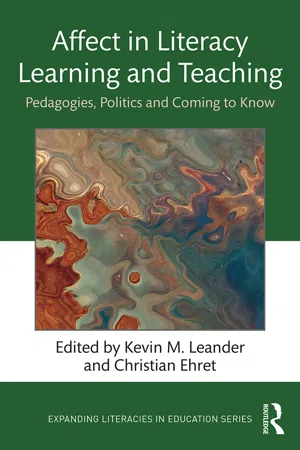
In this cutting-edge volume, scholars from around the world connect affect theory to the field of literacy studies and unpack the role and influence of this emerging area of scholarship on literacy education. Offering an introduction to affect theory and scholarship as it relates to literacy studies, contributors discuss the role of humanizing and dehumanizing influences on schooling and examine the emotional and affective dimensions at individual and communal levels. Arguing that an affective turn requires a radical rethinking of the nature of literacy, these chapters address the impact and import of emotion and affect on reading, writing and calling to action. Grounded in trailblazing research, the contributors push the boundaries of academic writing and model how theoretically-driven writing about affect must itself be moving and expressive.
eBook - ePub
Affect in Literacy Learning and Teaching
Pedagogies, Politics and Coming to Know
- 238 pages
- English
- ePUB (mobile friendly)
- Available on iOS & Android
eBook - ePub
Affect in Literacy Learning and Teaching
Pedagogies, Politics and Coming to Know
About this book
Trusted by 375,005 students
Access to over 1.5 million titles for a fair monthly price.
Study more efficiently using our study tools.
Information
Topic
EducationSubtopic
Education Theory & PracticePART I
Pedagogies
Movement 1: Pedagogy under the Waterline of Perceived Value
When we begin to describe the affective intensities of pedagogical relations, our language stutters to express the feeling of even everyday relational transformations between and among teacher–student, student–student, student–texts–and–. . . . Yet these everyday relational transformations are the qualities of pedagogical experience to which we point and say: That’s what it’s all about; that’s when things changed; I’ll never forget that. Authors in this part move beyond the ordinary work of language and attempt to express speculative propositions through which there is an explicit call upon the future to become different. Collectively, authors also move with a breadth of language in tones, styles, formats and ethos that create differences through which to feel pedagogical relations.
To question and connect, Boldt (Chapter 1) traverses her worlds as a teacher and as a psychotherapist. In play therapy with one child, “Bo,” she has many, many perceptions of him and how she might reach him. Yet, nothing seems to work; nothing seems to reach across for very long. Something imperceptible is filling up all space. One day, Bo comes to therapy after trauma, and seems to have completely shut down. He silently plays in the sand table. Boldt weaves a line of thought through her narrative in her chapter—a desire to relate above all. She reflects on a proposition from a mentor: “Stay with the child. Stop trying to make interpretations.” Boldt plays alongside Bo in the sand table, moving sand, trying to stay present, becoming interested after a time in shoveling, sometimes bumping into Bo, giving up on knowing but not on relating. Something moves.
The part continues with an invitation to rethink value in pedagogy. A common and important critique of contemporary education centers on our current obsession with, and standardization of, forms of assessment. Value in education in this modality creates its own economy, as Manning (Chapter 2) describes, of cycles of debt and credit, of plans, of measurement in the form of assessment. Critical reform of the assessment-driven curriculum poses its set of solutions: fewer assessments, different assessments, more authentic assessments. Yet, in what Manning terms the “undercommons” (following Harney & Moten, 2013) learning creates its own value, value that is not well perceived, perhaps not perceived at all. How do we evaluate teaching and learning in the undercommons, where “The soundscape of learning is full of inklings which reside below the threshold of actual perception?” (Manning, this volume). What does pedagogy caught up in all these inklings look like? And, in the contradictory attempt to express the ineffable, what do these inklings become?
Charlene (in Lenters, Chapter 3) lives her days in school below the waterline of perceived value, most of the time. She is labeled as seriously ADHD, she is critiqued by credit-driven fellow group members, and she returns again and again to puppy videos while her group is supposed to be working on the “oil boom” project. Lenters traces the shifting assemblages of relations between Charlene, other people, objects, practices and events in the classroom, looking, seeming to wait for an opening, a kind of differenciation with possibility across series of becomings. Some new becomings are just more striated spaces—refrains of school-as-school. The researcher and the teacher watch Charlene across time with puzzlement and even resignation. Yet, somehow, Charlene finds pedagogical possibility in the assemblage, following her deep feelings for animals, making connections to the oil boom project while being moved by puppy videos. Lenters asks of school, “Had Charlene’s differenciation been recognized earlier on as more than frivolous obsession, what might have come of it?”
Across the chapters there are different terms for that-which-cannot-be-named in experience: “Thisness” or “haeccity” (Boldt), the “infrathin” (Manning), and “differenciation” (Lenters). These terms describe how the value of the pedagogical moment far exceeds measurement. This excess itself, as Manning writes, gives experience its value. Then, we might ask, what role does the work of writing the experience have? What is the role for language (and literacy) in pedagogical valuing?
These chapter authors suggest movement in the field toward rethinking expressions of pedagogies in literacy research as speculative propositions that have the potential to intensify future experiences of literacy teaching and learning as they unfold in present moments. Although language and signs are ordinarily propositional, speculative propositions are intentionally so, with explicit calls upon the future. Not too different from ordinary road signage reminding us to drive carefully, authors express propositional pedagogies, in a sense, whereby the affects of the pedagogical relations they present on the page may spill over to affect readers’ future experiences of pedagogy, of research, of life.
Thinking alongside Whitehead’s (1927–1928/1985) process philosophical perspective on the proposition, Stengers (2011, p. 416) examines how language itself is propositional:
[I]t is the proper character of all language to give their full importance to propositions, not insofar as they have the power to cause [. . .] but in that their entertainment lures us into feeling, thinking, speaking, in short, becomes, in the most various ways, an ingredient of the experiences that will follow it.
Language thereby becomes a material actor through its capacity to affect in future experience, a capacity we might describe through its propositional efficacy.
In this conceptualization, propositions (as accounts of teaching and learning) do not state a logically derived truth that can be examined rationally, but rather they suggest, abstractly, qualities of experience that may re-emerge through feelings that change the trajectory of ongoing activity. Whitehead (1927–1928/1985) described these shifts in experience as epochal shifts, which are possible at multiple scales: For example, individual, cultural, national, etc. While the part begins with an explicit set of propositions (for radical pedagogy), we encourage the readers to read through all of this pedagogy as propositional language: propositional not because these accounts represent experience directly, but because they lure us into understanding and change, into becoming different in epochal shifts possible across scales.
Although we expect readers to imagine many more, reading these chapters again ourselves we were moved anew to consider one such shift: How might we generate an alter-economy of literacy research and pedagogy wherein new modes of expression and encounter value the excess of experience by allowing that excess to become what it could be? We feel Boldt-Bo’s desire for relation because of how that desire is allowed to live through the page in a mode of research writing that resists interpreting their experiences together. This written language thereby lives beyond the page as a lure for feeling without interpretation in resonant pedagogical experiences to come. Through an alter-economy of literacy research and pedagogies we sense these pieces pushing toward values such as non-representational writing of pedagogical moments as a lure for future feeling. Our writing and living relationally produce value that cannot be interpreted and controlled by majoritarian economies that tell Charlene to focus on the oil boom, what has already been assessed as assessable. Under the waterline of a best-practices economy of education, affective currents stir.
References
Harney, S.M. & Moten, F. (2013). The undercommons: Fugitive planning and black study. New York, NY: Minor Compositions.
Stengers, I. (2011). Thinking with Whitehead: A free and wild creation of concepts. Cambridge, MA: Harvard University Press.
Whitehead, A.N. (1985). Process and reality. New York, NY: The Free Press. (Original work published 1927–1928).
1
AFFECTIVE FLOWS IN THE CLINIC AND THE CLASSROOM
Gail Boldt
I am a teacher and a psychotherapist. Historically speaking, I was first a teacher of third- and fourth-grade children and then of preservice teachers, and more recently, I have also become a child psychotherapist, seeing children from three to twelve years old for weekly sessions. I am writing this chapter from this both/and-ness of who I am, who I am becoming, and what I understand myself to be in relation to children. I use this chapter to bring you into the present of my work and thinking as a therapist, and as I do that, I expect to create departures in my thinking and imagination in relation to teaching. This chapter is a participant in my drive to, as Ehret and Leander suggest in the introduction, “feel the world, to take affective intensities seriously, to engage with the surplus, with the unspoken and powerfully unknown.” (p. 00). My thoughts, dreams, reflections, these lines of flight, are not implications for teaching so much as they are connective tissues and resonances of affect themselves.
The intellectual and emotional struggles of becoming and being a therapist remind me in many ways of the struggles I experienced as an elementary teacher. Much of the time, I feel that I don’t know what I’m doing. As both a teacher and a therapist, I fill this unknowingness with self-doubt, which I project onto the parents. I imagine their impatience and criticism. As both a therapist and a teacher, I believe that what matters includes strong relationships, coming to know the child’s intrapersonal and intersubjective worlds, shared exploration and playfulness. I struggle against perceptions that the job of the teacher is to focus on the problem of what children are presumed to not know and that teaching is a rational, measurable act. Why would I be surprised that these are the same things I struggle against when therapy is conceptualized through sixteen-week treatment plans and so-called evidence-based outcomes?
When I reflect on my insecurity, I have at least the benefit of hindsight about what it feels like to become and be a teacher. Not that teaching is or should be the same thing as doing therapy, but these two occasions of being with children inevitably speak to one other, offering me unexpected ways to understand each through the other. Right now, I am most immersed—almost drowning sometimes—in the question of what it is that children might need from me and what I might need from them. It’s with the help of a journal I kept during my student teaching days that I am able to remember sitting with my host teacher, crying and saying to her, “I have all of the theories in my head, but I don’t know how to make them happen. There is a huge gap between what I know and what I can do.” She says, “You haven’t learned yet how to let the children fill that gap. You are still talking to yourself, to your own head. You aren’t yet in a relationship with the children.”
This question of what it might do to be in different kinds of relationship with children is perhaps the central question of psychotherapy, almost regardless of the school of thought in which one is trained. By training, by temperament and taste, the orientation through which I approach my work and that gives me a language for thinking about what happens is psychoanalysis. In this chapter, I use sketches, loosely based in my clinical practice,1 along with descriptions of how some psychoanalytic researchers talk about what it is that matters in the therapeutic relationship. I bring these into conversation with the research of Akiko Hayashi and Joseph Tobin (2015) about how experienced Japanese teachers think about the complexities of teaching relationships. I also bring in Deleuzo-Guattarian theory, which allows different lines of flight in my thinking, and besides, it sings to me. I do this in the Deleuzo-Guattarian (1987) spirit of the and . . . and . . . and . . ., by which I mean creating an assemblage in which the individual pieces maintain their integrity but, when brought together, also create something new. In this chapter, I will perform something about how the teacher–therapist assemblage enlivens my thinking about each, and my expectation is that the reader will do the same with the experience of reading this chapter alongside her/his own experiences, thinking, imagination and desires.
I Talked and Talked
It is the early months of my practice. Dany has dumped a box of construction blocks of assorted sizes onto the floor. She is now working methodically to sort them by color, by size, by shape. She announces that this is a zoo of blocks and that people who visit the zoo expect to see the same kinds of blocks together. Dany has played this same game for the past several sessions. Each week, the sorting occupies most of our fifty minutes together. She never includes me in the sorting, never asks for my help or opinion. I’m simply there to watch. Sometimes when she finishes the sorting, if there is still time, the blocks might venture out of their area, to quarrel and physically fight with blocks in other areas. The orderliness of the zoo doesn’t necessarily make it a happy place.
My mind is not such a happy place either. I don’t know what I’m doing, watching her sort those blocks week after week. I don’t know what it is that will help this child with the conflicts her parents have reported. I don’t know what Dany wants and I don’t know what she’s doing. I try offering what I imagine to be an interpretation. This is, after all, psychoanalytically oriented psychotherapy.
“Your zoo reminds me of your family,” I say, “with so many different people from so many different families living together in one family.” This is met with silence, which I fill, in my head, with Dany’s imagined response: “Gail, you are a complete idiot.” Indeed.
I have elected to work with three different supervisors. In supervision, we talk over our cases with an experienced therapist who provides guidance and listens for our countertransferences or, in other words, the ways we might be enacting our own emotional issues in sessions with our clients. Until I have enough hours to earn a clinical license—something I’m working toward but that will take me many years—the state requires me to get one hour of supervision for every twenty hours of work with clients. In an average week, I choose to schedule one hour of supervision for every three hours I see clients. There are weeks when I have more supervision than clients. This speaks to the anxiety I feel about the speed of my learning.
One of my supervisors is at the clinic. She helps me with my cases and with navigating the clinic as a workplace. The second is a psychoanalytically oriented psychotherapist who lives and practices in the area, someone I have known and trusted for many years. The third is a psychoanalyst who lives a few hours from where I live. I’m on sabbatical from my university position during the first year of my practice, and I commute once a week to study with her and to spend an hour in her office discussing my cases.
In classical psychoanalysis, interpretation is the thing understood to affect change. Sigmund Freud described an unconscious that is a repository, not for repressed ideas, but for energy. In Freud’s model, when an event, idea, desire or feeling occurs that is unacceptable to the ego, it must be repressed. In repression, Freud (1923/2000; 1936) argues, the idea or the thought of the thing is split from the affect; the idea is banished and the affect is pushed into the unconscious. The energy or anxiety of the affect can continue to provoke us, a thorn in the side, but as long as it is unattached to an idea, it cannot be released. Unmoored from the original meaning it held for us, the energy attaches to other ideas; the repressed returns in symptoms and behaviors that may hint at, but that also disguise the unacceptable idea. The role of interpretation is to reattach the unacceptable idea to the affect, making conscious what was formerly unknown to the client (Gabbard, 1994) so that it may be worked through and assimilated into one’s conscious sense of self.
Reading the work of Melanie Klein, a central figure in the development of psychoanalytic therapy with children, I encounter interpretations, often based in the primal scene (Segal, 2012), that seemed far removed from anything I would ever think to say to a child, let alone actually say. But I do think I have to say something, and I rarely have any idea of what that might be. My psychoanalytic supervisor tells me, “Stay with the child. Stop trying to make interpretations. You’re trying too hard. You need to stay in the room, with the child and with what is happening between the two of you. And even then, only say it if you feel like you have to, not just...
Table of contents
- Cover Page
- Half Title
- Series Page
- Title Page
- Copyright Page
- Dedication
- Table of Contents
- Series Editor Introduction
- About the Contributors
- Introduction
- PART I Pedagogies
- PART II Politics
- PART III Coming to Know
- Afterword
- A Short Note Concerning the Index
- Index
Frequently asked questions
Yes, you can cancel anytime from the Subscription tab in your account settings on the Perlego website. Your subscription will stay active until the end of your current billing period. Learn how to cancel your subscription
No, books cannot be downloaded as external files, such as PDFs, for use outside of Perlego. However, you can download books within the Perlego app for offline reading on mobile or tablet. Learn how to download books offline
Perlego offers two plans: Essential and Complete
- Essential is ideal for learners and professionals who enjoy exploring a wide range of subjects. Access the Essential Library with 800,000+ trusted titles and best-sellers across business, personal growth, and the humanities. Includes unlimited reading time and Standard Read Aloud voice.
- Complete: Perfect for advanced learners and researchers needing full, unrestricted access. Unlock 1.5M+ books across hundreds of subjects, including academic and specialized titles. The Complete Plan also includes advanced features like Premium Read Aloud and Research Assistant.
We are an online textbook subscription service, where you can get access to an entire online library for less than the price of a single book per month. With over 1.5 million books across 990+ topics, we’ve got you covered! Learn about our mission
Look out for the read-aloud symbol on your next book to see if you can listen to it. The read-aloud tool reads text aloud for you, highlighting the text as it is being read. You can pause it, speed it up and slow it down. Learn more about Read Aloud
Yes! You can use the Perlego app on both iOS and Android devices to read anytime, anywhere — even offline. Perfect for commutes or when you’re on the go.
Please note we cannot support devices running on iOS 13 and Android 7 or earlier. Learn more about using the app
Please note we cannot support devices running on iOS 13 and Android 7 or earlier. Learn more about using the app
Yes, you can access Affect in Literacy Learning and Teaching by Kevin Leander,Christian Ehret,Kevin M. Leander in PDF and/or ePUB format, as well as other popular books in Education & Education Theory & Practice. We have over 1.5 million books available in our catalogue for you to explore.