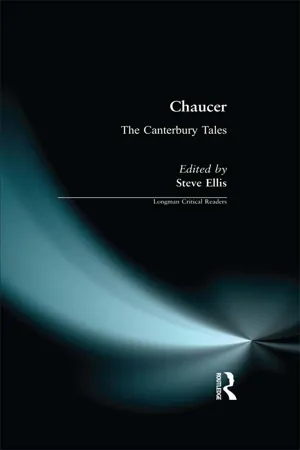
This new addition to the Longman Critical Readers Series provides an overview of the various ways in which modern critical theory has influenced Chaucer Studies over the last fifteen years. There is still a sense in the academic world, and in the wider literary community, that Medieval Studies are generally impervious to many of the questions that modern theory asks, and that it concerns itself only with traditional philological and historical issues. On the contrary, this book shows how Chaucer, specifically the Canterbury Tales, has been radically and excitingly 'opened up' by feminist, Lacanian, Bakhtinian, deconstructive, semiotic and anthropological theories to name but a few.
The book provides an introduction to these new developments by anthologising some of the most important work in the field, including excerpts from book-length works, as well as articles from leading and innovative journals. The introduction to the volume examines in some detail the relation between the individual strengths of each of the above approaches and the ways in which a 'postmodernist' Chaucer is seen as reflecting them all.
This convenient single volume collection of key critical analyses of Chaucer, which includes work from some journals and studies that are not always easily available, will be indispensable to students of Medieval Studies, Medieval Literature and Chaucer, as well as to general readers who seek to widen their understanding of the forces behind Chaucer's writing.
- 256 pages
- English
- ePUB (mobile friendly)
- Available on iOS & Android
eBook - ePub
About this book
Trusted by 375,005 students
Access to over 1.5 million titles for a fair monthly price.
Study more efficiently using our study tools.
Information
Index
LiteratureTable of contents
- Cover
- Half Title
- Longman Critical Readers
- Title Page
- Copyright Page
- Table of Contents
- Dedication
- General Editors’ Preface
- Publisher’s Acknowledgements
- Editor’s Acknowledgements
- Editions and Abbreviations Used in the Text
- 1 Introduction
- 2 Structure as Deconstruction: ‘Chaucer and Estates Satire’ in the General Prologue, or Reading Chaucer as a Prologue to the History of Disenchantment
- 3 The Politics of Discourse in Chaucer’s Knight’s Tale
- 4 Robyn the Miller’s Thrifty Work
- 5 The Law of Man and Its ‘Abhomynacions’
- 6 ‘Vanysshed Was This Daunce, He Nyste Where’: Alisoun’s Absence in the Wife of Bath’s Prologue and Tale
- 7 The Powers of Silence: The Case of the Clerk’s Griselda
- 8 Umberto Eco, Semiotics, and the Merchant’s Tale
- 9 Metafictional Strategies and the Theme of Sexual Power in the Wife of Bath’s and Franklin’s Tales
- 10 The Subject of Confession: The Pardoner and the Rhetoric of Penance
- 11 Aspects of Female Piety in the Prioress’s Tale
- 12 Signs and / as Origin: Chaucer’s Nun’s Priest’s Tale
- 13 From: A Mixed Commonwealth of Style
- Notes on Authors
- Further Reading
- Index
Frequently asked questions
Yes, you can cancel anytime from the Subscription tab in your account settings on the Perlego website. Your subscription will stay active until the end of your current billing period. Learn how to cancel your subscription
No, books cannot be downloaded as external files, such as PDFs, for use outside of Perlego. However, you can download books within the Perlego app for offline reading on mobile or tablet. Learn how to download books offline
Perlego offers two plans: Essential and Complete
- Essential is ideal for learners and professionals who enjoy exploring a wide range of subjects. Access the Essential Library with 800,000+ trusted titles and best-sellers across business, personal growth, and the humanities. Includes unlimited reading time and Standard Read Aloud voice.
- Complete: Perfect for advanced learners and researchers needing full, unrestricted access. Unlock 1.5M+ books across hundreds of subjects, including academic and specialized titles. The Complete Plan also includes advanced features like Premium Read Aloud and Research Assistant.
We are an online textbook subscription service, where you can get access to an entire online library for less than the price of a single book per month. With over 1.5 million books across 990+ topics, we’ve got you covered! Learn about our mission
Look out for the read-aloud symbol on your next book to see if you can listen to it. The read-aloud tool reads text aloud for you, highlighting the text as it is being read. You can pause it, speed it up and slow it down. Learn more about Read Aloud
Yes! You can use the Perlego app on both iOS and Android devices to read anytime, anywhere — even offline. Perfect for commutes or when you’re on the go.
Please note we cannot support devices running on iOS 13 and Android 7 or earlier. Learn more about using the app
Please note we cannot support devices running on iOS 13 and Android 7 or earlier. Learn more about using the app
Yes, you can access Chaucer by Geoffrey Chaucer,Steve Ellis in PDF and/or ePUB format, as well as other popular books in Literature & Ancient & Classical Literary Criticism. We have over 1.5 million books available in our catalogue for you to explore.