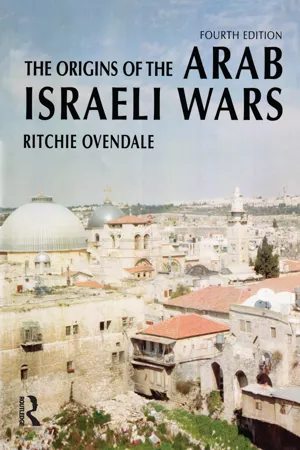
This highly-regarded history gives a balanced and judicious introduction to this immensely complex and controversial subject, weaving different strands of the story into a single coherent narrative, thus making it essential reading for all students studying conflict in the Middle East. Of all the troubles affecting the modern world few are as topical, deep rooted and intractable as the Arab-Israeli conflict. For this region, an understanding of the past is vital to an understanding of the present. Ritchie Ovendale's classic study of the roots of the conflict is now updated for a fourth time and considers events until 2003.
- 400 pages
- English
- ePUB (mobile friendly)
- Available on iOS & Android
eBook - ePub
The Origins of the Arab Israeli Wars
About this book
Trusted by 375,005 students
Access to over 1.5 million titles for a fair monthly price.
Study more efficiently using our study tools.
Information
CHAPTER ONE
‘The Jewish State’ versus ‘the Arab Awakening’
At the end of 1894 a Jewish officer of the French general staff, Alfred Dreyfus, was convicted behind closed doors of espionage for Germany, and sentenced to deportation for life to Devil’s Island. The officer was publicly degraded at the École Militaire: his sword was broken; he was stripped of his uniform; and taken away in chains. The mob present shouted, ‘Death. Death to the Jews.’ Dreyfus was a parvenu, an example of social climbing by a Jewish family seeking assimilation and acceptance by high society through launching their sons on military careers. Known for boasting about his family fortune – which he spent on women – Dreyfus was not even liked by the young Austro-Hungarian journalist, Theodor Herzl, who reported the trial. But Herzl became convinced that Dreyfus was innocent, and was shaken by the apparent hostility to the Jews that the case unleashed in France. Six months later Herzl suggested to Barons Maurice de Hirsch and Albert Rothschild ‘a Jewish exodus’: for nearly 2,000 years Jews had been dispersed all over the world without a state of their own; if only the Jews had a political centre they could begin to solve the problem of anti-Semitism.
The Dreyfus affair became the symbol of Jewish inequality in European society. The confession of one officer, and the suicide of another, led to Dreyfus’s being pardoned in 1899, but he was never acquitted. The discovery of Dreyfus’s innocence did not lead to social acceptance of the Jews. Marcel Proust, the French novelist who found similarities between the exclusion forced by his Jewishness and his homosexuality, when recalling things past observed: ‘The politicians had not been wrong in thinking that the discovery of the judicial error would deal a fatal blow to anti-semitism. But provisionally, at least, a social anti-semitism was on the contrary enhanced and exacerbated by it.’1 From Emile Zola’s famous defence of Dreyfus, J’Accuse, to the 1931 play in Paris which had to be suspended because the government could not maintain order during the performances, to the 1950s Hollywood film starring José Ferrer, the affair has been kept before public consciousness. It focused attention on anti-Semitism, and helped to give birth to the Zionist movement.2
The rise of anti-Semitism in modern Europe
The ideas of liberty, equality and fraternity embodied in the French Revolution, as well as those outlined by the American Declaration of Independence, led to a certain emancipation of the Jews: in the United States in 1781, and in France in 1790, they were freed from special restrictions. The Napoleonic armies liberated Jews in many European countries. After Napoleon’s defeat there was some reaction: the 1819 ‘Hep! Hep!’ riots, starting in Würzburg and spreading throughout the German states and into Austria, Hungary, Poland and Denmark, reflected a suspicion of Jewish financiers and bankers, and suggested that the Jews were responsible for economic difficulties. These were repeated in 1830, and some central European Jews emigrated to the United States. But many Jews were assimilated into European society during the middle decades of the nineteenth century. In Britain a baptized Jew, Benjamin Disraeli, became Prime Minister in 1868, and a professing Jew, Baron Lionel de Rothschild, was elected to the House of Commons in 1858. Around 1860, however, a new word appeared, ‘anti-Semitism’, and with it a new challenge to the position of the Jews. The attack was now based not on grounds of creed, but of race. Assimilation was no longer possible: according to the new doctrine racial characteristics were unchangeable and a Jew could not, for instance, become a German through baptism and a rejection of his heritage. These ideas were popularized in the 1880s through a work by Eugen Dühring entitled The Jewish Question as a Question of Race, Morals and Civilisation. From 1851 in Russia Jews suffered increasing restrictions. Then, following the assassination of the Tsar, Alexander II, in March 1881, Russia’s difficulties were attributed to Jewish corruption, and Jews were massacred in a series of attacks in which the government either acquiesced or connived. These became known as pogroms. By 1914 it is estimated that over 2 million Jews had fled from Russia, and most had settled in the United States. But in 1882 Leon Pinsker, a Jewish doctor from Odessa, argued in his book Auto-Emancipation that anti-Semitism would persist where the Jews were a minority; they needed a homeland of their own. This suggestion, however, offered no immediate solution, and the waves of anti-Semitism in Europe from 1880, symbolized by the Dreyfus affair, meant that over 3 million Jews fled over three decades, settling in Britain, Canada, Australia and South Africa, but the vast majority found a new home in the United States. A few went to that area of the Ottoman Empire that was loosely known as Palestine. Palestine was, in the late nineteenth century, a geographic concept. Administratively, the south of Palestine was governed from Jerusalem, and the north from Beirut. The Ottoman government used the term for an area that became known as Palestine under the British mandate in 1922; the Arab and Jewish usage was imprecise as it depended on various historical interpretations.3 In 1856 a British Jew, Sir Moses Montefiore, was allowed by the Ottoman Sultan to buy land for Jewish settlement in the area. This work was later supported by the Rothschild family. With the racial anti-Semitism in Europe, symbolized by the Dreyfus affair, Palestine assumed a particular importance with some of the Jewish élite. The period saw the origins of Zionism.4
The origins of Zionism
The word ‘Zionism’ was probably first used by Nathan Birnbaum in an article published in 1886. It has come to be understood as meaning a movement for the re-establishment of a Jewish nation in Palestine, or as one writer insists, ‘Erez-Israel’.5 Followers of Zionism emphasize the historic links between the Jews and Palestine. In the second millenium BC immigrant Semitic tribesmen moved towards the sea across the Arabian Desert, and became known as Hebrews. One tribe, or group of tribes, claiming descent from Abraham of Ur, acquired the name of Israelites.
Migration to Egypt followed, but with the return under Moses to Palestine, it appears that by about 1100 BC the Israelites occupied most of the hill country in Palestine and were distinguished from the neighbouring tribesmen by their belief in only one god. The Israelites were occupied by the Assyrians, moved to Babylon, and for about four centuries administered as part of the Persian Empire. With the ascendence of Hellenism, however, the Jews successfully revolted against foreign domination, and from around 150 to 63 BC, when Palestine was subjected to the over-lordship of Rome, the Jews maintained their independence. There were unsuccessful revolts against Roman rule, and in AD 135 Jerusalem was destroyed. The Diaspora, or dispersion of the Jews around the world, had started even before 135, and in Iraq there had been a separate community of Jews for over 600 years. Six centuries after the sack of Jerusalem the Jews even followed the Arabs into North Africa and Spain where they spoke Arabic and were distinguished only by their religion. But it was in the Christian world that the Jews began to be disliked and suffered persecution, particularly at the time of the Crusades and during the medieval Inquisition. In the middle of the seventeenth century an effort was made to stop the Jews from permeating Russia, and by then Jews were often restricted to special areas of towns which became known as ghettos, and forced to wear a distinguishing yellow badge.6
With the assimilation evidenced during the nineteenth century the promise of the Jewish god that the race would eventually return to Palestine assumed a largely symbolic meaning. But the rise of anti-Semitism changed that, and Zionism played on what could be considered as the old faith.
Herzl is commonly regarded as the father of political Zionism. But several writers before him had argued in terms of a separate Jewish state. In 1833, Disraeli, in his first novel, Alroy, outlined his scheme for a Jewish empire with the Jews ruling as a separated class. This scheme was moderated to the domination of empires and diplomacy by Jewish money in Coningsby, published in 1844. In Tancred, Disraeli explained history in terms of race, and saw the Jews as being a superior race. But in George Eliot’s novel, Daniel Deronda (1876), one of the characters is there to show that the Jews still have a mission to fulfil: the repossession of Palestine. Political writers like Moses Hess with Rome and Jerusalem (1862) and Pinsker expressed similar ideas.7
When writing Der Judenstaat, most accurately translated as The State of the Jews, Herzl was seemingly unaware of these earlier writings. Recent biographies reveal Herzl to have been an isolated man who probably contracted gonorrhoea as a student, and hence did not marry till fairly late for fear of passing on the infection. But this liaison was desperately unhappy, and he was only able to think creatively when separated from his family, as happened during the composition of Der Judenstaat. Witnessing the Dreyfus affair was probably only one of several factors that led to Herzl’s conversion to Zionism. Herzl’s diaries show that in formulating his ideas he was influenced by the activities of Cecil John Rhodes, the great imperialist who bestowed his name on a country: in May 1895 Mashonaland and Matabeleland became Rhodesia, which was administered by a chartered company, the British South Africa Company. Herzl studied carefully how Rhodes had managed to wrest control of the land from the Matabele and Mashona. The diaries reveal the assumption that the land to form the Jewish state would already be populated by a few landowners and many poor peasants. The poor were to be removed by being denied work in the new Jewish country while being offered employment in ‘transit countries’. The landowners were to be dealt with by secret agents making purchases simultaneously, and giving the impression that they were paying more than the land was worth. Rhodes, once he had obtained the concession from a Black chief, used his influence to obtain a legal charter from a ‘sponsor’, Britain, and then opened Rhodesia to White settlement by defeating the Matabele with guns. Herzl was aware that Rhodes had the necessary financial backing and a sponsor who saw its interests being promoted.8
Der Judenstaat appeared in Vienna in February 1896. In the preface Herzl stated that his idea was an old one: the establishment of a state for the Jews. Anti-Semitic fervour made this an urgent necessity: that force had shown that the Jews could not assimilate and had made them into one people. The Jews’ position deteriorated whenever they lived together in any great numbers. The recent liberal laws had only encouraged anti-Semitism by enabling the Jews to become a bourgeois people, and to compete with the native middle classes. Herzl asked that the Jews be granted sovereignty over territory adequate for their national requirements. They would see to the rest. Here the influence of the Rhodesian experience is evident: a Society of Jews would establish political policies and a scientific plan; they would be executed by a ‘Jewish Company’ which would dispose of Jewish fortunes and organize commerce in the new land. Herzl had two possible regions in mind: Palestine or Argentina. Argentina was one of the most fertile countries, temperate, vast and sparsely populated. Palestine was the unforgettable historic homeland, and the very name would be a good rallying point. If the Sultan gave the Jews Palestine, Herzl said that they would, in return, manage Turkey’s finances. The state of the Jews would be part of a wall of defence for Europe in Asia, an outpost of civilization against barbarism. The Christian places could be controlled by some international arrangement. In 1895 Argentina’s population was almost 4 million, that of Palestine around 500,000. In Der Judenstaat Herzl did not mention how the local population was to be disposed of; those thoughts were reserved for his diary, at that time not intended for publication.9
With the publication of Der Judenstaat Herzl became the ambassador of the emerging Zionist movement. In June 1896 he travelled to Constantinople to see the Sultan, but was warned through an intermediary that the Sultan regarded Palestine as a cradle of other religions besides Judaism. Then, having failed to win the sympathy of Baron Edmond de Rothschild, he turned to organizing the Jewish masses behind his ideas, and arranged the first Zionist Congress which met in Basel in August 1897. There, following a tactical manœuvre by Max Nordau, Heimstätte was adopted as a synonym for state. The idea of a Jewish ‘home’ was thought to be less provocative than that of a state. Out of the Basel programme emerged the World Zionist Organization, a national flag, a national anthem, ‘Hatiqva’, and the Jewish National Fund. Herzl had further unsuccessful negotiations with the Sultan, and was photographed with the German Kaiser, but by July 1902 it was evident that he was unlikely to secure the necessary charter from the Ottoman Empire or Germany. Herzl had hopes of buying the Sultan with South African money, and wanted advice from Rhodes, but the imperial statesman died before he could meet him. There was some foundation for Herzl’s hopes in that Zionism grew rapidly in South Africa, and gained the sympathies of both the High Commissioner, Sir Alfred Milner, and the Boer leader, General Jan C. Smuts.10
Frustrated, Herzl turned to the country most likely to benefit f...
Table of contents
- Cover
- Half Title
- Title Page
- Copyright Page
- Table of Contents
- List of Maps
- Acknowledgements
- Author’s Note on Arab and Hebrew Names
- Maps
- 1 ‘The Jewish State’ versus ‘the Arab Awakening’
- 2 Two Pledges and the Origins of a Conflict
- 3 The Division of the Middle East and the Roots of War
- 4 British Paramountcy over Arabs and Zionists
- 5 The United States and the Jewish State Movement
- 6 The Arab and Zionist Cases in British and American Eyes
- 7 The Recognition of Israel and War
- 8 Realignment and Change
- 9 The Suez–Sinai War of 1956
- 10 Towards the June 1967 War
- 11 Attrition, and the October War
- 12 Camp David and the War in Lebanon
- 13 The Palestinian Uprising
- 14 The Peace Process
- 15 The Second Palestinian Uprising
- 16 Conclusions
- Bibliography
- Index
Frequently asked questions
Yes, you can cancel anytime from the Subscription tab in your account settings on the Perlego website. Your subscription will stay active until the end of your current billing period. Learn how to cancel your subscription
No, books cannot be downloaded as external files, such as PDFs, for use outside of Perlego. However, you can download books within the Perlego app for offline reading on mobile or tablet. Learn how to download books offline
Perlego offers two plans: Essential and Complete
- Essential is ideal for learners and professionals who enjoy exploring a wide range of subjects. Access the Essential Library with 800,000+ trusted titles and best-sellers across business, personal growth, and the humanities. Includes unlimited reading time and Standard Read Aloud voice.
- Complete: Perfect for advanced learners and researchers needing full, unrestricted access. Unlock 1.5M+ books across hundreds of subjects, including academic and specialized titles. The Complete Plan also includes advanced features like Premium Read Aloud and Research Assistant.
We are an online textbook subscription service, where you can get access to an entire online library for less than the price of a single book per month. With over 1.5 million books across 990+ topics, we’ve got you covered! Learn about our mission
Look out for the read-aloud symbol on your next book to see if you can listen to it. The read-aloud tool reads text aloud for you, highlighting the text as it is being read. You can pause it, speed it up and slow it down. Learn more about Read Aloud
Yes! You can use the Perlego app on both iOS and Android devices to read anytime, anywhere — even offline. Perfect for commutes or when you’re on the go.
Please note we cannot support devices running on iOS 13 and Android 7 or earlier. Learn more about using the app
Please note we cannot support devices running on iOS 13 and Android 7 or earlier. Learn more about using the app
Yes, you can access The Origins of the Arab Israeli Wars by Ritchie Ovendale in PDF and/or ePUB format, as well as other popular books in History & Asian History. We have over 1.5 million books available in our catalogue for you to explore.