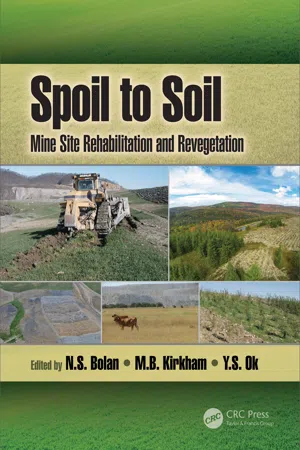
Spoil to Soil: Mine Site Rehabilitation and Revegetation
eBook - ePub

Spoil to Soil: Mine Site Rehabilitation and Revegetation

  1. 371 pages
  2. English
  3. ePUB (mobile friendly)
  4. Available on iOS & Android
eBook - ePub

Spoil to Soil: Mine Site Rehabilitation and Revegetation

About this book

Spoil to Soil: Mine Site Rehabilitation and Revegetation presents both fundamental and practical aspects of remediation and revegetation of mine sites. Through three major themes, it examines characterization of mine site spoils; remediation of chemical, physical and biological constraints of mine site spoils, including post mine-site land-use practices; and revegetation of remediated mine site spoils. Each theme includes chapters featuring case studies involving mine sites around the world. The final section focuses specifically on case studies with successful mine site rehabilitation.

The book provides a narrative of how inert spoil can be converted to live soil. Instructive illustrations show mine sites before and after rehabilitation. The purpose of this book is to provide students, scientists, and professional personnel in the mining industry sensible, science-based information needed to rehabilitate sustainably areas disturbed by mining activities.

This book is suitable for undergraduate and graduate students majoring in environmental, earth, and soil sciences; environmental and soil scientists; and mine site environmental engineers and regulators.

Frequently asked questions

Yes, you can cancel anytime from the Subscription tab in your account settings on the Perlego website. Your subscription will stay active until the end of your current billing period. Learn how to cancel your subscription.
No, books cannot be downloaded as external files, such as PDFs, for use outside of Perlego. However, you can download books within the Perlego app for offline reading on mobile or tablet. Learn more here.
Perlego offers two plans: Essential and Complete
  • Essential is ideal for learners and professionals who enjoy exploring a wide range of subjects. Access the Essential Library with 800,000+ trusted titles and best-sellers across business, personal growth, and the humanities. Includes unlimited reading time and Standard Read Aloud voice.
  • Complete: Perfect for advanced learners and researchers needing full, unrestricted access. Unlock 1.4M+ books across hundreds of subjects, including academic and specialized titles. The Complete Plan also includes advanced features like Premium Read Aloud and Research Assistant.
Both plans are available with monthly, semester, or annual billing cycles.
We are an online textbook subscription service, where you can get access to an entire online library for less than the price of a single book per month. With over 1 million books across 1000+ topics, we’ve got you covered! Learn more here.
Look out for the read-aloud symbol on your next book to see if you can listen to it. The read-aloud tool reads text aloud for you, highlighting the text as it is being read. You can pause it, speed it up and slow it down. Learn more here.
Yes! You can use the Perlego app on both iOS or Android devices to read anytime, anywhere — even offline. Perfect for commutes or when you’re on the go.
Please note we cannot support devices running on iOS 13 and Android 7 or earlier. Learn more about using the app.
Yes, you can access Spoil to Soil: Mine Site Rehabilitation and Revegetation by N.S. Bolan, M.B. Kirkham, Y.S. Ok, N.S. Bolan,M.B. Kirkham,Y.S. Ok in PDF and/or ePUB format, as well as other popular books in Biological Sciences & Ecology. We have over one million books available in our catalogue for you to explore.

Information

Publisher
CRC Press
Year
2017
Print ISBN
9781498767613
eBook ISBN
9781351247283

Section IV

Mine Site Revegetation Potential

12
Phytotechnologies for Mine Site Rehabilitation

Ramesh Thangavel, Rajasekar Karunanithi, Hasintha Wijesekara, Yubo Yan, Balaji Seshadri, and N.S. Bolan
CONTENTS
12.1Introduction
12.2Phytotechnologies
12.3Processes Involved in Phytotechnologies
12.3.1Soil Cover
12.3.2Hydraulic Control
12.3.3Contaminant Removal
12.3.4Rhizosphere Modification
12.4Summary and Conclusions
Acknowledgments
References

12.1Introduction

Soils are a prime and very important natural resource, and soil fertility is a major concern for sustainable agriculture and economic development of any country. In recent decades, problems of contaminated land sites, water bodies, groundwater, and air worldwide have increased manyfold due to anthropogenic activities. Mining is one of the anthropogenic activities that cause pollution problems in, around, and outside of mining areas. It results in the mobilization of metals and organic and inorganic substances into the environment, which causes pollution of air, soils, sediments, vegetation, and surface and groundwater. It also increases the morbidity and mortality of plant and animal species and results in the loss of visual, aesthetic characteristics of landscapes (Bolan et al. 2003; Pavli et al. 2015).
Due to geochemical changes in mine site soils, the physical, chemical, and biological activities of the soils are changed. Soils of mine sites are often considered as drastically disturbed. They are nutritionally and microbiologically reduced habitats that have reduced crop productivity and food quality, and they need restoration for revegetation (Singh et al. 2004). The shortage of organic matter at mine sites results in poor aggregate stability and structure (Castillejo and Castello 2010). Low water-holding capacity, erosion of tailings by wind and water, crusting, and cracking are some of the adverse effects that result from mine site soil structure (Hossner and Hons 1992). Mine site soil also contains hazardous contaminants such as heavy metals, which may enter groundwater and food chains. Thus, poor soil structure, contaminant toxicity, and low microbial activity are major constraints for revegetation and restoration of mine sites.

12.2Phytotechnologies

Remediation of mine site soils is necessary to minimize their impact on ecosystems. This is a challenging job with respect to cost and technical complexity. Worldwide, different physical, chemical, and biological approaches have been used for the rehabilitation of mine sites to restore ecosystem structure and function, thereby improving the ecological integrity and sustainability of the system. It includes removal, isolation, incineration, solidification/stabilization, vitrification, thermal treatment, solvent extraction, and chemical oxidation. However, these methods have disadvantages like high cost, intensive labor, irreversible changes in soil properties, and disturbance of native soil microflora. Chemical methods also involve the movement of contaminated materials to treatment sites, thus adding risks of secondary contamination. Therefore, less environmentally disruptive and more cost-effec...

Table of contents

  1. Cover
  2. Halftitle Page
  3. Title Page
  4. Copyright Page
  5. Contents
  6. Foreword
  7. Preface
  8. Editors
  9. Contributors
  10. SECTION I Mine Site Characterization
  11. SECTION II Mine Site Rehabilitation Practices
  12. SECTION III Post Mine Site Land-Use Practices
  13. SECTION IV Mine Site Revegetation Potential
  14. SECTION V Case Studies of Successful Mine Site Rehabilitation
  15. Index