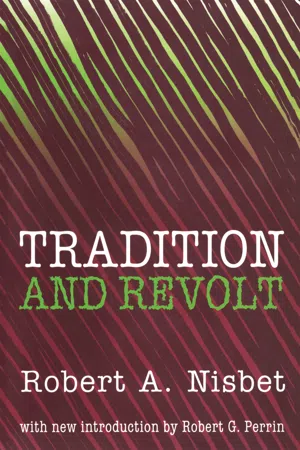
This classic volume deals with a crucial contemporary social issue: the conflict between traditionalism and modernism. Nisbet considers such subjects as power, community, culture, and the university. He deals directly with the values of authority, tradition, hierarchy, and community on the one hand, and individualism, secularism, and revolt on the other. Nisbet's underlying argument is that there is a close historical relationship between the distribution of power in democratic society and the displacement of social class, kinship, neighborhood, and the church. The book challenges concerned Americans to understand and address the basic conflicts confronting contemporary society.
In his introduction, Robert G. Perrin shows how the chapters in this volume reflect Nisbet's sociological vision exemplified throughout his career. Perrin notes that when these writings first appeared, they stimulated and informed debate on a broad range of topics such as value conflict, leadership, community, sociology, social class, technology, and the university. They also foreshadowed works yet to come in Nisbet's long and distinguished intellectual journey.
Originally published in 1968, Tradition and Revolt was greeted with thoughtful reviews in leading sociology journals. Writing in the American Journal of Sociology, Joseph R. Gusfield called it "so welcome a publication," one containing "remarkable contributions to the analysis of modern society." Nisbet's vision of Western social life as shaped by the struggle between the dialectically opposed values of tradition and modernity illuminates contemporary issues. Tradition and Revolt will be of particular value to sociologists, cultural historians, and political theorists.
Robert A. Nisbet (1913-1996) was Albert Schweitzer Professor Emeritus of the Humanities at Columbia University, and before that, dean of the School of Humanities at the University of California at Riverside. Among his many books are History of the Idea of Progress, The Sociological Tradition, The Degradation of the Academic Dogma, and Teachers and Scholars, all available from Transaction.
Robert G. Perrin is professor of sociology and director of graduate studies at the University of Tennessee.
- 308 pages
- English
- ePUB (mobile friendly)
- Available on iOS & Android
eBook - ePub
Tradition and Revolt
About this book
Trusted by 375,005 students
Access to over 1.5 million titles for a fair monthly price.
Study more efficiently using our study tools.
Information
[1]
Rousseau and the Political Community
It is doubtful whether any political theorist, with the possible exception of Plato, has more often been charged with inconsistency than has Jean Jacques Rousseau. How, it is asked—and has been asked since the age in which Rousseau wrote—can the individual be absolutely free, as Rousseau declares him to be in the Social Contract, and, at one and the same time, under the absolute dominion of the General Will? How can there be in fact what Rousseau described as “a form of association which will defend and protect with the whole common force the person and goods of each associate, and in which each, while uniting himself with all, may still obey himself alone, and remain as free as before”? How is it possible for there to be “the total alienation of each associate, together with all his rights, to the whole community” and, despite this, indeed because of it, the achievement by the individual of a degree of independence that he had known in the earliest phases of his history but had lost through the rise of inequality and injustice.1 Answers to these questions are doubtless impossible in terms of strict logic, but it is at least possible, I think, to clarify what Rousseau was trying to do.
The individualism of Rousseau’s thought is not the individualism of a William Godwin; it is not the libertarian assertion of absolute rights against the state. Rousseau’s passionate defense of the individual arises out of his opposition to the forms and observances of society. “What excites Rousseau’s hatred,” Professor Vaughan has commented, “is not the state, but society of any sort, quite apart from the civic ties by which in fact it is held together. His ideal, alike in the Discourses and in Émile, is no doubt individual freedom: freedom, however, not in the sense of immunity from control of the state but in that of withdrawal from the oppressions and corruptions of society.”2 It is this ideal which animates the educational philosophy of Émile, the belief in the goodness and perfectibility of the individual when he is protected from the corruption of society. It is, perhaps above all others, the basic theme of the Confessions. The splendidness of isolation from society is a leitmotif which recurs again and again in the passages of that work.3 The ideal lies implicit in the Discourse on Inequality where each stage of advancement that removes the individual from the isolation which was his existence in the conditions of nature is marked as a point on the way to degeneration. It is not the political state which inspires Rousseau’s hostility, but the harshnesses, inequalities, and dissensions of civil society. In a letter to Mirabeau, he writes: “It is of the essence of society to breed a ceaseless war among its members; and the only way to combat this is to find a form of government which shall set the law above them all.”4
The traditional bonds of society, the relationships we generally speak of as social, are the ties which to Rousseau symbolize the chains of existence. It is from these that he desires to emancipate the individual, and to replace their gross inequalities with a condition of equality approximating as nearly as possible the state of nature. “Each citizen would then be completely independent of all his fellow men, and absolutely dependent upon the state: which operation is always brought by the same means; for it is only by the force of the state that the liberty of its members can be secured.”5 There is no other single statement in all Rousseau’s writings which better serves as the theme of his political philosophy than this. In it is incorporated the essential argument of the two Discourses and of the Contrat social. His ideal is independence for the individual, but independence, it will be observed, not from the state but from fellow members of society.
The function of the state is made apparent by the same statement. Its mission is to effectuate the independence of the individual from society by securing the individual’s dependence upon itself. The state is the means by which the individual can be freed of those restrictive tyrannies which compose society. It is the agency of emancipation which permits the individual to develop the latent germs of goodness heretofore frustrated by a hostile society. By entering into the pure state, Rousseau declares, “Man’s actions receive a moral character which was wanting to them before,” and “from a stupid and limited animal he now for the first time becomes a reasoning being and a man.”6 The state is thus of the essence of man’s potential being, and far from being a check upon his development, it is the sole means of that development. Through the power of the state, man is spared the strife and tyranny which arise out of his selfish and destructive passions. But in order to emerge from the dissensions of society, and to abide in the spiritual peace of the state, there must be “an absolute surrender of the individual, with all of his rights and all of his powers, to the community as a whole.”7
Rousseau’s emphasis upon the community has been too often interpreted in a sense that is foreign to his own aim. Commentators have occasionally written of his “community” as the revival of a concept which had disappeared with the Middle Ages. The mystic solidarity which Rousseau preaches is not, however, the solidarity of the community existing by custom and unwritten law. The social community, as it existed in the thought of Thomas Aquinas or, later, in the theory of Althusius, is a community of communities, an assemblage of morally integrated minor groups. The solidarity of this community arises out of the moral and social observances of the minor groups. Its unity does not result from being permeated with sovereign law, extending from the top through all individual components of the structure. Rousseau’s community, however, is a political community, one which is indistinguishable from the state and which shares all the uniformitarian qualities of the state. It is, in his mind, a moral unity, but it is a unity conferred by the sovereign will of the state, and directed by the political government. Thus the familiar organic analogy is used to indicate the unitary structure of his political community.8 The same centralization of control which exists in the human body must dominate the structure of the community; unity is conferred by the brain which in Rousseau’s analogy represents the sovereign power. The General Will is the analogue of the human mind, and as such must remain as unified and undiversified as the mind itself. The Volonté genérale, as he is careful to indicate, is not synonymous with the Volonté de tous, the will of all. It is the will of the political organism, an entity which has a life of its own quite apart from that of the individual members of which it is built.
In its supra-human reality it is always right, and while the Volonté de tous may be often misled, the General Will never deviates from the strictest rectitude. The General Will is indivisible, inalienable, and illimitable. It demands the unqualified obedience of every individual in the community, and implies the obligation of each citizen to render to the state all that the state sees fit to demand. This preeminence of the state in the life of the individual is not, however, despotism; it is the necessary basis of true individual freedom. “In order that the social contract shall be no empty formula it tacitly implies that obligation which alone can give force to all the others: namely that anyone who refuses obedience to the general will is forced to it by the whole body. This merely means that he is being compelled to be free.”9 In this last phrase is revealed clearly the relationship between individualism and authoritarianism in the thought of Rousseau. The same rationale of values which leads him to restrict morality to life within the state, compels him similarly to regard the state as the sphere of freedom. The individual lives a free life only within his complete surrender to the omnipotent state. The state is the liberator of the individual from the toils of society.
The totalitarian implications of Rousseau’s thought do not arise merely out of the severity of his theory of sovereignty. The most common form of criticism—that the theory sets up an illimitable power—is applicable to all monistic theories of sovereignty. In any social theory where the sovereign state exists as a concept there is implicit at least the idea of potentially unrestricted power. What gives uniqueness to Rousseau’s doctrine is not so much its severity as its subtle but explicit identification with freedom. What has connoted bondage to the minds of most men is exalted as freedom by Rousseau. To regard the power structure of the state as a device by which the individual is only being compelled to be free is a process of reasoning that sets Rousseau apart from the tradition of liberalism. The phraseology of liberalism in this case merely intensifies the authoritarianism which underlies it. What Rousseau calls freedom is at bottom no more than the freedom to do that which the state in its omniscience determines. Freedom for Rousseau is the synchronization of all social existence to the will of the state, the replacement of cultural diversity by a mechanical equalitarianism. Other writers have idealized such an order in the interests perhaps of justice or of stability, but Rousseau is the first to invest it with the value of freedom. Therein lies the real distinctiveness of his theory of sovereignty.
It is, however, in the bearing of Rousseau’s General Will upon traditional society that the full sweep of its totalitarian significance becomes manifest. It has been made clear that the object of Rousseau’s dislike is society, and the special merit of the state lies in its power to emancipate the individual from traditional society. The relationship among individuals which forms the General Will, and which is the true state, is obviously an exceedingly delicate one. It must be unitary and indivisible for its nature fully to unfold. In short, it must be protected from the operations of extraneous channels of constraint. “For the same reason that sovereignty is inalienable, it is indivisible,” he writes; “the Will is general or else it is nothing.”10 To achieve a pure sovereignty, one which will be untrammeled by social influences, one which will encompass the whole of man’s personality, it is necessary that the traditional social loyalties be abrogated. A unified, general, Will is incompatible with the existence of minor associations; hence they must be banished.
When the people, having been adequately informed, hold its deliberation, and the citizens have had no communication among themselves, the whole number of individual opinions will always result in the General Will, and the decision will always be just. But when factions arise, and partial associations are created at the expense of the great association, the will of each of these associations becomes general so far as its members are concerned, and particular in its relation to the state: it may then be said that it is no longer a number of votes equal to the number of men, but equal only to the number of associations. ... It is therefore essential, if the General Will is to be able to express itself, that there should be no partial society within the state, and that each citizen should think only his own thoughts.11
The proscription of all forms of association except that which is identical with the whole being of the state: such is Rousseau’s drastic proposal. This is not to be regarded as one of these hasty, ill-considered remarks for which Rousseau is famous. Nor is it true that his banishment of associations is out of harmony with the rest of his thought. We have seen that Rousseau’s animus is against society, against those ties which make individuals dependent upon one another. We have seen, further, that his conception of sovereignty demands the attributes of unity and indivisibility; the General Will is general or else it is nothing. Is it not then logical that the right of non-political association should be sharply restricted? In his earlier Économie politique, Rousseau, in almost the same words, had presented this analysis of the relation of associations to the state.12 There is to be no bond of loyalty, no social affiliation, no interdependence, save that which is embodied in the General Will. This will, as we have seen, is meticulously distinguished by Rousseau from the mere “will of all.” The latter is the collective opinion or judgment reached by the people in their ordinary social roles; in their roles of businessman, soldier, cleric, family member, and so on. This will is not the “voice of God”; it is not necessarily just, right, and equitable. But the General Will is. What makes the General Will, in Otto von Gierke’s words, a process of permanent revolution is that by its very nature it must seek to dissolve away all of the social roles in society which, by their very existence, militate against both the individual’s freedom and his capacity to enter into the absolute political community.
The genius of the idea of the General Will lies in its masterful utilization of the ancient distinction between appearance and reality. We must, Rousseau is saying, beware of the apparent will of the people—the will that simple majority vote may make evident—for this is the will of the people still incompletely emancipated from the private authorities and the separate roles that are given them by history. The real will of the people is that will which lies latent in man and that requires as its condition man’s liberation from these authorities and roles. This is the General Will and is alone “the voice of God.”
How, in practical operation, is the General Will to be ascertained? Representation through parliamentary institutions is out of the question, for, we are told, the General Will cannot be represented. To seek to represent it is to distort it. Moreover, representative institutions are themselves a part of the hated legacy of the Middle Ages. Balloting will not do, for, as we have seen, balloting may yield only the spurious and deceptive “will of all.” Rousseau’s answer to his question is a fascinating one:
But how, I shall be asked, can the General Will be known in cases in which it has not expressed itself? Must the whole nation be assembled together at every unforeseen event? Certainly not. It ought the less to be assembled, because it is by no means certain that its decision would be the expression of the General Will; besides, the method would be impracticable in a great people, and is hardly ever necessary where the government is well-intentioned: for the rulers well know that the General Will is always on the side which is most favourable to the public interest, that is to say, most equitable; so that it is needful only to act justly, to be certain of following the General Will.13
How can the ruler be certain of acting justly? He must be, above all things, virtuous. Only “the most sublime virtue,” Rousseau writes, “can afford sufficient illumination for it”—that is, for the distinction between the real will and the apparent will. But what is virtue? And here we come full circle back to the General Will.
If you would have the General Will accomplished, bring all the particular wills into conformity with it; in other words, as virtue is nothing more than this conformity ...
Table of contents
- Cover
- Half Title
- Title Page
- Copyright Page
- Table of Contents
- Introduction to the Transaction Edition
- Introduction
- [1] Rousseau and the Political Community
- [2] The Politics of Pluralism: Lamennais
- [3] Leadership and Social Crisis
- [4] Conservatism and Sociology
- [5] History and Sociology
- [6] The Decline and Fall of Social Class
- [7] Moral Values and Community
- [8] Sociology as an Art Form
- [9] Power and the Intellectual
- [10] The Impact of Technology on Ethical Decision-Making
- [11] Kinship and Political Power in First Century Rome
- [12] The Permanent Professors: A Modest Proposal
- [13] Project Camelot and the Science of Man
- [14] Conflicting Academic Loyalties
Frequently asked questions
Yes, you can cancel anytime from the Subscription tab in your account settings on the Perlego website. Your subscription will stay active until the end of your current billing period. Learn how to cancel your subscription
No, books cannot be downloaded as external files, such as PDFs, for use outside of Perlego. However, you can download books within the Perlego app for offline reading on mobile or tablet. Learn how to download books offline
Perlego offers two plans: Essential and Complete
- Essential is ideal for learners and professionals who enjoy exploring a wide range of subjects. Access the Essential Library with 800,000+ trusted titles and best-sellers across business, personal growth, and the humanities. Includes unlimited reading time and Standard Read Aloud voice.
- Complete: Perfect for advanced learners and researchers needing full, unrestricted access. Unlock 1.5M+ books across hundreds of subjects, including academic and specialized titles. The Complete Plan also includes advanced features like Premium Read Aloud and Research Assistant.
We are an online textbook subscription service, where you can get access to an entire online library for less than the price of a single book per month. With over 1.5 million books across 990+ topics, we’ve got you covered! Learn about our mission
Look out for the read-aloud symbol on your next book to see if you can listen to it. The read-aloud tool reads text aloud for you, highlighting the text as it is being read. You can pause it, speed it up and slow it down. Learn more about Read Aloud
Yes! You can use the Perlego app on both iOS and Android devices to read anytime, anywhere — even offline. Perfect for commutes or when you’re on the go.
Please note we cannot support devices running on iOS 13 and Android 7 or earlier. Learn more about using the app
Please note we cannot support devices running on iOS 13 and Android 7 or earlier. Learn more about using the app
Yes, you can access Tradition and Revolt by Robert Nisbet in PDF and/or ePUB format, as well as other popular books in Social Sciences & Social History. We have over 1.5 million books available in our catalogue for you to explore.