eBook - ePub
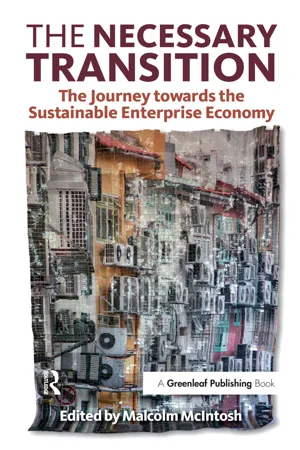
The Necessary Transition
The Journey towards the Sustainable Enterprise Economy
- 268 pages
- English
- ePUB (mobile friendly)
- Available on iOS & Android
eBook - ePub
About this book
Life on Earth for humanity and our ecosystems is at a point of great change. There is much to be learnt about previous great disruptions. The key words are *adaptation* and *transformation*. Most international companies operate across multiple social and environmental geographies, so they know this intellectual and practical landscape. And for many governments the challenges of social and environmental justice are also paramount – not least because equitable societies are best for business, and best for human well-being.The Necessary Transition addresses the many transitions taking place around the world: from high- to low-carbon economies, from gross inequality to egalitarianism, from massive human rights abuses to socially just societies, and from high corruption to societies with high social cohesion and integrity.The book brings together leading international researchers and practitioners to share their knowledge and expertise, and offers answers to many of the pressing questions that must be addressed in the journey towards a sustainable enterprise economy – an absolutely necessary transition for humanity.Contributors include: Sara Parkin, Founder-Director and Trustee of the UK's Forum for the Future; Bill Champion, Managing Director, Rio Tinto Coal Australia; and Mark Swilling, co-author of "Just Transitions" and Academic Director of the Sustainability Institute, South Africa.The key question is: "Is a transition to a sustainable future possible within the logic of conventional capitalism and 20th-century models of development?" This book provides radical perspectives from varying entry points and is essential reading for academics and practitioners interested in how we plan, speed and scale such necessary transitions.
1
Contested futures
Conceptions of the next long-term development cycle
Mark Swilling
Sustainability Institute, Stellenbosch University, South Africa
Sustainability Institute, Stellenbosch University, South Africa
Introduction
This chapter will review some of the emerging stories of the future that have been generated by the global crisis. By drawing on the multi-level perspective (Grin et al. 2010), neo-Schumpeterian perspectives (Gore 2010; Köhler 2012) and a political ecology perspective on transitions (Lawhon and Murphy 2011), it will be argued in the first part of the chapter that these are attempts to re-imagine a post-crisis landscape in ways that, for some, will preserve the status quo (using, for example, market-oriented ‘green economy’ discourses) while for others quite significant changes in the patterns of production and consumption that have dominated the post-World War II period are envisaged. As such, these re-imaginings deserve attention because—thanks to the pervasive use of computer-aided scenario-building in recent times—images of the future do influence decisions that can shape these futures. However, the primary concern of this chapter is not just stories of the future, but also the kinds of real-economy conditions that could materially contribute to the possibility of a more sustainable and equitable future. In the second part of the chapter, it will be argued that rising resource prices have joined climate change and ecosystem services as a key landscape driver of change. After over a century of declining resource prices, the steady rise of resource prices since the turn of the millennium is clearly a game changer. It will be argued that the rise to prominence of the ‘green economy’ discourse reflects a growing recognition of this inflection point. This does not, however, automatically imply the unfolding of a sustainability transition precisely because the sociopolitical regimes and institutions of the post-World War II era remain dominant.
Re-imagining the landscape: crises, cycles and waves
According to the multi-level perspective (MLP) on sustainability transitions, the macro-level sociotechnical landscape provides the context for the relatively autonomous institutionalisation of sociotechnical regimes and the initiation of niche innovations protected somewhat from potentially hostile market and political dynamics (Grin et al. 2010). Regimes are institutionalised configurations of shared assumptions, technologies, regulations, market norms and consumer preferences that ‘lock in’ a particular mode of production and consumption. Niches, on the other hand, are loci for radical innovation that can either subvert or reform existing regimes depending on the dynamics and intensity of the landscape pressures. A regime can reform itself by tapping internal innovations and/or external knowledge that has evolved in niches, or it can deny/resist change and eventually collapse (Smith et al. 2005). If it collapses, a new regime is constituted from the knowledge sets that have evolved within the niches. The landscape includes:
… environmental and demographic change, new social movements, shifts in general political ideology, broad economic restructuring, emerging scientific paradigms, and cultural developments. Landscapes provide an influential backdrop with ramifications across a variety of regimes and niches: providing gradients and affordances for how to go about establishing socio-technical configurations that service societal needs (Smith et al. 2010: 7, emphasis added).
Following Rotmans and Loorbach (2009), a key aspect of the transition management approach is the facilitation of engagements between actors to develop shared visions of the future. However, these actors—who are, as Lawhon and Murphy (2011) point out, largely drawn from corporate, scientific and policy elites—arrive at these engagements with preconceptions of the future that shape the discourse. These preconceptions are, in turn, influenced by a variety of academic, semi-academic and popular writing that construct imaginaries of future trajectories. What follows below is a review of a set of typical perspectives that all aim in one way or another to re-imagine the ‘gradients and affordances’ of a future sociotech-nical landscape that transcends the present crisis-ridden landscape on terms that may, depending on who uses the ideas, challenge existing power structures.
Six key texts will be briefly reviewed, all of which systematise, in one way or another, a set of storylines about the future that are easily recognised in the diverse range of popular discourses about the future that have proliferated since 2007–2008. They represent, therefore, clusters of discursive and cultural ontologies of probable futures (Geels 2010). These texts are: Standard Chartered, The Super-Cycle Report (2010); Arun Motianey, Supercycles: The New Force Transforming Global Markets and Investment Strategy (2010); Allianz Global Investors, The Sixth Kondratieff: Long Waves of Prosperity (2010);1 James Bradfield-Moody and Bianca Nogrady, The Sixth Wave: How to Succeed in a Resource-limited World (2010); Ernst Von Weizsäcker and colleagues, Factor Five (2009); and Jeremy Rifkin’s The Third Industrial Revolution: How Lateral Power is Transforming Energy, the Economy and the World (2011).
Compiled by the research division of the global banking group Standard Chartered, the core argument of their report is that there have been two major ‘super-cycles’ plus a third which is current, namely: 1870–1913 when the global economy grew on average by 2.7% per annum; 1946–1973 when economic growth rates averaged 5%; and 2000–2030 when economic growth is expected to average out at 3.5% with the current recession seen as a relatively brief moment of ‘rebalancing’ (Standard Chartered 2010). The definition of a supercycle is ‘a period of historically high global growth, lasting a generation or more’ and which is characterised by a nation that becomes a dominant economic driver (Standard Chartered 2010: 1). For Standard Chartered, the shift in economic power from the ‘West’ to the ‘East’, rapid urbanisation and the massive future growth of the Asian middle class are seen as the key drivers of the next supercycle (2000–2030). Interestingly, the period between the 1970s and 2000 is seen as a period of weak debt-financed growth in the West, economic stagnation in Japan, collapse of the Soviet Union, debt and currency crises in Latin America, while China and India had not yet ‘opened up’. As a result ‘[t]here was no dynamic driver for the world economy’ during this period (Standard Chartered 2010: 3).
The key fact that is used to substantiate the argument that we are now well into a third supercycle is that the global economy in 2010 was almost twice the size it was in 2000 (i.e. a GDP of US$32 trillion in 2000, rising to US$62 trillion in 2010)—a trajectory driven mainly by growth in the East, a driver that is seen as lasting for at least two more decades. Yes, Standard Chartered admits, there are challenges today, but they have faith good policy decisions will sort out the economic problems in due course; and in a very short section it is argued that innovation will deal with the problems of climate change and rising resource prices (including rising oil prices which are specifically mentioned as an unpredictable threat). Global GDP is, therefore, confidently expected by Standard Chartered to be US$143 trillion by 2030 (in real terms) which is, of course, more than double what it was in 2010.
Arun Motianey worked for Citibank for 30 years which, he says, allowed him to experience first-hand the real workings of the booms and busts of the global financial system as it evolved during the period of globalised financialisation starting in the late 1970s (Motianey 2010). He concluded that how this system actually works contradicts the prevailing theories of how it should work. He sets out to debunk the notion that we can understand national economies as aggregations of individual/household transactions, and the global economy as aggregations of national-level economic dynamics. Instead, the globalised architecture of the financial, trade and production system has given rise to a sociotechnical landscape that he calls a ‘supercycle’ that has its own autonomous logic and ‘laws’. He equates a supercycle to a large undulating integrated pipeline that is constituted at the level of the global economy unrelated to the specific dynamics of each national economy—a classic ‘landscape’ dynamic in MLP language. A supercycle starts with the extraction and processing of commodities, proceeds through to the production of intermediate goods, and ends with consumable goods and services that are bought and consumed by end-users (households, businesses). Waves of goods flow through the pipeline, expanding and contracting in line with the complex logics of price-regulated supply and demand. The problem is that in a world of nations comprising multiple currencies and exchange rates, as a price drops somewhere along the pipeline for whatever reason, this translates into higher profits and therefore over-investment in capacity, assets and expanded employment further down the pipeline. This would not be a problem if prices were a true reflection of economic value, but they are not because of institutional inefficiencies. Instead, the (frequently debt-financed) over-investment in capacity, assets and expanded employment translates into asset bubbles that end in crashes followed by deflation. This pattern starts at one end of the pipeline and gradually and steadily gets transferred down the pipe driving the booms and busts along the way that we now know so well. The hyper-financialisation of the global economy oiled the wheels of this roller coaster: fostered by the US Federal Reserve and the US Treasury, financialisation (made possible by the deregulation of financial institutions—what former UK Prime Minister Gordon Brown called the ‘light touch’ regulation) created the space for financial innovations that were used to accelerate and profit from transacting these booms and busts. Speculators and transactors made their profits, leaving behind a trail of economic devastation. As Motianey (2010: 23) puts it:
Like a long snakelike balloon losing air, the pipeline begins to deflate at one end (the bust), which makes the next section closest to it on the balloon (the boom) appear to inflate. But then eventually the deflation travels through the entire length of the balloon.
For Motianey, once deflation has worked its way through the pipeline, the endpoint is either a great big crash due to policy failure (as happened after the 1929 crash), or a prolonged unproductive malaise similar to what has afflicted the Japanese economy since the 1990s. The Japanese malaise writ large is his metaphor for the future. Accordingly, therefore, he looks back and sees two great sociotechnical landscapes or supercycles. The first is what he calls the ‘classical supercycle’ which began with the adoption of the gold standard in the 1870s and ended in the early 1930s with the mass destruction of productive capacity as states held back from intervening after the 1929 crash until it was too late. The second supercycle is the ‘modern supercycle’, which began with the formation of what he calls the ‘volcker fed’ in 1979 and which is continuing well into the second decade of the 21st century. The deregulation of the global financial system that the US Federal Reserve promoted made it possible to create a gigantic pipeline of interlinked sovereign surpluses and debt that drove the booms and busts around the world—from the Latin American debt crises of the 1980s, transferred to the Asian crashes of the 1990s, and then on to the sovereign debt crises of developed economies in the 2000s. However, the key difference is that, unlike the end of the classical supercycle, states have learnt to respond with counter-cyclical measures that have transferred household and banking debts into sovereign debt coupled to austerity measures, while simultaneously keeping interest rates low in the hope of stimulating growth. Because monetary authorities are determined to also keep inflation low, the end result is what Motianey calls the ‘great malaise’—a prolonged uncreative deflationary depression. The only alternative, in his view, would be to accept that a new era of inflation is needed to devalue the debt and realign the prices of production and consumption. But the resulting ‘creative destruction’ (to use Schumpeter’s famous words) not only runs contrary to economic orthodoxy, it is also contrary to the interests of the banks who resist all attempts to devalue what they are owed by the governments of the world. So, contrary to the optimism of the Standard Chartered report, he concludes:
We will not face the Second Great Depression; more likely we will face the first Great Global Malaise—where the whole world looks like Japan—or perhaps the Great Stagflation (Motianey 2010: 28).
As the global economy bumps along the bottom into its fifth year of recession, the combined impact of debt-constrained fiscal intervention, the limits to monetary policy imposed by ultra-low or even negative real interest rates and the build-up of unprecedented reserves of unspent cash by investors seems to confirm Motianey’s profound pessimism. It must surely be more than a glitch in a long-term upward trend.
While reports like the one from Standard Chartered see a saviour in the birth of an Asian middle class, Motianey’s perspective blames economic orthodoxy for the gutless opposition to the inflationary dynamics needed to flush out the deadwood of accumulated debt that is responsible for the great malaise. Both, however, ignore the question of sustainability; by contrast the next three perspectives directly link solutions to the global economic crisis to a transition to a more sustainable global economy.
The report published by the global asset management company Allianz Global Investors, The Sixth Kondratieff: Long Waves of Prosperity, argues that the current global economic crisis marks the beginning of the end of the fifth Kondratiev cycle and the start of the sixth Kondratiev cycle (Allianz Global Investors 2010). Following the tradition started by Kondratiev, the Russian economist who first thought of economic history in terms of long waves of 40 to 60 years (Kondratieff 1935), Allianz notes that during the first phase of the Kondratiev cycle interest rates go up as demand increases for capital to fund the investments in new technologies formulated by the alliances between innovators and entrepreneurs. However, this is not a problem because earnings from the new value chains that get created easily cover the costs of capital as profit margins soar. However, diminishing returns over time on investments in ever-maturing technologies reduces the demand for credit resulting, in turn, in a decline in real interest rates. Every major crisis, including the present one, has been brought on by this dynamic, the Allianz report argues. The conditions that lead to a new Kondratiev cycle include the exhaustion of the potential of mature technologies, an excess ...
Table of contents
- Cover
- Half Title
- Title
- Copyright
- Contents
- Foreword
- Acknowledgements
- Introduction
- 1. Contested futures: Conceptions of the next long-term development cycle
- 2. Radical openness and contextualisation: Reflections on a decade of learning for sustainability at the Sustainability Institute
- 3. The devil is in the synergy: The exhibitions at MOSET: a hypothetical museum of human transitions
- 4. Transformations and translations of Japanese business-society
- 5. Occupation or action: Are they more or less than the sum of their parts?
- 6. The pillars of peace: Identifying the elements that allow human potential to flourish
- 7. The wicked problem of developing a new social contract for the necessary transition
- 8. Together: the power of collaboration
- 9. Boundary objects, HRM tools and change for sustainability
- 10. Climate change is everyone's business
- 11. Industry transformation through sustainable entrepreneurship: Examples in the apparel and energy industries
- 12. Public policy processes for transition to a sustainable enterprise society: The case of extractive industries
- 13. Sustainable development: Continuing to re-earn our license to operate
- 14. Currencies of transition: Transforming money to unleash sustainability
- Index
Trusted by 375,005 students
Access to over 1.5 million titles for a fair monthly price.
Study more efficiently using our study tools.
Frequently asked questions
Yes, you can cancel anytime from the Subscription tab in your account settings on the Perlego website. Your subscription will stay active until the end of your current billing period. Learn how to cancel your subscription
No, books cannot be downloaded as external files, such as PDFs, for use outside of Perlego. However, you can download books within the Perlego app for offline reading on mobile or tablet. Learn how to download books offline
Perlego offers two plans: Essential and Complete
- Essential is ideal for learners and professionals who enjoy exploring a wide range of subjects. Access the Essential Library with 800,000+ trusted titles and best-sellers across business, personal growth, and the humanities. Includes unlimited reading time and Standard Read Aloud voice.
- Complete: Perfect for advanced learners and researchers needing full, unrestricted access. Unlock 1.5M+ books across hundreds of subjects, including academic and specialized titles. The Complete Plan also includes advanced features like Premium Read Aloud and Research Assistant.
We are an online textbook subscription service, where you can get access to an entire online library for less than the price of a single book per month. With over 1.5 million books across 990+ topics, we’ve got you covered! Learn about our mission
Look out for the read-aloud symbol on your next book to see if you can listen to it. The read-aloud tool reads text aloud for you, highlighting the text as it is being read. You can pause it, speed it up and slow it down. Learn more about Read Aloud
Yes! You can use the Perlego app on both iOS and Android devices to read anytime, anywhere — even offline. Perfect for commutes or when you’re on the go.
Please note we cannot support devices running on iOS 13 and Android 7 or earlier. Learn more about using the app
Please note we cannot support devices running on iOS 13 and Android 7 or earlier. Learn more about using the app
Yes, you can access The Necessary Transition by Malcolm McIntosh in PDF and/or ePUB format, as well as other popular books in Business & Business General. We have over 1.5 million books available in our catalogue for you to explore.