- 140 pages
- English
- ePUB (mobile friendly)
- Available on iOS & Android
eBook - ePub
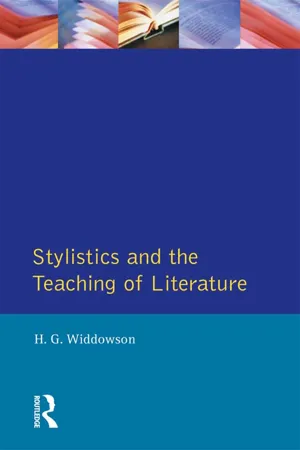
Stylistics and the Teaching of Literature
About this book
This volume forms part of the Applied Linguistics and Language Study collection that looks at the field of analysing and appreciating literary texts. First published in 1975, this text makes a considerable contribution to extending our view of the principles underlying language teaching and curriculum design. The author begins by distinguishing the idea that discipline from the pedagogic subject in order to demonstrate that stylistics is Janus like in the way it can be treated, for example, at school or university, as a way from linguistics to literary study or the reverse. To understand this bidirectionality he explains distinctions between the linguist's text and the critic's messages by introducing the concept of discourse as a means through which to understand the communicative value of passages of language.
Trusted by 375,005 students
Access to over 1.5 million titles for a fair monthly price.
Study more efficiently using our study tools.
Information
Topic
EducationSubtopic
LinguisticsPART ONE
2
Literature as text
Generally speaking, literature has attracted the attention of linguists for two quite opposing reasons. One of them is that it represents data which can be accounted for in terms of models of linguistic description and the other that it represents data which cannot be so accounted for. The first reason is expressed by Halliday as follows:
Linguistics is not and will never be the whole of literary analysis, and only the literary analyst—not the linguist—can determine the place of linguistics in literary studies. But if a text is to be described at all, then it should be described properly; and this means by the theories and methods developed in linguistics, the subject whose task is precisely to show how language works.*
In Halliday’s view (at least, as expressed in the article from which the above quotation is taken) the description of the linguistic elements that occur in a piece of literary writing, the account of how it exemplifies the system of the language, is part of the analysis of the piece of writing as a literary work. In this article, Halliday considers Yeats’ poem Leda and the Swan and describes how two parts of the system of English are exemplified in it: the first being the nominal group and the second the verbal group. What I want to do now is to consider Halliday’s claim by looking at his discussion of the first of these. We will try to establish what contribution his observations make to an understanding of the poem: whether and to what extent they can be regarded as a part of a literary analysis.
LEDA AND THE SWAN
A sudden blow: the great wings beating still
Above the staggering girl, the thighs caressed
By the dark webs, her nape caught in his bill,
He holds her helpless breast upon his breast.
How can those terrified vague fingers push
The feathered glory from her loosening thighs?
And how can body, laid in that white rush,
But feel the strange heart beating where it lies?
A shudder in the loins engenders there
The broken wall, the burning roof and tower
And Agamemnon dead.
Being so caught up,
So mastered by the brute blood of the air,
Did she put on knowledge with his power
Before the indifferent beak could let her drop?
As Halliday observes, the definite article in English can function in a number of different ways and can be distinguished in the grammar accordingly. In general, its function is to signal that the nominal group in which it appears constitutes a specific reference. This reference may be of three kinds. Firstly, it may be contained within the group itself in the form of a modifier (which precedes the head word in the group) or of a qualifier (which follows it). Thus, in the nominal group the white goddess the modifier white in association with the definite article specifies a particular goddess. Similarly, the goddess in the temple has definite reference since the qualifier in the temple in association with the definite article again specifies a particular goddess. Where the definite article signals that some other element in the nominal group (modifier or qualifier or both) indicates a specific reference, the article is said to be cataphoric. This might be expressed as follows:
M(odifier) | H(ead) | Q(ualifier) | |
The | white | goddess | |
The | goddess | in the temple | |
The | white | goddess | in the temple |
A second kind of reference is one which links the head of the nominal group with something previously mentioned. If I have been talking about a goddess, for example, I may say something like ‘The goddess was a figure of great mystery’ and here I specify again a particular goddess, one who had been previously talked about. Where the definite article signals that the nominal group relates to what has been referred to before, as in this case, the article is said to be anaphoric.
A third kind of reference is said to occur when, given a certain situation, the head word itself is sufficient to identify something specific and requires no additional elements in the nominal group nor any link with previous mention to be understood as constituting a specific reference. Such a use of the article is known as homophoric (or exophoric) and examples would be the sun or the moon where only one referent is possible (assuming that the speaker is not discussing any heavenly body other than earth) and The Queen, when this is understood to refer uniquely to the Queen of the United Kingdom and the President when this is understood to refer uniquely to the President of the United States.
It will be noticed that in this account of the definite article two quite different kinds of criteria have been used. On the one hand, appeal has been made to the way the nominal group is structured, so that one can say: if the nominal group has either a modifier or a qualifier or both, then the definite article is cataphoric and if not it is either anaphoric or homophoric. On the other hand, appeal has been made as to how the nominal group functions as communication, so that one can say: if the nominal group itself constitutes a specific reference and does not depend on being linked to anything else then the definite article is cataphoric. The first kind of criteria has to do with linguistic form and the second with communicative function, and the relationship between them is of considerable importance in this particular poem, as we shall see.
Halliday notices that in Leda and the Swan there are 25 nominal groups (excluding those consisting only of pronouns and the name Agamemnon) of which 10 contain the definite article with either a modifier or a qualifier or both. This information is set down in the form of a table. What we have so far is a simple example of text analysis. But now a complication arises: although by formal criteria the definite articles in these 10 nominal groups must be counted as cataphoric, they do not seem to operate as such if one takes functional criteria into account. That is to say, these nominal groups do not seem to make the kind of self-contained reference which Halliday suggests characterises the cataphoric use of the article. For example, the expressions the great wings beating still and the dark webs meet the formal conditions for cataphora (their structure as nominal groups being MHQ, and MH respectively) but the wings are not identified as kinds of wings which are great and beating, nor the webs as kinds of webs which are dark. Rather the reference appears to be to something outside the nominal group and therefore, with respect to function, to be either anaphoric or homophoric in Halliday’s terms.
Halliday himself notices this discrepancy between the form of these nominal groups and the function they appear to have in the poem. The dark webs, the great wings and the staggering girl are, he says, identified anaphorically by reference to the title of the poem, so that the dark webs and the great wings relate to the swan and the staggering girl to Leda. He then adds:
The only other type of writing I can call to mind in which this feature is found at such a high density is in tourist guides and, sometimes, exhibition catalogues. (I hope I need not add that this is in no sense intended as an adverse criticism of the poem.)*
Now clearly the way in which the poem as text exemplifies different nominal group structures is, as isolated information, of very slight interest and this aspect of Halliday’s analysis, on its own, cannot be said to contribute anything to an understanding of the poem as such. What is of interest is that these groups do not appear to function as they most commonly do but in a way which is found in certain restricted uses of English. We may take the point that the comparison between Leda and the Swan with an exhibition catalogue is not intended as an adverse criticism but it does imply criticism in the sense in which literary critics use that term. Halliday begins with text analysis and shows how a part of the language system is exemplified in the poem. He then points to the fact that this part of the system is being used in a somewhat unusual way. This prepares the ground for a discussion of the poem as discourse, that is to say for a consideration of how these linguistic facts are relevant to an understanding of the message which the poem conveys. But having come to this stylistic brink, Halliday withdraws with a final provocative remark. His primary interest lies in the text and the nature of the poem’s message is outside his concern.
Let us now attempt, briefly, to extend Halliday’s observations into a stylistic analysis in the sense defined in Chapter 1 by considering the use of these nominal groups as features of the poem as a discourse. If their use of forms which are commonly ‘cataphoric’ is in fact ‘anaphoric’ in the manner of exhibition catalogues and tourist brochures what does this tell us about the meaning of the poem?
We will begin by a brief consideration of how anaphoric reference works. A nominal group can be linked up with one preceding if some kind of semantic association can be made between them. Thus, as Halliday suggests, the staggering girl can be linked up anaphorically with Leda in the title of the poem since part of the meaning of the name is that it is feminine, or (to put it slightly more technically) the name has a semantic feature /+female/ and this feature is shared by the item girl. Similarly wings and webs being actually bodily parts of birds can be associated with the swan in the title. But not all of the nominal groups can be linked with the title so obviously. There is no direct semantic relation, for example, between either Leda or the swan and The broken wall or the burning roof and tower although it seems evident that neither is cataphoric in function either. There appear to be two possibilities. The first is that the reference here is homophoric: mention of Leda and her encounter with the swan creates a kind of situation in the mind in which broken walls and burning towers must have exclusive reference to Troy, just as being, let us say, in Canterbury creates an actual situation in which any mention without modification or qualification of the Cathedral would quite unambiguously refer to Canterbury cathedral. The second possibility is that the reference is in a way homophoric but in a more exact sense than that in which Halliday appears to use the term in that it indicates details in a picture, real or realistically imagined, of which the poem is in fact a direct description. That is to say, the nominal groups here may be functioning deictically to point to things supposed to be actually present in the immediate context of utterance.
Let us explore this second possibility a little further. If it is the case that the high incidence of nominal groups usually cataphoric but functioning in a non-cataphoric way is a feature of the way English is used in tourist guides and exhibition catalogues, then it is pertinent to ask why they are so used. The answer would seem to be that it is because the nominal groups are deictic in function, making reference to external objects which it is assumed will be present to the reader when he reads and thus part of the situation: paintings or sculptures, churches or castles or other ancient buildings. Consider, for example, the following extract from a guide to Florence:
The graceful Loggia in the Florentine Gothic style with round arches was the place to which unwanted children were taken. The three statues in the tabernacles on the font represent the Madonna and Child between St. Lucy and St. Peter Martyr. They are of the Pisan school of the 14th Century. The frescoes which once adorned the façade were removed to save them from the inclemencies of the weather.…
The nominal groups which serve as subjects in the first two of these sentences are similar to those in the Yeats’ poem we have been discussing in that although their structure would seem to indicate that the definite article is cataphoric they in fact function deictically since the nominal groups relate to what it is assumed the visitor will see as he walks around, guide-book in hand. The same would be true if these sentences referred to maps or photographs in the guide-book itself. Thus these sentences have a communicative function which we might make explicit in the following manner: ‘The graceful Loggia, which you see before you on the left of the altar …’ ‘The three statues, illustrated below …’ The last sentence in the extract provides an interesting comparison with the first two for here the reference is cataphoric in function: the frescoes cannot become part of the situation in which the tourist finds himself because they are no longer there. They are identified independently by the nominal group itself.
If the nominal groups in Leda and the Swan are deictic in the same way as those in the tourist guide-book we have just been considering then it suggests that Yeats is describing either an actual picture or one which is clearly delineated in his mind as a precise vision. Furthermore the picture, real or imagined, includes the broken wall and the burning towers of Troy. That Yeats is describing from a definite ‘model’—defined clearly in reality or in his mind—rather than simply associating ideas, as it were, is suggested by two further observations. The first is the use of the definite article in the nominal group the thighs caressed by the dark webs. This follows the group the staggering girl which could relate to the title. But since this latter group establishes the link with Leda identifying her as the girl, there seems no motivation...
Table of contents
- Cover Page
- Half Title Page
- Series Page
- Title Page
- Copyright Page
- Acknowledgements
- Preface
- Series Page
- Contents
- Introductory
- Part One
- Part Two
- Conclusion
- Further reading on stylistics
- Index
Frequently asked questions
Yes, you can cancel anytime from the Subscription tab in your account settings on the Perlego website. Your subscription will stay active until the end of your current billing period. Learn how to cancel your subscription
No, books cannot be downloaded as external files, such as PDFs, for use outside of Perlego. However, you can download books within the Perlego app for offline reading on mobile or tablet. Learn how to download books offline
Perlego offers two plans: Essential and Complete
- Essential is ideal for learners and professionals who enjoy exploring a wide range of subjects. Access the Essential Library with 800,000+ trusted titles and best-sellers across business, personal growth, and the humanities. Includes unlimited reading time and Standard Read Aloud voice.
- Complete: Perfect for advanced learners and researchers needing full, unrestricted access. Unlock 1.5M+ books across hundreds of subjects, including academic and specialized titles. The Complete Plan also includes advanced features like Premium Read Aloud and Research Assistant.
We are an online textbook subscription service, where you can get access to an entire online library for less than the price of a single book per month. With over 1.5 million books across 990+ topics, we’ve got you covered! Learn about our mission
Look out for the read-aloud symbol on your next book to see if you can listen to it. The read-aloud tool reads text aloud for you, highlighting the text as it is being read. You can pause it, speed it up and slow it down. Learn more about Read Aloud
Yes! You can use the Perlego app on both iOS and Android devices to read anytime, anywhere — even offline. Perfect for commutes or when you’re on the go.
Please note we cannot support devices running on iOS 13 and Android 7 or earlier. Learn more about using the app
Please note we cannot support devices running on iOS 13 and Android 7 or earlier. Learn more about using the app
Yes, you can access Stylistics and the Teaching of Literature by H.G. Widdowson in PDF and/or ePUB format, as well as other popular books in Education & Linguistics. We have over 1.5 million books available in our catalogue for you to explore.