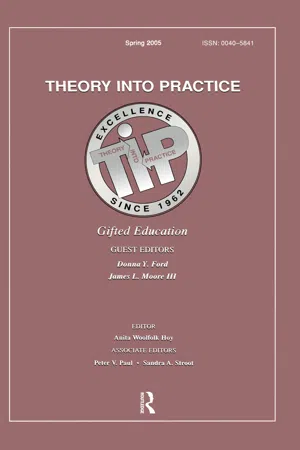
A scholar's dream come true, 40 years of The Ohio State University's educational journal, Theory Into Practice. Every theme issue, thousands of articles, on a broad range of education-related topics, can be easily accessed. Edited and written by leading thinkers and practitioners in their fields, many of these theme issues are used in classes year after year as their message remains relevant indefinitely. Whether you are a teacher, student, professor, administrator, or librarian, Volume 44, Number 2, 2005 This Issue: Gifted Education, Applying Gifted Education Pedagogy to Total Talent Development for All Students, Gifted Programs and Services, will be of benefit to you.
eBook - ePub
Gifted Education
A Special Issue of Theory Into Practice
- 112 pages
- English
- ePUB (mobile friendly)
- Available on iOS & Android
eBook - ePub
Gifted Education
A Special Issue of Theory Into Practice
About this book
Trusted by 375,005 students
Access to over 1.5 million titles for a fair monthly price.
Study more efficiently using our study tools.
Information
Topic
EducationSubtopic
Education GeneralDonna Y. Ford
James L. Moore III
Deborah A. Harmon
Integrating Multicultural and Gifted Education: A Curricular Framework
This article raises a number of critical questions related to multiculturalism and gifted education. In particular, the authors suggest that culturally relevant content is lacking in gifted education programs. They make the case that gifted students of color are being shortchanged by gifted education programs that lack infusion of diversity issues; these students would benefit substantially from gifted education programs that infuse multiculturalism throughout the curricula. Last, but not least, the article introduces and discusses the Ford and Harris (1999) model for infusing multiculturalism in gifted education programs.
As stated throughout this special theme issue, gifted education faces critical challenges as the nation becomes increasingly diverse. With the increasing diversity, there comes the need to change many school practices, not only in terms of increasing the representation of students of color in gifted education but also in terms of more effectively meeting the academic needs of students who are gifted and diverse. In other words, once gifted students of color are recruited (i.e., identified and placed), public schools are challenged to address the following questions: (a) How do we serve gifted minority students? (b) What are their academic needs? And (c) What are their interests?
Over the years, many scholars of gifted education (Ford, Grantham, & Harris, 1996; Ford & Harris, 1999) have stressed the importance as well as the need for infusing multicultural education into the gifted education curricula. These scholars have also suggested that these fields combined offer great promise for meeting the pedagogical, cultural, and learning needs of students of color, especially in gifted education. In this article, we further the discourse by also stressing the importance of infusing multiculturalism and culturally relevant pedagogy in gifted education. As a conceptual framework or model, we present segments of Ford and Harris’ (1999) multicultural gifted education curricula.
Donna Y. Ford is the Betts Chair of Education and Human Development at The Peabody College of Education. James L. Moore III is an Assistant Professor in the College of Education at The Ohio State University. Deborah A. Harmon is an Assistant Professor in the College of Education at Eastern Michigan University.
Requests for reprints can be sent to James L. Moore III, College of Education, The Ohio State University, 1945 N. High Street., Columbus, OH 43210. E-mail: [email protected]
As gifted education scholars, researchers, and practitioners, we have listened to diverse students, parents, teachers, and school counselors around the country articulate their concerns and challenges related to gifted education. Many of these concerns are associated with the lack of diversity or multiculturalism in the curricula. As a result, we have made special efforts to focus our attention on these concerns and apparent deficits in gifted education.
The absence of multiculturalism in gifted education curricula has proven to be a hindrance or inhibitor of learning for many students of color in American public schools (Ford & Harris, 1999). To continue to use curricula and educational practices that are monoculture and ethnocentric lessens the possibility of reaching students of color academically in gifted education programs. In fact, it is quite likely that these students may become ambivalent or disengaged from school in general and gifted education in particular (Flowers, Milner, & Moore, 2003; Ford, 1996; Moore, Ford, & Milner, 2005; Ogbu, 2003). Although many teachers, school counselors, and administrators recognize the importance of culturally relevant pedagogy and curricula, many are not able to infuse multiculturalism in gifted education (Ford & Harris, 1999; Milner et al., 2003). Subsequently, students of color as well as White students are shortchanged of educational experiences where they can learn about different racial and cultural groups. The overall richness of classroom experiences and interactions is highly predicated on the teacher, classroom content, and the degree of congruence of the two with the student. The more that gifted students of color are reflected in the curricula, the more likely they are to appreciate the course content and engage their gifted teachers and classmates. As part of a larger study, Ford (1995) interviewed 43 gifted, African American students in Grades 6 through 9 about their academic needs, interests, likes, and dislikes. Specifically, 41% of the students agreed or strongly agreed that “I get tired of learning about White people in class”; 87% agreed or strongly agreed that “I get more interested in school when we learn about Black people”; and all the African American interviewees supported the statement “I want to learn more about Black people in school.” In addition, a substantial number of the African American interviewees suggested that many public schools are doing the bare minimum, if anything, as it relates to multicultural education. For example, one African American male stated
You get tired of learning about the same White people and the same things. We need to broaden our horizons and learn about other people, even other countries. The White people are just trying to advance other White people and leave Blacks behind and ignorant. ... I feel like being in the class more when I learn about Blacks and my heritage. It gives me encouragement and lets me know that I have rights. Its helps to improve my grades. Learning about White people doesn’t help me know about myself. ... I’d like to educate my children about my heritage when I get older. I want to feel good about who I am. Why shouldn’t I want to learn more about Black people? (see Ford, 1995, p. 12)
Furthermore, the African American students’ comments revealed their displeasure with and disinterest in traditional education and gifted education offered in their schools. The previous statement implied that the student believed that his education fell short in terms of cultural relevance, significance, and meaning. In addition, the students’ comments revealed that they desired an education that was multicultural and that they sought self-affirmation, self-understanding, and self-empowerment from the curricula. Ford (1995) concluded that: (a) the gifted Black students sampled were not being educated to live in a racially and culturally diverse society (and neither were their White classmates); (b) the curricula did not enhance their racial and cultural identities; and (c) for some gifted African American students, school courses lacked relevance and meaning, thus, they were disinterested and unengaged. These negative attitudes toward this color-blind or culture-blind curricula may explain, in part, why African American students are represented disproportionately among underachievers, low achievers, and dropouts (Ford, 1996; Harmon, 2002). The lack of educational relevance can decrease students’ motivation and interest in school. This disinterest in school cannot be negated, ignored, and minimized by teachers, school counselors, and administrators. What follows is a framework for integrating multicultural education and gifted education. We integrate the best from what both fields have to offer.
A Multicultural Gifted Education Framework
The framework described herein was created by Ford and Harris (1999). They relied extensively on the models of Banks (1993) and Bloom (1956). Ford and Harris (1999) intersected or connected what have, heretofore, been parallel curricula models in education. Bloom’s (1956) Taxonomy comprised six levels of thinking. This classification is often dichotomized as “low level” (e.g., knowledge, comprehension, and application) to “high level” (e.g., analysis, synthesis, and evaluation; see Table 1). The lowest levels are exemplified by rote learning and limited transference of learning. Students are taught facts, asked to recall information, and then asked to apply what they have learned in a limited fashion (e.g., make a timeline). These levels tend to be teacher directed, leaving little room for students’ initiative and imagination; much of this level is convergent thinking. At the higher levels, students are required to explore, examine, critique, and combine what they have learned. This more child-centered approach encourages students to hypothesize or predict and be creative in their efforts and with their products, more indicative of divergent thinking1 Teachers who hold high expectations of students of color, who believe that students of color are gifted, and who want to challenge students of color, endeavor to teach at the highest levels. Thus, many teachers in gifted education and in high-achieving classrooms utilize Bloom’s Taxonomy or some other model that focuses on higher level thinking skills and problem solving (Colangelo & Davis, 1997; Davis & Rimm, 1997).
Table 1
Bloom’s Taxonomy: Description and Possible Products
Bloom’s Taxonomy: Description and Possible Products
Description | Sample of Possible Products | |
Evaluation | Students critique, judge, research topics, issues, events, etc. | Survey, study, report, give opinion with support |
Synthesis | Students combine ideas, events, etc., to make something new or unique, to make a new whole. | Poem, song, cartoo... |
Table of contents
- Cover
- Title Page
- Contents
- This Issue: Gifted Education
- Applying Gifted Education Pedagogy to Total Talent Development for All Students
- Gifted Programs and Services: What Are the Nonnegotiables?
- Identifying Gifted Students from Underrepresented Populationss
- Identification Concerns and Promises for Gifted Students of Diverse Populations
- Identification and Assessment of Gifted Students With Learning Disabilities
- Integrating Multicultural and Gifted Education: A Curricular Framework
- Parent Advocacy for Culturally Diverse Gifted Students
- Services and Programs for Academically Talented Students With Learning Disabilities
- Quality Curriculum and Instruction for Highly Able Students
- Underachievement Among Gifted Students of Color: Implications for Educators
- Additional Resources for Classroom Use
Frequently asked questions
Yes, you can cancel anytime from the Subscription tab in your account settings on the Perlego website. Your subscription will stay active until the end of your current billing period. Learn how to cancel your subscription
No, books cannot be downloaded as external files, such as PDFs, for use outside of Perlego. However, you can download books within the Perlego app for offline reading on mobile or tablet. Learn how to download books offline
Perlego offers two plans: Essential and Complete
- Essential is ideal for learners and professionals who enjoy exploring a wide range of subjects. Access the Essential Library with 800,000+ trusted titles and best-sellers across business, personal growth, and the humanities. Includes unlimited reading time and Standard Read Aloud voice.
- Complete: Perfect for advanced learners and researchers needing full, unrestricted access. Unlock 1.5M+ books across hundreds of subjects, including academic and specialized titles. The Complete Plan also includes advanced features like Premium Read Aloud and Research Assistant.
We are an online textbook subscription service, where you can get access to an entire online library for less than the price of a single book per month. With over 1.5 million books across 990+ topics, we’ve got you covered! Learn about our mission
Look out for the read-aloud symbol on your next book to see if you can listen to it. The read-aloud tool reads text aloud for you, highlighting the text as it is being read. You can pause it, speed it up and slow it down. Learn more about Read Aloud
Yes! You can use the Perlego app on both iOS and Android devices to read anytime, anywhere — even offline. Perfect for commutes or when you’re on the go.
Please note we cannot support devices running on iOS 13 and Android 7 or earlier. Learn more about using the app
Please note we cannot support devices running on iOS 13 and Android 7 or earlier. Learn more about using the app
Yes, you can access Gifted Education by Donna Y. Ford, James L. Moore III, Donna Y. Ford,James L. Moore III in PDF and/or ePUB format, as well as other popular books in Education & Education General. We have over 1.5 million books available in our catalogue for you to explore.