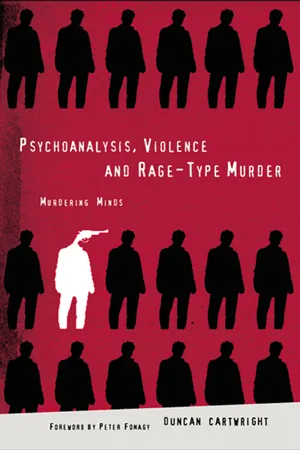
What turns an apparently 'normal' individual into a killer?
Many people who commit "rage type" murders have no history of violence. Using psychoanalytic theory and a number of case studies, this book isolates key psychological factors that appear to help explain why such acts of extreme violence occur.
Starting from a psychoanalytic standpoint, Psychoanalysis, Violence and Rage-Type Murder argues for a pluralistic approach to understanding aggression, and claims that the origins of aggression have no single source or cause. Drawing broadly on psychological, criminological and psychoanalytic research the author outlines the clinical features of the act and explores the possible role that psychopathology and personality might play in the build up to murder. These observations raise a number of questions about the so-called 'normality' of the individual alongside the capacity to commit murder, and how we might understand the stability of such offenders. Psychoanalysis, Violence and Rage-Type Murder will be of great interest to psychotherapists, forensic psychotherapists, psychoanalysts, psychologists, criminologists and health care workers.
- 216 pages
- English
- ePUB (mobile friendly)
- Available on iOS & Android
eBook - ePub
About this book
Trusted by 375,005 students
Access to over 1.5 million titles for a fair monthly price.
Study more efficiently using our study tools.
Information
Part I
Aggression and violence in psychoanalysis
Chapter 1
Aggression, rage and violence
No one questions the experiential evocation of aggression – aggression as a response to frustration, deprivation, pain, overstimulation. What we do not know is whether it starts from within as an innate drive or as a reaction to something without.
(Shengold, 1999, p.xiii)
The term aggression is often used in very broad and confusing ways in psycho-analytic literature. Much of the confusion comes from the use of the term to refer to both a psychological drive and/or a behavioural action. Perelberg (1999a) defines aggression as ‘a variety of behaviours, feelings, and representations, from attempts to master the environment to something that is perceived as destructive’ (p. 40). Aggression is thus seen as having constructive and destructive aims. Whilst some have emphasized both its neutralized constructive potential as well as its harmful nature, others argue that aggression is distinctly destructive and should be separated from positive terms such as assertiveness and psychic activity. The above distinctions are all ultimately derived from what one understands the nature of aggression to be. This, of course, remains a perennial debate in psychoanalysis stretched between those who view it as reactive in nature and those who view it as instinctual.
I shall begin by reviewing Freud’s understanding of aggression and then go on to consider both sides of the debate, highlighting some of the main theories and contributions on the nature of aggression. The emphasis here is on considering how aggression as an intrapsychic occurrence has been formulated. In particular, the status of the internal object within these formulations will be considered. Although regarded by some as simply an intellectual debate, this has important implications for how we understand, treat and make prognostic assumptions about pathological states.
I shall argue that even in Freud’s work, the many different ways in which aggression is understood hints at a problem that the nature-nurture debate on aggression has obscured from full view. Whilst the debate is of great importance, with both sides shedding light on different aspects of aggression, it draws us into the spurious position of believing that there is one kind of aggression that must have one origin.
With this argument in place, I briefly consider the concept of rage as a particular form of aggression with specific psychological determinants. Finally, the broad features of what constitutes violent action are explored. The definitions of violence outlined here bear testimony to the complex origins of different forms of aggression.
THE NATURE AND OBJECT OF AGGRESSION
Freud on aggression
It is often argued that Freud only considered aggression to be an important component of the personality when he began to formulate the nature of aggression as being linked to the death instinct (Freud, 1920). His ideas on aggression, however, were far more complex than being simply about the externalization of the death instinct.
Freud first briefly mentions the role of aggression in ‘Three essays on the theory of sexuality’ (1905a) and ‘Fragment of an analysis of a case of hysteria’ (1905b). In the former he finds aggression to be a means of sexual mastery over an object. In the latter he considers it a form of resistance to treatment. His first comprehensive attempt to understand aggression, however, can be found in ‘Instincts and their vicissitudes’ (Freud, 1915). In this paper he explores elements of love and hate and their relation to self-preservative and sexual instincts.
Freud argues that, during the pre-genital stages of development love and hate are indistinguishable and the infant remains indifferent to his own sadistic actions and injury to his objects. The primary motive at this stage, through incorporating and devouring the object, is the urge for mastery over the object. However, he argues that hate itself has a different instinctual source based in the self-preservative instincts:
The ego hates, abhors and pursues with intent to destroy all objects which are the source of unpleasurable feeling for it, without taking into account whether they mean a frustration of sexual satisfaction or the satisfaction of self-preservative needs. Indeed it may be asserted that the true prototypes of the relation of hate are derived not from sexual life, but from the ego’s struggle to preserve and maintain itself.
(Freud, 1915, p.136)
It is only later on in development that sadism proper emerges when sadistic tendencies are internalized and fused with the sexual instincts to form masochistic object relations. In turn, when this is externalized again, aggressive tendencies have become associated with pleasure, and the pain inflicted on the object begins to accrue a sexual motive. The external object, when first presented, is hated and seen as a source of unpleasure because it challenges the individual’s narcissistic conception of the world. Freud describes the genesis of hate as follows:
Hate, as a relation to objects, is older than love. It derives from the narcissistic ego’s primordial repudiation of the external world with its outpouring of stimuli. As an expression of the reaction of unpleasure evoked by objects, it always remains in an intimate relation with the self-preservative instincts.
(Freud, 1915, p.135)
With the introduction of the death instinct in ‘Beyond the pleasure principle’ (1920), Freud’s understanding of aggression took a new turn. Aggression was now seen as an innate manifestation of the death drive, although not simply equated with the death instinct. Here, he reserves the term aggression for the externalization of the death instinct.
Freud’s need to postulate the existence of the death instinct did not come directly from a need to explain the expression of aggressiveness. He sought primarily to understand how the repetition of unpleasant phenomena in the form of the repetition compulsion did not abide by the pleasure principle. Using evidence from the biological sciences he concludes his speculation with the observation that all living organisms hold within them the seeds of their own destruction: an element of instinctual life that seeks to return living matter to an inanimate state. Apart from aggression having a different function here, sadism is now seen as being secondary to masochistic dynamics. The death instinct seeks its own form of satisfaction characterized by internal pain.
Still later, in terms of his structural model, Freud begins to view unconscious guilt as the result of ‘a piece of aggressiveness that has been internalized and taken over by the superego’ (Freud, 1933, p.142). He describes the superego as being, in part, a construction made up of aggression that has been taken in from the outside world. There is no sign of the death instinct here at first. But Freud goes on to suggest that the superego may also absorb aspects of the ‘destructive instinct’ (p.143) that could not be discharged onto external objects: ‘aggressiveness may not be able to find satisfaction in the external world because it comes up against real obstacles. If this happens it will perhaps retreat and increase the amount of self-destructive-ness holding sway in the interior.’ (Freud, 1933, p.138).
Freud claims that the relative harshness of the superego, observed in neurotics, compared to lower levels of strictness and aggression found in their external world confirms the occurrence of the above process. The destructiveness of the superego thus becomes a key dynamic in understanding melancholia, neuroses and masochism (Freud, 1923).
Freud is never conclusive about the role of aggression in the personality, especially about how his earlier work on aggressiveness and hate should be considered alongside the death instinct. We may assume perhaps that the self-preservative instincts, which become part of the life instincts in his revised model, would still retain elements of aggressiveness aimed outwards in the service of the preservation of the ego. In support of this, Perelberg (1995b) points out that Freud, in ‘Analysis terminable and interminable’, also introduced the concept of ‘free aggressiveness’. This type of aggression could attach itself to any instinct with the effect of creating the coexistence of contradictory affective states. It offers a possible explanation as to why the instinct of self-preservation always has some measure of aggressiveness in its action.
Often, the opposition between sexuality and aggression is confused and seen as the same as the opposition between the life and death instincts, which has tended to misrepresent Freud’s understanding of aggression. Aggression cannot be accounted for as simply emanating from the destructive motives of the death drive. As Anna Freud (1972) and later Perelberg (1995b) have argued, Freud shows aggression to have different sources of development which cannot be confined to this opposition. It could be said that Freud’s ideas reflect the difficulties inherent in much of the literature on aggression: although one type or source of aggression is sought, a consideration of how the term is used in many different ways, hints at a more complex problem.
In summary, Freud considered four different manifestations of aggression that may exist internally or otherwise be discharged. They are: aggression that has its roots in self-preservation and protection of the ego; free-floating aggression; aggression that emerges from the externalization of the death instinct which, by definition, has a destructive aim; and aggression that has an intrapsychic location and is absorbed by the superego and turned against the ego. Although never integrated into a single theory of aggression, both reactive and instinctual elements are evident here.
I turn now to considering subsequent arguments and theories related to considering aggression as instinct or reaction before considering the essence of the debate further. This review is far from exhaustive. Rather, I have selected a few positions that best illustrate the diverse ways in which the concept of aggression has been used.
Aggression as instinct
Hering (1997) lauds Freud’s efforts in placing human destructiveness firmly within the individual through the formulation of the death instinct:
Whatever you might think of Freud’s concept of a death drive which opposes all forms of life, one has to pay tribute to his courage. Not only did he envisage a force of silent and absolute destructive intention, he also did not hesitate to place it within each man’s and each woman’s own psyche. By doing so he set a frame within which the struggle with this ‘evil’ could take place in a less externalized and alienated form.
(Hering, 1997, p.211)
Although it has its supporters (for example Abraham, 1927; Hitchcock, 1996; Klein, 1957; Segal, 1997; Shengold, 1991), the death instinct, or the idea of an aggressive drive, still remains one of the most contentious theoretical ideas put forward by Freud. Many believe that there is little need to postulate an entirely separate destructive instinct in order to understand aggression (Fromm, 1973; Glasser, 1998; Kernberg, 1980; Stern, 1985).
Zulueta (1993), a vehement opponent of the death instinct theory, views it as nothing more than a cultural construct emanating from Western Christian belief systems, particularly the belief in the original sin. To view destructiveness and wickedness as an innate component of humanity, she argues, clears the individual of personal responsibility and also helps emphasize man’s inability to control himself. More importantly, she argues that the idea of the death instinct has never disappeared – despite research to the contrary – because it has become the easiest way to give meaning to suffering. It also gives us reason to feel guilty rather than simply out of control and helpless. Further, Zulueta claims that viewing love and hate as derivatives of opposite drives prevents the exploration of the links between them. As a consequence, it fails to give appropriate emphasis to the link between violence and our need for stable loving attachments.
Ornstein and Ornstein (1993) explore the clinical consequences of dual drive theory explaining that if aggression is considered to be a drive, aggression itself can no longer be analysed, only the way it is managed becomes responsive to analytic interventions. A further consequence of dual instinct theory relates to the idea that the release of aggression through the analytic process will put an end to neurotic symptoms. These theorists find it more useful, however, to focus on the need to keep aggression out of the transference in order to maintain self-cohesiveness. From a different perspective, Kernberg (1980) dismisses the Kleinian death instinct on the basis that it has no clinical significance and cannot be observed in any meaningful way. Many others have also argued that the death instinct has received little clinical substantiation (Fairbairn, 1952; Glasser, 1998; Guntrip, 1968; Kohut, 1978) and some have pointed to a lack of empirical verification regarding the concept (Hollin, 1989; Parens, 1993).
Those who have supported the concept claim that the power of the death instinct is clinically observable (Klein, 1957; Segal, 1997; Rosenfeld, 1971; Shengold, 1991) and the nature of human destructiveness cannot be simply explained as a response to frustration. Segal (1997), for instance, illustrates how feelings of dead-ness and despair in the countertransference are often projected manifestations of the death instinct. Rosenfeld (1987), on the other hand, uses his observations of ‘destructive narcissism’ as evidence of the death instinct. Shengold (1999) argues that transference–countertransference resistances make it difficult to deal with the idea of an aggressive drive. He thinks that this often keeps us from acknowledging and theorizing its importance:
It is my conviction that murder, the aggressive drive to violence – central to both the preoedipal and oedipal in Freudian and Kleinian theory – has been consistently underplayed as a motivational force because it gives rise to so much anxiety and so much resistance in clinical work, on the part of analysts as well as patients.
(Shengold, 1999, p.xv)
Although the idea of the death instinct itself is difficult to prove, one would be hard pressed to prove that aggression does not have its roots in instinct, no matter how remote. Ethological research reminds us of how difficult it is to divorce psychology entirely from biology. The protective aggressive displays that can readily be observed in the animal kingdom, for instance, cannot be fully divorced from our own behaviours (Konner, 1993; Lorenz, 1963; Schuster, 1978). One might argue that this is especially the case when we consider the disproportionate ways in which aggression is expressed across the sexes. Here, biological, genetic and basic instinctual links to aggression cannot be ignored.
It is often held that the struggle between representatives of life and death can just as easily be formulated in purely psychological terms (Brenner, 1971). What this precept lacks, however, is a link to the body. One of Freud’s key motivations for considering the instinctual nature of man in understanding the psychology of the individual was to provide an essential link to the body and biological processes. I would agree with Schafer (1976) in arguing that the physiological characteristics of aggression and its ‘bodily’ nature are often underestimated by non-drive theorists. He views aggression as a ‘psychophysiological reaction’ which occurs in a relational context rather than simply being seen as an isolated spontaneous bodily impulse. Similarly, Kernberg (1984) sees the rejection of the instinctual nature of aggression as disregarding the biological forerunners of human development. Given that the nature of the link between aggression and the body is the essence of what constitutes a violent act, biological variants, such as instinctual and neurophysiological make-up, are difficult to ignore.
Ideas pertaining to the instinctual nature of aggression have been developed in two main directions since Freud. These directions are most evident in the Kleinian and Ego Psychology schools, the former being the principal advocate of the death instinct. They both provide possible explanations for how the origins of aggression can be formulated intrapsychically.
Klein (1932) bases much of her psychological understanding of the individual on Freud’s ideas of the death instinct. Based on clinical observations with children, she argued that envy and destructiveness dominate in early life as derivatives of the death instinct and are responsible for primary forms of anxiety in the psyche. Through projective and introjective mechanisms the infant’s main task at this very early stage is to split off all part-objects that have become ‘bad’ through their association with destructiveness which, in turn, results in further paranoid anxiety (Klein, 1946). Klein found the death instinct to be a useful concept for explaining what she observed to be a much earlier formation of an archaic harsh superego (Klein, 1928). For her, the formation of this primitive internalized object resulted from the internalization of the death instinct that had initially been projected outwards onto other objects.
Central to the Kleinian approach is the observation that phantasies, the psychic derivatives of the life and death instincts, are always object related (Isaacs, 1948; Klein, 1958). There is no such thing as primary narcissism or a destructive objectless state. The central implication of this for understanding aggression is that Kleinian formulations are not driven by energetic or homeostatic principles where discharge is the essential driving force, placing the significance of the object as secondary. Klein began from the premise that the object is always present in phantasy constellations, setting up an object-related dynamic from which aggression emanates. Her concept of projective identification also shifted the meaning of aggressiveness from simply being a deflection of the death instinct away from the self (Freud, 1920) to ...
Table of contents
- Cover
- Half Title
- Title Page
- Copyright Page
- Dedication
- Table of Contents
- Preface
- Foreword by Peter Fonagy
- Acknowledgments
- Introduction
- Part I: Aggression and violence in psychoanalysis
- Part II: Investigating rage-type murder
- Part III: Intrapsychic dimensions of rage-type murder
- Bibliography
- Index
Frequently asked questions
Yes, you can cancel anytime from the Subscription tab in your account settings on the Perlego website. Your subscription will stay active until the end of your current billing period. Learn how to cancel your subscription
No, books cannot be downloaded as external files, such as PDFs, for use outside of Perlego. However, you can download books within the Perlego app for offline reading on mobile or tablet. Learn how to download books offline
We are an online textbook subscription service, where you can get access to an entire online library for less than the price of a single book per month. With over 1.5 million books across 990+ topics, we’ve got you covered! Learn about our mission
Look out for the read-aloud symbol on your next book to see if you can listen to it. The read-aloud tool reads text aloud for you, highlighting the text as it is being read. You can pause it, speed it up and slow it down. Learn more about Read Aloud
Yes! You can use the Perlego app on both iOS and Android devices to read anytime, anywhere — even offline. Perfect for commutes or when you’re on the go.
Please note we cannot support devices running on iOS 13 and Android 7 or earlier. Learn more about using the app
Please note we cannot support devices running on iOS 13 and Android 7 or earlier. Learn more about using the app
Yes, you can access Psychoanalysis, Violence and Rage-Type Murder by Duncan Cartwright in PDF and/or ePUB format, as well as other popular books in Psychology & Emotions in Psychology. We have over 1.5 million books available in our catalogue for you to explore.