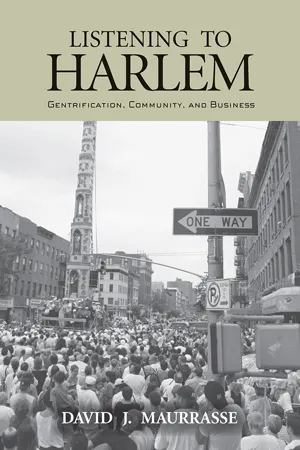
Harlem is flourishing. Many say a second Renaissance is happening above 120th Street. Magic Johnson opened a major theater, Bill Clinton has centered his post-presidential offices there, countless homes have been restored to their former glory, and, not without controversy, many whites are flocking to the neighborhood. But what will this gentrification do to Harlem, and how will it change life for Harlem's longtime residents?
As communities and businesses struggle with differing motivations and needs, David Maurrasse looks at ways they can work together to form partnerships. Listening to Harlem offers an exciting portrait of the struggles confronting one of America's most important neighborhoods. This engaging read will appeal to anyone with an interest in how the neighborhood is faring today, as well as those involved professionally and socially in urban development.
- 245 pages
- English
- ePUB (mobile friendly)
- Available on iOS & Android
eBook - ePub
About this book
Trusted by 375,005 students
Access to over 1.5 million titles for a fair monthly price.
Study more efficiently using our study tools.
1
Harlem Then and Now
Throughout Harlem’s rich history, the area has remained a compelling mosaic of all that is great and challenging about urban neighborhoods in America, and perhaps in the world. The majestic architecture, unique culture, commanding public figures, and overall vibrancy have coexisted with high crime, unemployment, struggling public schools, poverty, drugs, and potentially explosive racial and ethnic tensions. When Harlem is on an upswing, the media, real estate, speculators, politicians, and residents emphasize the neighborhood’s many assets, but when it is down, all of the negatives can seem to eclipse what made Harlem the vibrant center of life and culture for the African diaspora.
The fact that Harlem is a part of New York City, where scale, energy, excesses, delights, and frights are all magnified, should come as no surprise. Harlem, in itself, is a vast area, taking up a solid chunk of Manhattan north of 110th street. The neighborhood spans three city districts—West Harlem, Central Harlem, and East Harlem, and boasts a population of nearly half-a-million people, essentially a city in itself.
HARLEM, HISTORY, AND ECONOMIC DEVELOPMENT
Before John Bess’s time, Harlem was in its heyday—the Renaissance of the 1920s. But it was at the turn of the century when the Harlem that is associated with African American life and culture began to emerge.
We think of Harlem as an African American community, but that was not always the case. New York City’s African Americans gradually moved up from the very southern tip of the Manhattan Island and eventually settled in Harlem. Much of this movement was facilitated by displacement from some Manhattan neighborhoods that few would imagine as Black communities today, such as the Wall Street area, the space currently occupied by Penn Station, and the area that is now Central Park. African Americans are the second oldest ethnic population in New York City, after the Dutch.1 Of course, Native Americans predated both populations—the Algonquin Indians, in this case. Continually pushed northward by influxes of White immigrants and various commercial development projects, African Americans populated the Five Points district north of city hall, parts of Greenwich Village, and an area known as Little Africa, which is now Penn Station. Although Harlem’s Black population remains significant, today’s largest concentration of Black New Yorkers currently resides in Brooklyn. Nevertheless, Harlem’s mystique persists, as it continues to dominate public consciousness with respect to the Black experience.2
It is important to note that, from the very beginning, the majority of New York City’s Black population were of Caribbean origin. Of the enslaved and free Black residents of colonial New York, 80 percent could trace their African roots to the Caribbean.3 In fact, it was a free African with roots in the Caribbean, Jan Rodriguez, who in 1613, helped to build a Dutch trading post in what we now know as Manhattan. The Dutch eventually named this area New Amsterdam in 1626, when New Netherland Director-General Peter Minuit purchased Manhattan island from the Algonquins for the equivalent of $24. One year before that, the Dutch brought in the first group of New York’s enslaved Africans to be the city’s labor force. These slaves built roads and homes, and cleared fields for farms, not only in Manhattan, but in the areas beyond New Amsterdam, which would become the Bronx, Brooklyn, Queens, and Staten Island.4 As Africans gradually settled in New York, their status varied, from slave to free to half-free. Some of these Africans owned property and engaged in commerce, but in 1655, the Dutch turned all of New Amsterdam into a slave trading post, leading to increased restrictions on the African population.5
The rights of Africans were even further diminished after the English wrested control of New Amsterdam from the Dutch and renamed it New York in 1664. Slave codes were developed to restrict enslaved Africans’ behavior. The English also seized the property and rights of free and half-free Blacks.6 Before English control, many Africans and Native Americans could aspire to be “cartmen,” those who drove one-horse wagons to perform public works for the city—carrying commodities, maintaining roads, transporting rubbish, and other duties. They had actually formed a guild in 1667, enabling them to contract with the city. By 1691, however, the English-controlled legislature passed ordinances that made race a qualification for a carting license, prohibiting Blacks and Native Americans from these positions.7 Carting and street vending were opportunities for people with almost no starting capital to make an income. These and other opportunities for Black economic empowerment were continually denied or severely limited. By 1712, Blacks, Native Americans, and “mulattoes” were officially prohibited from inheriting or transferring land to their heirs.
It was not until 1799 that the New York State Legislature passed an act that would lead to the gradual emancipation of African slaves (male slaves by the age of twenty-eight and females by the age of twenty-five).8 An amendment of this act in 1817 called for the abolition of slavery on July 4, 1827. New York was an essential state in the cotton industry, which was buoyed by slavery.9
Seneca Village, near what is now Central Park West and 80th Street, was one of the African American neighborhoods that predated the Black migration to Harlem. Andrew Williams, a shoe shiner, bought three lots of land in this area for $125 in 1825.10 The area ultimately became a haven for Black landowners and eligible voters. But, by 1858, the neighborhood was destroyed to make way for Central Park. The concentration of African Americans in Manhattan literally made a gradual shift northward. And it was often forces outside of Black peoples’ control that led to the movement from one neighborhood to another. Between 1790 and the dawn of the Harlem migration in about 1910, Black communities in Manhattan were as follows: 1790–1840: Free African Community, near what is now City Hall; 1820–1863: Stagg Town, Mulberry and Baxter Streets, around what is now Little Italy; 1863–1890: Little Africa/Little Liberia: Thompson, Sullivan, Bleecker Streets, around Greenwich Village; 1880–1910: The Tenderloin, 23rd Street to 42nd Street by 8th and 9th Avenues; and 1890–1910: San Juan Hill, 58th to 65th between 8th and 11th Avenues.11
New York’s Black population gradually established their own institutions, churches, newspapers, and so on, with both success and failure. Economic power seemed to be the most elusive goal, but not for lack of trying. By 1851, a group of Black New Yorkers convened to discuss forming a Black bank from their own savings that totaled between $40,000 and $50,000 (the idea never came to fruition).12 By 1853, Black economic power became more apparent, as investments in New York’s business enterprises by African Americans totaled $839,100, and real estate holdings totaled $1,160,000.13 As New York’s population ballooned during the industrial revolution, the numbers of local African Americans grew as well. However, the extensive European migration to New York City shrunk the scope of jobs and other opportunities for income production for African Americans, particularly between 1870 and 1900.14
African Americans were well represented in the Tenderloin district in the western part of midtown, just before the migration to Harlem. The Black population grew even more rapidly as the turn of the 19th century approached; 1890’s New York experienced an influx of about twenty-five thousand new Black residents, who tended to move to the Tenderloin, and another portion of Manhattan’s western stretch of land, known as San Juan Hill, between 60th and 64th Streets and Tenth and Eleventh Avenues. Fifty-Third Street was the major thoroughfare in the Black community at the time, playing host to two Black-owned hotels, various small businesses, numerous churches, and a Black YMCA.15 But on August 15, 1900, Blacks in the Tenderloin were attacked by a mob of several thousand Whites, who assaulted every Black person in their path between 27th and 42nd Streets around Eighth Avenue. The fatal stabbing of a White police officer by a Black man three days before the incident sparked the violence. During the funeral on August 15, Whites grew angry, and both civilians and police officers converged on the Tenderloin’s Black community.
This brutal incident in many ways hastened the need for effective community organizing among Blacks that would lead them to strengthen their power as a collective and heighten their position and profile in New York, and around the world this thinking became the foundation of the Harlem Renaissance. New construction in the Tenderloin early in the twentieth century also displaced many of the area’s African Americans—another contributing factor in the last leg of African Americans’ northern migration in Manhattan. In 1910, many of the Tenderloin’s predominantly Black blocks were demolished, displacing thousands, to make way for the construction of Penn Station, Macy’s, the U.S. Post Office, and the Hotel Pennsylvania.16
Overall, many of New York City’s landmarks were once home to Black communities. Although gentrification is a relatively new term, the displacement of African Americans is not new. The history of African Americans in New York City is somewhat of a microcosm of the struggle of people of African descent in the United States and other parts of the world—even when advancing through their own collective endeavor, they are displaced, denied, prohibited, attacked, and even robbed by formal and informal policies through institutions that they have not controlled.
Harlem was established as a permanent Dutch settlement, a separate town, called New Harlem, in Manhattan in 1658. It is named for a town in Holland that fought tenaciously before falling to the Spanish in the sixteenth century.17 The town was annexed by New York City in 1873. Even Harlem’s landmark Abyssinian Baptist Church was located in the Tenderloin, on West 40th Street, before its own uptown exodus in the 1920s. Ethiopian merchants and Black members of the First Baptist Church who wished to escape segregated seating founded the church in 1808, on what is now Worth Street in lower Manhattan.18
Before the uptown movement of African Americans, Harlem was a primarily German and Irish neighborhood, which ultimately experienced an influx of Italian and Jewish immigrants. Before the arrival of the immigrants in the late 1800s, Harlem was home to the city’s elite. One can still see remnants of the neighborhood’s past wealth in various stunning works of architecture dispersed among dilapidated housing and more recent, less ornate, buildings. For all intents and purposes, Harlem was “New York’s first suburb.”19 Living in Harlem was considered a symbol of high status in the 1800s—a destination for the wealthy.
In the early 1900s, African Americans from southern parts of Manhattan, then African Americans from the South, and ultimately immigrants from Africa and the Caribbean converged, making Harlem the capital of the African diaspora. In 1900, African Americans comprised less than 2 percent of New York City’s population of 3.5 million.20 Contributing to the growth of Harlem’s burgeoning Black population, an additional infusion came from the South in search of a new, urban, northern life, and economic opportunity.
The proposal and eventual development of the subway—the Lenox Avenue IRT (Interborough Rapid Transit) to 145th Street (now going to the very edges of the Bronx) in 1910, created great anticipation among developers in the 1890s.21 As a result, real estate developers built extensively and landlords rapidly bought property. The IRT was completed to 148th Street in October of 1904, carrying six hundred thousand passengers per day at forty miles per hour. Some of the greatest anticipation was in West Harlem, which was intended for wealthier people. Therefore, luxury housing, with elevators, maids’ rooms, and butlers’ pantries, was constructed. For example, William Waldorf Astor built an apartment house on Seventh Avenue, which cost $500,000—all part and parcel of what was to become “the loveliest Negro ghetto in the world.”22
However, New York City as a whole was experiencing significant development at that time as well, and too many residential properties had been built in anticipation. These realities became apparent around 1904, as rents were cut, and a few months of free occupancy were offered. Some landlords and corporations succumbed to the pressure, and decided to rent to Blacks, whereas others relied on the threat of renting to Blacks in order to scare neighbors into buying them out at market rates. These were no simple economic transactions, as racism prevented many Whites from giving in to what was known as the “Negro invasion.” As a reflection of their disdain, many White Harlem residents formed “protective associations,” particularly on some of Harlem’s more affluent streets (137th, 129th, 135th, as well as others). Signed agreements among residents, promising not to rent to Blacks for ten or fifteen years, and restrictive covenants that limited the number of Black janitors, servants, and other jobs, “White only” signs, and proposed evictions of existing Black Harlemites were all characteristic of the White resistance to the prospective African American uptown migration.23
But, ultimately, Harlem’s Whites shared no uniform strategy or voice around real estate. Some were going to sell and could not be convinced otherwise. In their desperation to rent out vacant residential units, landlords began to relax their restrictions against African Americans, facilitating this uptown exodus. Between 1907 and 1914, many Whites entered a “panic selling” mode, sparking a staggering turnover in property; two-thirds of the homes near areas where African Americans were congregating were sold in this brief period.24
Of course, someone had to manage some of this activity. An ambitious African American named Philip A. Payton Jr. was one of the few African American landlords to benefit from this scenario. Through his Afro-American Realty Company, which he founded in 1904, he approached many of Harlem’s existing landlords with the proposition of renting to select African Americans at above-market rates. Given their anxieties about finding paying tenants, landlords put some aspects of their prejudices aside in exchange for money. Payton embarked on a campaign, of sorts, to recruit Black residents to Harlem. He advertised on billboards and was one of the first to advertise in subway cars.25
Payton became the most successful real estate agent in the city and African Americans gained access to well-built homes; however, they were still paying more than Whites. Payton’s clients paid at least $5 per month more than Whites for similar homes in Harlem.26 Despite having been New Yorkers for centuries before many Whites, African American Harlem residents not only required landlords’ desperation for tenants to gain access to decent housing but also had to pay more for it.
As has been the case in so many urban areas, significant increases in the population of African Americans influences “White flight.” Therefore, Harlem rapidly shifted from a White majority to a Black one in a relatively short period of time, although the landlords were still mainly White. In Harlem, African Americans had managed to occupy some of the best real estate that any Black population has encountered en masse in the country at the time. As the people moved, the institutions followed: churches, branches of the Urban League and one of the founding chapters of the NAACP, the YMCA, YWCA, social service agencies, small businesses, and more, all made the northward trek.
In many ways, these institutions represented a form of self-government for African Americans. Given continued obstacles to empowerment in the country, the state, and the city, Harlem residents, through their own organizations, were able to maintain some semblance of self-determination. By 1921, Harlem boasted two newspapers, The Amsterdam News and the New York Age, sixty church...
Table of contents
- Cover
- Half Title
- Title Page
- Copyright Page
- Dedication
- Table of Contents
- Acknowledgments
- Introduction
- Chapter 1. Harlem Then and Now
- Chapter 2. Harlem Rising
- Chapter 3. Equitable Urban Development
- Chapter 4. Resident Perspectives
- Chapter 5. Making Urban Development Work
- Chapter 6. CBO’s Perspectives and Proposed Solutions
- Chapter 7. Development’s New Day?
- Endnotes
- Appendix
- Index
Frequently asked questions
Yes, you can cancel anytime from the Subscription tab in your account settings on the Perlego website. Your subscription will stay active until the end of your current billing period. Learn how to cancel your subscription
No, books cannot be downloaded as external files, such as PDFs, for use outside of Perlego. However, you can download books within the Perlego app for offline reading on mobile or tablet. Learn how to download books offline
Perlego offers two plans: Essential and Complete
- Essential is ideal for learners and professionals who enjoy exploring a wide range of subjects. Access the Essential Library with 800,000+ trusted titles and best-sellers across business, personal growth, and the humanities. Includes unlimited reading time and Standard Read Aloud voice.
- Complete: Perfect for advanced learners and researchers needing full, unrestricted access. Unlock 1.5M+ books across hundreds of subjects, including academic and specialized titles. The Complete Plan also includes advanced features like Premium Read Aloud and Research Assistant.
We are an online textbook subscription service, where you can get access to an entire online library for less than the price of a single book per month. With over 1.5 million books across 990+ topics, we’ve got you covered! Learn about our mission
Look out for the read-aloud symbol on your next book to see if you can listen to it. The read-aloud tool reads text aloud for you, highlighting the text as it is being read. You can pause it, speed it up and slow it down. Learn more about Read Aloud
Yes! You can use the Perlego app on both iOS and Android devices to read anytime, anywhere — even offline. Perfect for commutes or when you’re on the go.
Please note we cannot support devices running on iOS 13 and Android 7 or earlier. Learn more about using the app
Please note we cannot support devices running on iOS 13 and Android 7 or earlier. Learn more about using the app
Yes, you can access Listening to Harlem by David Maurrasse in PDF and/or ePUB format, as well as other popular books in Business & Sociology. We have over 1.5 million books available in our catalogue for you to explore.