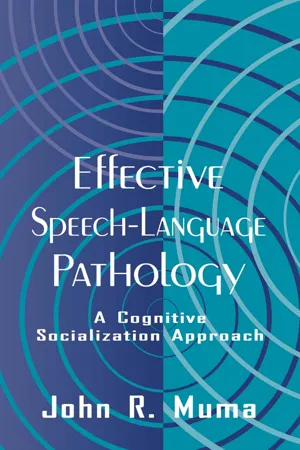
This book is the first to summarize the voluminous literature on the development of cognitive, codification, language, and expressive/affective (CCCE) skills from a clinical standpoint. Emphasizing the need to ground services in research and theory, the author constructs three basic clinical models--a conceptual model for understanding, a descriptive model for formal assessment, and a facilitative model for intervention. These models have major implications for the work of all those who deal with CCCE problems in a professional capacity.
- 400 pages
- English
- ePUB (mobile friendly)
- Available on iOS & Android
eBook - ePub
About this book
Trusted by 375,005 students
Access to over 1.5 million titles for a fair monthly price.
Study more efficiently using our study tools.
Information
Subtopic
History & Theory in PsychologyIndex
PsychologyCHAPTER
1
SETTING THE STAGE
APPROPRIATENESS
Please permit me the basic premise of this book. Taken from the United States' federal policies, specifically P.L. 94–142 and P.L. 99–457, it is simply that individuals needing clinical services are entitled to the most appropriate services. Most appropriate is taken to mean that which is most supportable by the contemporary scholarly literature. Because clinical services are rendered to individuals, it is desirable to extend the meaning of appropriateness to relevance to an individual's presumed repertoire of skills.
In identifying patterns of impairment, Brinton and Fujiki (1994) held a similar perspective by relying on the literature on the one hand and local cohort performance on the other, “in identifying patterns of impairment, specific behaviors are compared with developmental expectations drawn from the literature and from the child's community cohort” (p. 61).
Thus, appropriateness in this book usually has two connotations: relevance to the contemporary scholarly literature and relevance to an individual's presumed repertoire of skills.
Inasmuch as this volume is about clinical services in cognition, codification and language, communication, and expression (CCCE), the scholarly literature that provides the most supportable information for rendering appropriate clinical services is the contemporary cognitive socialization literature with its attendant influences from philosophy, psychology, linguistics, psycholinguistics, and assessment. At once, reference to these literatures, rather than the clinical fields per se, raises a provocative issue: The clinical fields may be somewhat disconnected from the relevant cognitive socialization literature in understanding and dealing with many aspects of CCCE, especially the behavioristic applications, the reliance on frequency counts as presumed measures of acquisition, and the use of tests that lack construct validity.
Such disconnections might be somewhat justifiable if they substantiate theoretical positions that are uniquely clinical. However, Ringel, Trachtman, and Prutting (1984) observed that the clinical fields lack adequate theories for predicting, explaining, and understanding clinical impairments. Rather, the clinical fields that deal with cognition and language rely on the normal acquisition literature for three fundamental reasons. First, the kinds of impairments usually seen clinically “fit” the nature of normal acquisition with the exception that such problems persist. To this extent, the normal acquisition literature provides an attractive substantive base for understanding clinical conditions and rendering appropriate clinical services. Second, if it were true that clinical conditions are aberrant from the nature of the normal acquisition process, the clinical fields would be faced with a very perplexing situation. In this case it would be necessary to step outside of the normal human condition and reconnoiter the foreign terrain to appreciate what is taking place and what should be done to render appropriate clinical services. Then, we are faced with the very unpleasant recognition that such clients are not “one of us” and for us to deal appropriately with such individuals in becoming one of us, we are utterly naked in understanding and knowing what to do. In these cases, the socialized-based perspective, which is very attractive in dealing with both normal and other clinical conditions, is even more attractive (Hagstrom, 1994; K. Nelson, 1996). Third, the normal acquisition literature in the field of cognitive socialization has many attractive theoretical perspectives that offer viable perspectives for rendering appropriate clinical services.
NEED FOR PHILOSOPHICAL VIEWS AND THEORETICAL PERSPECTIVES
The basic message from the philosophy of science literature (Bruner, 1986; Crick, 1988; Kuhn, 1962; Medawar, 1984) is that it behooves scholars to have explicit philosophical views and theoretical perspectives in order to achieve a disciplined understanding of what they are striving to explain, predict, understand, or do. Such perspectives establish coherence. Theories provide coherent explanations, predictions, and understandings (Kaplan, 1964; Kerlinger, 1973); said differently, theories provide a means of organizing what is known into a coherent understanding.
Accordingly, professions strive to be solidly grounded on recognized philosophical views and theoretical perspectives simply because a great deal needs to be explained, predicted, and understood. Lacking such underpinnings, a profession is likely to become the product of authoritarianism, elitism, anarchy, dogma, hearsay, hype, and misused eclecticism.
To reiterate, Ringel et al. (1984) made a telling observation of speech-language pathology and audiology. They held that this field lacked its own coherent theories. This is serious because the literature on the philosophy of science explicitly defines the roles of philosophical views and theoretical perspectives as the substantive base of scholarship.
It is all the more serious because a survey by Prutting, Mentis, and Myles-Zitzer (1989) showed that a very small percentage of the training programs in speech-language pathology and audiology include readings (3.6%) or subject matter in a course (11.3%) on the theory of science. This means that the field is largely unaware of the significance of philosophical views and theoretical perspectives as its substantive base. Such naivete would go a long way toward appreciating:
1. Why various disconnections have occurred between the clinical fields and the scholarly fields in CCCE.
2. Why reliance is often placed on authoritarian pronouncements and dogma thereby evidencing a political orientation.
3. Why technicians may disdain theoretical perspectives.
Surprisingly, there are advocates in the clinical fields who take the view that theories may be dismissible. For example, Kamhi (1993), Perkins (1986), and Starkweather (1992) decreed that theories may be unnecessary for the clinical fields. Starkweather (1992) cushioned this view by saying:
There is a certain sense in which theoretical beliefs should influence therapy-one should have a good understanding of the disorder so as to make good judgments and choices when confronting an individual—but to allow a theoretical belief to restrain one's therapeutic practice is thoroughly irresponsible. (p. 95)
Kamhi (1993) indicated that “providing clinical services that are theoretically coherent is not only impractical, but also unrealistic” (p. 59). Such decrees are very dangerous because they invite elitism, anarchy, dogma, hype, authoritarianism, and so on. Fortunately, Perkins has since become an advocate of theories.
The 1983 ASHA Task Force on Training Standards (Rees & Snope, 1983) recognized the lack of philosophical views and theoretical perspectives as possible major reasons that the field may have become technician (atheoretical, ascholarly) rather than clinician (theoretical, scholarly) oriented. In order to rectify this problem, Resolution II-B was passed, calling for courses to be solidly based on theoretical perspectives in an effort to overcome technicianship and promote clinicianship.
Because theoretical perspectives are predicated on philosophical views, according to the literature on the philosophy of science, it is necessary to expand this resolution to the philosophy of science in general and recognized philosophical views in particular. By doing so, philosophical views and theoretical perspectives constitute the most fundamental underpinnings of the field. Such underpinnings provide rational evidence for holding particular views and taking particular actions in the clinical arena. Thus, philosophical views and theoretical perspectives define what may be viable (appropriate) for a field and in so doing define what is practical (Muma, 1986a, 1991; Prutting & Kirchner, 1983, 1987).
Cruickshank (1972) raised a telling issue about the field of learning disabilities. He was concerned that this field claims to deal with learning disabilities but it is not predicated on theories of learning. It is utterly ironic that the field of learning disabilities continues to be atheoretical, especially in view of the fact that major theoretical advancements have occurred in the scholarly literature on cognition (K. Nelson, 1996). Such disconnections not only point to the atheoretical nature of the field but bring to the fore the vulnerability of this field and related fields to authoritarianism, elitism, anarchy, dogma, hype, and misused eclecticism.
There are two major symptoms of this circumstance: (a) Atheoretical and exclusionary definitions, and (b) Authoritarianism with attendant dogma. Both the national and federal definitions of learning disabilities and language impairment are atheoretical and exclusionary. When such definitions are atheoretical, clinical entities may be defined in virtually any way. That is precisely what has happened. For example, Gillespie, Miller, and Fielder (1975) reviewed state legislation concerning learning disabilities and found that there was very little, if any, agreement as to an operational definition of learning disabilities. Similarly, McCauley and Demetras (1990) showed that there was little consensus as to how individuals were identified as language impaired in studies with these participants.
Furthermore, the atheoretical nature of the field of learning disabilities is evidenced by yet another major issue: Definitions of learning disabilities are definitions of exclusion. Such definitions indicate that if a child does not have a hearing loss, mental retardation, or emotional disturbance, then a learning disability may be evident. This might be viewed as a “washed” definition but, unfortunately, substantive considerations of recognized theories of learning are what have been “whitewashed” in favor of normative tests that lack construct validity with theories of learning. Such a circumstance invites dogma at the expense of scholarship.
Three special issues of the Harvard Educational Review (Harvard School of Education, 1971, 1973, 1974) raised a similar concern about assessment practices in the schools. In short, the concern was that assessment practices have relied on brute empiricism whereby an individual's performance is compared to a norm and inferences are made about presumed skills, resulting in assessment practices that merely categorize and label individuals, missing the more important issues concerning the nature of a problem. This practice has become so accepted and pervasive that it has attained a level of acceptability as a bona fide practice of educational institutions. Yet it is little more than a mechanism for labeling children rather than assessing what they can do. It is what Mercer (1972a, 1972b) called “the lethal label” problem.
Messick (1980a, 1989a, 1989b) echoed this concern but from a different vantage point. He and other scholars in assessment were concerned that assessment practices may lack construct validity. This is a fundamental concern because they indicated that the traditional “holy trinity” for validity (content, criteria, construct) is no longer viable simply because all aspects of validity are derived from construct validity. Thus, it is imperative to establish construct validity for all assessment: “All measurement should be construct referenced' (Messick, 1980, p. 1015). M//validity is at its base some form of construct validity. … It is the basic meaning of validity” (Guion, 1977, p. 410).
Unfortunately, a survey (Muma & Brannon, 1986) of the most frequently used language tests in speech-language pathology revealed a general lack of construct validity, which means that the results for these tests are open to any interpretation—an ethical dilemma. Furthermore, it means that the interpretation of performances on these tests may be mere dogma under the sponsorship of norms. To be relieved of this ethical dilemma, it would be necessary to establish construct validity either derived directly from theoretical premises or indirectly via factor analytic procedures governed by theoretical perspectives. Either way, theory is needed to explain, predict, and understand.
In subtle ways, a call for improved scholarship may be in the form of questioning what a field is about. In audiology and speech-language pathology this question has arisen: Does a field want a research doctorate or a professional doctorate? At the heart of this question is a subtle one concerning scholarship on the one hand and the art of the field on the other. When discussions surface concerning the limits of a profession or what a profession is about, the issues invariably turn to definitions and theoretical perspectives. Here is where philosophical views and theoretical perspectives realize their greatest importance.
The clinical fields in general need to have a firmer grounding on philosophical views and theoretical perspectives as unifying constructs. The field of learning disabilities has already taken the lead in appreciating traditional philosophical views (Heshusius, 1989; Poplin, 1988; Weaver, 1985). The next steps, of course, are to consider the developments that have occurred in the contemporary philosophical literature, especially concerning the nature of science and human affairs (Bruner, 1986), brute and institutional facts (Lakoff, 1987), and the contemporary theoretical perspectives, especially experiential cognition (K. Nelson, 1996).
Professions are continuously realigning to particular views and perspectives, but the process is not an arbitrary one if scholarship and discipline have anything to do with it. It is a natural process of scientific evolution. Those issues and practices that lack support from the scholarly literature fall by the wayside, whereas those that have been substantiated, or show potential, are advanced.
COGNITIVE SOCIALIZATION
The cognitive socialization literature over the past few decades has given fuller meaning to Brown's (1956) perspective that language acquisition is “a process of cognitive socialization” (p. 247). Some particular theoretical perspectives have had major influences on this literature or show promise for doing so; for example, speech acts or relevance theory, representational theories, functionalist theories, shared meaning for knowledge of events, expression theory, rare-event learning mechanism theory, experiential realism, experiential cognition, social origins of the mind, and informativeness theory.
Perera (1994) identified the most influential theoretical perspectives in language acquisition since the early 1970s. They were the following:
1. Government binding and parameter setting (Atkinson, 1992; Chomsky, 1986)—Perhaps the most elegant innatist views of lan...
Table of contents
- Cover
- Half Title
- Title Page
- Copyright Page
- Table of Contents
- Preface
- 1 Setting the Stage
- 2 Philosophical Views and Theoretical Perspectives
- 3 A Clinical Model: Cognitive Socialization
- 4 Cognition
- 5 Codification: Message of Best Fit
- 6 Communication and Expression
- 7 Clinical Assessment: Description
- 8 Language Intervention: Facilitation
- 9 Epilogue
- Appendix A
- Appendix B: Science And Human Affairs: Clinical Implications
- Appendix C: It Works: A Technician's Creed
- Appendix D: Language Sampling: Grammatical Assessment
- References
- Author Index
- Subject Index
Frequently asked questions
Yes, you can cancel anytime from the Subscription tab in your account settings on the Perlego website. Your subscription will stay active until the end of your current billing period. Learn how to cancel your subscription
No, books cannot be downloaded as external files, such as PDFs, for use outside of Perlego. However, you can download books within the Perlego app for offline reading on mobile or tablet. Learn how to download books offline
Perlego offers two plans: Essential and Complete
- Essential is ideal for learners and professionals who enjoy exploring a wide range of subjects. Access the Essential Library with 800,000+ trusted titles and best-sellers across business, personal growth, and the humanities. Includes unlimited reading time and Standard Read Aloud voice.
- Complete: Perfect for advanced learners and researchers needing full, unrestricted access. Unlock 1.5M+ books across hundreds of subjects, including academic and specialized titles. The Complete Plan also includes advanced features like Premium Read Aloud and Research Assistant.
We are an online textbook subscription service, where you can get access to an entire online library for less than the price of a single book per month. With over 1.5 million books across 990+ topics, we’ve got you covered! Learn about our mission
Look out for the read-aloud symbol on your next book to see if you can listen to it. The read-aloud tool reads text aloud for you, highlighting the text as it is being read. You can pause it, speed it up and slow it down. Learn more about Read Aloud
Yes! You can use the Perlego app on both iOS and Android devices to read anytime, anywhere — even offline. Perfect for commutes or when you’re on the go.
Please note we cannot support devices running on iOS 13 and Android 7 or earlier. Learn more about using the app
Please note we cannot support devices running on iOS 13 and Android 7 or earlier. Learn more about using the app
Yes, you can access Effective Speech-language Pathology by John R. Muma in PDF and/or ePUB format, as well as other popular books in Psychology & History & Theory in Psychology. We have over 1.5 million books available in our catalogue for you to explore.