- 352 pages
- English
- ePUB (mobile friendly)
- Available on iOS & Android
eBook - ePub
About this book
Since unification, Italy has grown from a backward agrarian society into one of the world's leading industrial powers. Yet her history exhibits spectacular disunities, inconsistencies and paradoxes. Dominated by political Catholicism, she has also been home to Fascism, the mafia, and the largest Communist movement outside the Eastern Bloc. Her politics are notoriously fissiparous - yet policy itself never changes. Until now. This timely, absorbing and richly illustrated account of the historical development of the Italian nation-state traces the main paradoxes of what `Italy' has been, and questions what she may become.
Trusted by 375,005 students
Access to over 1.5 million titles for a fair monthly price.
Study more efficiently using our study tools.
Information
Chapter 1 . . . . . . . . . . . . . . . . . . . . . . . . . . . .
The origins of modern Italy: The dream of reason and the dream of unity
This book is about the significance we can assign to the strengths and weaknesses of one of the major partners in the European Union. It explores them from a historical point of view, tracing the roots of the present in the past, and the difficult and often paradoxical routes followed by the ‘makers of Italy’, and the victims of their nation-building efforts, to the present condition of the country, its society, politics and economy. In particular, in attempting to identify and characterise the nature and implications of the success of Italians in coping with the material and cultural contradictions of their country’s geopolitical and economic situation and of its social structure, the book will focus its attention on the specific form taken by the modern nation-state in the area now usually coloured green on the map of Europe, and how the inner logic of its formation and its deep structures impinge on Italians today.
One starting-point must be that, despite all the peculiarities for which its political life is notorious, Italy works – if only just. Over the last two centuries the Italian ‘nation’ has been ‘remade’ politically at least five times, and perhaps is about to be refashioned yet again. But, in another sense, little really seems to have changed during this period: deeply ingrained habits of mind and patterns of behaviour centred upon the single-minded pursuit of the interests of the individual, the family and the ‘clan’, still dominate Italian ‘civil society’. There is a basic paradox here: it is almost as if the Italian people prefer to deal with the stresses and strains of modern life without reference to a wider collectivity, as if the need to carry the burden of their institutions and leaders is not just expensive and uncongenial (as electorates may frequently feel in any part of the world), but an imposition upon them from without and from above which they would gladly throw off altogether.
As with any attempt at historical explanation of a current situation, interpretation cannot be dispensed with, even at the outset. A set of ‘facts’ cannot simply be deployed as the cause of a particular course of development, for ‘facts’ embody interpretations. Such a ‘fact’ is already contained in the concept of ‘a process of modernisation’, which is the basic question addressed by this book: how the people of the peninsula and islands called ‘Italy’ arrived, via a tortuous process of repeated crises punctuated by stagnation, at a point where, economically, they have outstripped other apparently better-endowed countries, including the United Kingdom, while indulging in at least one change of régime and 44 changes of government since 1943.1 For the outside world, at least, ‘Italy’ is, in the 1990s, a political and economic reality to be reckoned with, despite all its contradictions. At the same time, it often seems almost as impervious to conventional political analysis as Japan, another recently fashioned constitutionally democratic nation-state, which shares Italy’s peculiarity of never, apparently, being able or willing to practise democracy as an alternation of parties in power, however blatantly corrupt (and worse) its ruling party is proven to be.
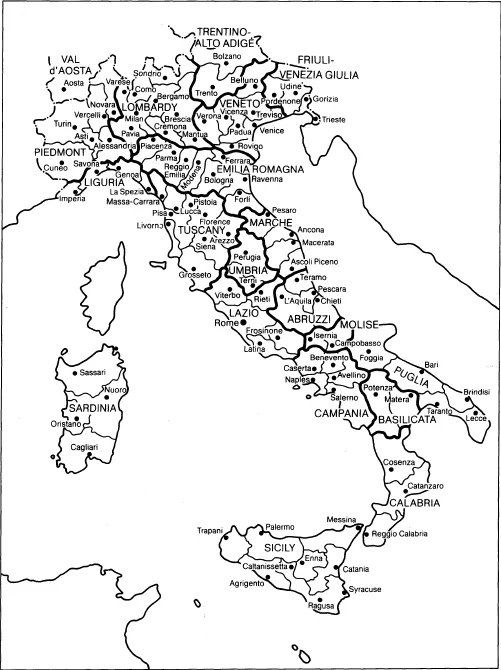
Map 1. Italy : Regions and Provinces.
After David Hine Governing Italy: the Politics of Bargained Pluralism (OUP, 1993), p. vii.
After David Hine Governing Italy: the Politics of Bargained Pluralism (OUP, 1993), p. vii.
As one of the two great political and cultural power-houses of the ‘classical world’, and as a centre of a self-aware population, Italy has a special place at the very origins of our continent’s distinctiveness. To be thorough in a retrieval of its developmental path into modernity it would probably be necessary to trace out the whole of its history from the Roman Republic of classical times onwards, through the barbarian invasions, the centuries-long struggle between the Eastern Christendom of Byzantium and its Western rival based in Rome, the conflict between the latter and the Holy Roman Empire, and the dynastic wars between Normans, Hohenstaufens and Angevins for possession of the peninsula, its resources and its trade.
The social self-awareness of its populations, though formed over a considerably longer period, is not, however, essentially any older than that of the other distinct population groups of the European continent, and the lineages of contemporary Republican Italy as a polity may largely be found within the last two centuries. It therefore seems reasonable to take as our starting-point the moment in European history, between the eleventh and the fifteenth centuries, when some at least of the familiar nation-states of today first became recognisable units, and brought with them the relative political stability which was a condition for the emergence of the homines novi, the ‘new men’ who took the roles of adventurers, explorers, soldiers of fortune, but also capitalist bankers, manufacturers, traders, and even prelates and princes.
The process was slow, uneven and spasmodic, but in the Italian peninsula, which was then divided into five large and many small sovereign states constantly at odds or at war with each other and most of which were subdivided into several smaller semi-autonomous mini-states frequently tempted or driven into rebellion, it was more rapid and generally more intensive than elsewhere in Europe. There were simply more opportunities available for the mixture of aristocratic attitudes and entrepreneurial skills which usually characterised the ‘new man’. The situation was made even more complex by the presence in the peninsula of the Pope, spiritual leader of Christendom but also a great temporal prince in his own right, as the ruler of much of central Italy. Around the Papacy there was constant intrigue and unstable alliances were continually being formed between the supporters and the adversaries of the Papal power, both in the peninsula and further afield.
The diplomatic and military dimensions, although endlessly complicated by theological dispute and problems of princely succession, were historically the least significant aspect of the tensions and pressures which prevailed at all levels of the social structures in the states of Italy. It was not the constant ebb and flow of territorial boundaries nor the rise and fall of particular self-made princely houses which determined the economic success of the new capitalists, but the growing opportunities for trade in goods and financial services which, despite wars, plagues, piracy, crusades and persecutions, dominated the thoughts of the ‘new men’ from the time of Dante onwards. War and economic advantage often, in practice, went together: the Republics of the Genoese and Venetians in particular were able, by aggregating their skills in war, in navigation, in commerce and in banking to dominate the western and eastern basins of the Mediterranean.
Equally, however, ‘new men’ without powerful states behind them, and often of humble social antecedents, were able not only to amass great fortunes, but also to rise in the social scale, to acquire by benefactions the approval of their fellow citizens, and even to become, by their economic success, politically powerful. The inhabitants of Lombardy gave their name to banking throughout Europe, pursuing the dangerous trade of lending money to monarchs. Perhaps more historically significant, however, was the success of men such as Francesco di Marco Datini, the ‘Merchant of Prato’, who, through the fortuitous survival of a massive archive of the fourteenth century ledgers (always headed ‘In the name of God and of profit’), letters and contracts in which he preserved a complete record of his life and times, has become one of the most intimately accessible figures of the period when parts of Italy seemed to be anticipating a mercantile culture which was not to become general in the rest of Europe for centuries. Yet there is something unmistakably modern about him:
avid for gain, determined to become rich, never satisfied with what he has acquired (a fortune which would seem substantial even in our own time), suspicious of his factors, his employees, his servants, his peasants, a dogged worker both by day and by night […] irascible and imperious, he was also perpetually anxious, ever dreading that some misfortune might fall upon him: any of his ships that was delayed might have been sunk or become the prey of the Saracens.2
What is particularly significant about men like Datini is their seeming imperviousness, in their working, gainful lives, to the pervasive teachings of the Church, whose vision of the meaning of the universe as the detailed working out of God’s purposes in every human life reigned supreme, and which sternly forbade all forms of usury, enjoining the faithful to think ever of the life to come.
It was not that ‘new men’ such as Datini neglected religious observance, and even piety, nor that they did not care about their immortal souls: Datini was always troubled about his spiritual health. Yet though anxiety, ‘the canker that ate all joy away’, and which made them so much the precursors of our time, was never far from their thoughts, in material terms they very successfully lived double lives, reconciling the imperatives of both God and profit with apparent ease.3 The model of behaviour and attitudes which can be discerned in them still continues to adapt itself to the changing circumstances of the Italian peninsula.
This admirable ability to come to terms with the contradictions between the spiritual and the material worlds appears well before the period usually referred to as the Italian Renaissance, which is generally dated from the mid-fifteenth century. Despite war, famine and plague, modern capitalism, or at least some of its principal attributes and attitudes, took root in the peninsula over a century earlier: in Dante’s Florence, there were already large textile factories and a recognisable factory working class to go with them, as well as independent artisans, shopkeepers, merchants and bankers, while in the Po valley plain Europe’s first system of canals and locks was already installed.
It can be said, in fact, that to a considerable extent the Renaissance, which in Italy was almost entirely an expression of secular and refined aristocratic values, was an attempted refeudalisation and ran counter to further development of technology and the reorganisation of production of the types specific to capitalism, which necessarily involved loosening the ties with agriculture of sectors of the population, technical rationalisation, the formation of investment capital and the freeing of markets. It is, of course, an open question whether, in the thirteenth and fourteenth centuries, the technical conditions for any further diffusion of the embryonic capitalism represented by men such as Datini were yet present either quantitatively or qualitatively, and the arrest of the processes by which they made their fortunes may not therefore have been inevitable. We need not, however, settle this rather hypothetical dispute before we can acknowledge that the economic changes which affected social structures and social attitudes in parts of the Italian peninsula between the twelfth and fifteenth centuries, must have radiated to other parts of Europe and left permanent residues of unsatisfied aspiration to upwards mobility both at home and abroad.
Conventionally, the Renaissance in Italy is not characterised as a turning-point in economic and social history so much as in the realms of culture and ideas: it was the moment when the classical world of Greece and Rome were called in by scholars not, as it was in the medieval concept, to confirm the superiority of the Christian world-view, or at best as mere antecedents for the latter, but to question its subordination of this life to the next. L’uomo è la misura di tutte le cose, the phrase so often used to sum up the essence of Renaissance thinking, expresses not only the content but the method, being borrowed from Plato, who attributes it to a still earlier philosopher.4 Later Italians were to look back upon the half-century down to 1492 as almost a golden age. This was especially so for Florentines, one of whom, writing amidst the troubles of the following century, recalled:
The city was in perfect peace, the leading citizens were united, and their authority was so great that none dared to oppose them. The people were entertained daily with pageants and festivals; the food supply was abundant and all trades flourished. Talented and able men were assisted in their career by the recognition given to art and letters. While tranquillity reigned within her walls, externally the city enjoyed high honours and renown.5
That with the Renaissance there was indeed a justly celebrated flowering of all the arts and sciences, the former now profoundly influenced by models sought in the real, or imagined, classical world, and that artists and inventors in the Italian peninsula were setting the pace for all Europe, should not obscure the fact that the later part of the period saw the population of Italy subjected increasingly to war and pillage and its élite thrust back into conformist religiosity. From 1490 onwards the states of the peninsula were constantly invaded, or allied themselves with invaders, while their rulers sought to save themselves or to settle scores with their enemies.
The invaders came from all quarters, but the two most persistent were the French and the Spaniards (in unholy alliances with Germans and Swiss), both seeking to appropriate not only the rich spoils of what was then Europe’s most prosperous and economically advanced area, but also the control of the centre of Christendom itself, the Papacy, in order to be able to deploy its ideological power in their own expansionist, dynastic cause. The Papacy itself was in the hands of a succession of larger-than-life figures, of whom the best known was Alessandro Borgia. All the great cities of a country marvelled at as ‘the land of a hundred cities’ suffered in the conflicts which kept the whole peninsula in miserable turmoil for almost 70 years, and two of the greatest were subjected to unprecedented sieges and sack by the invading armies: Rome was looted, pillaged and half destroyed in 1527 by uncontrolled armies of German and Spanish troops, while Florence, where the ancient Republic had been briefly re-established, after a year’s siege during which Michelangelo had acted as director of fortifications, underwent a similar fate at the behest of the Pope in 1529. By 1559, when a final settlement was reached between the warring parties, the only path for personal advancement for ambitious and talented inhabitants of the peninsula was to become trusted servants and agents of foreign rulers, or to make their fortune abroad as courtiers or condottieri.
For the next century and a half, with the partial exception of the ancient Republic of Venice, the peninsula declined from its former cultural pre-eminence to become a poverty-stricken backwater dominated by religious obscurantism and the Holy Inquisition. Even if men of huge talent still arose and made their contributions to world culture, nowhere was it possible to write and speak with the freedom of spirit which had characterised the three centuries from Dante to Machiavelli. It was no accident that Italy’s greatest contribution to the arts in this period was in music, with the development of opera from the polyphony which had reigned in the Renaissance period. In architecture, too, great distinction was achieved in the period of the baroque. Only in the case of a great philosopher and a great scientist, did the Renaissance spirit of speculation and enquiry seem briefly to revive, but Giordano Bruno, who envisaged a plurality of worlds, was bur...
Table of contents
- Cover
- Half Title
- Title Page
- Copyright Page
- Table of Contents
- List of Illustrations
- Preface
- Acknowledgements
- 1. The origins of modern Italy: the dream of reason and the dream of unity
- 2. The making of Italy by diplomacy, politics and war
- 3. The ‘historic compromises’ of the Liberal State
- 4. From Liberal State to Fascism
- 5. The Fascist movement and the seizure of power, 1919–1925
- 6. The Fascist régime, 1926–1945
- 7. Fascism and aggression, 1934–1945
- 8. 1943–1945 as the turning point of modern Italian history
- 9. The consolidation of republican Italy
- 10. ‘Stable instability’ and economic progress, 1953–1968
- 11. 1968–1969 and ‘the years of the bullet’
- 12. Italy in the 1980s and 1990s
- Afterword
- Bibliography
- Index
Frequently asked questions
Yes, you can cancel anytime from the Subscription tab in your account settings on the Perlego website. Your subscription will stay active until the end of your current billing period. Learn how to cancel your subscription
No, books cannot be downloaded as external files, such as PDFs, for use outside of Perlego. However, you can download books within the Perlego app for offline reading on mobile or tablet. Learn how to download books offline
Perlego offers two plans: Essential and Complete
- Essential is ideal for learners and professionals who enjoy exploring a wide range of subjects. Access the Essential Library with 800,000+ trusted titles and best-sellers across business, personal growth, and the humanities. Includes unlimited reading time and Standard Read Aloud voice.
- Complete: Perfect for advanced learners and researchers needing full, unrestricted access. Unlock 1.5M+ books across hundreds of subjects, including academic and specialized titles. The Complete Plan also includes advanced features like Premium Read Aloud and Research Assistant.
We are an online textbook subscription service, where you can get access to an entire online library for less than the price of a single book per month. With over 1.5 million books across 990+ topics, we’ve got you covered! Learn about our mission
Look out for the read-aloud symbol on your next book to see if you can listen to it. The read-aloud tool reads text aloud for you, highlighting the text as it is being read. You can pause it, speed it up and slow it down. Learn more about Read Aloud
Yes! You can use the Perlego app on both iOS and Android devices to read anytime, anywhere — even offline. Perfect for commutes or when you’re on the go.
Please note we cannot support devices running on iOS 13 and Android 7 or earlier. Learn more about using the app
Please note we cannot support devices running on iOS 13 and Android 7 or earlier. Learn more about using the app
Yes, you can access Italy Since 1800 by Roger Absalom,Roger Abaslom in PDF and/or ePUB format, as well as other popular books in History & 19th Century History. We have over 1.5 million books available in our catalogue for you to explore.