- 184 pages
- English
- ePUB (mobile friendly)
- Available on iOS & Android
eBook - ePub
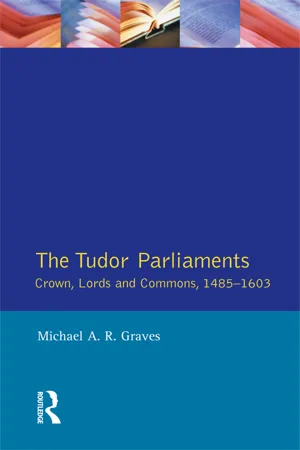
Tudor Parliaments,The Crown,Lords and Commons,1485-1603
About this book
This excellent short survey looks at the workings of parliament under the first four Tudor monarchs. After an introductory first section which looks at parliament's medieval origins, the author then considers all aspects of early parliamentary history - including the historiography of the early Tudor parliaments, membership and attendance, the legislative roles of the Lords and Commons and the specific parliaments themselves.
Chapter one
THE HISTORIOGRAPHY OF THE TUDOR PARLIAMENTS: A CRITICAL ANALYSIS
‘Revisionism’ has become an accepted and familiar term in both Tudor and early Stuart historiography. As far as Parliament is concerned it represents a reaction against the politically-orientated, Commons-weighted history of Parliament, which has held the field for most of this century (and which, in the following pages, is styled the orthodoxy as a convenient shorthand description). It rests upon two premisses: that Parliament was both bicameral and a trinity (king, Lords and Commons); and that its functions, procedures and business, not politics, should be our prime concern – after all, politicking was no more than the art of achieving a desired end and the end-product of Parliament, its business, was legislation. The essence of the revisionist approach can be summarised thus:
(1) King, Lords and Commons were co-equal partners in the legislative process and the assent of all of them was necessary to make statute. However, this requires some qualification. The Crown presented measures for Parliament’s consideration and, in most sessions, it requested financial aid. Thereafter its formal role was confined to the assent or veto of those Bills which had passed the two houses (though, as we shall see, in practice the Crown continuously used privy councillors to supervise the progress of Bills and it frequently intervened to check or smooth their passage). The Lords and Commons hammered out the final form of Bills which were to be presented to the monarch at the end of the session and they enjoyed an equal right to reject, amend or assent to Bills before them. However, their roles in relation to any particular Bill differed, depending on which house was the initiator (or ‘proprietor’) of it (see Ch. 2, p. 33). The Commons alone had the right to initiate grants of lay taxation. The Lords could reduce the amount of money voted but not increase it. However, in practice it often pressured and coerced the lower house to act speedily and generously; in 1593 it virtually seized the initiative. Moreover, as the assembly of a noble élite, it exercised, an additional, invisible social influence in the Commons, which made it a formidable power within the parliamentary trinity.
(2) Parliaments were a conjunction, a ‘coming together’ of Crown and governing class. In so far as their existence – both their summons and dissolution (or prorogation) – was determined by the monarch, they were meetings of a royal institution. They were called to equip the monarch with the new laws and additional revenue – also enacted in statutory form – which would enable him to govern effectively. When a Parliament had performed those functions satisfactorily, its life was terminated. In practice, however, it satisfied more needs than this. Parliament was an occasion for the Crown to state its intentions, declare its policies and test public opinion, and for the governing class to express its views, present its grievances and raise matters of general concern. It was also a platform on which ambitious men could attract royal favour and, above all, it was a means of satisfying the legislative needs of the governing élite.1 Most parliamentary Bills were introduced not by the government but by lords spiritual and temporal, knights and burgesses who were promoting their own interests or those of kin, friends, neighbours or of the communities which they represented. Therefore in terms of law-making – the prime function of Parliaments – the success of any session must be measured by the quality and volume of the laws which it passed, in other words by its productivity: did it give the Crown what it needed and, in some measure, satisfy the legislative aspirations of members of the governing class?
(3) Parliaments were co-operative ventures. In any assembly of aggressive, self-confident ‘governors’, who were accustomed to giving orders and to being obeyed, there were bound to be clashes of personality, opinion and interest. It would be unrealistic to expect any Tudor monarch, his episcopate and peerage, and a sizeable representative sample of the gentry and urban oligarchies, to work together in perfect harmony throughout a parliamentary session. Yet the fact remains that, for most of the time, they were in general agreement on fundamentals. Hot-heads, brabblers and praters, men of extreme views or profound conviction, the bold and the tactless were always to be found: those who spoke out in 1523 against heavy taxation consumed in futile wars and the acquisition of ‘ungracious dogholes’ in France; Sir George Throckmorton criticising the annulment of Henry VIII’s first marriage in the early 1530s; Peter and Paul Wentworth inveighing against the queen’s abuse of parliamentary privilege in the 1560s and 1570s. While these are all examples of dissension in the Commons, it is worth recalling too Henry VIII’s concern about the potential opposition in the Lords during the Reformation Parliament (1529–36), the imprisonment of Bishop Gardiner by successive aristocratic regimes in Edward VI’s reign (partly because he represented a serious parliamentary threat), the opposition of catholic bishops and peers to the Edwardian Reformation, Lord Paget’s conduct in April–May 1554, and the stubborn resistance of Marian bishops to the Elizabethan Settlement in 1559 (see Chs 4–6).
Yet in both houses these were exceptions to the normal cooperation which existed in Tudor assemblies. If Parliaments had been the regular occasion for conflict and opposition, would monarchs have continued to call them despite the frequent need for additional revenue? In 1629 Charles I provided the answer when he resolved to dispense with Parliaments for the time being and instead resorted to non-parliamentary levies in order to balance income and expenditure. The decision, however, was the outcome of a deadlock between the king and the governing class which had caused business to grind to a halt. Until the 1620s criticism, dispute and opposition were just aberrations from the norm. Tudor monarchs learned to live with them as part of the give-and-take of the parliamentary process. In any case, when disagreement and dissension occurred they were more often not the consequence of ‘matters of great moment’ (such as royal policies or national issues) but rather of contentious local, sectional or economic Bills. Most of the conflict and lobbying was between competing interests within the governing class and not between the Crown and that class. There were no signs of escalating political tension. Nor is there any substantial evidence that the roots of Stuart conflict can be traced back to the Tudor Parliaments.
This revisionist version of sixteenth-century parliamentary history is the reverse of the old, established orthodoxy. Formulated by A. F. Pollard, elaborated and brought to completion by J. E. Neale, reinforced by Wallace Notestein, Conyers Read and others, and influencing an entire generation of Tudor scholars, the orthodox interpretation has held sway for much of this century. Indeed, until the mid-1960s it enjoyed a remarkable and general acceptance. As late as 1960 G. R. Elton bestowed upon it his imprimatur.2 What then are the essentials of this persuasive orthodoxy? They can be described briefly, but the important initial point to remember is that they all reinforce a kind of subordination, prologue-like, to the coming climax of the mid-seventeenth century. The Tudor century is not to be studied in its own right, but as a mere introduction to the political convulsions of the 1640s and 1650s. It is a period to be ransacked for the origins of the English Civil War and Revolution.
According to the orthodox historians, Parliament ‘rose’ in legislative and political authority under the Tudors, the crucial point of change being the 1530s. Until that decade the competence of statute and the authority of Parliament were limited. Statute could not deal with matters spiritual, nor did it encroach upon the sanctity of property in any general way. However, the 1530s changed all that. In 1532–34 the spiritualia as well as the temporalia of the papacy were transferred to the Crown. And in 1536 the dissolution of the monasteries, the suppression of the franchises and the Statute of Uses carried through a property revolution which was authorised by Acts of Parliament. Statute had proved itself to be omnicompetent – capable of dealing with any aspect of human affairs. This was not universally apparent at once, nor were the implications immediately perceived. However, the Act of Six Articles which, in 1539, set forth a corpus of orthodox catholic doctrine, the Edwardian prayer books, the Marian reaction and the Elizabethan Settlement were all enacted by parliamentary authority. Gradually they brought the point home: Parliament was sovereign and there was nothing which it could not touch.
Nor was this the sum total of change. Within Parliament there was a shift in power. During the 1530s the Commons superseded the Lords as the more important legislative chamber. It seized the initiative in business, and became more politically conscious, sensitive of its privileges, willing and able to criticise and oppose the Crown. Thereafter, in contrast, the House of Lords slithered from its former superiority towards political impotence. It lost its independence and instead compliantly assisted the Crown to achieve its parliamentary objectives and to control the more assertive Commons. Repeatedly we are told that there is little to be learned about the Elizabethan Lords. The fact that foreign ambassadors and diarists rarely had much to say about its political activities was regarded by Neale as a register of its lack of importance. Such a conclusion raises the question whether the significance of a legislative assembly should be gauged by its politicking rather than by its record of business. Nevertheless that was the common attitude of historians until the mid-1960s.
Inevitably it was a point of view which concentrated attention on the Commons. Was not the lower house the focus of opposition to the Crown during the great constitutional crisis of 1640–42? Therefore the roots of that opposition were traced back through the history of the Commons in the previous century. They manifested themselves as early as 1510 and 1523 over matters of the purse (see pp. 59–60, 61–2). In the 1530s members were critical of Henry VIII’s marital schemes and schismatic policy. The house was also stubborn in its hostility to the Bills of uses and proclamations – a protracted resistance which extended over several sessions. Then, in Mary’s reign, a politically-charged atmosphere spawned an organised parliamentary opposition. It was, as Neale admits, ‘a flash in the pan’, but it was also, according to both him and Notestein, the precursor of a persistent and troublesome opposition in the Elizabethan Commons.3 They focused their attention exclusively on examples of its resistance to Marian policies and ignored the Lords. In particular they settled on the Parliament of 1555 as the exemplar of early organised resistance to the Crown. Naturally that resistance was Commons-based, as was demonstrated when some members challenged the Bill to restore first fruits and tenths to the papacy, and when Sir Anthony Kingston locked the doors of the House and secured a snap division which defeated an official Bill to penalise exiles.
From that point, Neale then extended the story of organised opposition through Elizabeth’s reign. The dynamic was ardent, radical protestantism (i.e. puritanism) which mingled love and devotion to the queen with its desire to drive her along the road towards a godly Genevan Church and society. However, there was now a significant difference. Whereas the Marian opposition had been negative and obstructive, this was a positive, constructive force with an alternative programme of its own. So there was born Neale’s ‘puritan choir’, a radical party which attempted to ram through Parliament in 1566/7 and 1571 a reform programme, consisting of the so-called Alphabetical Bills, the Reformatio Legum Ecclesiasticarum and a Bill to revise the prayer book. In the sessions between 1563 and 1571 it also pressed the queen to marry or name a successor in order to avoid the dreadful alternative of another catholic, Mary Stuart, on the throne.4 These attempts failed, but parliamentary opposition did not die. In the 1580s there were the presbyterian campaigns to replace the Anglican prayer book with the Geneva-style directory of worship and in 1597 and 1601 there was the general clamour against the harmful monopolies granted by the queen.5 By 1601, as many a well-rehearsed schoolboy will tell us, the House of Commons had become a power to be reckoned with, able and willing to challenge the Crown’s authority. With his magisterial authority Neale set the seal of authenticity on this tradition when he wrote that ‘By Elizabeth’s reign, a balanced history of parliament would be almost as predominantly a history of the House of Commons as it is in early Stuart times.’6
Yet how valid is the picture of a lower house marching steadily onwards and upwards to the constitutional confrontation of 1640? In any case, whatever happened in the early seventeenth century, and whenever the crisis actually crystallised is not (and should not be) the particular concern of a study of Tudor Parliaments. Unfortunately the orthodox historians were preoccupied with what was to come and their writings were indelibly coloured by their knowledge of the future. They produced retrospective history, a search for the origins of the great political upheaval of the following century. Neale wrote that it was his specific purpose ‘to banish the old illusion that early-Stuart Parliaments had few roots in the sixteenth century’.7 That purpose coloured his thinking and dictated his argument. However, if we are to understand what Tudor Parliaments were all about, it is essential, at the very outset, to set aside that retrospective approach and assess them in their own right.
This is particularly true of the House of Lords. If Tudor Parliaments in general have been demoted to no more than a mere prologue, the fate of the upper house is even worse. It has been consigned to virtual political oblivion by a school of history which, for all practical purposes, treated Parliament as a duet of Crown and Commons, and which conceived of the institution in terms of politics, not business. To understand how this interpretation evolved, it is necessary to examine the modern historiography of Parliament in the context of modern parliamentary developments. The reform Acts of the nineteenth and early twentieth centuries, together with the constitutional crisis of Edward VII’s reign, combined to produce the supremacy of a democratically elected House of Commons within the parliamentary trinity. The fact that its supremacy was short-lived, and that power has since shifted from Parliament to cabinet, does not alter the impact of these developments on parliamentary historiography during the first half of this century.
The interplay between historical and historiographical development has been underlined by G. R. Elton’s recent review of the Elizabethan volumes of the History of Parliament Trust. He identified several phases ...
Table of contents
- Cover
- Half Title
- Title Page
- Copyright Page
- Table of Contents
- List of tables
- Abbreviations
- 1. The historiography of the Tudor Parliaments: a critical analysis
- 2. The Tudor Parliaments: procedures, records, personnel and privileges
- 3. The pre-Reformation Parliaments, 1485–1529
- 4. The Reformation Parliaments I, 1529–1553
- 5. The Reformation Parliaments II, 1553–1558: The Years of Change
- 6. The Early Elizabethan Parliaments, 1559–1566/7
- 7. The Elizabethan Parliaments: the era of Lord Burghley, 1571–1597
- 8. Epilogue
- Parliamentary sessions, 1485–1601
- Bibliography
- Index
Trusted by 375,005 students
Access to over 1.5 million titles for a fair monthly price.
Study more efficiently using our study tools.
Frequently asked questions
Yes, you can cancel anytime from the Subscription tab in your account settings on the Perlego website. Your subscription will stay active until the end of your current billing period. Learn how to cancel your subscription
No, books cannot be downloaded as external files, such as PDFs, for use outside of Perlego. However, you can download books within the Perlego app for offline reading on mobile or tablet. Learn how to download books offline
We are an online textbook subscription service, where you can get access to an entire online library for less than the price of a single book per month. With over 1.5 million books across 990+ topics, we’ve got you covered! Learn about our mission
Look out for the read-aloud symbol on your next book to see if you can listen to it. The read-aloud tool reads text aloud for you, highlighting the text as it is being read. You can pause it, speed it up and slow it down. Learn more about Read Aloud
Yes! You can use the Perlego app on both iOS and Android devices to read anytime, anywhere — even offline. Perfect for commutes or when you’re on the go.
Please note we cannot support devices running on iOS 13 and Android 7 or earlier. Learn more about using the app
Please note we cannot support devices running on iOS 13 and Android 7 or earlier. Learn more about using the app
Yes, you can access Tudor Parliaments,The Crown,Lords and Commons,1485-1603 by Michael A.R. Graves in PDF and/or ePUB format, as well as other popular books in History & British History. We have over 1.5 million books available in our catalogue for you to explore.