- 281 pages
- English
- ePUB (mobile friendly)
- Available on iOS & Android
eBook - ePub
About this book
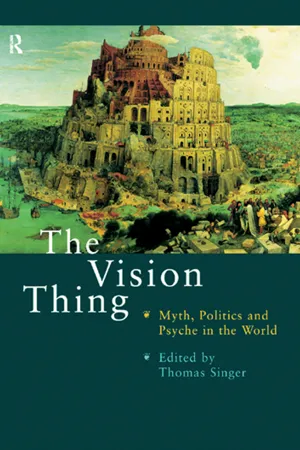
Contemporary politics goes on at a mythic level. This is the provocative argument put forward in this unique book which results from the collaboration of practising politicians, organisational and political consultants, scholars of mythology and culture, and Jungian analysts from several countries.
The first part of the book focuses on leadership and vision, and features a reflection on myth and leadership by former U.S. Senator Bill Bradley. The second part deals with the way the theme of 'the one and the many' works itself out in politics today. From the perspective of 'the many', there are chapters on factionalism, ethnic strife, genocide and multiculturalism. From the perspective of 'the one', there are chapters on the economic myth and gender politics showing how these bring coherence to today's confused political scene, culminating in the suggestion that the modern political psyche is itself in the midst of a rite of passage.
The relevance of the book to the practice and study of politics, mainstream and marginal, cannot be overemphasised and the book will provide stimulating reading for practitioners and students in these areas as well as for those engaged in psychological work such as therapy, counselling or analysis.
Information
Part I
Leadership and vision in myth and politics
Foreword
Thomas B. Kirsch
From the origins of psychoanalysis to the later development of analytical psychology, myth has played a central role in depth psychological theory. For Freud it was the myth of Oedipus which was seen as the universal in the child’s development. Jung, a decade later, found that behind the dream images of the individual and the hallucinations of the psychotic, there existed a collective level of the psyche which was best described in mythopoetic terms. For the next fifty years Jung’s research led him to study various mythological systems which corroborated his hypothesis of the collective psyche and archetypal theory. In the latter part of his life he focused his attention on western alchemy, as he discovered there the missing links between pagan mythology and the dreams of the modern individual.
However, both for Freud and Jung, the investigation of myth was largely an intrapsychic event. From early on Freud gave up on the idea that the fantasies of his patients had any basis in outer reality. Today there is some controversy about these findings, as some investigators would like to reinterpret his conclusions. For Jung there was no question of the reality of the inner world. This was where the archetypes could be most intensely experienced, as described in the chapter entitled “Confrontation with the unconscious” in Memories, Dreams, Reflections (Jung 1963). Out of Jung’s own experience he developed a technique called active imagination, where one consciously dimmed the ego so that the inner archetypal images could become more alive. At the same time he wrote on psychological types, where he outlined the differences between introversion and extraversion. Jung saw himself as an introvert, and all of his writings emphasized that aspect of personality development. Although theoretically, archetypal theory has both an inner and outer aspect, the inner subjective reality had much more reality for Jung than did its outer manifestation. Thus, those who followed Jung came to analytical psychology because of his exploration of the inner archetypal world.
Jung did have an extraverted side which led him into great difficulties. In 1934 he took over the presidency of the International General Medical Society for Psychotherapy, which at the time had a large Nazi contingent. To this day he has been criticized for his role in that organization during the decade leading up to the Second World War. When Jung was asked about his connection to the International General Medical Society for Psychotherapy, he said that he was a Swiss neutral trying to help German psychotherapy, and that he was completely “apolitical.” This apolitical side was the norm among the first generation of Jungian analysts.
After Jung’s death in 1961 there has been a gradual shift away from his extreme introverted bias. A major theoretical development has been proposed by Joseph Henderson in his book Cultural Attitudes in Perspective (Henderson 1984). Here he writes about the cultural level of the psyche which can be viewed as another layer of psychological reality between the individual and the archetypal. In this layer Henderson defines four different cultural attitudes: philosophic, religious, aesthetic, and social. Those with a well-developed social attitude will probably have a strong involvement in political life.
As analytical psychology has become more a part of the mainstream psychotherapeutic community, the extraverted aspect of life has taken on more meaning. Instead of only speaking about the inner king and queen, we now speak of modern political and cultural figures as representing royal archetypal images. Why else would there be so much interest in Princess Diana? Now archetypes are not only seen in dreams and visions, but they can be spoken of with regard to political, historical, and social figures and events. Jungian analysts like Andrew Samuels, Renos Papadopoulos, Jerome Bernstein, and Walter Odajnyk have all written books on politics in relation to various aspects of analytical psychology. Politics is no longer a taboo subject within the Jungian framework. The chapters in Part I of this book focus on vision and leadership as it appears in myth and politics.
Bibliography
Henderson, Joseph (1984) Cultural Attitudes in Perspective, Toronto: Inner City Books.
Jung, C.G. (1963) Memories, Dreams, Reflections, New York: Pantheon Books.
Chapter 1
Reflections on myth, politics, and leadership
Senator Bill Bradley
I was a child of the Cold War. When I was eleven years old I made a diagram of my own private bomb shelter. In that diagram I had a place where I was going to keep my cot, a place where I was going to keep my favorite books, a place for my favorite food, and one for my basketball. My assumption was that after Armageddon there would still be basketball.
That Cold War is over now, along with all of the mythology we built up around it, including my personal mythology of a bomb shelter that would keep a special place for my basketball. The end of the Cold War has been a tremendous liberation from a fear that, while not constant, was often somewhere in the back of our minds. Things are largely better. But the end of the Cold War era poses a fundamental question for American politics: what is the nature of our leadership in the world? For more than fifty years our leadership came primarily from our proven ability to defend other nations from what was seen by many as not only an obvious military threat, but an actual living evil: the communist Soviet Union.
This was the context I had in mind when I first had a conversation with my friend Tom Singer about what happens when the negative organizing force of an entire society dissolves. Our conversation took place shortly after I had come back from a Senate intelligence committee tour of Europe. One of the most memorable moments had been a visit with our European Command in Stuttgart, Germany. As a demonstration of the new openness between our two societies, seven army officers described how they had just returned from observing Soviet military exercises at the invitation of the Gorbachev regime. Although I am certainly not clinically trained, as the officers described what they had seen, they appeared to me to be depressed. What they were describing was how easy it had been to get all at once what they had spent a lifetime learning the skills to obtain, either clandestinely or through piecing together millions of little bits and pieces of information. Suddenly, there it was, all there for everyone to look at.
It struck me that the end of the former Cold War really does have deep and far-reaching impacts on society as a whole. Over fifty years of war, first Hot, against Fascism, and then Cold, against Communism, has profoundly affected everyone’s attitude – even all our mythologies – of the world. The impacts are far more than my childhood memory of the bomb shelter, or the fact that increasingly large chunks of our national wealth have been going to build weapons. Ever larger and larger segments of our intelligentsia have been working either to devise those weapons or as part of the large information-gathering apparatus we had to establish for spying on people, places, and circumstances that might conspire to bring about our own destruction. My childhood beliefs, the national defense budget, and our intelligence operations have all been justified by the pervasive rationale that we will have to protect ourselves against the threat of an evil force.
But the ramifications didn’t just end there. Some of the related things that happened were unexpectedly good. We built the interstate highway system because of the premise that in war we would have to move vehicles and equipment quickly across the country. It was in reaction to Sputnik, and from the Defense Education Act, that many people I know got college educations. Sometimes there were less favorable consequences – such as the fact that in every American subdivision the streets are so wide. Did you ever think about the reason for that? The answer is that if the Cold War ever turned into a Hot War, every road had to be wide enough for two trucks travelling at fifty miles an hour to pass each other. But the roads are so wide and impersonal that they keep us apart. They impede our sense of community. For example, in cities there is something called “street smarts,” which depend on a sense of alleys and byways. It’s hard to develop “cul-de-sac” smarts in the suburbs.
The Cold War also hardened our perception of psychological reality into a rigid dualism. You were either against communism or you were not. You were either for a strong military deterrent or you were not. You were either a loyal American or you were not. This dualism infected our politics at all levels of thinking. In fact, the defining characteristic of our politics for so many years has been to say what we are against, not what we are for. What will define our view of reality in the future to replace this rigid either/or? For those who don’t want to think through what we are for, and find it easier to be against something, a natural impulse has been to find another source of conflict. We are already seeing that ethnic and religious violence stand poised to replace communism as the world’s largest negative force.
Today, the Iron Curtain – at least in Europe – is already being replaced by the “Velvet Curtain.” Everything north and east of a line that extends through the Balkans and eastern Poland, down through Rumania and hooking around to Croatia is Roman Christendom. Everything west and south of that is Orthodox Christendom. Coming out from the south is Islam. At the moment, these forces converge in the former Yugoslavia with the tragedy that we see unfolding there. From this point of view, while nationalism is still important, it no longer has the same pull as ethnic religion, which may become the paradigm of future conflicts, and holocausts, in the world.
A counter view says that religious chauvinism and ethnic hatred will be replaced by the desire to become rich. Religious impulses cannot compete with people’s desire to have more material things. Some argue that the economic myth of open economies and markets is also the only one that has been truly egalitarian. Either you make it or you don’t. That myth is truly global. It accepts the premise of interdependence, and rewards not individualism but a systems approach. Thinking systemically, according to that view, is the only way to succeed in a world of highly competitive individuals and units.
When Tom Singer and I spoke, we raised another possibility. Could people still learn something by reference to the traditional myths that have previously given diverse people around the world meaning in their lives? Myths help to explain why things are the way they are by placing them in a context of the way they’ve always been.
That further possibility for constructing a post-Cold War point of view – of considering the myths of diverse people alongside the religious and economic forces governing their lives – raised two questions in my mind. Are those diverse myths simply unrelated stories that prepare us for a state of being that enhances our flexibility when we find ourselves living inside different circumstances? For example, Shell Oil Company says it did so well after the oil supply disruption of the mid-1970s because it had rejected “forecasting” long ago. That corporate view no longer took the past and arbitrarily ascribed certain criteria to measure its “performance” from which to predict the future. Instead, Shell engaged its management in a process of developing “possible” stories about the future. The thinking was that, with such stories in mind, there would be an element of flexibility that could accommodate the unforeseen, the truly unpredictable, the untoward event that no forecast could possibly have predicted by only looking at the past. When the oil supply disruption did come, Shell was operating within a story, not scrambling to rethink a failed forecast. Here’s the difference: once you are in the story that’s being told, you have to ask, “Well, how’s this story going to turn out?” By thinking about your experience within a story that’s being told, you also have to start thinking about the future in a different way.
Pursuing the possible relevance of myth to our world after the end of the Cold War and the collapse of the “Evil Empire” led me to take up another question with Tom, one rather closer to home: what myth might speak to a practicing politician who is not trained psychologically but who thinks, reads, and feels? My thoughts naturally turned to a version of the hero myth – the belief (often false) that the course of history can turn on one individual political figure. As Thomas Carlyle insisted, great men make a difference in the future of nations and the world. The way they make a difference is by force of will, cunning, and intelligence. They seem to personify their country at a particular time. I believe that there have been three American politicians who through their own lives succeeded in embodying the prominent struggle or trauma of the nation at that particular time.
Abraham Lincoln’s embodiment of national trauma was very real. While he was in the White House, a relative of his wife was living with them. Her husband had been a Civil War Officer in the Confederate Army, killed by the northern troops that Lincoln commanded. Every day, when Lincoln came down for breakfast, sitting at the table was the personification of the enemy that he was fighting. Her presence reminded him of how personal the conflict was that he presided over. It underlined the fact that the clashing armies were destructive and deadly. It told him that the goal of war was to reunite. In that sense, he confronted, embodied, and felt moved to heal the national trauma every day.
Franklin Roosevelt did the same thing. In the midst of the Depression, still struggling against the after-effects of polio, he kept his spirits high, maintaining compassion and joy at the same time that he worked every day. His physical circumstances seemed to personify a nation that was flat on its back economically. Yet his jaunty spirit, his eternal optimism, his ability to roll his head back and laugh anew, said to all America that we too could pull through. It was what the country needed to see and to feel.
The last of my three examples would be Robert Kennedy, who through the experience of his brother’s loss embodied the trauma that the country itself had experienced post-1963. The country was in bloody conflict abroad in the Vietnam War and at home with anti-war demonstrations on campuses and race riots in the cities. Bobby Kennedy addressed the roiling emotions around these conflicts with a vital understanding and compassion. Yet, unlike his brother Jack, Bobby’s style was not particularly attractive. He risked telling the truth in staccato messages that often made people feel uncomfortable. He had the habit of going into an audience and telling people what they didn’t want to hear because he knew that there was nothing to gain by failing to do that. He had lost his brother. We had lost a President. It was a new day. And a new chance. And he himself embodied that possibility.
So, there are these three – Lincoln, FDR, and RFK – people who have taken on the nation’s woes and symbolically carried them through their own lives. Through their personal embodiment of the nation’s struggle and suffering, they told us that they understand. But, there’s a deeper, more urgent need, I think, than the rare emergence of the compassionate hero/leader, particularly if our goal is to perpetuate our democratic ideal of individual liberty, social equality, and representative government. For that, the hero myth becomes problematic. Bertolt Brecht in his play Galileo has a character who says, “Pity the nation that has no heroes.” To which Galileo replies, “Pity the nation that needs them.” This political observation reminds us that what happens in our lives as citizens is in some cases the foundation on which all else will rest.
Barbara Bush put it well when she said that “what happens in your house is more important than what happens in the White House.” Our citizenship occurs within our families and local lives. And yet if you look at our civil society you find that disconnectedness and isolation are increasing and individuals are less willing to reach out to others. PTA membership is down; Red Cross membership is down; Elks, Lions down; JCs down. The traditional voluntary organizations that De Tocqueville said characterized the uniqueness of America have in the last thirty years fragmented and withered to a surprising degree. Some say that new organizations, such as those brought forth by the environmental movement, have taken the place of the old, more conventional organizations. But the new movements have focused primarily on themselves. They have not fostered face-to-face interactions with others, seeking to find what people have in common.
What has been lost is the public square, the ...
Table of contents
- Cover
- Title
- Copyright
- Dedication
- Contents
- List of illustrations
- Notes on contributors
- Acknowledgements
- Introduction: the vision thing
- PART I Leadership and vision in myth and politics
- PART II The one and the many in myth and politics
- Index
Trusted by 375,005 students
Access to over 1.5 million titles for a fair monthly price.
Study more efficiently using our study tools.
Frequently asked questions
Yes, you can cancel anytime from the Subscription tab in your account settings on the Perlego website. Your subscription will stay active until the end of your current billing period. Learn how to cancel your subscription
No, books cannot be downloaded as external files, such as PDFs, for use outside of Perlego. However, you can download books within the Perlego app for offline reading on mobile or tablet. Learn how to download books offline
Perlego offers two plans: Essential and Complete
- Essential is ideal for learners and professionals who enjoy exploring a wide range of subjects. Access the Essential Library with 800,000+ trusted titles and best-sellers across business, personal growth, and the humanities. Includes unlimited reading time and Standard Read Aloud voice.
- Complete: Perfect for advanced learners and researchers needing full, unrestricted access. Unlock 1.5M+ books across hundreds of subjects, including academic and specialized titles. The Complete Plan also includes advanced features like Premium Read Aloud and Research Assistant.
We are an online textbook subscription service, where you can get access to an entire online library for less than the price of a single book per month. With over 1.5 million books across 990+ topics, we’ve got you covered! Learn about our mission
Look out for the read-aloud symbol on your next book to see if you can listen to it. The read-aloud tool reads text aloud for you, highlighting the text as it is being read. You can pause it, speed it up and slow it down. Learn more about Read Aloud
Yes! You can use the Perlego app on both iOS and Android devices to read anytime, anywhere — even offline. Perfect for commutes or when you’re on the go.
Please note we cannot support devices running on iOS 13 and Android 7 or earlier. Learn more about using the app
Please note we cannot support devices running on iOS 13 and Android 7 or earlier. Learn more about using the app
Yes, you can access The Vision Thing by Thomas Singer in PDF and/or ePUB format, as well as other popular books in Politics & International Relations & Political History & Theory. We have over 1.5 million books available in our catalogue for you to explore.