Family Law
eBook - ePub

Family Law

  1. 256 pages
  2. English
  3. ePUB (mobile friendly)
  4. Available on iOS & Android
eBook - ePub

Family Law

About this book

Key Facts and Key Cases: Family Law will ensure you grasp the main concepts of your Family Law module with ease. This book explains in concise and straightforward terms:

• The law relating to marriage and its breakdown
• Recent developments in money cases
• All recent cases relating to private and public child law Helen L. Conway is a former practising barrister, now District Judge. She is an experienced law author and has taught law in both the academic and commercial sectors.

Key Facts and Key Cases is the essential series for anyone studying law at LLB, postgraduate and conversion courses and professional courses such as ILEX. The series provides the simplest and most effective way to absorb and retain all of the material essential for passing your exams. Each chapter includes:

• diagrams at the start of chapters to summarise key points
• structured headings and numbered points to allow for clear recall of the essential points
• charts and tables to break down more complex information

Chapters also contain a Key Cases section which provides the simplest and most effective way to absorb essential cases needed for exam success, using a simple and memorable visual checklist:

• Essential and leading cases are explained
• The style, layout and explanations are user friendly
• Cases are broken down into key components by use of a clear system of symbols for quick and easy visual recognition

Series editors: Jacqueline Martin LLM, has ten years' experience as a practicing barrister and has taught law at all levels and Chris Turner LLM, who is a Senior Lecturer in law at Wolverhampton University.

Frequently asked questions

Yes, you can cancel anytime from the Subscription tab in your account settings on the Perlego website. Your subscription will stay active until the end of your current billing period. Learn how to cancel your subscription.
No, books cannot be downloaded as external files, such as PDFs, for use outside of Perlego. However, you can download books within the Perlego app for offline reading on mobile or tablet. Learn more here.
Perlego offers two plans: Essential and Complete
  • Essential is ideal for learners and professionals who enjoy exploring a wide range of subjects. Access the Essential Library with 800,000+ trusted titles and best-sellers across business, personal growth, and the humanities. Includes unlimited reading time and Standard Read Aloud voice.
  • Complete: Perfect for advanced learners and researchers needing full, unrestricted access. Unlock 1.4M+ books across hundreds of subjects, including academic and specialized titles. The Complete Plan also includes advanced features like Premium Read Aloud and Research Assistant.
Both plans are available with monthly, semester, or annual billing cycles.
We are an online textbook subscription service, where you can get access to an entire online library for less than the price of a single book per month. With over 1 million books across 1000+ topics, we’ve got you covered! Learn more here.
Look out for the read-aloud symbol on your next book to see if you can listen to it. The read-aloud tool reads text aloud for you, highlighting the text as it is being read. You can pause it, speed it up and slow it down. Learn more here.
Yes! You can use the Perlego app on both iOS or Android devices to read anytime, anywhere — even offline. Perfect for commutes or when you’re on the go.
Please note we cannot support devices running on iOS 13 and Android 7 or earlier. Learn more about using the app.
Yes, you can access Family Law by Helen Conway in PDF and/or ePUB format, as well as other popular books in Law & Law Theory & Practice. We have over one million books available in our catalogue for you to explore.

Information

Publisher
Routledge
Year
2013
eBook ISBN
9781134659982
Edition
1
Topic
Law
Index
Law
1
Marriage and civil partnership
1.1 Marriage
1.1.1 The definition of marriage
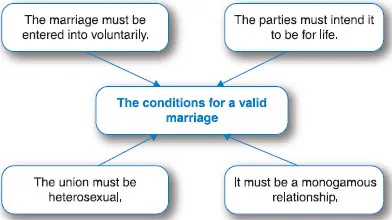
1 Marriage is the voluntary union for life of one man and one woman to the exclusion of all others (Hyde v Hyde (1866)).
2
3 The Marriage Act 1949 requires:
for a Church of England wedding – the publications of banns, a licence, or a certificate of a superintendent registrar or naval officer;
for other marriages – a certificate of a superintendent registrar.
4 Marriages can be solemnised in:
a church or chapel of the Church of England;
a registered non-conformist church or other building;
premises approved by the local authority;
any place if a special licence is obtained.
5 Jews and Quakers may marry according to their own customs with a certificate from a superintendent registrar.
6 Following the Gender Recognition Act 2004 transsexuals may marry according to their ā€˜acquired gender’ after issue of a ā€˜gender recognition certificate’.
1.2 Nullity
1.2.1 Void marriages
1 A void marriage will be treated as never having taken place.
2 The parties can treat it as never having taken place without having to get a decree of nullity.
3 The validity of a marriage can be put in issue at any time even after the death of one or both of the parties.
4 A decree of the court is not necessary to end the marriage as it never existed, but a nullity petition will give access to the court’s powers to deal with finance after divorce and will have a declaratory effect.
5 S 11 Matrimonial Causes Act 1973 (MCA 1973) sets out the grounds for nullity:
It is not valid under the Marriages Act 1949 because:
i) the parties are within the prohibited degrees of relationship;
ii) either party is under 16;
iii) the parties have intermarried.
At the time of the marriage either party was already lawfully married.
The parties are not male and female. Same sex ā€˜marriages’ are not possible (but see civil partnerships, 1.6 below). The Gender Recognition Act 2006 makes marriages of transsexuals in their acquired gender possible.
The marriage was polygamous, entered into outside England and Wales and one party was domiciled in England and Wales at the time of the marriage. The Private International Law (Miscellaneous Provisions) Act 1995 amended the law so that the marriage is not void simply because it was conducted abroad under a law which allows polygamy, but only if either spouse already had a spouse when married in England and Wales.
1.2.2 Voidable marriages
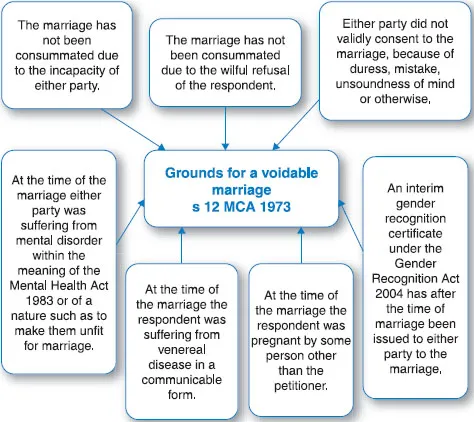
1 A voidable marriage will be regarded as a valid subsisting marriage until a decree annulling it has been pronounced at the request of one of the spouses.
2 Its validity cannot be challenged after the death of one of the parties.
3 For non-consummation due to incapacity, the incapacity must be incapable of removal by medical or psychological treatment. An inability to conceive or a lack of enjoyment of the intercourse is not sufficient (Baxter v Baxter [1947] 2 All ER 43).
4 The incapable party may petition, but a decree will not be given if the other party objects (Pettit v Pettit [1962] 3 All ER 37).
5 Wilful refusal to consummate is a ā€˜settled and definite decision come to without just excuse’ (Horton v Horton [1947] 2 All ER 871).
6 Consummation must have been suggested to the refusing party ā€˜with such tact, persuasion and encouragement as an ordinary spouse would use in such circumstances’ (Baxter v Baxter [1947] 2 All ER 43).
7 Refusal to go through with a religious ceremony upon which cohabitation is contingent can amount to wilful refusal (A v J (Nullity Proceedings) [1989] 1 FLR 110).
8 For valid consent, the parties must be capable of understanding the nature of the contract and the responsibilities of marriage (Hill v Hill [1959] 1 All ER 281).
9 For duress, the test is ā€˜whether the threat, pressure, or whatever it is, is such as to destroy the reality of the consent and ov...
Table of contents

  1. Cover
  2. Half Title
  3. Title Page
  4. Copyright Page
  5. Table of Contents
  6. Preface
  7. Table of Cases
  8. Chapter 1. Marriage and Civil Partnership
  9. Chapter 2. Family Law Act 1996 Pt IV and Pt IVA
  10. Chapter 3. Protection from Harassment Act
  11. Chapter 4. Children’s Rights
  12. Chapter 5. Introduction to the Children Act 1989
  13. Chapter 6. Parental Responsibility
  14. Chapter 7. Private Child Law
  15. Chapter 8. Services for Children in Need
  16. Chapter 9. Emergency Child Protection
  17. Chapter 10. Care and Supervision Orders
  18. Chapter 11. Adoption: The Adoption and Children Act 2002
  19. Chapter 12. Challenging the Local Authority
  20. Chapter 13. Finances before a Divorce
  21. Chapter 14. Financial Remedies – Finances after a Divorce/Dissolution of Civil Partnership
  22. Chapter 15. Child Support
  23. Chapter 16. Financial Applications Under Schedule 1 of the Children Act 1989
  24. Index