- 322 pages
- English
- ePUB (mobile friendly)
- Available on iOS & Android
eBook - ePub
About this book
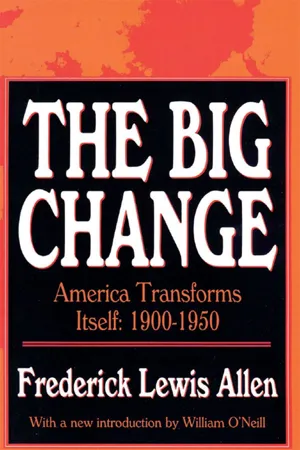
Frederick Lewis Allen was one of the pioneers in social history. Best known as the author of Only Yesterday, Allen originated a model of what is sometimes called instant history, the reconstruction of past eras through vivid commentary on the news, fashions, customs, and artifacts that altered the pace and forms of American life. The Big Change was Allen's last and most ambitious book. In it he attempted to chart and explain the progressive evolution of American life over half a century. Written at a time of unprecedented optimism and prosperity, The Big Change defines a transformative moment in American history and provides an implicit and illuminating perspective on what has taken place in the second half of the twentieth century.Allen's theme is the realization, in large measure, of the promise of democracy. As against the strain of social criticism that saw America as enfeebled by affluence and conformity, Allen wrote in praise of an economic system that had ushered in a new age of well being for the American people. He divides his inquiry into three major sections. The first, 'The Old Order,' portrays the turn-of-the-century plutocracy in which the federal government was largely subservient to business interests and the gap between rich and poor portended a real possibility of bloody rebellion. 'The Momentum of Change' graphically describes the various forces that gradually transformed the country in the new century: mass production, the automobile, the Great Depression and the coming of big government, World War II and America's emergence as a world power. Against this background, Allen shows how the economic system was reformed without being ruined, and how social gaps began to steadily close.The concluding section, 'The New America,' is a hopeful assessment of postwar American culture. Allen's analysis takes critical issue with many common perceptions, both foreign and domestic, of American life and places remaining social problems in careful perspective. As William O'Neill remarks in his introduction to this new edition, The Big Change is both a deep and wonderfully readable work of social commentary, a book that gains rather than loses with the years.
Trusted by 375,005 students
Access to over 1.5 million titles for a fair monthly price.
Study more efficiently using our study tools.
Information
PART ONE
THE OLD ORDER
Chapter 1
A New Century Begins
ON THE morning of January 1, 1900, there was skating for New Yorkers in Van Cortlandt Park, and presently it began to snow. But the sharp cold had not chilled the enthusiasm of the crowds who, the night before, had assembled in Lower Broadway to celebrate either the beginning of the twentieth century or the beginning of the last year of the nineteenth: there was some disagreement as to the proper interpretation of the event, but none as to the size and liveliness of the gathering. The cable cars were jammed with people, Broadway in front of Trinity Church was well-nigh impassable, the crowds were dense in Wall Street as far down as the Subtreasury steps, and there was a great din of tin horns, punctuated from time to time by firecrackers. It had been a good year, and another one was coming.
In its leading editorial of January 1, the New York Times sounded an optimistic keynote. “The year 1899 was a year of wonders, a veritable annus mirabilis, in business and production. …” it proclaimed. “It would be easy to speak of the twelve months just passed as the banner year were we not already confident that the distinction of highest records must presently pass to the year 1900. … The outlook on the threshold of the new year is extremely bright."
Uptown, in the mahogany-paneled library of his big brownstone house at the corner of Madison Avenue and Thirty-sixth Street, John Pierpont Morgan, head of the mightiest banking house in the world and the most powerful man in all American business, sat playing solitaire as the old year drew to an end. During the next twelve months Morgan would buy paintings and rare books and manuscripts in immense profusion on a European trip; would have a temporary ballroom built beside his house to accommodate twenty-four hundred guests at his daughter’s wedding, and would begin negotiations with Andrew Carnegie—the twinkling little steelmaster whose personal income in 1900 would be over twenty-three million dollars, with no income tax to pay—for the formation of the United States Steel Corporation, the biggest corporation that the world had ever seen. Morgan could not foresee all this now as he ranged the cards before him, but he was content. In the words of his future son-in-law and affectionate biographer, describing that very evening of December 31, 1899,
Mr. Morgan’s house was just where he wanted it to be and it suited his mode of life. Mrs. Morgan was well and they had their unmarried daughters, Louisa and Anne, living at home. His married children and grandchildren were all well and happy, and he himself was in good health. His friends were near by. The people in his social world were of his own kind, and the bankers and business men with whom he came into contact had, for the most part, the same standard of ethics and point of view that he himself had. New York was still a friendly, neighborly city and was a pleasant place in which to live. … At midnight, when the bells and horns proclaimed the beginning of the New Year, he was looking forward with the eagerness of a much younger man to the great possibilities of the century that was about to begin.
There were, to be sure, hundreds of thousands of New Yorkers for whom the city was hardly “a pleasant place in which to live.” On the Lower East Side there were poverty, filth, wretchedness on a scale which to us today would seem incredible. And in many other cities and industrial towns of America the immigrant families were living under comparable conditions, or worse; for at a time when the average wage earner in the United States got hardly five hundred dollars in a year—roughly the equivalent of fifteen hundred at present prices—most of the newcomers to the country scrabbled for far less. Let Van Wyck Brooks summarize what Upton Sinclair incontrovertibly disclosed a few years later about the state of the Poles and Lithuanians and Slovaks in the Chicago stockyard area:
Ignorant and stunted by European tyranny only to be utterly destroyed by American indifference, they were swindled by house-agents, political bosses … and judges who refused to recognize their rights. No one either knew or cared when their babies were drowned in the stinking green water that lay about their wretched shacks, when their daughters were forced into prostitution, when their sons fell into boiling vats because the employers had provided no safety devices.
“No one either knew or cared”—why not? Because it was a time of complacency. Since the end of the depression of the mid-nineties the voices of protest at the disparities of fortune in the United States had weakened. Populism was dead; the free-silver agitation had petered out; the once angry farmers of the Plains States were making out so well that in 1899 a traveler commented that “every barn in Kansas and Nebraska has had a new coat of paint.” Not yet had the oncoming group of journalists whom Theodore Roosevelt, in a burst of irritation, labeled “muckrakers” begun to publish their remorseless studies of the seamy sides of American life. American fiction, like American journalism, was going through what old Ambrose Bierce called a “weak and fluffy period”; Dreiser’s Sister Carrie, published in 1900, went almost unnoticed and then was withdrawn from circulation as too sordid or pornographic. The best journals and the best people concerned themselves very little with the fortunes of the average man, and very much with the fortunes of ladies and gentlemen, with the pomp and circumstance of Society, and with the furthering of a polite and very proper culture for the elect. If in the language of Morgan’s biographer, as he described the great banker’s contentment, there was discernible a faint tone of smugness, this was characteristic of the general attitude of the well born and well endowed as they contemplated the bright future.
Morgan looked confidently forward to an era of stability and common sense, in which political leaders like Mark Hanna would see that no foolish equalitarian ideas got anywhere in government, and in which the regulation of American business would be undertaken, not by politicians, but by bankers like himself, honorable men of wealth and judgment such as he liked to see in his favorite clubs.
Out in Terre Haute, in an upstairs bedroom of a high-ceilinged, eight-room house, a tall, gaunt, bald-headed Hoosier looked out over the railroad tracks and dreamed a quite different dream of the future. Eugene V. Debs was a one-time locomotive fireman. He had led the Pullman strike of 1894, had served a term in prison, had consumed Marxist literature in his cell, and had become an ardent Socialist. His exalted hopes were to take shape in the 1900 platform of the Social Democratic party, as whose candidate Debs would poll a meager 96,000 votes. But this was to be merely a beginning; had Debs but known it then, he was destined to have nearly a million followers by 1912. A friendly and merciful man with an insecure grasp of logic, Debs was hotly aware of the desperate plight of the immigrant workers, and he was sure he knew the one and only answer to their miseries. His platform called for public ownership of railroads, telegraphs, public utilities, and mines, and—somewhat more distantly—public ownership of the means of production and distribution generally. Nothing but this, thought Debs, would end the industrial horrors and inequities of the day.
Both Morgan and Debs would have been bewildered had they been able to foresee what the next half century would bring to the nation: how a combination of varied and often warring forces would produce an America which would not only be utterly unlike the America of 1900, but also would be utterly unlike the picture in either man’s mind; yet an America in which an astonishing productive capacity would be combined with the widest distribution of prosperity ever witnessed in the world.
To understand the extent and nature of the big change that was to take place, we must first go back to 1900 and look about us—at the scene, the conditions of life, the people.
First, the scene.
II
If a neatly adjusted time machine could take you back to the Main Street of an American town in 1900, to look about you with your present-day eyes, your first exclamation would probably be, “But look at all those horses!”
For in that year 1900 there were registered in the whole United States only 13,824 automobiles (as compared with over 44 million in 1950). And they were really few and far between except in the larger cities and the well-to-do resorts. For in 1900 everybody thought of automobiles as playthings of the rich—and not merely of the rich, but of the somewhat adventurous and sporting rich: people who enjoyed taking their chances with an unpredictable machine that might at any moment wreck them. There were almost no paved highways outside the cities, and of course there were no roadside garages or filling stations; every automobilist must be his own desperate mechanic. Probably half the men and women of America had never seen a car. When William Allen White organized a street fair in Emporia, Kansas, in 1899, the automobile which was brought there for the occasion—and proved to be the most exciting exhibit of the fair—came from Chicago by rail; it was the first automobile ever to have crossed the Missouri River.
But horses were everywhere, pulling surreys, democrats, buggies, cabs, delivery wagons of every sort on Main Street, and pulling harvesters on the tractorless farms out in the countryside.
The sights and sounds and sensations of horse-and-carriage life were part of the universal American experience: the clop-clop of horses’ hoofs; the stiff jolting of an iron-tired carriage on a stony road; the grinding noise of the brake being applied to ease the horse on a downhill stretch; the necessity of holding one’s breath when the horse sneezed; the sight of sand, carried up on the tires and wooden spokes of a carriage wheel, spilling off in little cascades as the wheel revolved; the look of a country road overgrown by grass, with three tracks in it instead of two, the middle one made by horses’ hoofs; the special male ordeal of getting out of the carriage and walking up the steeper hills to lighten the load; and the more severe ordeal, for the unpracticed, of harnessing a horse which could recognize inexperience at one scornful glance. During a Northern winter the jingle of sleigh bells was everywhere. On summer evenings, along the tree- lined streets of innumerable American towns, families sitting on their front porches would watch the fine carriages of the town as they drove past for a proud evening’s jaunt, and the cognoscenti would wait eagerly for a glimpse of the banker’s trotting pair or the sporting lawyer’s 2:40 pacer. And one of the magnificent sights of urban life was that of a fire engine, pulled by three galloping horses, careening down a city street with its bell clanging.
It is hard for us today to realize how very widely communities were separated from one another when they depended for transportation wholly on the railroad and the horse and wagon—and when telephones were still scarce, and radios non-existent. A town which was not situated on a railroad was really remote. A farmer who lived five miles outside the county seat made something of an event of hitching up and taking the family to town for a Saturday afternoon’s shopping. (His grandchildren make the run in a casual ten minutes, and think nothing of it.) A trip to see friends ten miles away was likely to be an all-day expedition, for the horse had to be given a chance to rest and be fed. No wonder that each region, each town, each farm was far more dependent upon its own resources—its own produce, social contacts, amusements—than in later years. For in terms of travel and communication the United States was a very big country indeed.
No wonder, furthermore, that the majority of Americans were less likely than their descendants to be dogged by that frightening sense of insecurity which comes from being jostled by forces—economic, political, international—beyond one’s personal ken. Their horizons were close to them. They lived among familiar people and familiar things—individuals and families and fellow townsmen much of their own sort, with ideas intelligible to them. A man’s success or failure seemed more likely than in later years to depend upon forces and events within his own range of vision. Less often than his sons and grandsons did he feel that his fortune, indeed his life, might hang upon some decision made in Washington or Berlin or Moscow, for reasons utterly strange to his experience. The world at which he looked over the dashboard of the family carriage might not be friendly, but at least most of it looked understandable.
III
Your second exclamation, if you found yourself on a Main Street sidewalk of 1900, would probably be, “But those skirts!”
For every grown woman in town would be wearing a dress that virtually swept the street; that would in fact actually sweep it from time to time, battering and begriming the hem, if its owner had not learned to hold it clear. From the high collar of her shirtwaist to the ground, the woman of 1900 was amply enveloped in material. (There were, to be sure, arbitrary limits to this envelopment. The evening dress of a woman of fashion might be as décolleté as that of the television star of the nineteen-fifties. But it also had a train, which she must hold up as best she could when dancing.) Even for country wear, in fact even for golf or tennis, the skirt must reach within two or three inches of the ground, and a hat—usually a hard sailor hat—must almost imperatively be worn. Pull out today a photograph album of the year 1900 and your first impression will be that even at the seashore or in the mountains all the women are wearing city clothes.
At any season a woman was swathed in layer upon layer of underpinnings—chemise, drawers, corset, corset cover, and one or more petticoats. The corset of those days was a formidable personal prison which did its strenuous best, with the aid of whalebones, to distort the female form into an hour-glass shape. Dresses almost invariably came in two pieces, and the discipline begun by the corset was reinforced by the bodice part of the dress, which was stiffened to complete the hour-glass effect. The bosom was compressed as nearly as possible into a single structure, and the correct posture called for a rearward-sloping “straight-front” effect from this eminence downward; the fashion-plate artists represented the well-dressed woman as almost falling forward—despite the counterbalancing effect of an unsubdued posterior—in the effort to achieve the perfect stance.
As for the men, their clothes, too, were formal and severe by today’s standards. Collars were high and stiff. The man of affairs was likely to wear, even under his everyday sack suit (of three-button coat, obligatory waistcoat, and narrowish trousers), a shirt with hard detachable cuffs and perhaps a stiff bosom too. If he were a banker or a businessman of executive stature he probably wore a frock coat to the office, and a silk hat instead of the less formal derby—except between May 15 and September 15, when custom decreed a hard straw hat (or, for the affluent, possibly a Panama). To go hatless, except in the wide open spaces, was for the well-dressed male unthinkable. If the weather were intolerably hot, he might remove his coat, and in certain informal offices—newspaper city rooms, for instance—he customarily did so. But his waistcoat must not come off (a rule which, considering the sort of shirt he was wearing, was not without aesthetic merit). The term “shirt sleeves” remains in our language as a survival of that custom.
In the country he might wear a blue serge coat with white flannel (or, more economically, white duck) trousers, or, under the proper circumstances, a tweed coat with riding trousers or knickerbockers. But when a man returned to the city, or a farmer put on town clothes for a visit to the county seat, he must invariably get into the severe three-piece suit, with starched collar and cuffs—even under a July sun.
These implacable costumes, male and female, reflected the prevailing credo as to the relations between the sexes. The ideal woman was the sheltered lady, swathed not only in silk and muslin but in innocence and propriety, and the ideal man, whether a pillar of rectitude or a gay dog, virtuously protected the person and reputation of such tender creatures as were entrusted to his care. If unmarried, a girl must be accompanied by a chaperone whenever she ventured out to an evening’s entertainment in the city. If she were a daughter of the rich, a maid might take the place of the chaperone; it was never quite clear, under these circumstances, who was supposed to protect the maid’s virtue. Eleanor Roosevelt has recorded in her autobiography her relief when, at the age of twenty or so, she found that her friend Bob Ferguson was considered close enough to the family to be permitted to escort her home from evening parties at the studio of Bay Emmett the painter. “Otherwise I always had to have a maid wait for me—that was one of the rules my grandmother had laid down.” And James W. Gerard has added his testimony as to the iron code which still governed New York Society in that period. “Even when I was thirty years old,” wrote Gerard in his old age, “if I had asked a girl to dine with me alone, I would have been kicked down her front steps. If I had offered her a cocktail, I would have been tossed out of Society for my boorish effrontery.” Needless to add that a woman must never be seen in a bar—or even a smoking car.
The chaperone was, to be sure, chiefly an urban institution. In the smaller places, especially west of the Alleghenies, and among city people vacationing in the country, the rules were greatly relaxed. As Henry Seidel Canby has said, there was developing
a free association of boys and girls in their teens and early twenties that perhaps never has existed on the same plane elsewhere in the history of the modern world. We had confidence in each other, and we were confided in. All through the Adirondack woods we climbed together in summer, sleeping in cabins, girls on one side, boys on the other, following by couples all day lonely and difficult trails, and in the winter skated far-off ponds, or sat all night in the spring on moonlit Delaware hills, falling in and out of love with never a crude pang of sex, though in a continual amorous excitement which was sublimated from the grosser elements of love.
But throughout these companionships one might almost say that an imaginary chaperone was always present. What was operating was in effect an honor system: these boys and girls knew they were expected to behave with perfect propriety toward one another, and only...
Table of contents
- Cover
- Half Title
- Title Page
- Copyright Page
- Table of Contents
- INTRODUCTION TO THE TRANSACTION EDITION FOREWORD
- FOREWORD
- PART ONE: THE OLD ORDER
- PART TWO: THE MOMENTUM OF CHANGE
- PART THREE: THE NEW AMERICA
- APPENDIX: Sources and Obligations
- INDEX
Frequently asked questions
Yes, you can cancel anytime from the Subscription tab in your account settings on the Perlego website. Your subscription will stay active until the end of your current billing period. Learn how to cancel your subscription
No, books cannot be downloaded as external files, such as PDFs, for use outside of Perlego. However, you can download books within the Perlego app for offline reading on mobile or tablet. Learn how to download books offline
Perlego offers two plans: Essential and Complete
- Essential is ideal for learners and professionals who enjoy exploring a wide range of subjects. Access the Essential Library with 800,000+ trusted titles and best-sellers across business, personal growth, and the humanities. Includes unlimited reading time and Standard Read Aloud voice.
- Complete: Perfect for advanced learners and researchers needing full, unrestricted access. Unlock 1.5M+ books across hundreds of subjects, including academic and specialized titles. The Complete Plan also includes advanced features like Premium Read Aloud and Research Assistant.
We are an online textbook subscription service, where you can get access to an entire online library for less than the price of a single book per month. With over 1.5 million books across 990+ topics, we’ve got you covered! Learn about our mission
Look out for the read-aloud symbol on your next book to see if you can listen to it. The read-aloud tool reads text aloud for you, highlighting the text as it is being read. You can pause it, speed it up and slow it down. Learn more about Read Aloud
Yes! You can use the Perlego app on both iOS and Android devices to read anytime, anywhere — even offline. Perfect for commutes or when you’re on the go.
Please note we cannot support devices running on iOS 13 and Android 7 or earlier. Learn more about using the app
Please note we cannot support devices running on iOS 13 and Android 7 or earlier. Learn more about using the app
Yes, you can access The Big Change by Frederick Lewis Allen in PDF and/or ePUB format, as well as other popular books in History & Economic History. We have over 1.5 million books available in our catalogue for you to explore.