- 128 pages
- English
- ePUB (mobile friendly)
- Available on iOS & Android
eBook - ePub
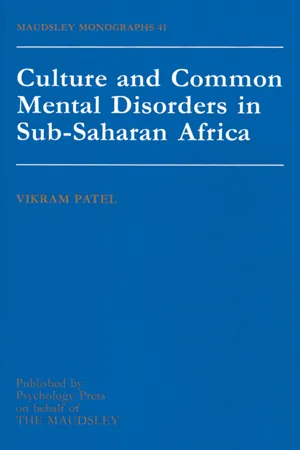
Culture And Common Mental Disorders In Sub-Saharan Africa
About this book
The influence of culture on mental illness has been the subject of considerable academic investigation and debate in recent years. This debate has provoked concerns about the validity and reliability of older methodologies which emphasised either universal characteristics of disorders which were heavily biased towards Euro-American systems, or the culturally relativist approach which saw psychological disorders as products largely of their own culture. The "new" cross-cultural psychiatry proposed that the integration of ethnographic and epidemiological techniques be required to enable a culture sensitive psychiatric model to emerge. This monograph describes a series of research studies conducted in primary care in Harare, Zimbabwe, focusing on the most frequent of all psychological disorders, Common Mental Disorders (CMD). The four consecutive studies are unique in several respects, most notably, the involvement of both biomedical and traditional health care providers at all stages, the development of an indigenous measure of CMD for use in epidemiological investigations, the examination of the relationship between local and biomedical models of psychological disorder and the sociodemographic and economic risk factors for CMD. The experiences and findings of these studies provide new directions in our understanding of the contribution of culture to the presentation, assessment, classification and risk factors for CMD in primary care in an urban African setting. The methodology used also sets out a model for epidemiological research in other areas of mental health in different cultural settings.
Trusted by 375,005 students
Access to over 1.5 million titles for a fair monthly price.
Study more efficiently using our study tools.
Information
CHAPTER ONE
Introduction
THE “NEW” CROSS-CULTURAL PSYCHIATRY
Epidemiology is of particular importance in psychiatry for several reasons: first, mental health resources are insufficient and epidemiological research can help establish the scale of the need by describing the frequency of psychiatric disorders and the burden they pose on individuals, families, and health care systems; second, most psychiatric disorders are poorly understood and epidemiological research can help unravel the multi-factorial aetiology of these disorders; third, epidemiological research can help improve our understanding of the relationship between physical and psychological illness (Tansella, de Girolamo, & Sartorius, 1992).
Historically, cross-cultural studies in psychiatric epidemiology have suffered several problems. First, case identification techniques varied from site to site and methods were not standardised (Compton et al., 1991). These inconsistencies led to a movement to standardise the process of psychiatric measurement and diagnosis. This process of standardisation was driven by psychiatric classification systems originating in Euro-American societies. Standardised interviews which mimicked the clinical psychiatric evaluation were developed and became the criteria for determining “caseness” in epidemiological investigations (Williams, Tarnopolsky, & Hand, 1980). After standardisation in Euro-American cultures, the interviews were subsequently used in other cultures. Most of these subsequent cross-cultural psychiatric investigations relied on implicit, largely untested assumptions: (1) the universality of mental illnesses, implying that regardless of cultural variations, disorders as described in Euro-American classifications occur everywhere; (2) invariance, implying that the core features of psychiatric syndromes are invariant; and (3) validity, implying that although refinement is possible, the diagnostic categories of current classifications are valid clinical constructs (Beiser, Cargo, & Woodbury, 1994). This approach, termed as the “etic” or universalist approach, became the most popular method for epidemiological investigations of mental illness across cultures. The etic approach offered the perspective that, since mental illness was similar throughout the world, psychiatric taxonomies, their measuring instruments, and models of health care were also globally applicable. There are two dominant systems of psychiatric classification, the ICD-10 Classification of Mental and Behavioural Disorders (World Health Organisation, 1992) and the Diagnostic and Statistical Manual (American Psychiatric Association, 1985), which reflect the psychiatric nosologies of Euro-American medicine. Diagnostic criteria of syndromes can and do change over time as is well demonstrated by the regular revisions of international psychiatric classifications; these revisions are considerably influenced by attitudinal, political, and historical factors (Westermeyer, 1985). Some cross-cultural researchers and psychiatric researchers in low-income countries have argued for the effectiveness and universal applicability of current classification systems (e.g. Corin & Murphy, 1979; Kerson & Jones, 1988; Odejide, 1979; Sen & Mari, 1987).
Problems with the etic approach arose when cross-cultural researchers pointed out that there was risk of confounding culturally distinctive behaviour with psychopathology on the basis of superficial similarities of behaviour patterns or phenomena in different cultures (Draguns, 1984). It was argued that classification of psychiatric disorders largely reflected American and European concepts of psychopathology based on implicit cultural concepts of normality and deviance (Baskin, 1984; Kirmayer, 1989). Some argued that cross-cultural psychiatry should examine the influence of culture on mental illness in Euro-American society itself, rather than assume that these illnesses were “natural” and free of any cultural bias (Murphy, 1977). Critics accused the etic approach of contributing to a world view which “privileges biology over culture” (Eisenbruch, 1991) and ignoring the cultural and social contexts of psychiatric disorders.
The field of medical anthropology has exerted a growing influence on health research, particularly in low-income countries. This influence has seen a shift in paradigms in public health and epidemiology from its unifocal and positivist “scientific” approach to the recognition that illness is the result of a “web of causation” which includes the individual’s sociocultural environment (Heggenhougen & Draper, 1990). Medical anthropology has been one of the key factors which fuelled the development of the “emic” approach in cross-cultural psychiatry. At a general level this approach argued that the culture-bound aspects of biomedicine, such as its emphasis on medical disease entities, limited its universal applicability (Helman, 1991). More specifically, this approach argued that culture played such an influential role in the presentation of psychiatric disorders that it was wrong to presume a priori that Euro-American psychiatric categories were appropriate throughout the world (Littlewood, 1990). Part of this argument was based on the lack of specific pathophysiological changes which could be identified in psychiatric disorders, which effectively made the diagnostic categories “illnesses” as compared to “diseases” (Helman, 1981; Littlewood, 1991). The emic approach proposed to evaluate phenomena from within a culture and its context, aiming to understand its significance and relationship with other intracultural elements.
Purely emic studies have also drawn their share of criticism, the most fundamental one being that they are unable to provide data which can be compared across cultures (Mari, Sen, & Cheng, 1989). These studies are usually small in scale and are unable to resolve questions of the long-term course and treatment outcome of illness episodes (Kirmayer, 1989). The reliability of emic studies is in doubt due to the lack of standardisation of research methods and the biased findings based on the interpretations of individual researchers. The emic approach has been criticised for not suggesting plausible alternatives, such as a set of principles which would help ensure cultural sensitivity, or models upon which to fashion culturally sensitive nosologies (Beiser et al., 1994). It is argued that culture is not a static concept; all cultures are constantly evolving and changing and with the increasing influence of Euro-American values and urbanisation in many low-income societies, “traditional” beliefs may not be as rigidly held as is supposed. Furthermore, any individual may hold a multiplicity of ideas regarding his illness and any or all of these ideas may change with time (Eisenbruch, 1990).
Despite major strides in the international classification of mental disorders and in the ethnographic approach to studying mental illness, a truly international psychiatry does not exist (Westermeyer, 1989). Thus, there are strengths and weaknesses of both the etic and emic approaches in cross-cultural psychiatry. It is increasingly accepted that the integration of their methodological strengths is essential for the development of the “new cross-cultural psychiatry” or a culturally sensitive psychiatry (Kleinman, 1987; Littlewood, 1990). Value must be given to both folk beliefs about mental illness as well as to the biomedical system of psychiatry (Leff, 1990). It is important to investigate the patients’ “explanatory models”, i.e. how patients understand their problems, their nature, origin, consequences, and remedies since these can radically assist patient-doctor negotiations over appropriate treatment (Kleinman, 1980). Similarly, researchers should examine the psychiatric symptoms of persons who are considered to be mentally ill by the local population and to interview the TMPs and other primary carers to ascertain the diagnostic systems used. In essence, the central aim of the “new” cross-cultural psychiatry would be to describe mental illness in different cultures using methods which are sensitive and valid for the local culture and resulting in data which are comparable across cultures. In order to tackle this difficult task, psychiatric research needs to blend both ethnographic and epidemiological methods and emphasise the unique contribution of both approaches to the understanding of mental illness across cultures.
COMMON MENTAL DISORDERS (CMD)
This is a term coined by Goldberg and Huxley (1992) to describe “disorders which are commonly encountered in community settings, and whose occurrence signals a breakdown in normal functioning.” CMD, also referred to as non-psychotic mental disorders, encompass a broad group of distress states which manifest with a mixture of anxiety and depressive symptoms. CMD are the contemporary equivalent of the neuroses, a descriptive category which has become increasingly unpopular because of its vague meaning and stigma. CMD have been classified in ICD-I0 in two main categories: “neurotic, stress-related and somatoform disorders” with a number of subcategories and “mood disorders” (with specific reference to unipolar depression). A simpler classification of CMD has been devised for use in primary health care (Ustun et al., 1995b; see Table 1.1).
TABLE 1.1
Classification of common mental disorders for primary health care in ICD-10
Classification of common mental disorders for primary health care in ICD-10
F32 | Depression |
F40 | Phobic disorder |
F41.0 | Panic disorder |
F41.1 | Generalised anxiety |
F41.2 | Mixed anxiety and depression |
F43 | Adjustment disorder |
F44 | Dissociative disorder |
F45 | Unexplained somatic symptoms |
F48 | Neurasthenia |
F51 | Sleep problems |
In practice, the subcategories of CMD are not without their conceptual problems: for example, obsessive–compulsive disorders are not common in community settings, whereas phobic disorders may not be counted as mental illnesses by some investigators. Part of this problem may be accounted for by the fact that classifications have tended to reflect the results of psychiatric assessments at tertiary care level. In most primary care patients, symptoms of anxiety and depression coexist to such an extent that their categorisation in either group is difficult. The WHO multinational study of CMD found that for all specific psychiatric disorders (excluding alcohol dependence), comorbidity rates (with other psychiatric disorders) exceeded 50% (Ormel et al., 1994) suggesting that one of the basic criteria of a successful classification, i.e. the mutual exclusiveness of different categories, was not achieved. Indeed, Goldberg and Huxley (1992) state that “it is becoming clear that the idea that CMD should be thought of as discrete disease entities with distinct causes, course and treatment is probably untenable.”
The World Health Report based on 1993 statistics shows that neurotic, stress-related and somatoform disorders are the third most frequent causes of morbidity (prevalence rates) worldwide (WHO, 1995). CMD are an important cause of disability and have been identified as a significant public health problem (Blue & Harpham, 1994; World Bank, 1993). The multinational study of the prevalence, nature and determinants of CMD was conducted in 14 countries, including Nigeria in Africa (Ustun & Sartorius, 1995). The startling finding of this study was that, despite the use of standardised methods in all centres, there were enormous variations in most variables. Indeed, the only similarities across centres were the general observations of the ubiquity of CMD and the comorbidity of anxiety and depression and the association of CMD and disability even after adjustment for physical disease severity. On the other hand, specific variables showed substantial variations; thus the prevalence rates of CMD ranged from 7% to 52% of primary care attenders; physician recognition of CMD varied from 5% to nearly 60%; and the association of key variables such as gender, physical ill health, and education with CMD were opposite in different centres (Goldberg & Lecrubier, 1995). For example, the relative risk of having a CMD for females varied from 1.9 in Bangalore to 0.3 in Ibadan. Similarly, the relative risk for depressive disorder for those with two or more children varied from 3.3 in Athens to 0.19 in Ibadan. These marked variations suggest the need for regional studies with local health service-driven priorities to complement multinational studies with their emphasis on uniformity and universality (Patel & Winston, 1994).
CULTURE AND COMMON MENTAL DISORDERS
Study of the influence of culture on mental illness is important for several reasons: for example, it enables us to understand how patients from different ethnic groups experience and express mental distress and, further, by shedding light on aetiological factors it plays an important role in the development of psychiatric theory by illuminating the diverse influences on mental distress posed by culture, society, and biology (Beiser, 1985; Sartorius, 1986). In recent years there has been increasing concern regarding the validity of cross-cultural psychiatric studies which have mainly utilised the etic approach. The uncertainty arises from the diagnosis of mental illness which relies almost entirely on clinical presentations, there being no “gold standard” validating pathological or diagnostic tests. It is generally accepted that culture plays a profound role in the expression of idioms of distress and that in psychiatry language is the very means of conveying symptoms. Yet, the validity of the descriptive categories of current classifications for other cultures has rarely been evaluated. The description of illnesses in Euro-American classifications are automatically assumed to be cross-culturally valid, prompting accusations of “psychiatric imperialism” (Fernando, 1991). Concerns about validity should be greatest for syndromes of depression and anxiety, where the boundaries between “normal sadness” and “clinical depression” are blurred (Kirmayer, 1989). For example, while the experience of normal sadness may be similar across cultures, the clinical significance of depression as a unique illness category may vary considerably (Beiser, 1985). On the other hand, it has been argued that dysphoria is a univeral human experience and that depression can be recognised in many cultures. Although there may be indigenous categories of mental illness, this does not necessarily invalidate the application of international psychiatric categories for epidemiological purposes (Bebbington, 1993).
The first problem one encounters in examining the cross-cultural validity of the clinical category of depression is that many languages have no conceptually equivalent term for depression (Chaturvedi, 1993; Ihezue, 1989; Manson, Shore, & Bloom, 1985; Swartz, Ben-Arie, & Teggin, 1985). Conceptualisation of depression in cross-cultural research is made especially difficult by the widely varying idioms of distress expressed by patients and the varying contextual significance of such idioms (Angst, 1973; Lutz, 1985). It cannot be assumed that even “core” features of depression in one culture have the same meaning in another. For example, Obeyesekere (1985) argues that hopelessness, a core cognitive feature of the biomedical model of depression, is perceived to be a positive feature of mental state for Buddhists. Although some African studies have reported that the “core” symptoms of depression were the same in their patients, these researchers sampled patients who were attending psychiatric facilities or who had already been diagnosed as having a depressive disorder by psychiatrists (Keegstra, 1986; Majodina & Attah Johnson, 1983; Makanjuola & Olaifa, 1987); it is unclear whether these patients were representative of depression in the community.
Somatic symptoms have often been percieved to be a common mode of presentation of depression in low-income countries. Recent studies have shown that, contrary to popular belief, somatic presentations of depression were also common in Euro-American societies (Bridges & Goldberg, 1985). Thus, somatic symptoms of depression appeared to be universal to many cultures, though this did not imply that the appropriate name for the disorder was “depression”, but merely that in Euro-American cultures the everyday experience of sadness came to the fore to the point that it became the most characteristic feature of “depression”. It has been suggested that somatisation is “an expression of personal and social distress in an idiom of bodily complaints and medical help seeking” nonspecific to particular diagnoses (Kleinman & Kleinman, 1985). For example, Cheng’s study in Taiwan (1989) suggests that for a substantial number of psychiatric patients in primary care, somatisation was a form of illness behaviour manifested in neurotic patients from a wide diagnostic spectrum including anxiety and depression.
Can depression be diagnosed in patients who do not experience the cognitive features of the illness? While some authors have assumed that depression is the “true” illness in patients presenting with nonspecific somatic symptoms (Ndetei & Muhangi, 1979), others have expressed reservations in diagnosing depression when the central cognitive features of the illness are absent (Venkoba Rao, 1994). Illness patterns with their own characteristic clinical and epidemiological features, but with no Euro-American equivalent, are seen to be “masked” presentations of an “underlying” depression. In these situations the fact that some patients complained of low mood or achieved “cut-off” scores on depression rating scales was taken as evidence for the assumption that the “true” diagnosis was depression, even though it is well recognised that emotional responses such as low mood and apprehension commonly occur as a reaction to a number of medical and psychiatric conditions. Thus, patients presenting with a primary complaint of “loss of semen” may also be depressed (Cheng, 1989); is depression comorbid with the semen loss syndrome (dhat syndrome in India), or is the latter a “masked” or “somatised” form of depression? Angst (1973) argues that the current concept of depression is so rooted in European culture that it is strongly influenced by a cultural bias; in his view, then, the concept of “masked depression” is as representative of a depressive syndrome as the classic descriptions.
Questions regarding the cross-cultural validity of the clinical category of depression remain unresolved, not least because “the universality of the category of depression (and other categories of neurotic disorder) is assumed, eliminating the need to establish validity, and the tautological circle is completed when the symptoms that serve as criteria for the diagnosis, because they are believed to reflect specific psychophysiological and hormonal states, are assumed to be universal” (Good, Good, & Moradi, 1985). Theoretic assumptions underlying the etic and emic approaches have influenced the choices researchers make of the method of assessment of psychiatric disorders across cultures. These methods will now be described.
ASSESSMENT OF MENTAL DISORDERS ACROSS CULTURES
The quantitative assessment of mental disorders, such as the measurement of psychiatric morbidity and determination of prevalence rates, requires standardised questionnaires. There are two methods of using questionnaires across cultures, viz., using preexisting measures developed in other cultures or developing measures de novo. Most cross-cultural studies use instruments developed in one culture (to date, always a Eur...
Table of contents
- Cover
- Half Title
- Title Page
- Copyright Page
- Dedication
- Table of Contents
- Glossary of abbreviations and Shona terms
- Acknowledgements
- Abstract
- 1. Introduction
- 2. The studies
- 3. Results of the studies
- 4. Discussion
- 5. Conclusions
- References
- Appendix 1
- Appendix 2
- Appendix 3
- Author index
- Subject index
Frequently asked questions
Yes, you can cancel anytime from the Subscription tab in your account settings on the Perlego website. Your subscription will stay active until the end of your current billing period. Learn how to cancel your subscription
No, books cannot be downloaded as external files, such as PDFs, for use outside of Perlego. However, you can download books within the Perlego app for offline reading on mobile or tablet. Learn how to download books offline
Perlego offers two plans: Essential and Complete
- Essential is ideal for learners and professionals who enjoy exploring a wide range of subjects. Access the Essential Library with 800,000+ trusted titles and best-sellers across business, personal growth, and the humanities. Includes unlimited reading time and Standard Read Aloud voice.
- Complete: Perfect for advanced learners and researchers needing full, unrestricted access. Unlock 1.5M+ books across hundreds of subjects, including academic and specialized titles. The Complete Plan also includes advanced features like Premium Read Aloud and Research Assistant.
We are an online textbook subscription service, where you can get access to an entire online library for less than the price of a single book per month. With over 1.5 million books across 990+ topics, we’ve got you covered! Learn about our mission
Look out for the read-aloud symbol on your next book to see if you can listen to it. The read-aloud tool reads text aloud for you, highlighting the text as it is being read. You can pause it, speed it up and slow it down. Learn more about Read Aloud
Yes! You can use the Perlego app on both iOS and Android devices to read anytime, anywhere — even offline. Perfect for commutes or when you’re on the go.
Please note we cannot support devices running on iOS 13 and Android 7 or earlier. Learn more about using the app
Please note we cannot support devices running on iOS 13 and Android 7 or earlier. Learn more about using the app
Yes, you can access Culture And Common Mental Disorders In Sub-Saharan Africa by Vickram Patel in PDF and/or ePUB format, as well as other popular books in Psychology & Mental Health in Psychology. We have over 1.5 million books available in our catalogue for you to explore.