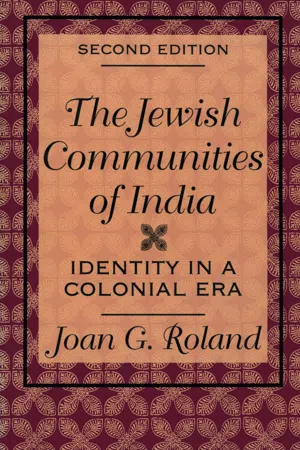
- 392 pages
- English
- ePUB (mobile friendly)
- Available on iOS & Android
eBook - ePub
About this book
Although the Bene Israel community of western India, the Baghdadi Jews of Bombay and Calcutta, and the Cochin Jews of the Malabar Coast form a tiny segment of the Indian population, their long-term residence within a vastly different culture has always made them the subject of much curiosity. India is perhaps the one country in the world where Jews have never been exposed to anti-Semitism, but in the last century they have had to struggle to maintain their identity as they encountered two competing nationalisms: Indian nationalism and Zionism. Focusing primarily on the Bene Israel and Baghdadis in the late nineteenth and twentieth centuries, Joan Roland describes how identities begun under the Indian caste system changed with British colonial rule, and then how the struggle for Indian independence and the establishment of a Jewish homeland raised even further questions. She also discuses the experiences of European Jewish refugees who arrived in India after 1933 and remained there until after World War II.To describe what it meant to be a Jew in India, Roland draws on a wealth of materials such as Indian Jewish periodicals, official and private archives, and extensive interviews. Historians, Judaic studies specialist, India area scholars, postcolonialist, and sociologists will all find this book to be an engaging study. A new final chapter discusses the position of the remaining Jews in India as well as the status of Indian Jews in Israel at the end of the twentieth century.
Information
Part I
The Setting
CHAPTER 1
Jews and Society in Premodern India
Origins and Early History of the Bene Israel
A lack of reliable evidence prevents us from determining the actual origin or direct lineage of the Bene Israel and the exact time that the group appeared in western India. Bene Israel traditions maintain that they are descendants of one of the Ten Tribes of Israel, but from that part of the population which was not deported after the Assyrians defeated the Kingdom of Israel in the eighth century B.C.1 According to their legends, the ancestors of the Bene Israel left northern Palestine, possibly fleeing the persecutions of Antiochus Epiphanes around 175 B.C., or perhaps later, and were shipwrecked near the village of Navgaon on the Konkan Coast of western India, twenty-six miles south of Bombay. Only seven men and women survived; they buried the bodies of the others in large graves still to be found at the site.2 Other scholars have proposed different theories of place and date of origin of this community: that the Bene Israel arrived in the reign of King Solomon in the tenth century B.C., before the Ten Tribes separated from the other two,3 that they came from Yemen in the middle of the first millennium A.D.,4 or that they were part of the dispersal that took place after the destruction of the Second Temple in A.D. 70. There may have been more than one immigration, including one from an Arab country in the fourth century A.D. as a result of the Sasanid Persian persecution. B. J. Israel, the most knowledgeable Bene Israel writing about the community in recent times, studied these various claims and seemed to favor a theory that the Bene Israel came to India in the fifth or sixth century A.D. from either southern Arabia or Persia (in both places there was trouble for the Jews at the time).5
But as there are no written records, inscriptions, or other evidence to confirm or disprove any of these conjectures, the origins of the Bene Israel remain shrouded in legend. A few individuals have even suggested that the Bene Israel descend from local inhabitants who were converted. In a letter to the rabbis of Lunel written in 1199 or 1200, Moses Maimonides, the celebrated Jewish philosopher, theologian, and physician, wrote, “The Jews of India know nothing of the Torah and of the laws nothing save the Sabbath and Circumcision.”6 The only Jews in India that would have fit that description were the Bene Israel, although we have no evidence that that was the community to which he was referring. The earliest written reference to a permanent Jewish settlement in the Konkan region is a letter from J. A. Sartorious, a Danish Christian missionary, who in 1738 mentioned hearing about a community of Jews in “Surat and Rajapore” who called themselves Bene Israel, and who did not have the Bible or know Hebrew. The only prayer that they knew was the Shema, the most important prayer of the Jews. In the earliest Cochini reference to the community, the Cochin Jewish merchant Ezekiel Rahabi wrote a report to the Jews of Amsterdam in 1768, mentioning the role the Cochinis were playing in the instruction of the Bene Israel. Bene Israel tradition speaks of a David Rahabi who around A.D. 1000 came to the Konkan and “discovered” the Bene Israel, recognizing them as Jewish from some of their practices: observance of circumcision and the Sabbath, and the refusal of the women to cook fish without scales. Actually, Rahabi family records do show that a son of Ezekiel Rahabi, David, visited western India and encountered the Bene Israel in the mid eighteenth century, while serving as an agent of the Dutch East India Company. B. J. Israel suggests that the Bene Israel might have in their memory amalgamated the first “discovery” by Maimonides with the later visit of David Rahabi.7
Nor is it clear when or how the name Bene Israel (Children of Israel) was adopted. H. S. Kehimkar, a Bene Israel historian writing at the end of the nineteenth century, claimed that the community took the name from the Koran (Banu Israel of the Hijaz) so that its members would not suffer at the hands of Muslims as they might have had they been known as Jews, or Yahudis. B. J. Israel suggests that the Bene Israel might have originated in a country dominated by Islam or that they took their name in India while under Muslim rule.8
The early history of the Bene Israel is also obscure. From Navgaon they gradually dispersed throughout the coastal Konkan villages, living in small communities of perhaps no more than one hundred people. Intermarriage with native women probably occurred to some extent. Cut off for centuries from contact with the mainstream of Jewish life, the Bene Israel gradually forgot all but a few essential elements of the Jewish religion. They continued to observe dietary laws and circumcision and abstained from work on the Sabbath. They celebrated the festivals of the New Year, Day of Atonement, Passover, Purim, and Feast of Ingathering, reciting the Shema on these and other important occasions. Given their long isolation, the maintenance of these traditions seems remarkable. For the rest, they slowly assimilated into their surroundings. Having no Hebrew prayer books, Bible, or Talmud, they forgot most of their Hebrew language and prayers.9 They adopted the regional dress as well as the local language, Marathi, as their mother tongue. Even their names began to show signs of assimilation. First names were Indianized: Samuel became Samaji; Ezekiel, Hassaji; Isaac, Issaji.
They developed traditional Marathi surnames by adding the suffix kar (inhabitant of) to the names of the villages where they originally resided, so that those who lived in Kehim became Kehimkars, those from Cheul, Cheulkars, residents of Talgaon, Talgaonkars. Nowadays, the Bene Israel have reverted to traditional biblical first names and also use biblical surnames, often patronyms. Although the village surnames are rarely used, most members of a community know the village names of others.10
The Bene Israel also adopted certain social customs from their Hindu and Muslim neighbors, such as laws of inheritance, ceremonial food offerings, and observance of certain marriage and funeral customs, but these did not affect Jewish ritual.11 They engaged in agriculture and coconut oil-pressing, gradually becoming known as Shanwar Telis (Saturday oilmen). This castelike designation placed them at the lower end of the Konkan class structure, since farming and oil-pressing were not particularly prestigious occupations. Some Bene Israel who had moved considerably up the socioeconomic ladder later resented being called telis because of the lower-class implications.12
Many Bene Israel date an early revival of their Jewish heritage to somewhere between the eleventh and fifteenth centuries A.D., when David Rahabi recognized them as Jewish and began to teach them the Hebrew language, as well as the liturgy, scriptures, rituals, and ceremonies of Judaism that they had forgotten. If this individual is indeed the mid-eighteenth-century Rahabi who came from Cochin, it is likely that he is the one who taught them Hebrew and brought them into the mainstream of Judaism. He selected young men from three prominent families—the Jhiradkars, Shapurkars, and Rajpurkars—for special teaching. These families had already been providing the community with leaders or teachers called kajis (from the Arabic kadi, or judge), who traveled throughout the Konkan to officiate at ceremonies and to settle disputes.13
By the middle of the eighteenth century, the Bene Israel population of the Konkan probably did not exceed five thousand. At this time they began moving from the villages to the towns of Pen, Panvel, and Thana, and then to Bombay, which was developing under the British and needed carpenters, masons, mechanics, and skilled tradesmen and artisans of all kinds. Bombay offered educational opportunities as well as employment, and the British East India Company was still seeking to expand its native regiments there.14 The first Bene Israel synagogue was completed in Bombay in 1796 and was known as Sha’ar ha-Rahamim (Gate of Mercy).15 Until the establishment of this synagogue, Bene Israel had worshiped at the homes of prominent families.
By 1833, some two thousand Bene Israel, one-third of their total number, lived in Bombay. They enlisted in the regiments, took up skilled trades, became clerks in government service and with private firms, and eventually also found work in the mills of the Sassoons, Iraqi Jews.16 As the Bombay community grew, the Bene Israel spread into several districts of the city, where they established additional synagogues and prayer halls. Military pensioners also retired to Poona, Ahmedabad, and Karachi, where they were instrumental in founding synagogues.17
A second religious renaissance began in the first decades of the nineteenth century. In 1826 and again in 1833, small groups of pious, idealistic Cochin Jews arrived in Bombay to teach the Bene Israel more Jewish ritual and ceremonials and to acquaint them with their heritage. Their efforts were augmented by those of the Arabic-speaking Jews from Iraq, who were also settling in Bombay at the time.18 A most important role in this religious revival was played by Christian missionaries who, after the ban on missionary activity in India was lifted in 1813, exerted a vital influence, particularly through their educational endeavors, on the Bene Israel. The American Marathi Mission (Congregational) established a number of schools for Bene Israel children in Bombay and nearby Kolaba district, where Hebrew was taught and Bene Israel were often employed as teachers. In the 1830s, the Free Church of Scotland’s mission was represented in Bombay by the outstanding archaeologist and linguist Dr. John Wilson, who took a special interest in the welfare of the Bene Israel and in their origin and history. By 1836, 250 Bene Israel children (perhaps one-quarter of the school-age Bene Israel in Bombay at the time), one-third of whom were girls, were attending the Reverend Dr. Wilson’s schools. Six years later, 38 Bene Israel were registered in the college he had opened, where they could also study Hebrew.19
The missionaries were hopeful that the Bene Israel, already monotheists, could eventually be brought to accept Christ as the Messiah. To this end, they translated books of the Old Testament into Marathi and developed Hebrew grammars in Marathi so that the community could become more familiar with the religion and language of its ancestors. Absorbing the Protestant emphasis on the importance of the text of the Bible, the Bene Israel became less concerned about rabbinical teaching and the law than about the scriptures themselves. Missionaries also recorded early Bene Israel beliefs and practices as they were related to them by the community. But as responsive as the Bene Israel were to the missionaries’ educational overtures, they rarely took the final step of conversion. They would reply to missionary arguments, “We do not know the replies to your questions; our learned men elsewhere do; ask them.”20
Missionary encouragement led to a rash of publishing and translation from Hebrew into Marathi undertaken by the Bene Israel themselves in the second half of the nineteenth century. But missionary activity also stimulated the spread of English among the Bene Israel, which enabled them to become acquainted with books of Jewish interest published in England and the United States. Soon, fewer translations of religious works into Marathi were necessary.21 This access to English materials naturally increased the Bene Israel’s sense of belonging to a larger Jewish community, gradually reducing their isolation and their dependence on other Jewish communities and missionaries in India for religious instruction and sustenance.
The Baghdadis Arrive
The port of Basra on the Persian Gulf had been a trading center of the British East India Company from 1760 on, and many Jews of that port and of Baghdad who had already played an important role in the English commerce in that part of the world gradually moved on to India. In the late seventeenth century, European Jewish merchants had taken up trade in the port of Surat, 165 miles north of Bombay on the west coast of India, to be joined in the following century by Arabic-speaking Jews from Aleppo, Baghdad, and Basra. They formed the Arab...
Table of contents
- Cover
- Half Title
- Title Page
- Copyright Page
- Dedication
- Contents
- Introduction to the Transaction Edition
- Preface
- Introduction
- Part I The Setting
- 1 Jews and Society in Premodern India
- Part II Changing Relationships 1870–1918
- Part III Jewish Options in the Interwar Years, 1919–39
- Part IV The War and Its Aftermath
- Conclusion
- Epilogue to the Transaction Edition: Challenges in India and Israel at the Turn of the Century
- Glossary
- Notes
- Selected Bibliography
- Additional Bibliography
- Index
Trusted by 375,005 students
Access to over 1.5 million titles for a fair monthly price.
Study more efficiently using our study tools.
Frequently asked questions
Yes, you can cancel anytime from the Subscription tab in your account settings on the Perlego website. Your subscription will stay active until the end of your current billing period. Learn how to cancel your subscription
No, books cannot be downloaded as external files, such as PDFs, for use outside of Perlego. However, you can download books within the Perlego app for offline reading on mobile or tablet. Learn how to download books offline
Perlego offers two plans: Essential and Complete
- Essential is ideal for learners and professionals who enjoy exploring a wide range of subjects. Access the Essential Library with 800,000+ trusted titles and best-sellers across business, personal growth, and the humanities. Includes unlimited reading time and Standard Read Aloud voice.
- Complete: Perfect for advanced learners and researchers needing full, unrestricted access. Unlock 1.5M+ books across hundreds of subjects, including academic and specialized titles. The Complete Plan also includes advanced features like Premium Read Aloud and Research Assistant.
We are an online textbook subscription service, where you can get access to an entire online library for less than the price of a single book per month. With over 1.5 million books across 990+ topics, we’ve got you covered! Learn about our mission
Look out for the read-aloud symbol on your next book to see if you can listen to it. The read-aloud tool reads text aloud for you, highlighting the text as it is being read. You can pause it, speed it up and slow it down. Learn more about Read Aloud
Yes! You can use the Perlego app on both iOS and Android devices to read anytime, anywhere — even offline. Perfect for commutes or when you’re on the go.
Please note we cannot support devices running on iOS 13 and Android 7 or earlier. Learn more about using the app
Please note we cannot support devices running on iOS 13 and Android 7 or earlier. Learn more about using the app
Yes, you can access Jewish Communities of India by Joan G. Roland,Joan G Roland in PDF and/or ePUB format, as well as other popular books in Social Sciences & Jewish History. We have over 1.5 million books available in our catalogue for you to explore.